University is meant to be a time of growth, independence, and opportunity. But for too many students, it is also a time of vulnerability. Crime on campus is a reality. And off campus, in the private rental sector, the risks are often higher.
Research reveals a stark gap in how students experience safety depending on where they live. Those in Purpose-Built Student Accommodation (PBSA) report feeling significantly safer than those in private rentals. Behind these numbers are real students: young people living away from home for the first time, often unaware of their rights or the security measures they should expect.
As student numbers rise and housing pressures intensify, new regulations, including the Terrorism (Protection of Premises) Act 2025 (Martyn’s Law), are raising the bar for security. This article examines the state of campus security, explains how Martyn’s Law applies to student housing, and outlines what universities, accommodation providers, and students themselves must do to create safer living environments.
The State of Student Safety in 2026: Key Statistics
The numbers tell a clear story. Student safety in the UK is uneven. Where you live makes a big difference.
Here’s what the data shows.
Safety perceptions:
A survey of 600 students found that 75% of PBSA residents feel safe. That number drops to 56% for private renters. This gap affects satisfaction, too: 67% of PBSA students rate their stay positively, compared with 51% in private rentals.
Security features:
PBSA rooms are nearly twice as likely to have lockable bedroom doors: 59% compared to 31% in private rentals. Lockable windows? 48% in PBSA versus 30% in private homes. CCTV is present in 27% of PBSA sites, more than double the 12% found in private accommodation.
| Security Feature | PBSA (%) | Private Rental (%) |
| Lockable bedroom door | 59% | 31% |
| Lockable windows | 48% | 30% |
| CCTV | 27% | 12% |
| Smart doorbell | 29% | 13% |
| Secure entry system | 31% | 17% |
Source: Here! Students survey, reported by The Landlord Association (2026)
Regional differences:
Sheffield stands out for all the wrong reasons. Only 69% of PBSA residents and 44% of private renters there feel safe, the lowest in the UK. Manchester follows at 66% in PBSA. On the other end, Oxford reports the highest safety perception at 88%, with Liverpool at 80% and Leeds at 78%.
The cyber threat:
It is not just physical crime. Research for NatWest’s student living index found that 57% of undergraduates encountered criminals or had money stolen in the past year. The average amount stolen from 18 to 24 year olds was £300. Kent students were hit hardest, with victims losing £436 on average.
Violence and sexual misconduct:
A survey by England’s higher education regulator found that one in three female students has endured sexual harassment at university. Women are nearly three times more likely to experience it than men – 33% versus 12%. In the Sheffield North West neighbourhood, which covers the university campus and student housing areas, police recorded 2,762 violence and sexual offences between May 2024 and April 2025.
Sheffield: A City of Contrasts for Student Safety
Sheffield is home to two major universities and a large student population. The city is considered one of the safest big cities in the UK, with the crime rate in 2024 at 102 per 1,000 people – lower than many nearby locations. Sheffield Hallam University notes that “Sheffield is considered one of the safest big cities in the UK”.
But the picture is not uniform. According to CrimeRate, Sheffield saw 83 crimes per 1,000 people in the 12 months to August 2025 – about 5% lower than the South Yorkshire average but above the UK average of 72 per 1,000. For violence and sexual offences specifically, the city average was 36.9 per 1,000 people (20,846 offences in total).
Student areas face particular challenges. In the Sheffield North West neighbourhood, which covers the university campus and popular student housing areas, police recorded 2,762 violence and sexual offences between May 2024 and April 2025. A survey of final-year undergraduates at the University of Sheffield found that 16.6% experienced sexual harassment in the last year, and 6.7% experienced sexual assault or violence.
These numbers highlight why universities and accommodation providers must take student safety seriously. For institutions and landlords looking to improve security, working with a professional security company in Sheffield that understands the local landscape is a critical first step.
Campus Security Trends 2026: What’s Changing
The security landscape for UK universities is shifting. The Association of University Chief Security Officers (AUCSO) released its first benchmarking report in 2025. It identifies seven trends, but three stand out.
Professionalisation:
Security is no longer just about guarding. Universities are bringing in formal qualifications, career pathways, and specialist roles. Security teams are now part of welfare frameworks and strategic planning.
Physical and cyber integration:
Universities hold huge amounts of financial, user, and research data. That makes them targets. The Cyber Security Breaches Survey 2025 found that 27% of higher education institutions experienced a breach or attack at least weekly. Major incidents dropped, but total cyber incidents rose from 11,000 to over 16,000 in 2025. Phishing remains the top threat, affecting 96% of further and higher education institutions combined.
Student well-being:
Security is expanding beyond guarding. Unite Students, the UK’s largest student accommodation provider, rolled out the “Ask for Angela” safety initiative across 64,000 student rooms. It’s a scheme originally designed for bars and clubs, now used in student housing to help residents feel safer.
Martyn’s Law and Student Accommodation: What You Must Know
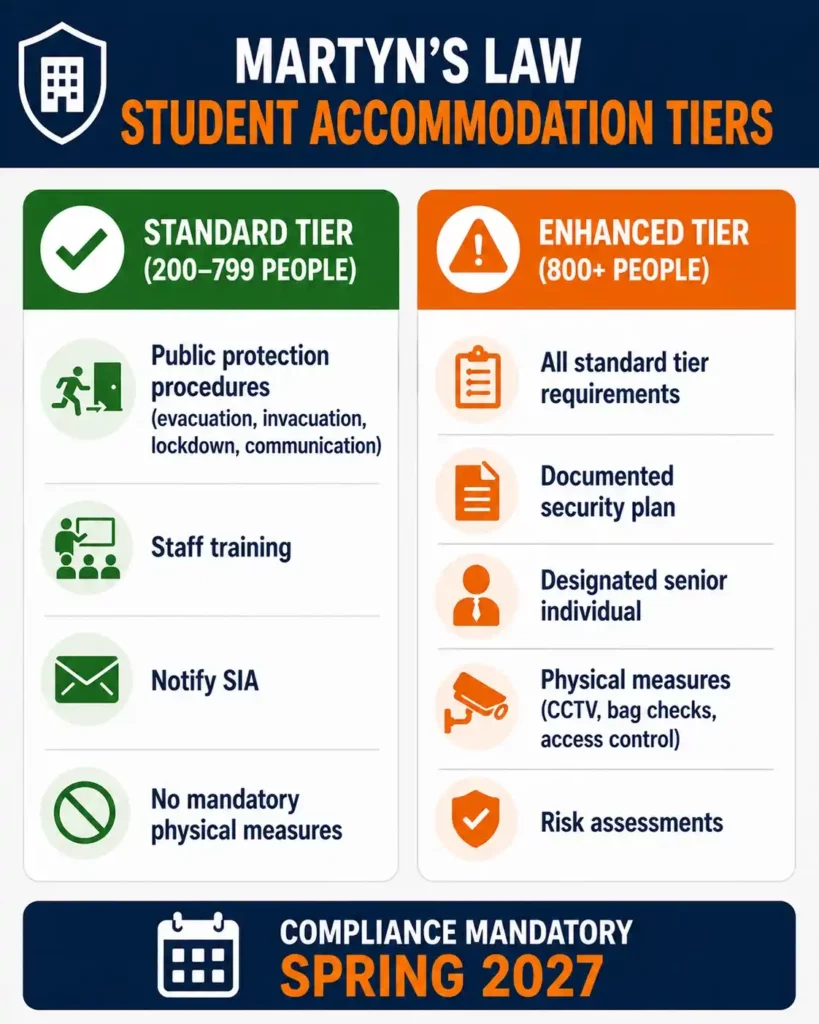
The Terrorism (Protection of Premises) Act 2025, better known as Martyn’s Law, received royal assent in April 2025. It is named after Martyn Hett, one of 22 victims of the 2017 Manchester Arena attack. The law is designed to protect the public from terrorist threats.
Who does it affect? Any premises where 200 or more people may be present. That includes many student accommodation blocks, especially large PBSA sites with common rooms, study areas, and dining facilities. It also covers university lecture theatres, libraries, and sports halls.
The two-tier system.
- Standard Tier (200–799 people): Must have public protection procedures, evacuation, lockdown, and communication. Staff must be trained. No mandatory physical measures, but the responsible person must notify the SIA.
- Enhanced Tier (800+ people): All standard requirements plus documented security plans, physical measures (CCTV, bag searches, access control), risk assessments, and a designated senior individual.
What does this means for student housing? The law takes effect in Spring 2027. The SIA is the regulator. Large PBSA sites are almost certainly in scope. Those signed up to approved government codes will be exempt from some parts of the assured system, but they still need public protection procedures.
For universities, the law applies across all buildings with 200+ capacity. That includes lecture halls and libraries. The message is clear: start planning now.
The Student Security Gap: PBSA vs Private Rentals
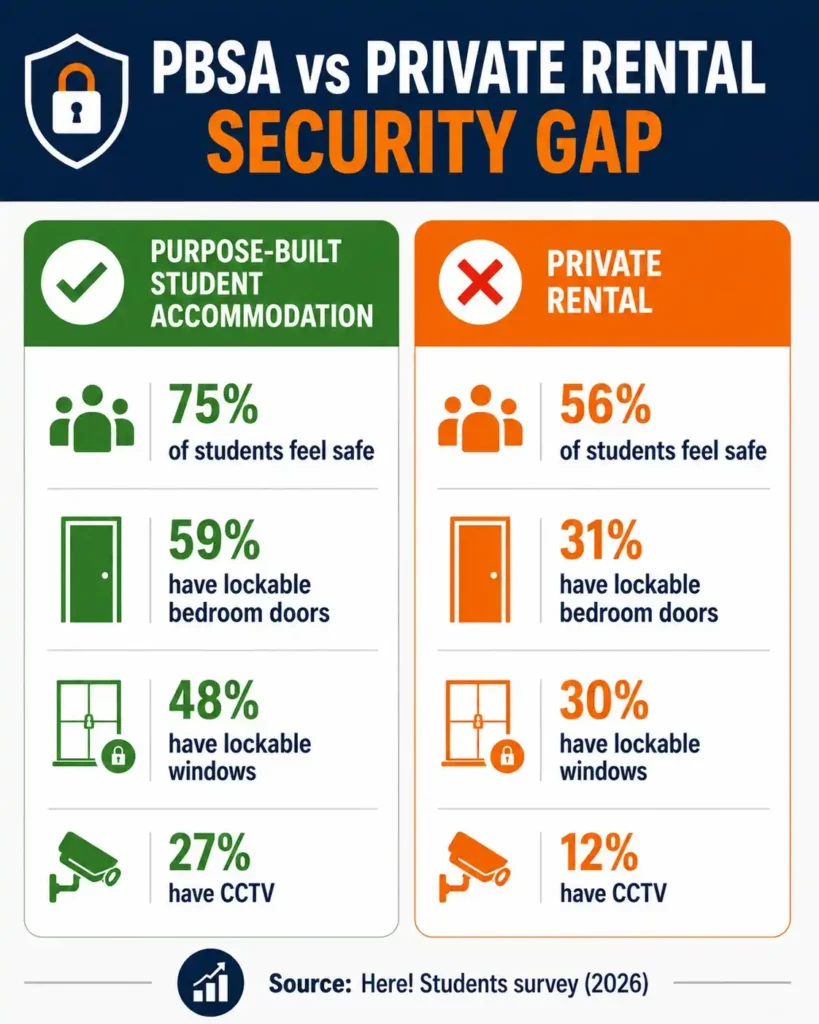
The data leaves no room for doubt. Students in private rentals are less safe. The gap is driven by basic security features that PBSA offers and private rentals often lack.
- Lockable doors and windows: Only 31% of private rentals have lockable bedroom doors. In PBSA, it’s 59%. The same pattern applies to windows – 48% in PBSA versus 30% in private homes.
- CCTV and entry systems: CCTV is present in 27% of PBSA sites but only 12% of private rentals. Secure entry systems? 31% versus 17%.
- Smart doorbells: Found in 29% of PBSA locations but only 13% of private homes.
Why the gap exists?
Private landlords are not subject to the same standards as PBSA providers. They face less scrutiny and fewer requirements. Students, often desperate for housing, lack leverage to demand improvements.
- The duty of care: Universities cannot simply direct students to the private market and walk away. They have a moral and legal duty of care. The Renters’ Rights Act 2025 reinforces this by preserving exemptions for PBSA providers signed up to approved government codes, a signal that regulated, quality housing matters.
- The human cost: Poor security leads to anxiety, stress, and disrupted studies. The National Student Accommodation Survey 2025 found that 7% of students experienced homelessness. When students cannot rely on their accommodation, they cannot focus on their education.
Student Security Services: What Universities and Accommodation Providers Should Offer
Closing the security gap requires action. Here is what universities and accommodation providers should be offering.
1. 24/7 manned guarding: SIA-licensed guards at entrances and common areas. They deter crime, challenge suspicious individuals, manage access, and de-escalate conflicts. Essential for large PBSA sites and campus buildings.
2. CCTV monitoring: Comprehensive coverage of entry points, corridors, and communal spaces. AI-enhanced systems can detect unusual behaviour and trigger real-time alerts.
3. Access control systems: Key fobs, PIN codes, or biometrics restrict entry to authorised residents. Integrated with visitor management to log guests properly.
4. Mobile patrols: Random-time patrols across campus and accommodation blocks. An unpredictable presence that criminals cannot plan around.
5. Alarm response and keyholding: For out-of-hours incidents. A trained person attends, investigates, and secures the premises.
6. Concierge services: A front-of-house presence that provides reassurance. Friendly, professional, and visible.
How to Improve Student Safety: A Practical Checklist for Universities
Use this checklist to enhance student safety and prepare for Martyn’s Law.
Step 1 – Conduct a security risk assessment: Audit all accommodation and campus buildings. Identify blind spots, weak access points, and poor lighting.
Step 2 – Upgrade CCTV coverage: Cover all entry points, corridors, and communal spaces. Consider AI-enhanced monitoring.
Step 3 – Deploy SIA-licensed security guards: Place uniformed guards at key entry points. Use static guarding and mobile patrols.
Step 4 – Implement access control systems: Key fobs, PIN codes, or biometrics for all blocks. Maintain visitor logs.
Step 5 – Ensure lockable doors and windows: A basic but essential feature. Work with landlords on improvements for private rentals.
Step 6 – Provide clear reporting mechanisms: Students must know how to report incidents. Anonymous reporting tools help.
Step 7 – Train staff on Martyn’s Law: All staff should understand evacuation, invacuation, lockdown, and communication procedures.
Step 8 – Engage with local police: Share intelligence on crime patterns. Many universities already have dedicated police liaison officers.
Step 9 – Educate students on safety: Practical advice: lock doors, keep windows secure, avoid walking alone at night, use safety apps like SafeZone.
Step 10 – Document everything: Logs of patrols, access records, and incident reports. Essential for insurance and regulatory compliance.
FAQs: Student Housing Security
1. What security measures should student accommodation have?
Lockable doors and windows, CCTV coverage, secure entry systems, and 24/7 on‑site or on‑call security. Larger sites need SIA‑licensed guards and AI‑enhanced monitoring.
2. How does Martyn’s Law affect student halls?
It applies to premises where 200+ people may be present. Large halls and common rooms are in scope, requiring public protection procedures and potentially documented security plans.
3. What’s the difference between PBSA and private rental security?
PBSA typically offers lockable doors, CCTV, and secure entry systems. Private rentals often lack these, leaving students more vulnerable.
4. How many security guards should a student block have?
Depends on size and risk. General guideline: 2‑4 guards per 1,000 residents for low‑risk sites, 6‑10 for high‑risk sites.
5. Can universities be liable for student safety in private rentals?
Universities have a duty of care. While not directly liable, they must provide advice, support, and influence landlords to improve standards.
6. What accreditations should a student security provider have?
SIA Approved Contractor status, ISO 9001, and for K9 units, NASDU accreditation. These demonstrate quality and professionalism.
Protecting the Next Generation
Campus security is not just about locks and cameras. It is about creating an environment where students can learn, grow, and thrive without fear. The data is clear: students in private rentals are significantly less safe than those in PBSA. The security gap is real and widening.
Martyn’s Law raises the bar. Universities and accommodation providers must act now to prepare for the Spring 2027 deadline. That means investing in student security services, manned guarding, CCTV monitoring, access control, and cybersecurity.
The cost of inaction is too high. When students feel unsafe, their mental health suffers, their studies suffer, and their trust in the institution erodes. Universities have a duty of care that extends beyond the campus gates.
Student accommodation security is not a luxury. It is a necessity. As student numbers rise and threats evolve, the sector must rise to the challenge. The next generation of students deserves nothing less.