Manned on-site security remains one of the simplest and most overlooked ways organisations protect people, property and day-to-day continuity. Cameras spot; sensors warn; but when something needs judgment, discretion or immediate physical action, a trained human being on site still closes the gap.
That gap is getting wider in places: organised theft rings are smarter, protests and public-order incidents are more fluid, and mixed-use commercial sites now combine retail, logistics and leisure in tighter footprints. These result in new blind spots that technology alone struggles to cover.
This guide doesn’t sell a service. It explains why procurement leads, operations managers and finance directors across the UK are rethinking security mixes and what a thoughtful, compliant on-site programme actually looks like. We will unpack the practical trade-offs between people and tech, clarify legal and insurer expectations, and give concrete checklists you can use straight away. Expect clear definitions, realistic cost drivers, operational routines you can adopt, and a forward-looking view of how AI, drones, and new venue legislation may change requirements.
If you’re deciding whether an on-site presence is right for your site, this article is the decision-ready resource: no jargon-heavy sales fluff, only the knowledge you need to specify, evaluate and measure an on-site security model with confidence.
Table of Contents
Manned Guarding Basics in the UK
Manned guarding simply means placing trained security personnel on-site to observe, deter and take action when needed. It’s different from remote or static-only security because it relies on human judgement, the ability to read tone, interpret behaviour, ask questions and step in before a situation escalates. Technology can alert, but only people can decide. That distinction matters more than ever across the UK.
What makes manned guarding different from static or remote-only security?
Static guarding usually refers to a guard who remains at a fixed point, such as a reception desk or entry booth. Useful, yes, but limited. Modern manned guarding blends movement, situational awareness and interaction. Duties often include:
- Patrolling wide areas
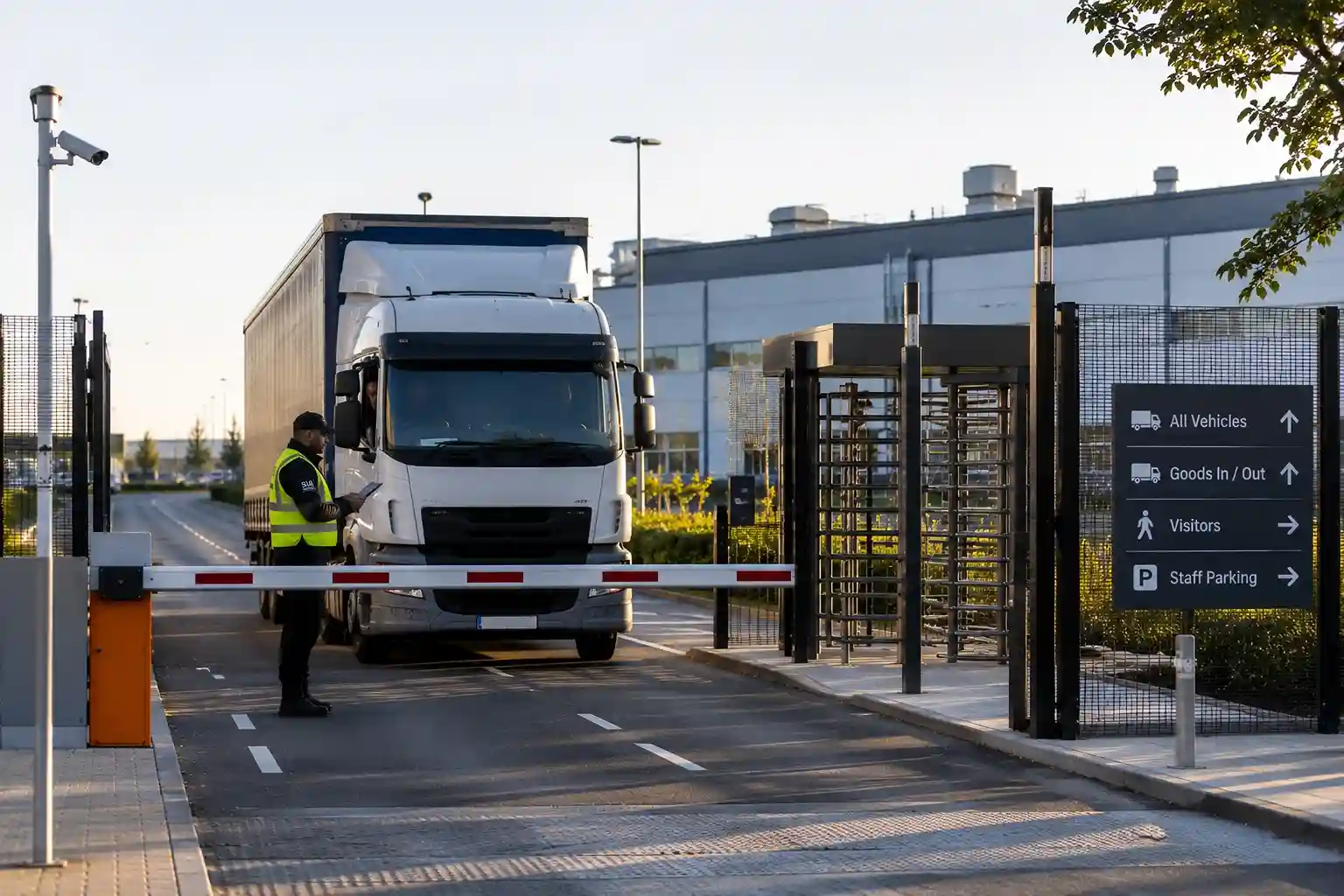
- Controlling pedestrian and vehicle access
- Responding to alarms in real time
- Supporting customer-facing roles
- Monitoring CCTV as part of a hybrid model
Remote monitoring has its place, but it cannot check a suspicious vehicle parked just outside the gate, calm a customer dispute in a retail unit, or secure a door that has been forced open. A human on-site can.
How UK crime patterns shape the demand for manned guarding
National crime indicators paint a clear picture: retail theft is climbing fast, organised groups increasingly target warehouses, and anti-social behaviour remains a frequent issue in mixed-use commercial zones. What drives demand isn’t only crime itself but how easily offenders recognise opportunity.
Across the UK, businesses typically see:
- Spike in shoplifting and push-out thefts
- Rise in warehouse break-ins and goods-in-transit interference
- Trespass and tool theft from construction sites
- Anti-social behaviour near retail parks and nightlife zones
When threats move quickly, a guard’s ability to intervene in real time becomes essential.
When do most incidents happen, and why timing matters
Peak crime windows vary by sector. A few patterns repeat across the UK:
Daytime risks
- High footfall in retail
- Customer disputes
- Opportunistic theft
- Delivery congestion
- Public-facing conflict
Night-time risks
- Organised theft from warehouses
- Perimeter testing on industrial estates
- Trespass on construction sites
- Arson attempts
- Lower natural surveillance
Day and night require different staffing patterns. Day shifts often prioritise customer interaction and visual presence; nights prioritise patrols, perimeter checks and rapid escalation protocols.
Why are UK warehouses particularly vulnerable?
Warehouses often sit in business parks or semi-rural edges, accessible, quiet and poorly monitored after hours. Common weak spots include:
- Multiple unsupervised loading bays
- Blind spots between racking aisles
- Poor external lighting
- Valuable, portable stock
- Limited night staffing
A remote camera may catch a figure moving. A guard can intercept, challenge, secure the area and record details. That difference in response time is why warehousing remains one of the highest users of manned guarding nationally.
How manned guarding addresses rising retail and retail-park challenges
Retail parks across the UK face a blend of low-level disorder and high-value theft. Guards help by:
- Providing a visible deterrent
- De-escalating confrontations
- Monitoring suspicious behaviour
- Liaising with store managers
- Responding to theft or vehicle-related issues
- Coordinating with the police when required
The surge in retail theft has also changed patterns: stores now request daytime patrols as often as evening cover.
Seasonal events and why they influence staffing needs
Events like Christmas markets, football fixtures, Black Friday, city festivals and Pride celebrations temporarily reshape city risk profiles. They bring:
- Higher footfall
- Portable ATMs and temporary structures
- Increased alcohol-related behaviour
- Additional traffic flow and late-night movement
Businesses near these zones often increase guard hours, add roaming patrols or reinforce front-of-house roles.
Transport hubs and tram routes: overlooked risk magnets
Cities with tram networks, such as Manchester, Nottingham, Sheffield and Edinburgh, have predictable movement corridors. Businesses located near stops often report:
- Loitering
- Property damage
- After-hours trespass
- Sudden surges of people
On-site guards help maintain order in these grey areas where responsibility overlaps between public and private spaces.
Economic conditions and business growth also influence demand
Security demand doesn’t rise only when crime does. It rises when:
- Businesses expand sites
- Industrial units increase floor space
- Retail brands open new branches
- Warehousing and logistics expand footprints
- Labour markets tighten
- Insurance requirements shift
During economic downturns, theft often increases. During growth periods, businesses take on new risks as they expand into larger premises. Either direction increases the relevance of manned security, just for different reasons.
Legal & Compliance Requirements for Manned Guarding in the UK
When you think about security, the presence of trained people often feels like common sense. But behind that presence lies a scaffold of rules, licences, vetting standards and legal duties designed to protect everyone, the public and the security teams themselves. Miss one of these requirements and it’s not just bad practice; it can be illegal and costly.
SIA Licensing: The Core Legal Requirement
Across the UK, the Security Industry Authority (SIA) regulates private security, including manned guarding. If someone is performing licensable activities such as guarding premises, controlling access, or patrolling, they must hold a valid SIA licence. These licences prove the individual is qualified, trained and vetted to operate in the private security sector. Learn about SIA licence conditions you must follow (gov.uk)
Licences are generally valid for three years and must be worn on duty, unless a lawful exception applies (e.g., covert store detectives). Operating without an SIA licence is a criminal offence, with penalties including licence suspension, revocation or prosecution.
Because these rules apply nationwide, businesses in regions such as the North West, West Midlands and Scotland all rely on SIA licensing as the fundamental compliance baseline.
Vetting (BS7858): Why Background Checks Matter?
Before anyone can get an SIA licence, they must pass criminal record and identity checks. Beyond that, many employers — especially those seeking higher assurance or accreditation, such as the Approved Contractor Scheme (ACS) adopt BS7858 security vetting standards.
BS7858 Security Screening is a British Standard for screening personnel working in secure environments. It goes beyond a simple DBS check: it verifies employment history, identity, criminal checks, and sometimes financial history to ensure trustworthiness.
Because manned guards often handle sensitive access or evidence, this level of screening is considered best practice, and many clients expect it before awarding a contract.
DBS Checks: What UK Businesses Need to Know?
A Disclosure and Barring Service (DBS) check is a standard part of obtaining an SIA licence, and businesses can expect their security providers to use them. However, clients typically do NOT see a guard’s DBS certificate directly (GDPR restrictions apply). What they should be able to verify is that every guard on site:
- Holds a valid SIA licence, and
- Has undergone appropriate criminal background checks as part of that licence process.
If you ever need reassurance, ask your security partner for a statement of compliance confirming that all personnel on your site meet DBS and licensing criteria.
Insurance Obligations: What Businesses Should Provide or Demand
Manned guarding introduces risk exposure for clients as well as suppliers. Most UK businesses hiring on-site teams will need to show appropriate public liability and employer’s liability insurance. These policies cover:
- Compensation for injury or loss caused by on-site personnel, and
- Losses arising from operational activities (e.g., accidental property damage).
While policy terms vary, insurers often require evidence of SIA licensing, BS7858 vetting and robust Standard Operating Procedures before agreeing to cover. It’s not a tick-box: inadequate documentation can lead to claims being declined.
CCTV, Data Protection and Compliance
When CCTV is part of your guarding mix perhaps as part of combined manned and remote monitoring you must obey UK data protection law (GDPR/DPA 2018). This means:
- Clear signage that CCTV is operating,
- Justified purpose for recording (security, safety),
- Secure storage and limited access to footage, and
- Defined retention periods.
Manned guards often interact with CCTV evidence (reviewing footage or supporting investigations), so policies must tie human activity into your data-protection framework.
For technical CCTV standards, refer to British Standard BS 7958 on CCTV operations.
VAT and Tax Treatment
From a tax perspective, security services, including manned guarding, are standard-rated for VAT in the UK. There’s no special reduced rate, so businesses should factor VAT into budget forecasts and contractual pricing. Always check current guidance from HMRC if you’re structuring cross-border or mixed services.
Council Rules and Construction Sites
Some local councils, especially in busy urban zones attach conditions to planning permissions or event licenses requiring additional security measures on construction sites. While there’s no uniform national code, you may encounter stipulations in places like the West Midlands or South East requiring specific barrier, patrol or access-control arrangements as part of a construction management plan.
Always review local authority planning conditions and consult your contract wording to align manned guarding with council expectations.
Business Licensing and Compliance History
Not only must individuals be licensed, but security firms themselves may need a business licence from the SIA before supplying licensable staff. This regime ensures businesses are “fit and proper” operators.
Documentation that proves compliance includes:
- SIA individual licences for each guard,
- Company business licence where applicable,
- BS7858 or ACS vetting records,
- Insurance certificates, and
- Internal policies on training, oversight and incident reporting.
Every reputable supplier should present these without hesitation.
Labour, Brexit and Operational Realities
UK labour law applies to manned guards like any other employees: overtime pay must comply with working-time regulations, and rights to work must be verified — especially in a post-Brexit environment where EU nationals face changed immigration requirements. Bad record-keeping here can jeopardise SIA licencing and expose businesses to fines.
Events, Police Collaboration and Data-Led Deployment
Manned guarding often plays a key role in event licensing requirements, especially under frameworks like Martyn’s Law for venues (which is expected to raise expectations for protective security). Guards may be part of an approved plan that satisfies licensing authorities.
Police and private manned guarding firms frequently work together through structures like Business Crime Reduction Partnerships (BCRPs). These collaborations share crime data, local risk insights, and incident histories to shape patrol patterns and resource allocation, especially in urban centres, where a combined public-private response reduces crime more effectively.
Costs, Contracts & Deployment Across the UK
Talking about the cost of manned guarding can feel a bit like talking about rent: everyone wants a simple number, but the real answer depends on where you are, what you need, and how fast you need it. Still, there are common patterns across the UK that help businesses understand what shapes the price and why the same guard can cost more in one location than another.
Typical cost drivers for manned guarding in the UK
While suppliers don’t publish universal rate cards (and probably never will), most UK businesses encounter these cost factors:
1. Location
City-centre deployments cost more than suburban or rural sites.
Why? Higher wage expectations, travel cost, and a generally more complex risk environment.
2. Shift patterns
- 24/7 coverage costs more per week but usually results in lower hourly rates.
- Short, ad-hoc shifts cost more per hour because staffing is less efficient.
3. Risk profile
A quiet office reception is priced differently from an industrial estate with night-time trespass issues or a retail park battling frequent theft.
4. Required skill level
First-aid training, banksman skills, conflict management, door-supervision qualifications, or blended customer-service roles often command higher wages.
5. Technology and reporting expectations
If the contract includes tools like digital patrol systems, integrated CCTV monitoring, bodycams or automated reporting dashboards, expect an uplift.
With those factors combined, most UK businesses see typical hourly guard rates fall within broad ranges set by labour costs and market conditions. Prices vary sharply by region, especially between South East/South West/Scotland — but the structure remains the same.
Inflation, wage pressure and what the run-up to 2030 really means for guarding costs
Security pricing in the UK has never stood still. But what’s coming next isn’t chaos or sudden spikes, it’s something quieter and, in many ways, more predictable.
Since around 2021, wage growth has crept upward year after year. Not because the industry decided to charge more, but because the ground beneath it shifted. And those shifts aren’t reversing any time soon.
A few realities are already locked in as we look towards 2030.
Statutory pay levels continue to rise. For labour-heavy services like manned guarding, even modest increases land immediately on hourly rates. There’s no buffer. If wages go up, costs follow.
At the same time, security is no longer competing only with itself. Warehousing, logistics, and manufacturing all draw from the same pool of frontline workers. As those sectors expand, keeping experienced guards becomes harder, and retention starts to matter just as much as recruitment.
Then there’s compliance. Training expectations are broader than they used to be. Vetting is tighter. Refresher courses, counter-terror awareness, and well-being obligations are none of these optional, and none of them are free. They raise the baseline cost of doing the job correctly.
Labour availability also plays a role. Post-Brexit changes didn’t break the workforce overnight, but they narrowed it. Fewer candidates are willing to work unsociable hours or travel to remote sites, which quietly pushes wages upward for experienced staff who will.
Put together, the picture is fairly clear. Between now and 2030, guarding costs are unlikely to jump dramatically, but they are unlikely to fall. What most businesses should expect, instead, is steady, incremental movement year by year.
That’s why many long-term guarding contracts already include inflation-linked review clauses. CPI-based adjustments allow pricing to move gradually, in step with the wider economy, rather than lurching upward at renewal time. It’s not about squeezing margins or passing risk around. It’s about keeping services viable without cutting corners.
For clients, this approach brings predictability. You know roughly where costs are heading and can plan for them. For providers, it means they can keep experienced people on the books, invest in training, and maintain consistent coverage.
The practical takeaway is simple. By 2030, manned guarding probably won’t be cheaper than it is today, but it should be easier to forecast. Businesses that accept gradual, managed increases tend to avoid disruption. Those chasing short-term savings often end up paying more later, just in different ways.
How long does deployment take?
Speed matters. When a business needs guards, they often need them yesterday. Deployment times depend on:
- Risk level
- Number of guards
- Vetting requirements
- Location
- Whether the supplier already operates nearby
Most reputable firms can deploy within 24–72 hours when urgently required, especially in dense regions like the North West, East Midlands or South East. Larger, long-term contracts may require a mobilisation window of 1–3 weeks for induction, uniforming, scheduling and site-specific training.
Contract lengths and notice periods
Manned guarding contracts aren’t one-size-fits-all. Common models include:
Short-term or temporary contracts
- 1 week to 3 months
- Often used for construction startups, urgent coverage gaps or after incidents
- Priced higher due to short duration
Medium-term contracts
- 6 or 12 months
- Most common for retail parks, industrial units, multi-tenant sites
Long-term contracts
- 2–3 years
- Usually include agreed annual adjustments and performance review clauses
Notice periods vary but generally sit between:
- 7–14 days for short-term
- 30 days for standard annual contracts
- 60–90 days for large multi-site deployments
These periods protect both parties from sudden operational disruption.
How guarding influences business insurance costs
A lesser-known benefit: Insurers often reduce premiums for businesses that implement structured, documented on-site security. Underwriters look for:
- 24/7 or structured night cover
- Access-control logs
- Incident reporting consistency
- Proof-of-presence (patrol verification)
- Clear escalation procedures
When a security partner maintains audit-grade documentation, insurers see lower risk, especially for warehouses, construction sites and retail units. So while guarding has a cost, it frequently offsets part of the insurance burden.
The Procurement Act 2023 and public-sector contracts
Public-sector buyers such as councils, NHS trusts, universities and transport authorities — now work under the Procurement Act 2023. This has reshaped how manned guarding contracts are tendered by:
- Increasing transparency on supplier performance
- Prioritising “value” instead of lowest price
- Tightening rules around compliance, social value and record-keeping
- Requiring clearer audit trails for guard training and vetting
For suppliers, this means stronger scrutiny. For public-sector clients, it means better-quality guarding and fewer loopholes. For private-sector businesses, these changes quietly raise the general expectation of compliance across the entire industry.
Why the price varies so much, and why it shouldn’t surprise you
A guard in a quiet business park outside Nottingham does not cost the same as a guard covering a busy loading bay near a tram hub in Manchester or a late-night bar district in the South East. Risk, complexity, and staffing pressure shape the numbers. If the pricing feels different from region to region, that’s because the operating reality is different.
What matters isn’t the cheapest line on a spreadsheet; it’s whether the service specification matches the risk. Underpriced guarding tends to fail quietly: high turnover, inexperienced staff, corner-cutting on patrols, or weak reporting. Those issues cost far more than the hourly rate ever will.
Training, Daily Operations & Guard Duties in the UK
If the legal framework sets the rules, training and daily routines are where the real work happens. The quality of manned guarding in the UK often comes down to what happens in the first ten minutes of a shift, how patrols are spaced, and how information moves between guards across the day. Good teams make this look easy. It isn’t.
Training Standards for UK Manned Guards
Before a guard ever steps onto a site, they must complete SIA-approved training, which is the baseline for the licence. But sector-specific expectations vary:
Retail environments
Guards assigned to retail or public-facing roles usually receive extra guidance in:
- Conflict management and de-escalation
- Customer service and safeguarding awareness
- Incident reporting involving vulnerable people
- Hands-off intervention protocols
- Theft-prevention observation techniques
Retail guards are often the only consistently visible authority on-site, so they’re trained to balance firmness with approachability, a skill not easily taught but essential on the job.
Industrial, warehousing and construction
Training tends to emphasise:
- Perimeter control
- Vehicle checks
- Lone-worker safety
- Radio discipline and response timing
- Hazard awareness (fuel, plant equipment, stored chemicals)
These sites require long patrols and a strong sense of environmental risk.
Night-time economy and events
Guards here usually need:
- Enhanced conflict management
- Crowd-control awareness
- Evacuation and emergency procedure familiarity
The environment changes quickly; training must prepare them for that.
The First Minutes of a Guard’s Shift in the UK
Ask any experienced guard, and they’ll tell you: how the shift starts often determines how the rest of it goes.
Immediate arrival checks
Most UK guards begin with a structured routine:
- Check in with the supervisor or control room, confirming arrival and location.
- Read handover notes, especially incidents from the previous shift.
- Assess the site visually, a quick walk-by to make sure nothing looks disturbed.
- Check that all access points are in the expected status, locked, unlocked or monitored as per the schedule.
This isn’t box-ticking; it’s situational awareness in action.
Equipment & System Checks
Before patrols begin, guards carry out a short round of operational checks:
- Radio test (primary communication tool)
- Torch and battery check (critical for night sites)
- Bodycam or ID verification – if issued
- CCTV system glance-over to confirm feeds are live
- Alarm panel status check
A malfunctioning radio or dead torch battery at 2 a.m. is more than an inconvenience. It’s a safety risk.
Shift Handovers: How UK Guards Maintain Continuity
Handovers are surprisingly detailed. A typical handover includes:
- A verbal briefing on incidents, alarms or suspicious activity
- Notes on repeat visitors, contractor schedules or expected deliveries
- A logbook review, particularly for entries marked “follow up”
- Status of CCTV faults, lighting outages or damaged locks
- Keys, fobs or access cards passed between guards
Good guards don’t just hand over; they leave context.
Patrol Routines and Frequency Across the UK
Patrol patterns vary by site, but a few rules hold everywhere:
Patrol frequency
- Light-risk sites: every 1–2 hours
- Medium-risk sites: every 45–60 minutes
- High-risk or night-time industrial sites: 20–40 minutes, with randomised timing
Randomisation is key since predictable patterns invite exploitation.
Perimeter checks
At the start of patrols, guards typically inspect:
- Fencing and gating
- Access doors (external and internal)
- Loading bays
- Isolated corners or blind spots
- Utility areas: checking for tampering, leaks, or forced access
Utility tampering is more common than most businesses realise.
Logging, Reporting & Documentation
Daily documentation is the backbone of UK manned guarding. Guards normally record:
- Patrol times and key observations
- Visitor entries and exits
- Alarm activations or system faults
- Delivery arrivals
- Any interactions involving conflict or unusual behaviour
- Maintenance issues (lighting failures, damaged doors, CCTV dead zones)
These logs later support insurers, auditors and sometimes police investigations.
Responding to Alarms & Emergencies
If an alarm triggers during early shift hours, often when ambient noise is low, and incidents stand out, the guards follow a structured escalation:
- Attend the alarm point quickly but safely
- Assess the cause: intrusion? Mechanical issue? Environmental trigger?
- Document findings in the logbook
- Notify control or emergency services if needed
- Secure the area until the risk is cleared
Even false alarms matter because patterns reveal vulnerabilities.
CCTV, Access Points & Internal Checks
At the start of a shift, guards typically:
- Check CCTV coverage and camera feeds
- Confirm internal access points (offices, storerooms, restricted zones) are correctly secured
- Verify previous incidents flagged on CCTV have been resolved
- Update keys-held register if applicable
In high-traffic environments, CCTV checks happen several times a shift.
Supervisor Contact & Reporting Frequency
Night-time shifts generally have more frequent supervisor check-ins:
- Standard sites: every 2 hours
- Medium-risk: every 60–90 minutes
- High-risk or isolated sites: every 30 minutes
These are both welfare checks and compliance requirements.
End-of-Shift Procedures
Before signing off, guards complete:
- A final perimeter sweep
- Secure-down checks (doors, gates, windows, lighting)
- Key and equipment return
- Logbook update with unresolved issues
- Brief handover to incoming staff
This ensures continuity and nothing falls between shifts.
24/7 Shift Patterns & Response Times
UK 24/7 guarding usually runs on:
- 8-hour rotations, or
- 12-hour shifts for static or low-activity sites
Emergency response times depend on geography, but many suppliers aim for 15–30 minutes for mobile backup in areas with high coverage (e.g., North West, West Midlands, South East).
Performance, Risks & Staffing Challenges
Performance in manned guarding isn’t just about turning up on time and patrolling on schedule. The real measure is whether those activities reduce risk in a way the client can see and the insurer can verify. The most reliable UK security contracts track a blend of behavioural and operational metrics.
KPIs UK businesses should monitor
While sites differ, a few universal KPIs give a clear picture of security performance:
- Patrol completion rates (with timestamped proof-of-presence)
- Incident response times: how quickly guards move from alert to attendance
- Accuracy and clarity of reporting
- Visitor management compliance
- Escalation quality: whether guards made the right call at the right time
- Customer-facing conduct in retail and public environments
Supervisors often review these weekly to spot patterns: missed patrols, inconsistent logs, or repeat incidents in the same blind spot.
Environmental and weather-related risks
The weather has a quiet but powerful influence on guarding in the UK. Heavy rain reduces visibility; frost and ice complicate foot patrols; high winds create hazards around scaffolding or loose materials. Guards working outdoors document weather conditions in their logbooks because it helps explain:
- Patrol timing changes
- Delays in accessing certain areas
- Increased risk of debris, blown fencing or unsecured gates
This documentation isn’t busywork; insurers frequently request it after incidents.
Environmental regulations also shape outdoor work. Guards must observe guidelines around:
- Site lighting levels
- Noise control at night
- Handling waste or hazardous materials near construction and industrial perimeters
It’s not uncommon for environmental compliance officers to inspect sites where guards operate, especially in regulated sectors.
Health, fatigue and shift-related impacts
Long shifts, especially 12-hour rotations, affect concentration. Fatigue slows reaction times and makes decision-making harder, particularly on quiet night shifts when stimulation is low. UK companies increasingly rotate tasks within shifts, encourage micro-breaks and use welfare checks to keep guards alert and safe.
Mental health support is also rising on the agenda. Night shifts, isolation on large sites and exposure to conflict can take a toll. Progressive employers offer:
- Access to wellbeing programmes
- Debriefs after major incidents
- Regular supervision and check-ins
- Early intervention for stress-related issues
Retention improves when guards feel supported, not simply scheduled.
The staffing challenge and how UK firms adapt
Labour shortages across security haven’t gone away; in some regions, they are worsening. UK firms now rely on strategies such as:
- Better pay alignment with logistics and warehousing
- Upskilling to create more attractive career paths
- Predictable shift rotations
- Travel allowances for remote sites
- Retention bonuses for long-term posts
None of these are glamorous solutions, but they work because guards stay where the work feels stable, the support is real, and the expectations are clear.
Technology & Future Trends in UK Manned Guarding
Technology doesn’t replace guards; it changes what they can see, understand, and act on. In UK urban areas, the blend of people and systems is moving faster than most businesses realise — and the next few years will reshape guarding more than the last ten did.
How technology is reshaping daily practice
A decade ago, guards mainly relied on notebooks, radios, and, occasionally, CCTV screens. Today, the landscape looks very different:
- Digital patrol verification systems timestamp movements
- Incident-reporting apps auto-format logs and attach evidence
- Access control systems integrate with cloud dashboards
- Body-worn cameras support de-escalation and evidence collection
Guards still make judgment calls, but tech now captures the proof.
Post-COVID changes to guarding protocols
The pandemic left behind permanent behavioural shifts. Businesses redesigned layouts, increased remote staffing and rethought physical access all of which increased the need for guards who can:
- Manage hybrid entry systems
- Support health-and-safety compliance
- Respond to irregular building occupancy patterns
Offices are emptier at odd times; industrial estates run 24/7; retail footfall spikes unpredictably. Guards now operate in environments that change more often than they used to.
AI as a partner, not a replacement
AI-assisted surveillance tools now highlight unusual movement patterns, spot repeat offenders and flag anomalies across multiple camera feeds. They don’t replace guards, but they direct attention to the places a human should look.
AI helps guards:
- Prioritise areas with suspicious activity
- Detect loitering or perimeter testing earlier
- Analyse patterns that repeat over time
- Reduce time spent manually reviewing footage
Think of AI as the extra set of eyes that never blinks.
Remote monitoring + manned guarding = hybrid protection
Remote monitoring centres complement on-site teams by:
- Confirming alarms before escalation
- Guiding guards to exact locations during incidents
- Watching multiple viewpoints simultaneously
- Providing audio challenge capability
- Maintaining oversight during lone-worker patrols
Many UK businesses now operate hybrid models because they provide coverage no single method can achieve alone.
Drone patrols & emerging aerial support
Drone patrols aren’t mainstream yet, but they’re appearing on large UK industrial sites, logistics hubs and remote perimeters. They offer:
- Rapid sweeps of wide areas
- Thermal imaging for night risks
- Live feeds shared with on-site guards
- Faster detection of trespass or perimeter breaches
Drones won’t replace foot patrols; they simply expand visibility.
Predictive analytics & smarter deployment
Software tools now analyse:
- Past incident data
- Time-of-day patterns
- Weather correlations
- Transport flow
- Nearby crime reports
This data helps determine when patrol frequency should increase, which blind spots need more attention, and how many guards are needed at certain hours. It’s the future of resourcing: not guesswork, but informed modelling.
Upskilling & new certifications for UK guards
As roles evolve, guards benefit from training in:
- Digital reporting platforms
- Counter-terror awareness (ACT training)
- Customer service and safeguarding
- Drone-assisted observation (where applicable)
- Enhanced first aid
- AI/CCTV integration basics
The more multi-skilled the guard, the more adaptable the service.
Green security practices
Sustainability is becoming a procurement requirement. UK guarding firms are adopting:
- Electric patrol vehicles
- LED or motion-triggered site lighting
- Digital reporting (reducing paper use)
- Solar-powered CCTV towers
- Eco-efficient uniforms and equipment
Sites want safer operations but also greener ones.
Martyn’s Law and the next wave of venue security
When Martyn’s Law (Protect Duty) fully takes effect, venues across the UK, including arenas, festivals, stadiums, and hospitality, will need to elevate their protective measures. Manned guards will play a central role in:
- Crowd safety planning
- Search procedures
- Evacuation readiness
- Vulnerability scanning
- Incident escalation
It won’t just add tasks; it will change expectations for training and documentation across the entire sector.
Conclusion
If there’s one thing the UK security landscape makes clear, it’s that manned guarding isn’t just about having someone in a uniform on-site. It’s about judgement, continuity and the reassurance that when something unexpected happens, and it always does, eventually someone is there who knows the site, understands the risks and can act without hesitation. The legal framework, the training, the KPIs, the tech… all of it matters. But in the end, it’s the combination that gives businesses real resilience.
If you’re still deciding whether on-site security fits your environment, start with the basics: your risks, your people, your operational hours. A short audit can often reveal gaps you didn’t realise were there. We offer regional guidance for areas like the North West, West Midlands, South East, Scotland, and others, not to sell you something, but to help you see the whole picture before you commit to anything. Think of it as a second opinion from people who look at sites every day.
If you want that kind of clarity, ask for a quick assessment or download the checklist mentioned earlier. No pressure, just practical, written insight you can take to your team or your insurer when you need it.
FAQ
1. Do all security guards in the UK really need SIA licences?
Yes, it’s non-negotiable. If a guard is doing licensable work without an SIA badge, the individual and the employer can face fines or prosecution. It’s one of the simplest checks clients can make.
2. Are DBS checks part of the process?
They are, but usually handled behind the scenes during vetting. Clients typically don’t see the certificate itself (for GDPR reasons), but should receive confirmation that checks were carried out.
3. How fast can a guard team be deployed?
If the need is urgent, many firms can get someone on site within 24–72 hours. For planned or multi-guard contracts, expect 1–3 weeks to set everything up properly.
4. Can manned guarding actually lower insurance costs?
Often, yes. Insurers pay attention to things like patrol logs, escalation procedures and proof-of-presence. Strong documentation tends to reduce perceived risk.
5. What performance indicators matter most?
Patrol timings, response speed, report quality and how well guards handle visitors or incidents. If those four are solid, everything else usually follows.
6. What about CCTV compliance? Is it complicated?
Not really. You just need clear signage, secure storage, limited access and proper retention periods. Most of this sits in a good data-protection policy.
7. Are long shifts a problem for guards?
They can be. Fatigue affects concentration, which affects safety. That’s why responsible employers rotate duties, schedule welfare checks and avoid stacking too many night shifts in a row.
8. Will Martyn’s Law change anything for venues?
Yes — quite a lot. It will raise the baseline for protective security, which means better training, stronger planning and more structured documentation for guards working at events or large public spaces.