Retail risk in Stockport rarely looks dramatic. It builds quietly. A busy lunchtime stretches the staff. A delivery door stays open longer than planned. A shop sits between a bus stop and a residential cut-through where footfall changes by the hour. Each moment feels manageable on its own, but together they create exposure over time.
That is the practical context behind Why Stockport businesses need Retail Security. Not as a claim, but as a decision question. One shaped by how the town’s retail spaces actually function day to day.
Stockport sits within Greater Manchester, yet its retail profile is distinct. A compact town-centre high street. Edge-of-town retail parks with shared access. Neighbourhood parades are positioned close to housing and transport routes. Each carries a different rhythm of risk.
Technology records activity. People interpret it. Retail incidents depend on judgment, timing, and presence more than alerts or footage.
Retail crime risks in Stockport are rising in ways that reflect national trends, but local conditions shape how that risk appears. This article exists to help decision-makers understand when on-site retail security is justified, how legal and insurance expectations apply, what realistic costs look like, and how to plan security that fits Stockport retail environments.

Retail Security Basics in Stockport
What Retail Security Means in a Stockport Context
Retail security is often reduced to visibility. In practice, it is about judgment.
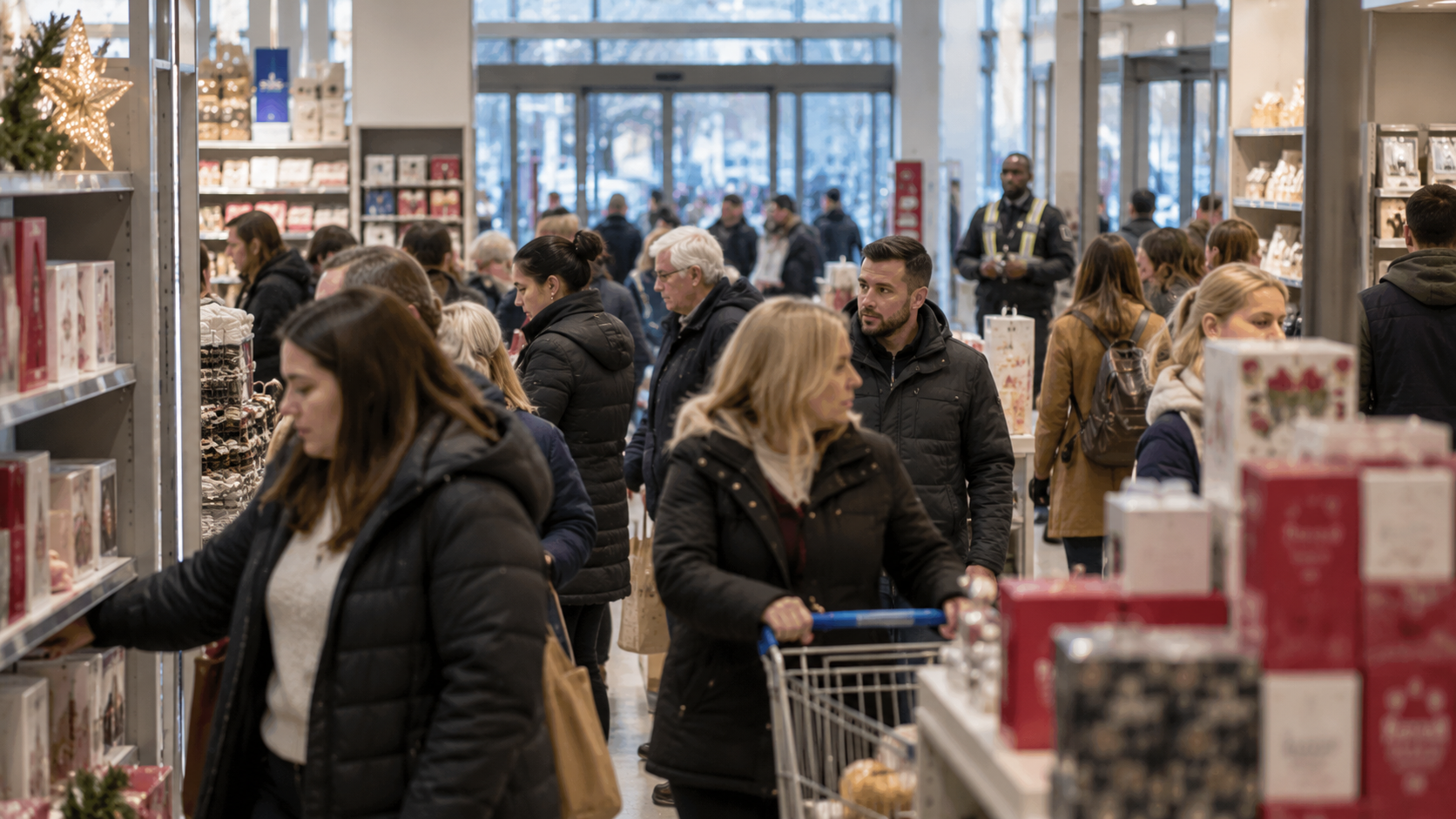
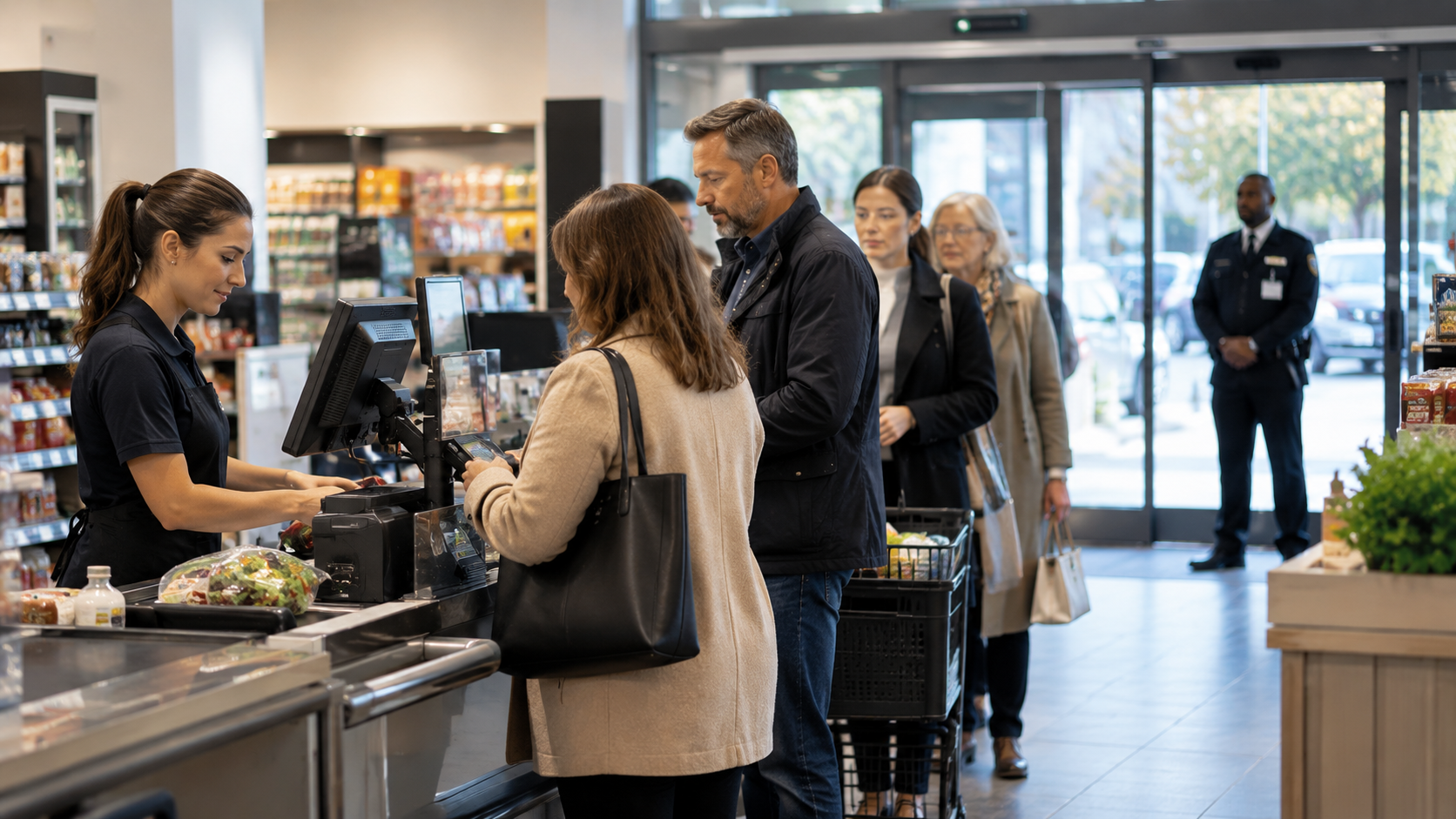
In Stockport, retail security means placing trained people on site to manage risk inside customer-facing environments. That includes observing behaviour, deterring opportunistic theft, responding to incidents, and supporting staff when situations start to feel unsafe.
This differs from three common alternatives:
- On-site retail guards, who move through space, engage, and intervene when needed.
- Static desks or reception posts, which provide presence but limited reach.
- Remote CCTV-only models, which record events but rely on a delayed response.
Cameras show what happened. Guards decide what to do next.
That distinction matters in Stockport’s mixed retail layouts. Many situations begin unclear, with actions that could be browsing or something more. A raised voice may be frustration, not aggression. These moments require interpretation, not just evidence.
This is often when retailers begin to consider why Stockport businesses need Retail Security. The focus is prevention, stopping small issues from stacking up over time.
How Stockport’s Retail Landscape Shapes Risk
Retail risk in Stockport shifts with location and time.
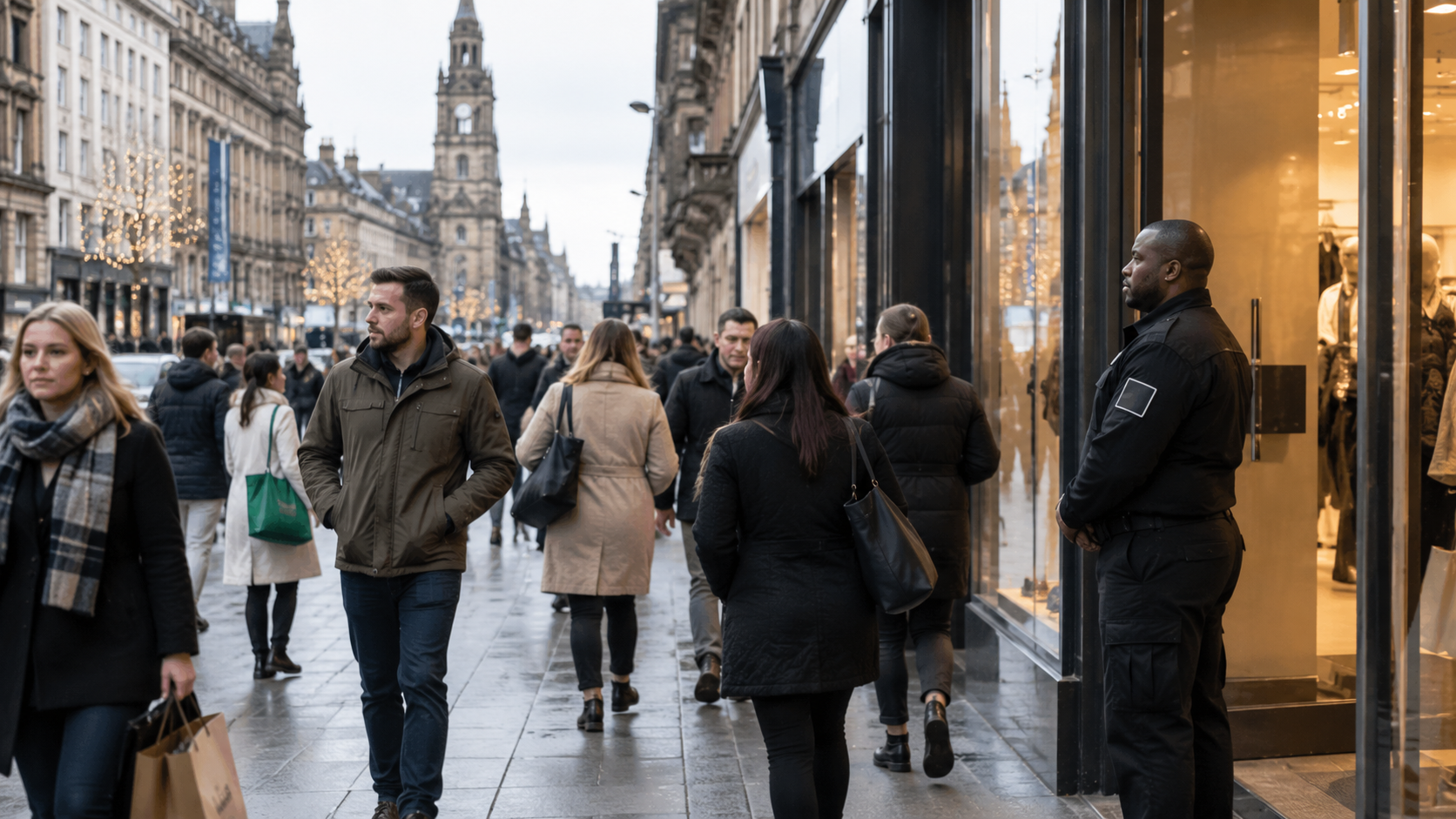
Town-centre units deal with dense, fast-changing footfall. Retail parks face wide perimeters, shared car parks, and vehicle movement. Neighbourhood shops sit close to residential routes, where familiarity lowers inhibition and repeat behaviour becomes more common.
That proximity increases several pressures:
- Daytime theft is easier to disguise,
- Staff face confrontation without immediate backup,
- Loitering and low-level anti-social behaviour blend into routine movement.
This is why Stockport retail theft prevention works best when it is proactive. Waiting for incidents to escalate rarely helps. Presence, consistency, and early engagement usually do.
Why Stockport Differs from Central Manchester
Retail security decisions in Stockport are not replicas of city-centre Manchester models.
Policing visibility is less uniform. Trading hours vary across dispersed sites. Staff often manage conflict alone during busy periods, particularly in smaller units.
As a result, retail crime risks in Stockport are shaped less by headline statistics and more by opportunity, layout, and timing. That reality drives many local retailers to reassess how risk is managed on site.
Many of these pressures are shared across the North West, but Stockport’s retail mix creates its own operational challenges.
Retail Crime Patterns, Timing, and Exposure in Stockport
When Retail Incidents Typically Occur
Most retail incidents in Stockport happen during normal trading hours.
Daytime risks include:
- Push-out theft during peak footfall,
- Refund abuse when staff are under pressure,
- Intimidation aimed at younger or lone workers.
These incidents rely on distraction, not force.
Evening risks increase as staffing reduces and footfall becomes less predictable, especially near transport corridors.
Night-time risks tend to concentrate around retail parks and delivery zones. These often involve perimeter testing, vehicle interference, or unsecured access points after closing.
Understanding timing matters more than counting incidents. Similar daytime patterns are now reported across Salford, where footfall density shifts risk toward peak trading hours.
Day Vs Night Retail Security Risks
Late-night cover once dominated retail security planning. That balance has shifted.
Across the UK, daytime retail theft risks now drive more demand than night time incidents. In Stockport, crowded periods create cover, awareness drops, and theft slips into the background of daily trade.
Daytime retail security focuses on visibility and engagement. Night-time cover prioritises patrols and perimeter control. Treating them as interchangeable creates gaps.
Retail Parks and Edge-Of-Town Exposure
Retail park security challenges rarely fall to a single store.
Shared car parks, multiple access points, and unclear responsibility between tenants create opportunities. Vehicle-assisted theft becomes easier. Escape routes are built into the layout.
A visible on-site presence reduces that opportunity, not through confrontation, but through awareness and coordination.
Transport Links and Retail Vulnerability
Retail units near rail stations, bus corridors, and commuter routes experience sudden changes in movement. People pass through quickly, dwell time stays short, and familiarity remains low.
These are movement patterns, not fixed crime zones. Retail security works best when it responds to flow rather than static assumptions.
Seasonal and Event-Driven Pressure
Christmas trading combines with major sales and local events to raise risk.
Each compresses risk into shorter windows. Extended hours, temporary layouts, and increased cash handling change the profile of otherwise stable sites. Smaller towns such as Lancaster demonstrate how familiarity can increase repeat low-level incidents.
This compression explains why retail crime is increasing in Stockport without relying on alarmist narratives. Pressure rises faster than staffing and oversight can adapt.
Sector-Specific Retail Vulnerabilities in Stockport
Retail risk does not behave the same way across Stockport. What works on the high street often fails on a retail park. What feels manageable in a neighbourhood shop can escalate quickly in mixed-use developments.
Understanding these differences matters because retail security is most effective when it is shaped around exposure, not generic threat models.
High-Street Retail Units
High-street locations benefit from visibility. They also absorb pressure first.
- Footfall changes quickly throughout the day.
- Lunchtime surges stretch staff.
- Late afternoons often bring younger crowds.
- Early evenings combine reduced staffing with unpredictable behaviour.
In these moments, staff safety in retail environments becomes a live concern, not a theoretical one.
Lone working adds another layer of exposure. Opening and closing routines, stock movements, and cash handling often fall to one person. Visibility deters some behaviour, but it can also invite confrontation when offenders believe staff are isolated.
Retail security in these settings focuses less on enforcement and more on presence. Quiet intervention. Early engagement. Support that staff can rely on before a situation turns hostile.
Retail Parks and Big-Box Stores
Retail parks carry a different risk profile.
Wide layouts create blind spots. Shared car parks allow vehicles to move freely between units. Responsibility for incidents often feels diluted, especially where multiple tenants share access routes.
Organised theft groups exploit this structure. Vehicle-assisted theft becomes easier. Items can be transferred quickly and disappear without confrontation.
Retail security here depends on coordination, clear authority, and visibility across shared space. Without that, even well-run stores become vulnerable through no fault of their own.
This is where commercial retail security in Stockport often diverges from standard models. What looks adequate on paper can fall apart in practice if shared exposure is not addressed.
Convenience Stores and Neighbourhood Retail
Neighbourhood retail brings familiarity, and familiarity cuts both ways.
Repeat offenders become common. Informal access points develop. Staff may hesitate to challenge behaviour because customers are known, or because confrontation feels personal.
Police response is not always immediate for low-level incidents, which places greater weight on early intervention and documentation. The goal is not escalation. It is the disruption of patterns before they harden.
Retail security in these environments often succeeds quietly. Presence reduces repetition. Consistency discourages testing.
Mixed-Use Developments
Retail beneath residential or office spaces introduces grey areas.
- Who controls access after hours?
- Who responds when an incident spills beyond store boundaries?
Ambiguity creates opportunity. Retail security helps clarify responsibility, establish boundaries, and prevent confusion that offenders exploit.
Legal and Compliance Requirements for Retail Security in Stockport
Retail security decisions sit inside a legal framework that is national in scope but locally applied. Missing a requirement does not just create risk. It can invalidate insurance and expose businesses to enforcement action.
SIA Licensing and Legal Obligations
Any individual performing a licensable security activity must hold a valid SIA licence. This applies to retail guards operating in Stockport in exactly the same way it applies elsewhere in England. Comparable licensing scrutiny applies across Merseyside, particularly in mixed-use retail zones.
Licensable activities include guarding premises, controlling access, and patrolling for the purpose of security.
Using unlicensed personnel is a criminal offence. Penalties can include prosecution, fines, and reputational damage. More quietly, it can also undermine insurance cover if an incident occurs.
For businesses, compliance checks are straightforward.
- Verify licence validity.
- Confirm the role aligns with the licence type.
- Anything less creates unnecessary exposure.
Any reputable security company in Stockport should be able to provide this verification quickly, without hesitation or caveats.
BS 7858 Vetting and DBS Expectations
Retail environments are customer-facing. Guards interact with staff, visitors, and sometimes evidence. Trust matters.
BS 7858 screening provides that assurance. It verifies identity, employment history, and suitability for background checks over a defined period. DBS checks form part of this process, but clients should not expect to see certificates directly.
What matters is confirmation that screening has been completed correctly. This is now an expected standard in most retail security contracts.
Insurance Expectations for Retail Premises
Insurers assess retail risk through behaviour, not promises.
They look for evidence:
- Documented security presence,
- Consistent patrol or coverage records,
- Clear incident reporting,
- Defined escalation procedures.
Public liability and employer’s liability policies often reflect this. When documentation is weak, claims become harder to defend. When it is strong, insurers see reduced exposure.
Retail security supports insurance defensibility as much as prevention.
CCTV, GDPR, and Retail Guard Interaction
When retail guards interact with CCTV systems, data protection law applies.
The approach relies on clear signage, a defined purpose, restricted access, and sensible retention periods.
Guards may review footage, support investigations, or provide statements. They must do so within policy. Poor handling creates legal risk that outweighs the value of the footage itself.
Event Licensing and Future Legislation
Retail units affected by local events can fall under additional scrutiny. Temporary changes in footfall, extended hours, or shared public space can sometimes trigger licensing conditions.
Looking ahead, legislation such as Martyn’s Law is expected to raise expectations around planning, training, and documentation in public-facing environments. Retail spaces adjacent to event zones or transport hubs are likely to feel this first.
Understanding the legal requirements for retail security guards in Stockport is therefore about staying compliant now and prepared later.
Costs, Contracts, and Deployment of Retail Security in Stockport
Retail security costs are often discussed as a single number. In practice, pricing reflects a series of trade-offs.
What Drives The Cost Locally
There is no flat rate for Stockport. Town-centre coverage costs differ from retail parks. Daytime patrols differ from overnight cover. Roles focused on visibility differ from those requiring active intervention.
Skill, timing, and exposure shape pricing more than geography alone. Visibility-only presence is cheaper. Judgment-driven coverage costs more. The difference matters when incidents arise.
Typical Contract Structures
Retailers in Stockport tend to use a mix of arrangements.
Short-term cover is common after incidents or during refurbishment. Seasonal uplift appears around Christmas, major sales, or events. Long-term contracts support multi-site portfolios where consistency matters.
Each structure has different implications for cost, continuity, and preparation.
Deployment Timelines
Urgent retail security can often be deployed quickly when providers already operate locally. Planned deployments allow time for site familiarisation, induction, and alignment with store routines.
That preparation improves outcomes. Guards who understand layout, staffing patterns, and peak pressure points intervene earlier and more effectively.
The case for why Stockport businesses need Retail Security sharpens when leaders weigh costs against disruption, insurance risk, and staff fatigue. It is rarely about price alone.
Insurance Offsets and Cost Justification
Well-documented retail security often reduces insurance friction. Insurers value predictability. Logs, reports, and proof of presence show risk is being managed, not ignored.
This is why the cost of retail security for Stockport businesses should be viewed alongside risk exposure, not isolated hourly rates.
Underpriced security often fails quietly. Turnover rises, reporting weakens, and gaps appear that become expensive when something goes wrong.
Training, Daily Operations, and Retail Guard Duties
Retail security works or fails long before an incident happens. The difference is usually found in preparation, routine, and awareness, not reaction.
Retail-Specific Training Expectations
Retail environments demand a different skill set from industrial or office sites.
Training focuses on:
- Conflict management and verbal de-escalation,
- Recognising behaviour patterns rather than offences,
- Safeguarding awareness for vulnerable customers or staff,
- Proportional response in public-facing spaces.
The goal is not enforcement. It is control without escalation. Most retail incidents do not require physical intervention. They need someone calm, visible, and confident enough to interrupt behaviour early.
How Retail Shifts Typically Begin
The first minutes of a shift matter more than most retailers realise.
Guards begin by building a clear picture of the site before taking position. They review staffing levels, active promotions, and any issues noted during earlier shifts. Delivery schedules are checked, especially those timed with peak footfall. This context guides where attention is focused and when extra awareness is needed.
Good handovers pass on more than facts. They pass judgment.
- What felt off?
- What nearly happened?
- What to watch?
That awareness often prevents repeat incidents.
Patrol Logic in Retail Environments
Retail patrols are about presence, not mileage.
When patrols become predictable, behaviour shifts around them. When they feel intrusive, customers pull back. The balance matters. Effective patrols stay visible enough to deter risk, but light enough to let normal activity continue.
Randomisation plays a role. Changing routes. Varying timing. Paying attention to overlooked corners rather than obvious walkways.
Retail security services for Stockport businesses work best when guards understand how people move through a space. Knowing door positions and camera angles alone is not enough.
Reporting and Documentation
Reports are not written for their own sake. They support insurance claims. They help management spot patterns. They protect staff when incidents are challenged later.
Good reporting is clear, factual, and timely. It avoids speculation. It records what was seen, what was said, and what action was taken. Over time, these records become a quiet but powerful risk-control tool.
Performance, Risks, and Operational Challenges in Stockport Retail
Retail security performance is not measured by how often guards intervene. It is measured by how often problems do not reach that point.
For retailers in Stockport, the challenge is not just preventing theft. It is maintaining control in environments where pressure changes by the hour and exposure is rarely consistent.
KPIs That Retail Businesses Should Actually Monitor
Retailers often track the wrong signals.
What matters most is not the number of incidents, but whether security activity reduces repeat behaviour and supports staff confidence. The most useful indicators tend to be simple:
- Whether patrols or coverage happen as planned,
- How quickly guards respond when issues begin to form,
- The clarity and accuracy of incident reporting,
- And how well guards support staff during difficult interactions.
If reports are vague, delayed, or inconsistent, problems are usually missed rather than solved. Clear documentation shows patterns early. That visibility allows retailers to adjust staffing, layouts, or trading routines before losses grow.
Environmental and Seasonal Pressures Unique To Stockport
Retail risk in Stockport shifts with conditions.
- Wet weather increases loitering.
- Hot spells raise frustration.
- Darker evenings compress footfall into shorter, more intense trading windows.
These changes affect behaviour, not just numbers.
Seasonal pressure matters too. Christmas trading, major sales, and local events bring temporary layouts, extended hours, and unfamiliar customers. Security performance during these periods often depends on preparation rather than response.
Good teams document these conditions, not as excuses, but as context. That detail helps management and insurers understand why certain days carry higher exposure than others.
Health, Fatigue, and Continuity of Coverage
Fatigue affects judgement, which is not an opinion. It is an operational reality.
Long shifts, quiet periods, and repetitive routines reduce alertness over time. In retail environments, that matters because most incidents are subtle before they escalate. Missed cues lead to late intervention.
For businesses, the risk is not simply tired guards; it is inconsistent. A stable, familiar presence notices changes faster than a rotating cover. Consistent attention brings patterns into focus, allowing regular offenders and early behaviour shifts to be identified.
This is not about staffing sympathy or recruitment difficulty. It is about continuity as a risk-control tool. When guards know the site, the staff, and the trading rhythm, performance improves without extra cost.
Why Underperformance Often Goes Unnoticed
Retail security failures are usually quiet.
They show up as rising shrinkage, higher staff turnover, and more refund disputes. The impact is felt on the shop floor long before any single major incident.
By the time problems are obvious, they have often been present for months. Performance monitoring is what prevents that slow drift.
Retail security works best when it is reviewed calmly, adjusted early, and judged on outcomes rather than activity alone.
Technology and Future Trends in Stockport Retail Security
Technology has changed retail security in Stockport, but not in the way many people expected. It has not replaced guards. It has changed where attention goes.
CCTV and On-Site Security: Different Jobs, Same Goal
CCTV still matters. It records movement, captures evidence, and helps explain what happened after the fact.
What it does not do is decide when something feels wrong.
In retail settings, that decision often happens in seconds. A guard notices someone circling. A group enters together but splits unusually. A person lingers without purpose near high-value stock. Cameras can show this. They cannot interpret it.
That is why CCTV works best when paired with on-site presence. Technology highlights the issue; human judgment determines the response.
AI Tools as Filters, Not Decision-Makers
AI is now used to flag patterns rather than incidents.
It highlights repeat movement and unusual dwell time. Behaviour that breaks from the norm draws focus and narrows attention.
In Stockport retail environments, that matters. Guards do not have time to watch everything. AI helps them focus on the few things that deserve a closer look. It does not replace judgment. It supports it.
Remote Monitoring and Hybrid Coverage
Retail sites are more spread out than they used to be. Some are quiet for hours, while others spike without warning.
Remote monitoring supports this reality. Control rooms confirm alarms. They guide guards to exact locations. They keep an eye on areas that would otherwise be missed.
Remote monitoring only works when there is someone on site. Most retail issues need immediate presence. Hybrid models exist because neither approach works on its own.
Data-Led Planning and Predictive Use
Security decisions are becoming quieter and more informed.
Retailers now review incident timing, weather, footfall patterns, and seasonal changes together. With time, behaviour clusters around certain hours, site layouts, and days.
This helps businesses decide when extra cover makes sense, and when it does not. It replaces guesswork with preparation.
Sustainability and Practical Change
Environmental pressure is influencing security choices.
Retailers are cutting energy use through better lighting control and motion-triggered systems. Digital reporting replaces paper logs and reduces wasted patrol miles.
These changes are practical, not cosmetic. They lower the cost and improve oversight at the same time.
Preparing for Future Expectations
Public-facing retail spaces are under growing scrutiny.
Planning and training will carry more legal weight in future regulations. This is especially true for sites close to transport links and public gatherings.
The retailers who adapt early will feel the least disruption later. Technology will continue to evolve. Retail security will still rely on people who understand space, timing, and behaviour. That part has not changed.
Conclusion
Retail security decisions in Stockport are rarely driven by fear. They are driven by exposure.
The town’s retail mix, from compact high-street units to edge-of-town retail parks and neighbourhood stores, creates varied risk profiles. Timing, layout, and footfall shape opportunity. Staff absorb the pressure when controls fall short.
That is why Stockport businesses need Retail Security to remain a planning question, not a purchase decision. It asks whether current arrangements reflect how sites actually operate day to day.
Businesses that assess risk calmly, understand legal expectations, and align security with real trading conditions tend to avoid disruption later. Those who delay often respond under pressure, when options are narrower and costs higher.
If you are reviewing your approach, start with the basics when your site is busiest and when it is quiet, where responsibility becomes unclear. A clear, honest assessment now usually prevents more difficult conversations later, whether with staff, insurers, or stakeholders.
Speak to our team to review your current retail security setup.
Frequently Asked Questions
1. When should Stockport retailers use on-site security?
When footfall, layout, or staffing patterns create exposure that technology alone cannot manage. This often includes busy daytime trading, retail parks, and sites near transport routes.
2. How retail security reduces theft in Stockport shops
By providing visible presence, early intervention, and consistent reporting. Most retail theft is deterred or redirected before it escalates.
3. Is retail security legally required in Stockport?
Not universally. However, if guards perform licensable activity, SIA compliance is mandatory.
4. Do retail guards need SIA licences?
Yes. Any guard undertaking licensable duties must hold a valid SIA licence.
5. Can retail security lower insurance premiums?
Often, yes. Insurers value documented presence, patrol logs, and clear incident reporting.
6. Is CCTV alone enough for retail protection?
CCTV records events. It does not intervene. Most retailers use it alongside on-site presence.
7. How quickly can retail security be deployed in Stockport?
Urgent cover can often be arranged within days. Planned contracts allow better preparation and site familiarisation.
8. What documentation should retailers expect from providers?
SIA licence verification, vetting confirmation, insurance certificates, and clear reporting procedures.