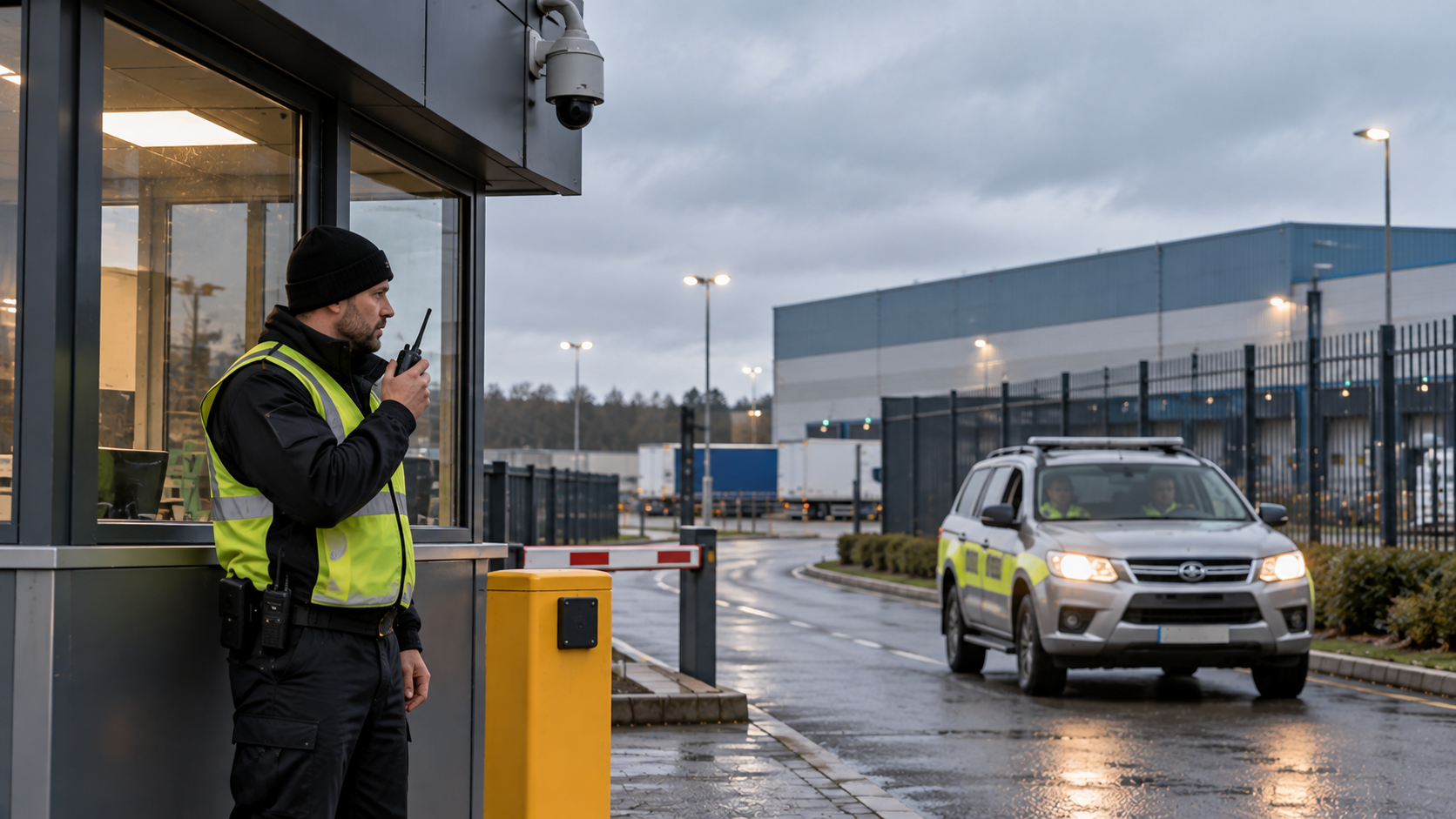
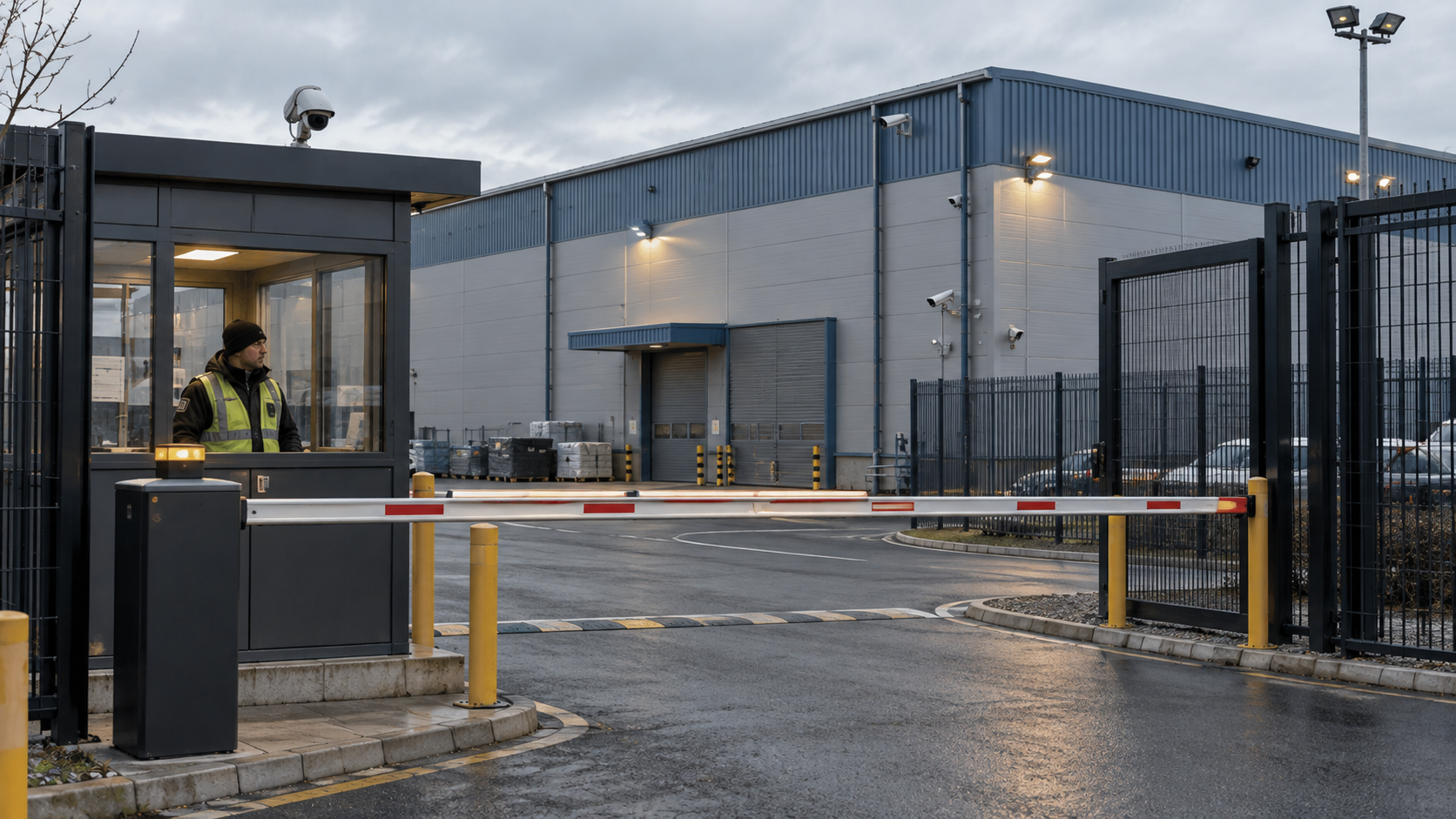
Construction sites are soft targets after hours. Plant machinery sits silent. Copper cable coils in locked but vulnerable containers. Perimeter fencing slows intruders but rarely stops them. The construction theft crisis is now well-documented: 92% of UK site managers report theft at their sites, costing the industry an estimated £800 million annually.
CCTV captures the aftermath. Alarms sound after the breach. What actually stops a thief before they strike? Increasingly, the answer is a security dog handler and their K9 partner, the most effective active deterrent a site can deploy.
This blog explains why trained security dogs outperform passive measures, how security dog handler teams are accredited, and why more construction managers in the West Midlands are adding K9 units to their security mix.
What Makes a Security Dog Handler Different?
A security dog handler is not a guard with a pet. It is a highly trained professional operating under an SIA licence (Security Industry Authority) and certified by the National Association of Security Dog Users (NASDU). This ensures both the handler and the dog meet rigorous standards for safety, welfare and operational effectiveness.
General-purpose security dogs are trained to perform under pressure. As per the Guard Dogs Act, 1975, a dog handler’s qualification is typically a NASDU Level 2 Award for a General Purpose Security Dog Handler, which combines obedience, non‑lethal apprehension methods and situational awareness. The result is a security unit that works seamlessly as one, capable of patrolling large perimeters, detecting intruders in darkness, and responding to alarms without human hesitation.
Unlike a human guard who can be distracted, fatigued, or simply in the wrong place at the wrong time, a K9 team offers 24/7 alertness, which is especially valuable during night shifts, when most construction theft occurs.
Detection: The Unfair Advantage
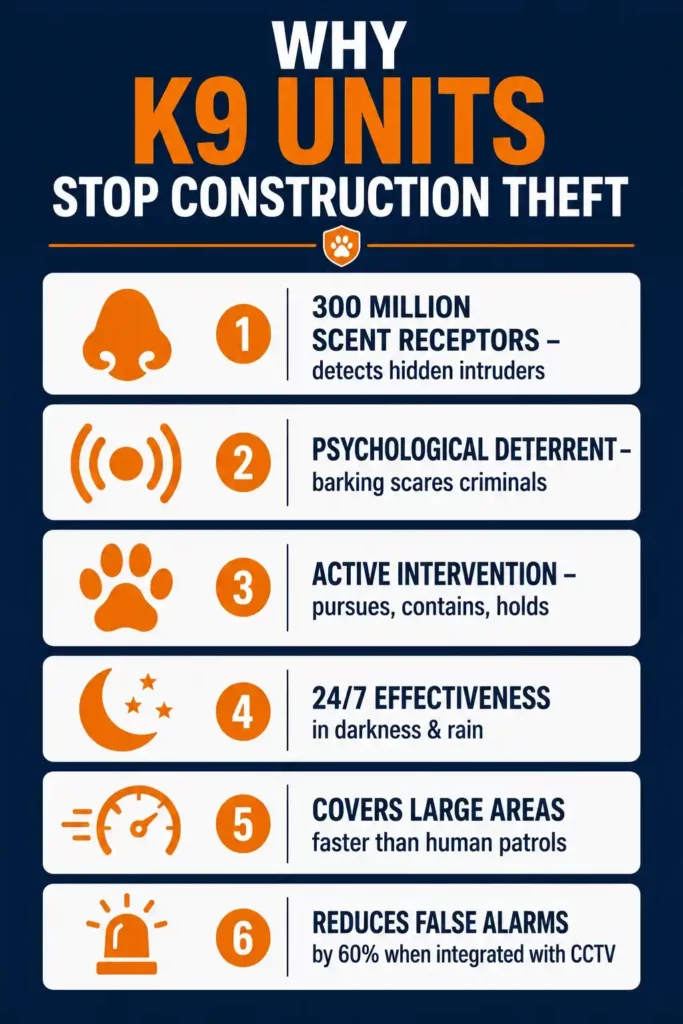
Dogs experience the world through scent. A General Purpose Security Dog has up to 300 million scent receptors, roughly 60 times as many as a human. This enables them to detect movement, sound, and potential threats far earlier than humans or conventional CCTV.
On a typical construction site, an intruder can hide behind stacked materials, inside a container, or under a parked digger. To a camera, they are invisible. To a K9 unit, they are impossible to miss.
Practical impact: On open sites, security dogs perform exceptionally well in low light or poor weather conditions that plague UK construction projects and severely hamper both human guards and standard cameras. The dog’s superior senses give security teams a critical early‑warning advantage that no camera can match.
The Psychological Deterrent: Why Criminals Avoid K9 Security Dogs?
Security professionals know something that criminals have learned the hard way: a barking dog is the single best psychological deterrent.
Trespassers are less likely to enter a location being protected by a professionally trained security dog. Even experienced thieves tend to avoid sites with visible K9 warning signs or patrol vehicles.
The reason is simple. Risk versus reward. A site with CCTV might still offer a window of opportunity. A site with a security dog and handler presents immediate, unpredictable danger. The dog can hear, smell and chase faster than a human can react. Criminals bypass these sites to target easier victims.
For construction site managers, this translates into fewer attempts, less vandalism and reduced theft. The national picture of rising construction site theft in the UK confirms that sites with proactive K9 units report far fewer incidents than those relying solely on cameras.
Active Patrolling: Not Passive Monitoring
Static CCTV watches. A security dog unit acts. K9 units are deployed to patrol perimeters, monitor access points, and reduce costly delays caused by damage or loss. Unlike a fixed camera that can only observe, a K9 team can:
-
- Pursue: Immediately chase an intruder who breaks cover.
-
- Contain: Hold a suspect at bay until police arrive.
-
- Deter: Make the presence known through audible and visible presence.
This is the fundamental difference between passive and active security. Cameras record what happened. K9 units stop it from happening at all.
For site managers in the West Midlands, specific Birmingham construction security strategies increasingly incorporate K9 units as a core layer, particularly for high‑risk developments such as Smithfield and the HS2 Curzon Street site.
Integration with Broader Security Measures
K9 security is not a standalone solution. It works best when integrated with other layers.
On large projects such as the Smithfield regeneration in Birmingham or HS2 sites, security managers combine K9 units with:
-
- AI‑enhanced CCTV towers for wide‑area surveillance
-
- Access control systems at entrances
-
- Mobile patrol vehicles for rapid response
-
- Static guards at high‑value storage zones
How it works in practice: The CCTV detects movement after hours. The system triggers an alert to the K9 handler’s radio. The handler and dog investigate immediately, often before the intruder has breached the inner perimeter.
This multi‑layer approach has become the new standard for construction site security across the UK. When combined with regular mobile patrols, K9 units provide unpredictable, wide‑area coverage that criminals cannot easily map or avoid.
Cost‑Effectiveness: One Team, Wide Coverage
One K9 team can patrol a significantly larger area than a single static guard. This makes K9 security units cost‑effective for large or multi‑zone sites.
A single handler and dog can cover the entire perimeter of a medium‑sized construction site in a fraction of the time it would take a guard on foot. For larger sites, rotating patrols maintain round‑the‑clock protection without doubling labour costs.
When you factor in the reduction in theft and vandalism, the return on investment becomes compelling. Preventing one major plant theft (average loss £45,000) pays for many months of K9 cover. West Midlands Police have publicly identified construction theft as a priority, and many security company in Birmingham now offer NASDU‑accredited K9 units as a standard recommendation for high‑risk developments.
Why Accreditations Matter: NASDU and SIA
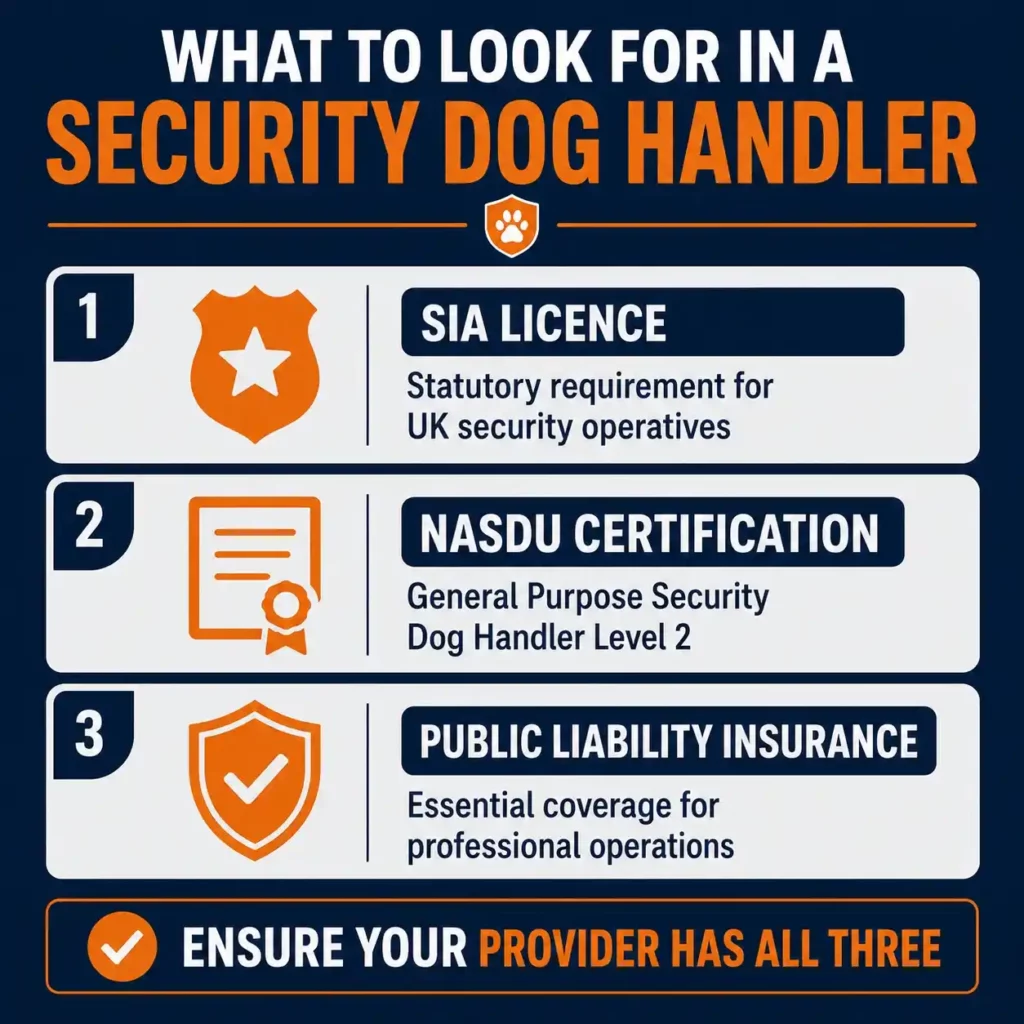
Not all dog handlers are equal. Professional buyers should insist on:
-
- SIA licence: The handler must hold a valid SIA licence, proving they have met the UK’s statutory requirements for private security operatives.
-
- NASDU certification: The dog and handler must be certified by the National Association of Security Dog Users, confirming they have passed rigorous training and welfare checks.
-
- Public liability insurance: Essential coverage for any professional security operation.
Many providers also hold additional accreditations such as CHAS, Constructionline and Safe Contractor, further demonstrating quality management and safety compliance.
For construction managers, these accreditations provide peace of mind that the K9 unit deployed to their site is legal, safe and effective.
When to Deploy K9 Security on Construction Sites
The best time to deploy a K9 unit is before a problem occurs. However, there are clear indicators that a site would benefit:
-
- Repeated trespass or vandalism: Intruders keep coming back.
-
- High‑value plant and tools on site: Mini excavators, telehandlers, copper cable.
-
- Large, open or low‑visibility perimeters: Difficult for human guards to cover efficiently.
-
- Night‑time vulnerability: The site is empty after hours, with no staff presence.
-
- Previous theft incidents: Once targeted, criminals often return.
K9 security units are particularly effective for large industrial estates, remote construction zones, and sites with multiple entry points.
Case in Point: Birmingham Construction Sites
The West Midlands has seen a surge in construction theft. Digbeth’s crime rate stands at 1,921.5 per 1,000 residents, and organised gangs have targeted sites across the city. Real incidents of cable theft near the city’s main police station, fuel theft from parked diggers, and overnight plant seizures all share a common pattern: the intruder was detected after the fact, not during the act. K9 patrols break this pattern by providing an unpredictable, highly responsive presence.
Don’t Wait for the Next Theft
Construction theft has industrialised. Organised gangs use drones, cloned credentials and insider intelligence to target UK sites. Passive measures, such as fences, cameras, and alarms, are no longer enough.
A trained security dog handler with their K9 partner offers the most effective active deterrent available today. Superior detection, psychological impact, wide‑area patrol capability and proven cost‑effectiveness make K9 units the ultimate defence for high‑risk construction sites.
Invest in K9 security before the next break‑in forces your hand.
Frequently Asked Questions
1. What qualifications should a security dog handler have?
A valid SIA licence and NASDU certification (typically Level 2 Award for General Purpose Security Dog Handler). These prove the handler and dog have met rigorous standards.
2. Are security dogs safe for my site and staff?
Yes, trained General Purpose Security Dogs use non‑lethal apprehension methods under handler control. Their presence deters rather than attacks.
3. How does K9 security compare to CCTV?
CCTV is reactive (records after the event). K9 units are proactive (deter and intercept). The most effective strategy uses both.
4. Is K9 security expensive?
One K9 team can cover a larger area than multiple static guards, offering cost‑effective coverage for large or open sites while reducing theft losses.
5. Can K9 units work alongside my existing guards?
Absolutely, K9 handlers coordinate with static guards, mobile patrols and remote monitoring centres, creating a unified security team.