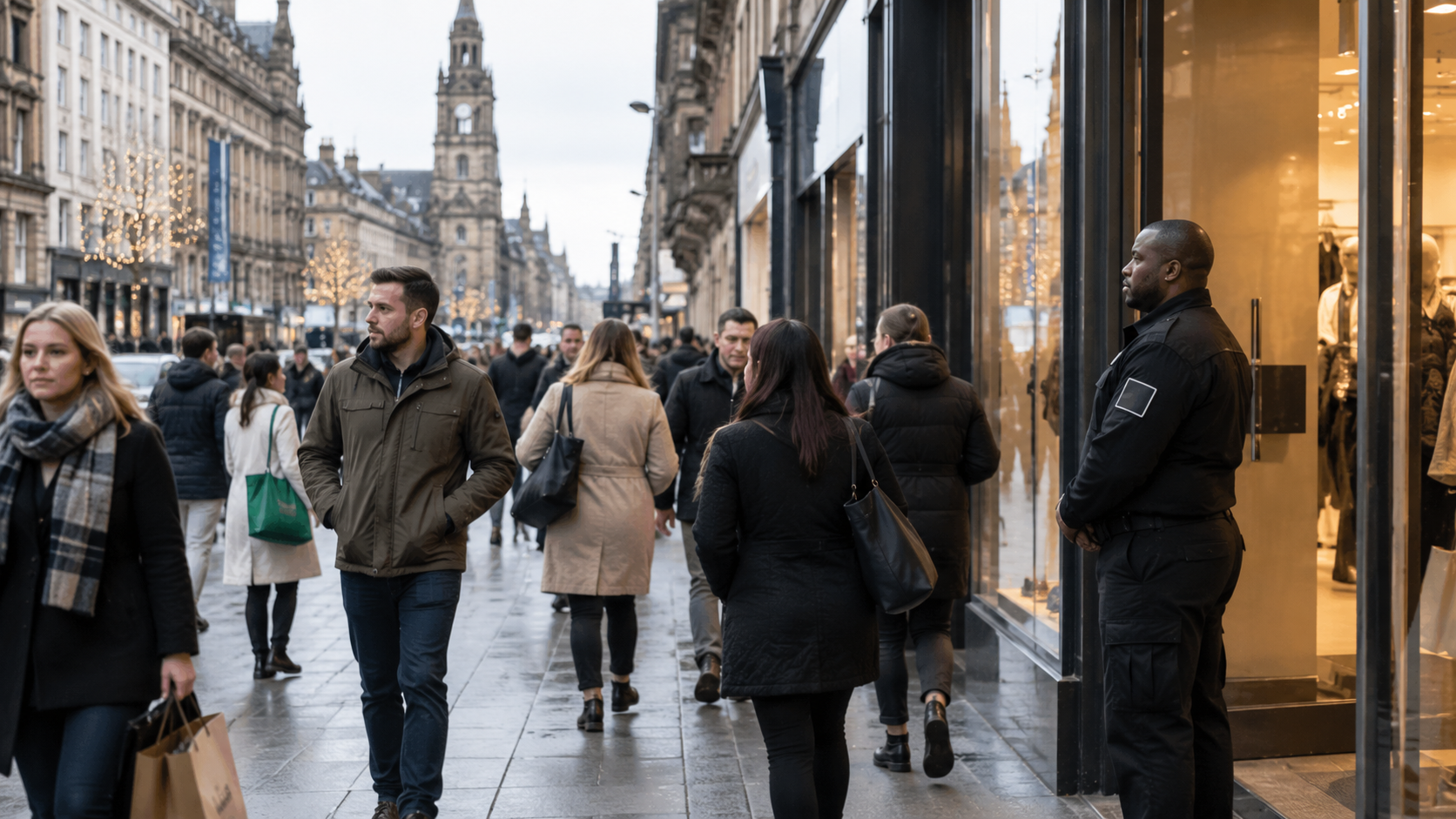
A suspected shoplifting incident can change character very quickly. One minute, a member of staff notices someone behaving unusually around a display. The next, that person has been approached, voices are rising, and customers nearby have stopped shopping to watch what happens.
At that point, recovering merchandise is no longer the only concern.
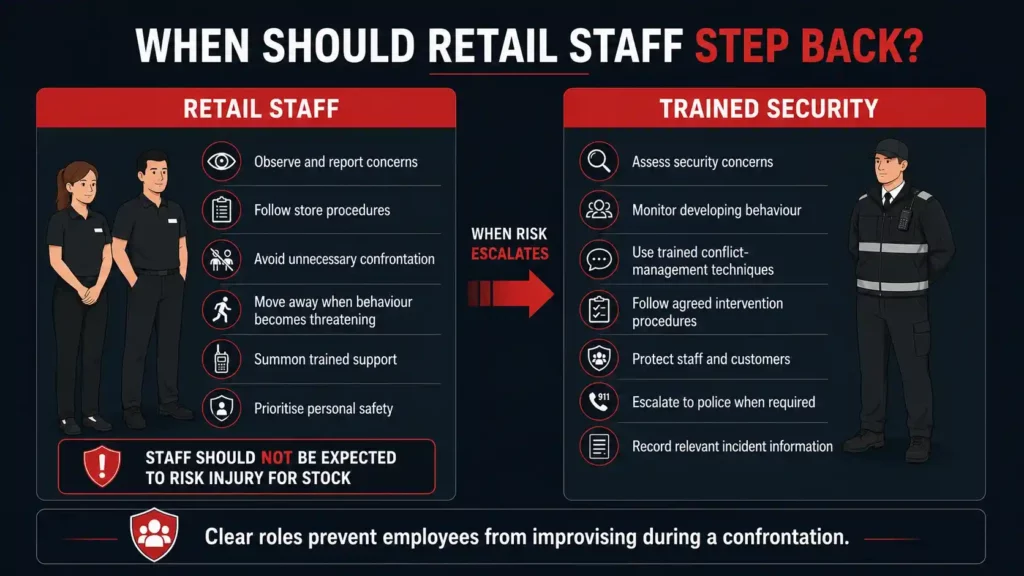
A good aggressive shoplifter response procedure should make one thing clear from the outset: ordinary retail employees shouldn’t be left improvising their way through a threatening confrontation. They need to know what to observe, when to disengage, how to summon help and where their responsibility ends.
For our security guards, the thinking is similar, but their role is different. They’re there specifically to assess security incidents, follow agreed site procedures, manage conflict within their training and escalate to police when required. That distinction matters.
Table of Contents
Retail Shoplifting Warning Signs Our Guards Look for Before Acting
Good intervention starts before anybody says a word. Security personnel may notice behaviour that warrants closer observation. Depending on the circumstances, retail shoplifting warning signs could include:
- repeated movement between particular displays;
- apparent concealment of merchandise;
- unusual attention to staff movements or positions;
- attempts to avoid normal payment routes;
- repeated movement towards exits.
But a warning sign is not proof of theft. That’s an important distinction.
Someone behaving nervously may simply be nervous. A customer repeatedly walking through an aisle may have forgotten what they came in for. Clothing, age, appearance or background should never become substitutes for evidence.
For a guard, the first task is therefore observation rather than accusation. Before deciding how to respond, useful questions include:
- What was actually seen?
- Is relevant CCTV available?
- Has merchandise genuinely been concealed or removed?
- Can another member of the team confirm what happened?
Taking those few moments seriously can prevent a poorly judged approach from creating a confrontation that never needed to happen.
It also explains why recognising retail shoplifting warning signs should form part of a wider incident procedure rather than becoming a licence to challenge anyone who “looks suspicious”.
De-Escalating Retail Conflict: Why Confrontation Isn’t the Goal
There’s a misconception about security work that the fastest intervention must be the strongest one. In retail, that can be exactly the wrong approach.
When de-escalating retail conflict, our SIA-lisensed guards assess what’s happening before deciding how to respond. That assessment may involve several immediate considerations:
- Has the person become verbally aggressive?
- Are other customers getting involved?
- Is there any indication of a weapon?
- Is the person trying to leave?
- Are they actively moving towards an employee?
- Would continuing the interaction make the situation worse?
Distance matters. Tone matters. So does knowing when to stop.
Liverpool offers a timely example of how seriously this approach is now being taken. In March 2026, Merseyside Police became the first UK police force to partner with the Retail Trust on a programme providing Liverpool city-centre shop workers with specialist de-escalation training and additional wellbeing support. The initiative is intended to help workers safely manage, defuse and recover from confrontational situations.
That’s closely aligned with how de-escalating retail conflict should be approached at store level. The aim isn’t to win an argument over merchandise. It’s to stop a stock-loss incident becoming an avoidable injury.
Retail Staff Citizen Arrest Limits: What Should Employees Actually Do?
This is where retailers need especially clear policies.
In England and Wales, section 24A of the Police and Criminal Evidence Act 1984 provides circumstances in which a person other than a constable may make an arrest for an indictable offence. But the existence of that legal power does not mean attempting an arrest is automatically sensible, safe or expected of a retail employee.
There are legal conditions around when the power applies, alongside separate legal considerations concerning any use of force.
More importantly from a workplace perspective, an employee facing an aggressive suspected offender has to make decisions in seconds, often without knowing whether the person is carrying a weapon or whether other offenders are nearby.
So discussions about retail staff citizen arrest limits shouldn’t begin with:
“What are we legally allowed to do?”
A better first question is:
“What are we expecting an ordinary shop worker to risk?”
For most retailers, the practical priorities should be much clearer:
- Protect personal safety rather than merchandise.
- Follow the company’s agreed incident procedure.
- Avoid unnecessary physical intervention.
- Disengage if the situation becomes unsafe.
- Seek security or police assistance when circumstances require it.
The same caution applies to security officers. An SIA licence does not turn a security guard into a police officer or confer general police powers. Guards operate within the law, their training, employer instructions and agreed assignment procedures.
Shoplifting Laws UK: What Changed in 2026?
The legal backdrop has changed considerably this year.
The Crime and Policing Act 2026, which received Royal Assent on 29 April, created a standalone offence of assaulting a retail worker. The Government says the offence carries a maximum penalty of six months’ imprisonment and/or an unlimited fine, with a presumption that a Criminal Behaviour Order is imposed on first conviction.
The Act also repealed section 22A of the Magistrates’ Courts Act 1980, which had created a particular procedural treatment for shop theft involving goods valued at £200 or less.
One distinction is worth making here: theft below £200 was never legal or exempt from police action. The Government says the repeal is intended to make clear that shop theft of any amount is illegal and should be treated seriously.
So, in practical terms, the changes to shoplifting laws UK strengthen the wider response around:
- offences against retail workers;
- repeat offending;
- Criminal Behaviour Orders;
- lower-value shop theft.
But legislation deals with what happens through policing and the justice system.
Store managers still need to answer a more immediate question: what happens during the minutes when an incident is unfolding on their shop floor?
That’s where a clear response procedure earns its keep.
How Our Guards Respond When Shoplifting Turns Aggressive
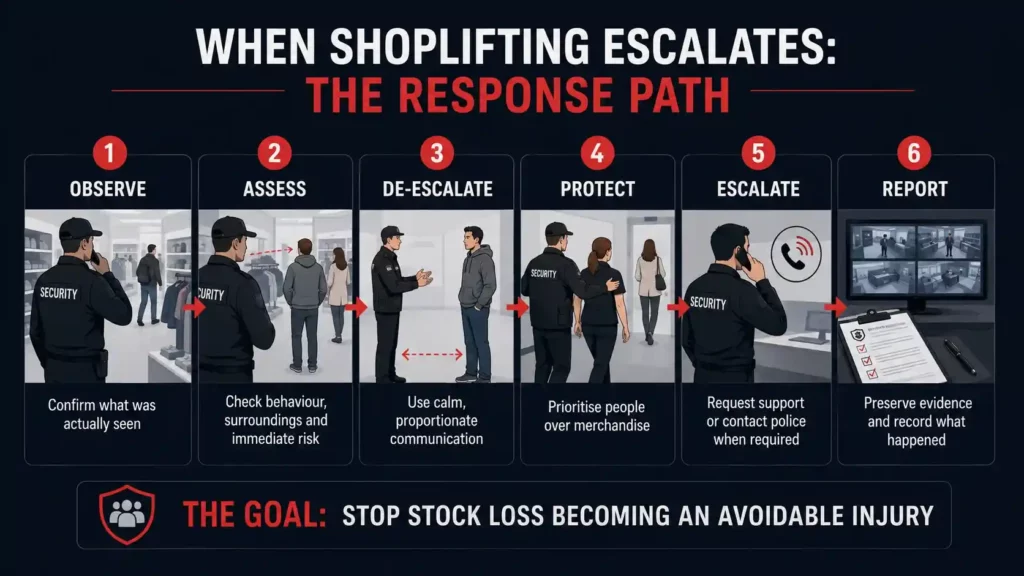
No two incidents unfold identically, so a rigid script isn’t particularly useful. There is, however, a decision-making process.
1. Observe what has actually happened
A guard first needs to establish what has been seen rather than acting on an assumption. That distinction matters. Acting too early can turn uncertainty into confrontation.
2. Assess the situation around the individual
Attention then moves beyond the suspected theft itself. Who else is nearby? How is the individual behaving? Are employees becoming involved? Is there an immediate threat? What do the store’s agreed procedures require?
3. Communicate without unnecessarily escalating
Where communication is appropriate, it should remain controlled. Provocative language helps nobody. Neither does turning a disagreement over merchandise into a contest over who backs down first.
4. Change priorities if behaviour escalates
Once threats or violence enter the situation, the priority changes. Depending on the circumstances, that could mean:
- requesting additional support;
- moving employees or customers away from immediate danger;
- disengaging from an unsafe interaction;
- following the site’s emergency procedure;
- contacting police or emergency services.
This isn’t theoretical. Merseyside Police reported a March 2026 case involving charges relating to 26 shop thefts across Liverpool and Litherland. In the incident that led to the arrest, police had been called following a reported attempted theft and physical altercation with security staff.
Incidents like this are why our approach to retail security isn’t based on encouraging confrontation.
A professional security presence gives the store somebody whose defined job includes observing security concerns and responding according to training and site procedures. It also means a sales assistant or supervisor doesn’t automatically become the person expected to manage an escalating situation.
That’s an important division of responsibility.
Reporting Retail Crime: What Happens After the Person Leaves?
Once the immediate danger has passed, there is a temptation to get the shop floor back to normal and move on. That can mean useful information disappears.
Effective reporting of retail crime starts with capturing the facts while they are still clear.
Depending on the incident, the record may need to cover:
- when and where it happened;
- what staff personally observed;
- what merchandise was involved;
- descriptions based on observation rather than assumption;
- who witnessed the incident;
- what action staff or security took;
- whether police were contacted;
- any relevant crime or incident reference number.
Relevant CCTV should be preserved according to the retailer’s procedures and applicable data-protection requirements. Where body-worn video is lawfully used, that footage may also become relevant.
There is another small but important discipline here: separate what somebody personally witnessed from what they were later told.
Good records matter particularly with repeat offending. They can help management identify recurring patterns and provide useful evidence when incidents are reported to police.
The Government’s current approach to retail crime also places emphasis on police attendance in circumstances including violence against shop staff, detained offenders and situations where evidence can only be secured by police personnel.
In other words, reporting retail crime isn’t admin added after the “real” incident. It’s part of the response.
Retail Staff Wellbeing Doesn’t End When the Incident Does
The offender had left, nobody needed hospital treatment, and the store stayed open. It’s tempting to call that a good outcome. The employee who was threatened may see it differently.
HSE guidance tells employers to assess and manage work-related violence and aggression, learn from incidents and support workers who may be physically or mentally affected afterwards.
That last part deserves attention.
Two colleagues can experience exactly the same confrontation and react very differently. One might be ready to return to the till ten minutes later. Another may feel shaken for days, particularly if the threats were personal or the offender regularly visits the store.
Supporting retail staff wellbeing after an incident could include:
- giving the employee time away from the immediate environment;
- checking on them again later rather than only immediately afterwards;
- explaining what follow-up action has been taken;
- recording any ongoing concerns;
- reviewing whether the response procedure worked;
- considering whether further workplace support is appropriate.
Don’t wait for physical injury before taking an incident seriously.
Build an Aggressive Shoplifter Response Procedure Before You Need It
The worst time to decide everyone’s responsibilities is halfway through an argument on the shop floor.
A practical aggressive shoplifter response procedure should establish the progression beforehand:
| Situation | Response |
| Suspicious behaviour | Observe before making assumptions |
| Reasonable concern | Follow the store’s agreed procedure |
| Conflict begins | Communicate and de-escalate where safe |
| Threat increases | Retail employees disengage and seek trained support |
| Immediate danger/serious offence | Escalate to police or emergency services |
| Incident ends | Preserve relevant evidence and report |
| Afterwards | Support affected employees and review the response |
The precise response will vary according to the store, circumstances and risk assessment. What shouldn’t vary is the underlying priority.
Stock can be replaced. A confrontation that leaves an employee frightened, threatened or injured is considerably harder to undo.
Protect the Team, Not Just the Stock
Retail theft is a commercial problem. The moment aggression enters the picture, it becomes a people problem too.
The Crime and Policing Act 2026 strengthens legal protection for retail workers, while initiatives such as the Merseyside Police and Retail Trust partnership show how policing, retailers and a security company in Liverpool can work together on prevention, de-escalation and recovery.
Individual retailers form another part of that picture.
Employees need clear boundaries. Managers need procedures that work under pressure. Trained security personnel can provide a dedicated response when an incident moves beyond ordinary customer service, while police remain central whenever circumstances require law-enforcement intervention.
That’s ultimately what a good procedure should achieve:
Nobody on the shop floor should have to invent the response while the situation is already escalating.
Frequently Asked Questions
1. What should retail staff do if a suspected shoplifter becomes aggressive?
Staff should prioritise personal safety, avoid unnecessary confrontation, follow store escalation procedures, seek trained support, and contact police when there is immediate danger.
2. Should retail staff physically stop a shoplifter?
Retail employees should follow company procedures and avoid unsafe physical intervention. Protecting staff and customers should take priority over recovering stolen merchandise.
3. How do security guards de-escalate retail conflict?
Trained guards assess behaviour, maintain safe distance, communicate calmly, avoid unnecessary provocation, request support when needed, and prioritise preventing violence or injury.
4. What information should be recorded when reporting retail crime?
Record the time, location, observed behaviour, merchandise involved, witnesses, actions taken and relevant CCTV, while distinguishing direct observations from second-hand information.
5. How should employers support retail staff after an aggressive incident?
Employers should check employee wellbeing, document the incident, provide appropriate support, review what happened, and update risk assessments or response procedures where necessary.