Neither is automatically the better option. A busy entrance may need someone there throughout the shift. A large warehouse yard may need regular physical checks across several areas. A business with both requirements may need a combination of the two.
What Is the Difference Between a Static Guard and a Mobile Patrol?
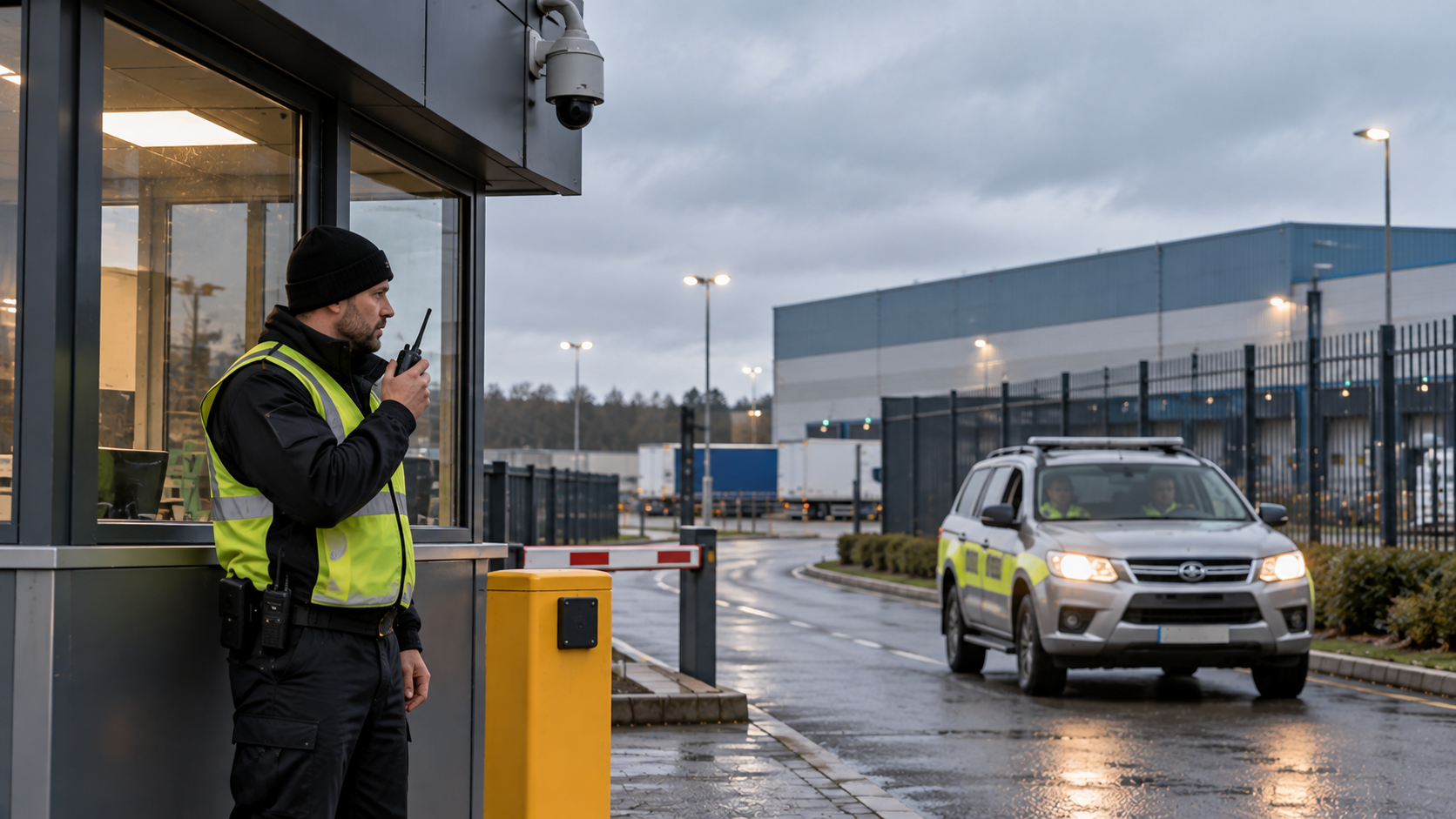
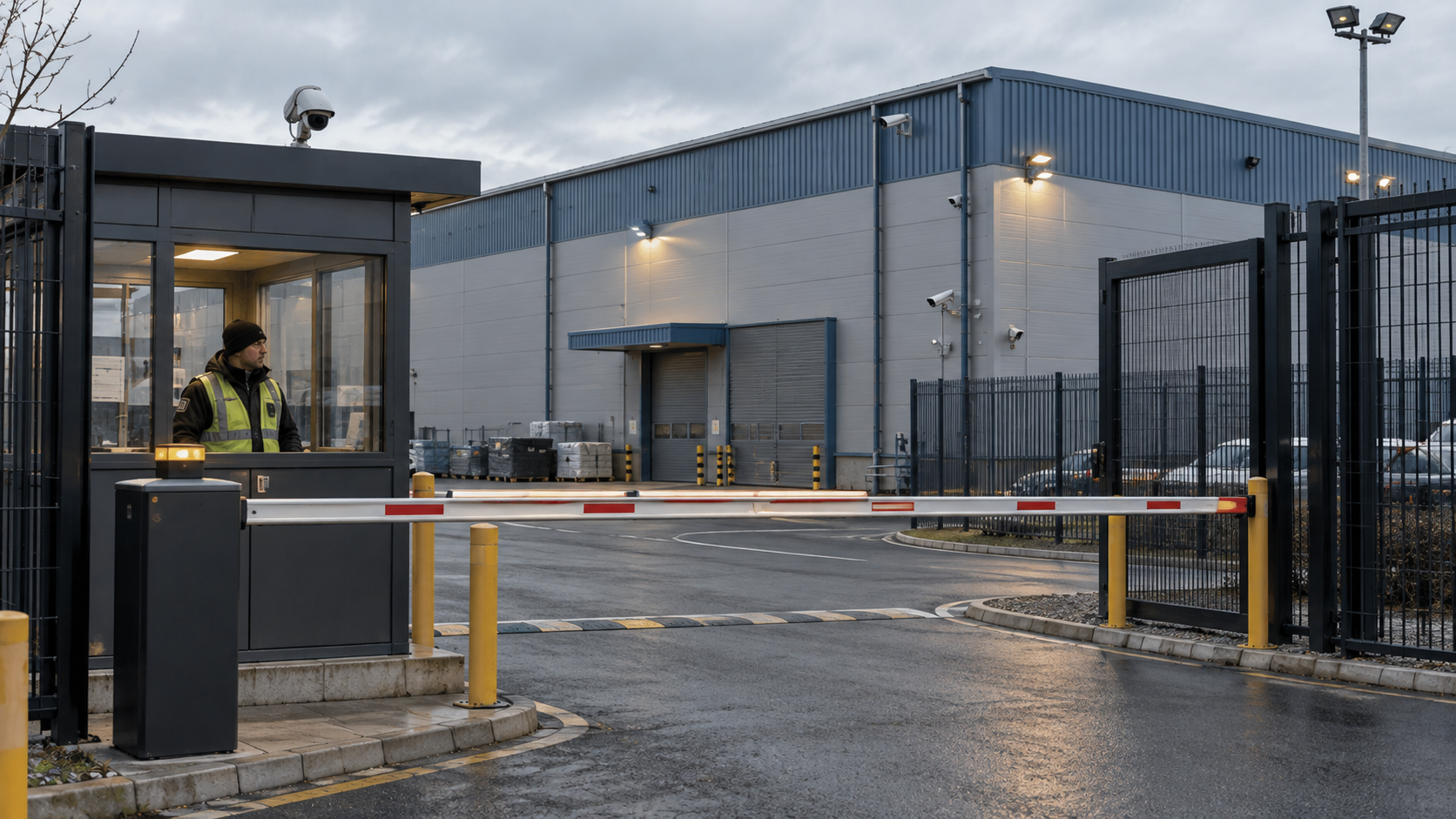
A static guard remains at a designated post for an agreed period, while a mobile patrol officer moves around a site or between locations to carry out scheduled or responsive security checks.
That basic difference has a surprisingly big impact on how each service works.
A static guard might be positioned at:
- A main entrance
- A gatehouse
- A reception area
- A construction-site access point
- A warehouse entrance
- A retail entrance
- A restricted facility
Their value comes from being there continuously.
Mobile patrols work differently. The officer moves around the property, checking designated areas and looking for signs of intrusion, damage, unsecured access or other issues.
They are particularly useful where a site is too large for one fixed position to provide meaningful coverage across the whole property.
Static guarding as a dedicated fixed-location service, while its mobile patrol service provides scheduled or random patrols, access checks, incident response and visible deterrence across larger areas.
When Does a Business Need a Static Security Guard?
A business is more likely to need a static guard when security depends on continuous supervision of a particular entrance, access point, reception area or operational location.
Consider a warehouse with a busy vehicle entrance. Drivers arrive throughout the day. Contractors turn up. Visitors need directing. Employees come and go. Deliveries need checking.
A mobile patrol could visit the entrance periodically, but it cannot provide the same continuous presence. But a static guard can.
Typical situations where fixed guarding may make sense include:
- Managing a busy entrance
- Controlling pedestrian or vehicle access
- Checking visitors and contractors
- Managing a gatehouse
- Supporting reception security
- Monitoring a particular high-risk area
- Providing a visible deterrent
- Responding immediately when an incident develops at the post
There is also a human advantage. People behave differently when they know someone is actively present.
An unfamiliar visitor may think twice before trying to enter through the wrong door. A driver can be challenged immediately rather than after the event. A developing disagreement can be noticed before it becomes a larger incident.
That is the practical value of having someone on the spot.
When Are Mobile Patrols More Suitable?
Mobile patrols are generally more suitable when the security requirement is spread across a larger site rather than concentrated at one location.
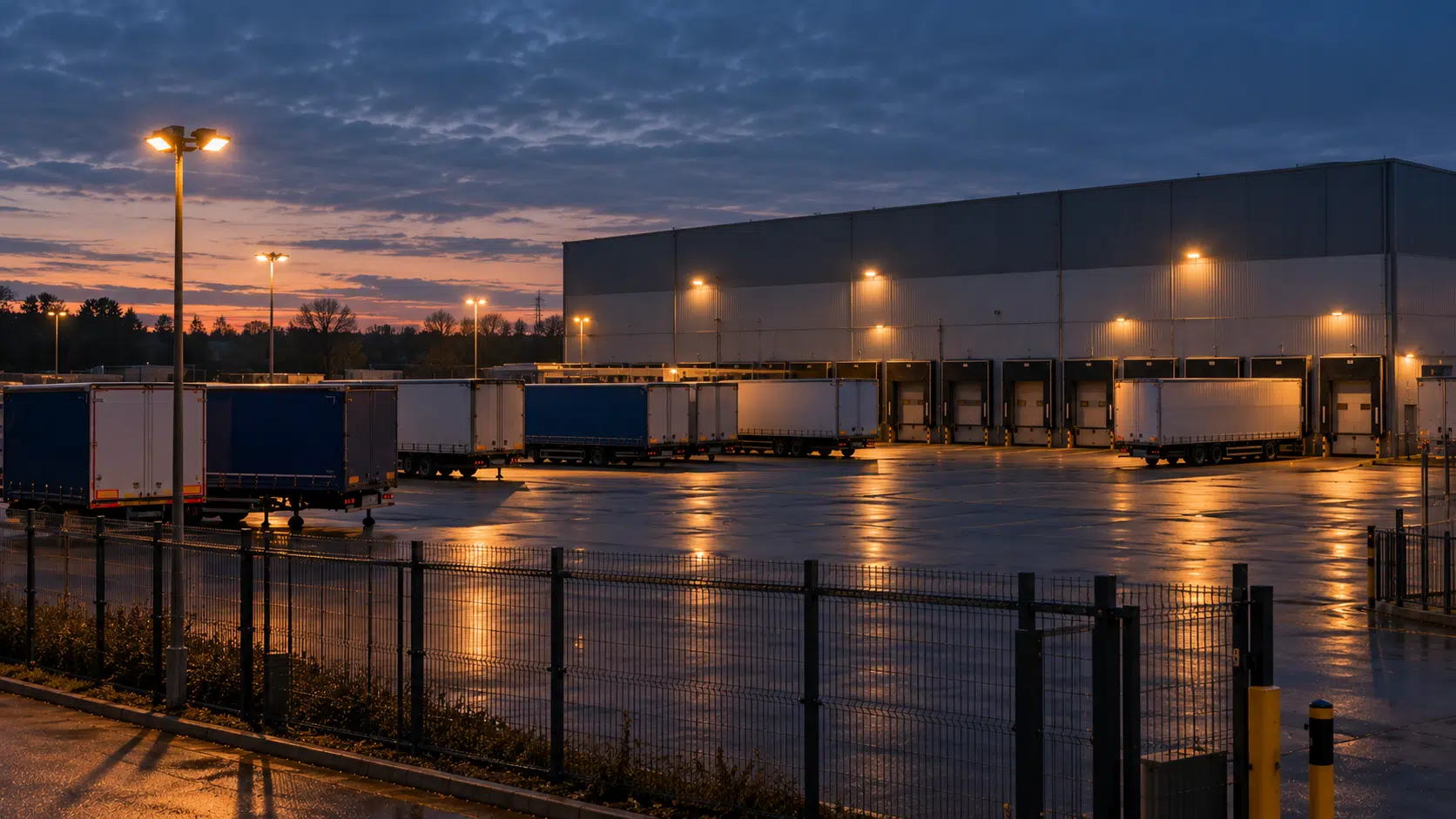
A warehouse is a good example. The main entrance might be secure, but what about the rear yard? The perimeter fence? The parked trailers? The storage area behind another building?
One fixed guard cannot physically be in all those places. A mobile patrol allows security personnel to move through different parts of the premises, carrying out physical checks and identifying issues that might otherwise go unnoticed.
Mobile patrols can be particularly useful for:
- Large warehouses
- Industrial estates
- Business parks
- Construction sites
- Vacant commercial properties
- Large external yards
- Sites with multiple buildings
- Out-of-hours security checks
They can also provide a useful presence when the business does not need somebody permanently stationed at the property. The important consideration is coverage rather than headcount.
A business may not need a guard sitting at the entrance all night if the main risk is spread across a large perimeter. In that case, physical patrols may provide more useful coverage.
Is a Static Guard Better Than a Mobile Patrol?
A static guard is not inherently better than a mobile patrol, and a mobile patrol is not inherently better than a static guard; each solves a different physical security problem.
The simplest way to decide is to look at where the risk sits.
Site requirement | More suitable approach |
Continuous entrance supervision | Static guard |
Gatehouse and visitor management | Static guard |
Busy pedestrian access point | Static guard |
Large external yard | Mobile patrol |
Multiple buildings | Mobile patrol |
Perimeter checks | Mobile patrol |
Vacant property | Mobile patrol |
Continuous monitoring of one critical area | Static guard |
Several vulnerable areas across a site | Mobile patrol |
Fixed entrance plus large external site | Combination |
This is why the phrase “static guard versus mobile patrol” can be slightly misleading. In practice, some businesses do not have to choose one or the other. They use each where it makes the most sense.
Can a Business Use Static Guards and Mobile Patrols Together?
Yes, combining static guarding and mobile patrols can provide broader coverage when a site has both a critical fixed point and wider areas that need physical checks.
Imagine a large distribution warehouse.
A static officer works from the main gatehouse, managing vehicle access and visitors. Beyond the gate, the property has a large yard, several loading areas and a perimeter that cannot be continuously observed from the entrance. A mobile patrol can cover those areas.
The two roles complement each other:
Static guard: Controls the point where people and vehicles enter.
Mobile patrol: Checks the areas beyond that point.
That arrangement can also make sense on construction sites, industrial estates and larger commercial properties where access control and perimeter coverage present different challenges.
The mistake would be to assume that adding both services automatically makes a site secure. They still need clearly defined responsibilities, communication and reporting procedures.
How Should Businesses Decide Between Fixed and Mobile Security?
Businesses should compare the location of the risk, the size of the site, operating hours, access requirements and the type of incident they need security personnel to deal with.
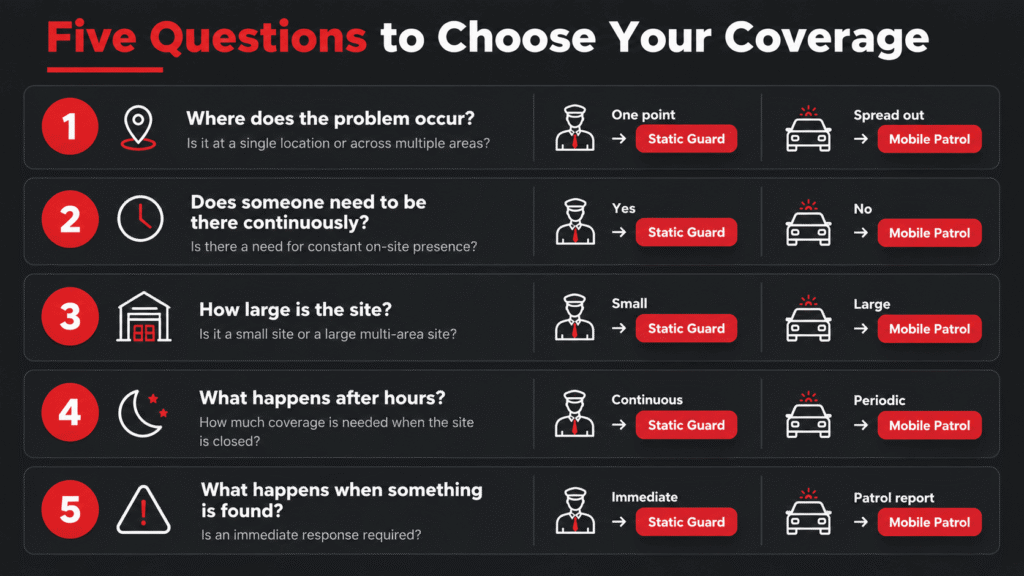
A practical review can start with five questions.
Where does the security problem actually occur?
If most incidents or vulnerabilities centre around one entrance, fixed guarding may make sense. If the problem is spread across a yard or perimeter, mobile coverage may be more appropriate.
Does somebody need to be present continuously?
If visitors, employees or vehicles need to be checked throughout the day, intermittent patrols are unlikely to provide the same level of control as a fixed post.
How large is the site?
The larger and more spread out the premises, the more difficult it becomes for one fixed position to provide meaningful physical coverage.
What happens after normal working hours?
A site can have excellent daytime access control and still be exposed overnight. This is where patrols, CCTV, alarms and keyholding arrangements may become particularly relevant.
What happens when something is found?
Finding a damaged gate is only useful if somebody knows what to do next. The patrol report, escalation procedure and response arrangement need to be clear.
What Should a Mobile Patrol Actually Check?
A mobile patrol should focus on the areas and conditions identified as vulnerable rather than simply driving around the site without a defined purpose.
Depending on the premises, checks might include:
- Perimeter fencing and gates
- Building entrances
- Loading bays
- Windows and doors
- External storage areas
- Vehicle and trailer parking
- Signs of damage or intrusion
- Unauthorised people or vehicles
- Lighting and visible hazards
- Areas identified as vulnerable during previous incidents
The exact checks should reflect the property.
A warehouse with a large yard needs a different patrol routine from a small office building.
A vacant commercial property needs a different approach again because there may be no employees present to notice a problem during the day. Good patrol work is therefore not about how many times a vehicle passes the building. It is about whether the patrol is checking the places where something could actually go wrong.
When Should a Business Consider Static Guarding?
Static guarding becomes particularly useful when a business needs continuous human supervision at a location where access, people or activity require active management.
Region Security Guarding’s static guarding service covers fixed-post security for locations including commercial premises, construction sites, warehouses and retail environments. The service can include access control, reception or front-of-house security and fixed security positions.
For a business considering fixed guarding, useful questions include:
- Do visitors need to be checked?
- Are vehicle movements frequent?
- Is there a single critical entrance?
- Is the site dealing with valuable stock or equipment?
- Are incidents likely to require an immediate on-site response?
- Would a visible security presence change behaviour?
If the answer to several of these is yes, a fixed security presence may be worth considering.
When Should a Business Consider Mobile Patrols?
Mobile patrols are worth considering when security needs to extend beyond a single access point, particularly across large, vacant, remote or externally exposed premises.
They can provide scheduled or random physical checks without requiring a permanent guard to remain on site.
That can make them suitable for businesses that need additional out-of-hours protection but do not require continuous fixed-point guarding.
They can also complement existing security.
For example, a business may already have CCTV and access control but want someone physically checking the perimeter. A patrol can provide that additional layer.
Region Security Guarding’s mobile patrol service includes scheduled and random patrols, access checks, incident response and visible deterrence across larger areas.
What Is the Right Security Coverage for a Business?
The right physical security coverage depends on what needs protecting, where the vulnerabilities are and when the site is most exposed; there is no universal choice between static guarding and mobile patrols.
A useful starting point is to map the site.
- Mark the entrances.
- Mark the vulnerable external areas.
- Mark where valuable assets are kept.
- Then look at what happens at different times of the day.
You may find that the main entrance needs continuous supervision while the wider site needs periodic checks. Or you may find that there is no reason for a permanent fixed post, but several areas need regular out-of-hours patrols.
Sometimes the answer is both.
The important thing is that the deployment follows the risk, rather than forcing the risk to fit a particular security service.
For businesses reviewing their options, Region Security Guarding provides both static guarding and mobile patrols, allowing coverage to be structured around the layout and operating requirements of the premises.