That matters because businesses rarely lose control of a premises because one camera was missing. More often, it is a combination of small weaknesses: an unsecured side gate, poor visibility around a yard, an unmanaged visitor, a faulty access point or no clear plan for what happens when an alarm activates after hours.
The better question, then, is not simply “What security do we have?” It is “How well do the different layers work together?”
Why Do Businesses Need More Than One Physical Security Measure?
Businesses need more than one physical security measure because no single control is designed to deal with every stage of a security incident. A layered arrangement gives the site more than one opportunity to deter, detect, delay and respond if someone gets past an initial barrier.
This is the principle known as defence-in-depth. ProtectUK recommends a multi-layered approach because, if one line of defence is compromised, the additional measures should make it harder for the threat to progress. The guidance also stresses that security should be proportionate to the risks facing the particular premises.
Think about a typical industrial site.
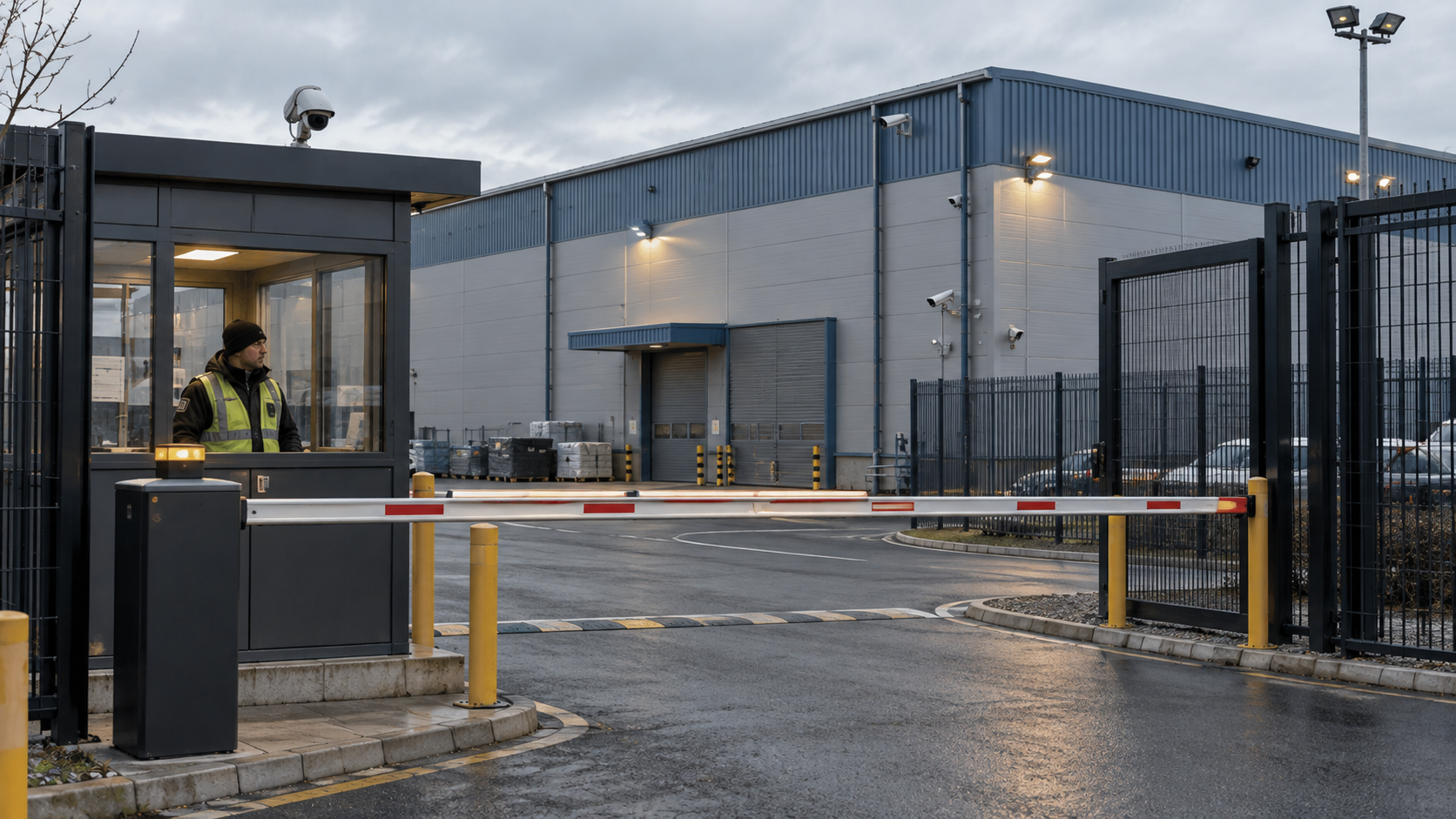
The main gate may be controlled during the day. CCTV may cover the yard. The perimeter may be fenced and the building protected by an alarm. Yet that site can still be exposed if a side gate is left open overnight and nobody is responsible for checking the area.
A layered approach closes that gap by giving each control a defined job:
- Perimeter protection establishes the boundary and creates an initial obstacle.
- Access control manages who and what comes through designated entry points.
- CCTV and detection systems help identify suspicious activity.
- Security personnel provide observation, challenge, access management and on-site response.
- Mobile patrols extend physical coverage across larger or less accessible areas.
- Alarms and keyholding arrangements support response when the site is unoccupied.
- Procedures and training make sure the controls are actually used as intended.
The important part is not how many measures are installed. It is whether a weakness in one layer immediately exposes the asset behind it.

What Are the Main Physical Security Measures for Business Premises?
The main physical security measures for business premises are perimeter protection, access control, surveillance, guarding, patrols, alarm response, security lighting and clear operating procedures. The right combination depends on the site’s layout, assets, people, access points and operating hours.
For a smaller office, that might mean controlled entry, CCTV and a clear out-of-hours alarm arrangement. A warehouse may need much more attention around vehicle access, loading bays, yards and visitor management. A factory might have several gates, contractors, production areas and restricted sections that all need different controls.
A useful starting point is to look at the site from the outside in:
Security area | What it should help you control |
Perimeter | Unauthorised approach and entry |
Gates and entrances | People and vehicle movement |
Reception or gatehouse | Visitor and delivery access |
Internal restricted areas | Who can reach sensitive locations |
CCTV and monitoring | Detection, verification and evidence |
Static guarding | Fixed-point supervision and intervention |
Mobile patrols | Checks across larger or distributed sites |
Alarms and keyholding | Out-of-hours detection and response |
Lighting | Visibility around vulnerable areas |
Procedures | How staff react when something changes |
That last point is easy to overlook.
Security is not just fences, cameras and locks. It is also what happens when a delivery arrives at the wrong gate, a contractor turns up without the expected paperwork, an access card stops working, or somebody notices a door that should have been locked standing open.
Those situations are where the quality of the overall security arrangement tends to show.
Is CCTV Enough to Protect a Business Premises?
CCTV is useful for detecting and recording activity, but it is not normally enough on its own because a camera cannot control access, physically challenge a person or deal with an incident on the ground.
That distinction matters more than it first appears.
A camera can tell you that somebody is walking towards a rear entrance. It may show what happened afterwards and provide useful evidence. What it does not do is prevent the person from trying the door, entering the building or moving deeper into the site.
That is where other layers come in.
An access control system may restrict entry. Good lighting may improve visibility. A security officer may spot unusual behaviour and intervene. A monitored alarm may trigger an agreed response. A mobile patrol may identify a breach during an external site check.
ProtectUK makes the same broader point in its guidance on integrated security: CCTV, lighting, alarms, access control and other measures are more effective when they are properly coordinated rather than treated as stand-alone systems.
There is another practical issue with CCTV: coverage on paper is not the same as coverage on the ground.
A camera can be perfectly positioned for a car park but useless when the real problem is a narrow service route beside the building. A lens can become obscured. Lighting conditions can change. Vehicles may be parked somewhere they were not expected to be.
Good security planning asks what the camera needs to achieve, not simply how many cameras are installed.
How Does Access Control Reduce Security Weaknesses?
Access control reduces security weaknesses by controlling who can enter a premises, which areas they can reach and, where appropriate, when they are allowed to do so.
That sounds straightforward until you look at how busy sites operate. A warehouse can have employees arriving for shifts, HGV drivers making deliveries, contractors carrying out maintenance, visitors attending meetings and vehicles leaving with stock. Treating every movement in exactly the same way is rarely practical.
A sensible access arrangement might therefore involve:
- Managed pedestrian entrances
- Vehicle access controls
- Visitor registration
- Contractor identification
- Staff passes or credentials
- Restricted internal areas
- Gatehouse or reception checks
- Clear procedures for unexpected arrivals
ProtectUK identifies access control as an important layer of site security and stresses the need for trained personnel, clearly defined public and private areas, and proper management of people and vehicles entering a site.
There is also a very ordinary problem that can undermine an otherwise good system: people finding ways around it. A door that is routinely propped open, a pass shared between employees, or an unfamiliar visitor waved through because the reception team is busy can gradually weaken the whole arrangement.
Technology helps. So do clear procedures. But somebody still has to operate the system properly.
When Do Businesses Need Security Guards as Part of Their Physical Protection?
Businesses are more likely to benefit from security guarding when they need a visible human presence to manage access, monitor activity, deal with incidents or cover a point where technology alone does not provide enough control.
The important thing is to start with the job that needs doing.
At a busy entrance, a static guard may control access, challenge unfamiliar people and deal with incidents before they develop. At a warehouse or industrial premises, a gatehouse officer may be responsible for visitors, delivery movements and site checks. At a large property, security personnel may support CCTV monitoring or coordinate an incident response.
The SIA’s current strategic plan places renewed emphasis on the quality of private security services and describes visible, alert and professional security as a deterrent that can help prevent or minimise incidents.
That human element becomes particularly useful when circumstances do not quite match the rulebook.
A person arrives without the expected information. A delivery turns up outside its agreed slot. Two visitors attempt to enter behind an employee. Someone is hanging around a restricted area rather than going where they said they were going.
A camera can record those situations. A properly trained security officer can see them in context and act according to the site’s procedures. That is why professional guarding is best viewed as one part of the security system, rather than a replacement for every other control.
Are Mobile Patrols Better for Large or Out-of-Hours Sites?
Mobile patrols can be more suitable than a permanent fixed post when security coverage needs to extend across a large site, several buildings, external areas or locations that do not require continuous supervision at one point.
Consider a warehouse with a sizable yard.
A guard stationed at the main entrance may provide excellent control there, but they cannot also be standing behind the loading bays, checking a remote boundary and inspecting the rear of another building at the same time.
Mobile patrols solve a different problem. They allow physical checks to move around the site, covering areas that are otherwise difficult to supervise continuously.
They can be particularly useful for:
- Large industrial premises
- Warehouse yards
- Business parks
- Construction sites
- Vacant commercial properties
- Sites with several buildings or access routes
- Out-of-hours security checks
It is not really a question of whether static guarding or mobile patrols are better. They do different jobs.
A busy entrance needs someone there. A large site with multiple vulnerable areas may need someone moving around it. And some premises need both.
How Should Perimeter Security, Access Control and Surveillance Work Together?
Perimeter security, access control and surveillance work best when each layer is designed to support the next, creating a chain from deterrence through to response rather than a collection of disconnected measures.
A simple way of looking at the arrangement is:
Deter → Detect → Delay → Respond
The perimeter establishes a boundary. Gates and access controls determine where people and vehicles can enter. CCTV, alarms and other detection measures highlight activity. Physical barriers can slow progress. Security personnel or an agreed response arrangement then deal with the situation.
The principle is not about making a premise completely impenetrable. That is rarely realistic. It is about creating enough obstacles, visibility and response capability that a person cannot move from outside the site to the protected asset without encountering some form of control.
That can make a material difference. For example, a person may get through a perimeter gate that has been forced. If CCTV identifies the movement and a patrol checks the area, the breach has not automatically become access to the building.
The first layer has failed. The overall system has not. That is what good layered security is supposed to achieve.

What Happens When One Security Layer Fails?
A properly layered security system is designed so that a weakness in one measure does not automatically compromise the rest of the site. This is where real-world security differs from a tidy security plan on paper.
A gate will occasionally be left open. A contractor may arrive at the wrong time. A vehicle may block part of a camera’s view. A side entrance may be overlooked during a busy shift. Equipment can fail.
The mistake is assuming that these events will never happen. Imagine a factory where a side gate is found unsecured after midnight. With only perimeter control, that could be the end of the story.
With several layers in place, the sequence might look very different:
- CCTV identifies unusual movement.
- An alarm or monitoring system raises attention.
- A security officer or mobile patrol checks the area.
- The breach is recorded and assessed.
- The gate is secured and the incident is escalated according to procedure.
That is the difference between having security measures and having a security arrangement that works.
How Can a Business Identify Gaps in Its Current Physical Security?
The best way to identify physical security gaps is to review the premises as it actually operates, including busy periods, shift changes, weekends and the hours when most staff have gone home.
Start with the basics.
What are you protecting?
Identify the people, stock, vehicles, equipment, buildings and restricted areas that matter most. This helps prevent the common mistake of applying the same level of protection everywhere.
Where can somebody get in?
Look beyond the obvious front entrance. Check service gates, loading bays, emergency exits, contractor entrances, boundary gaps and routes between neighbouring premises.
What happens after the site closes?
The security arrangement at 10am may look completely different at 10pm.
Who is there? Which gates are locked? Who receives an alarm? Who checks the premises? Who is authorised to attend?
Where are the blind spots?
Look at CCTV coverage, lighting, corners of yards, isolated buildings and sections of the perimeter that are difficult to see from normal working areas.
What happens when something goes wrong?
A business should be able to explain what happens when there is an alarm, suspected intrusion, access-control failure or other security incident.
Are people following the procedures?
A sophisticated access system is of limited use if doors are wedged open and passes are routinely shared.
Are the physical controls still in good condition?
Fencing, gates, locks, cameras, lighting and access points all need to remain functional. A control that has deteriorated may look secure while providing little practical protection.
This kind of review is often where businesses find that the answer is not necessarily “we need more security”. It may simply be that one existing layer needs attention.
How Much Physical Security Does a Business Actually Need?
There is no universal level of physical security that every business premises needs; the right arrangement should be proportionate to the site’s risks, operations, layout, assets and exposure.
A small office with controlled access has very different requirements from a distribution centre with a large yard and round-the-clock vehicle movements.
Likewise, a construction site changes as the project progresses. Access arrangements, valuable materials, plant, temporary fencing and contractor activity can all alter the risk.
That is why a useful security plan starts with risk rather than equipment.
Instead of asking:
“How many cameras should we have?”
Ask:
“Which areas need to be monitored, what are we trying to detect and what happens when we detect it?”
Instead of asking:
“Do we need a guard?”
Ask:
“Where is human intervention actually needed?”
The answers lead to better decisions.
For some businesses, that may mean static guarding at a critical entrance. Others may need mobile patrols covering a larger area. Some may need a combination of guarding, CCTV, access control and keyholding and alarm response.
The point is to match the protection to the problem.
What Should a Layered Security Plan Look Like in Practice?
A layered security plan should link each significant site risk to a practical control and define what happens when that control identifies a problem.
Site risk | Possible security layer | What it contributes |
Unauthorised entry | Access control or static guarding | Controls and challenges access |
Perimeter breach | Fencing, gates and patrols | Deters, delays and detects |
Suspicious activity | CCTV and monitoring | Identifies and records activity |
Unmanaged vehicle access | Verifies and manages vehicles | |
Large external areas | Mobile patrols | Extends physical site coverage |
Out-of-hours alarm | Keyholding and alarm response | Provides an agreed response |
Restricted internal areas | Access controls | Limits movement beyond authorised areas |
Poor visibility | Security lighting and surveillance | Improves detection and observation |
The strength of this model is that each measure has a clear purpose. A guard is not there simply because “guards are good”. A camera is not there simply because “CCTV is useful”. A patrol is not there simply to drive around the site.
Each one should solve a defined problem and connect with the other controls around it.
Should a Business Add More Security or Improve What It Already Has?
Before adding another security measure, businesses should check whether their existing controls are being used properly, maintained correctly and connected to an effective response process.
It is surprisingly easy to accumulate security measures without improving security very much.
A business may have cameras covering the site, but nobody regularly reviews vulnerable areas. It may have an access-control system, but staff routinely hold doors open for people they do not recognise. It may have an alarm, but there is confusion over who is expected to attend. It may have a perimeter fence, but the rear section has not been checked since building work altered the site.
Adding another control will not necessarily fix those weaknesses. Sometimes the better answer is to repair, reposition, reinforce or properly operate the layer that is already there.
That is why physical security should be reviewed as an ongoing operational issue rather than treated as a one-off installation project.
Final Thoughts: What Makes Physical Security Effective?
Effective physical security is not about having the largest number of security measures. It is about having the right measures working together around the actual risks of the premises.
A perimeter can make unauthorised entry more difficult. Access controls can restrict movement. CCTV can identify suspicious activity. A security officer can assess a situation in context. A patrol can check areas that are not continuously occupied. An alarm and keyholding arrangement can provide a response when the site is empty.
And when one of those controls does not work perfectly, the other layers still have a role to play. That is why businesses should look at physical security as a system rather than a shopping list.
The best place to start is with the site itself: where are the weak points, when is the business most exposed, who needs access, what needs protecting and what happens when something goes wrong?
Once those questions are answered, it becomes much easier to decide which combination of physical security measures for business premises is genuinely appropriate.