A locked door and a few cameras might be enough for a small storage unit. A busy distribution centre is a different proposition altogether.
The pressure points tend to appear around the edges of the operation: the gate, the loading bay, the vehicle yard, the visitor entrance and the hours when most of the workforce has gone home.
That is where a warehouse security plan needs to earn its keep.
Why Do Glasgow Warehouses Need a Different Security Approach?
Glasgow warehouses face a mixture of access, stock, vehicle and perimeter risks, so security needs to reflect the site’s layout, traffic patterns, operating hours and the value of the goods being handled.
A warehouse is designed to make movement easy. That is good for the business. It is also one of the things that can make security more complicated.
There may be several vehicle entrances, pedestrian doors, loading bays and contractor access points. A distribution centre can have drivers arriving throughout the day, while an e-commerce facility may continue operating well into the evening.
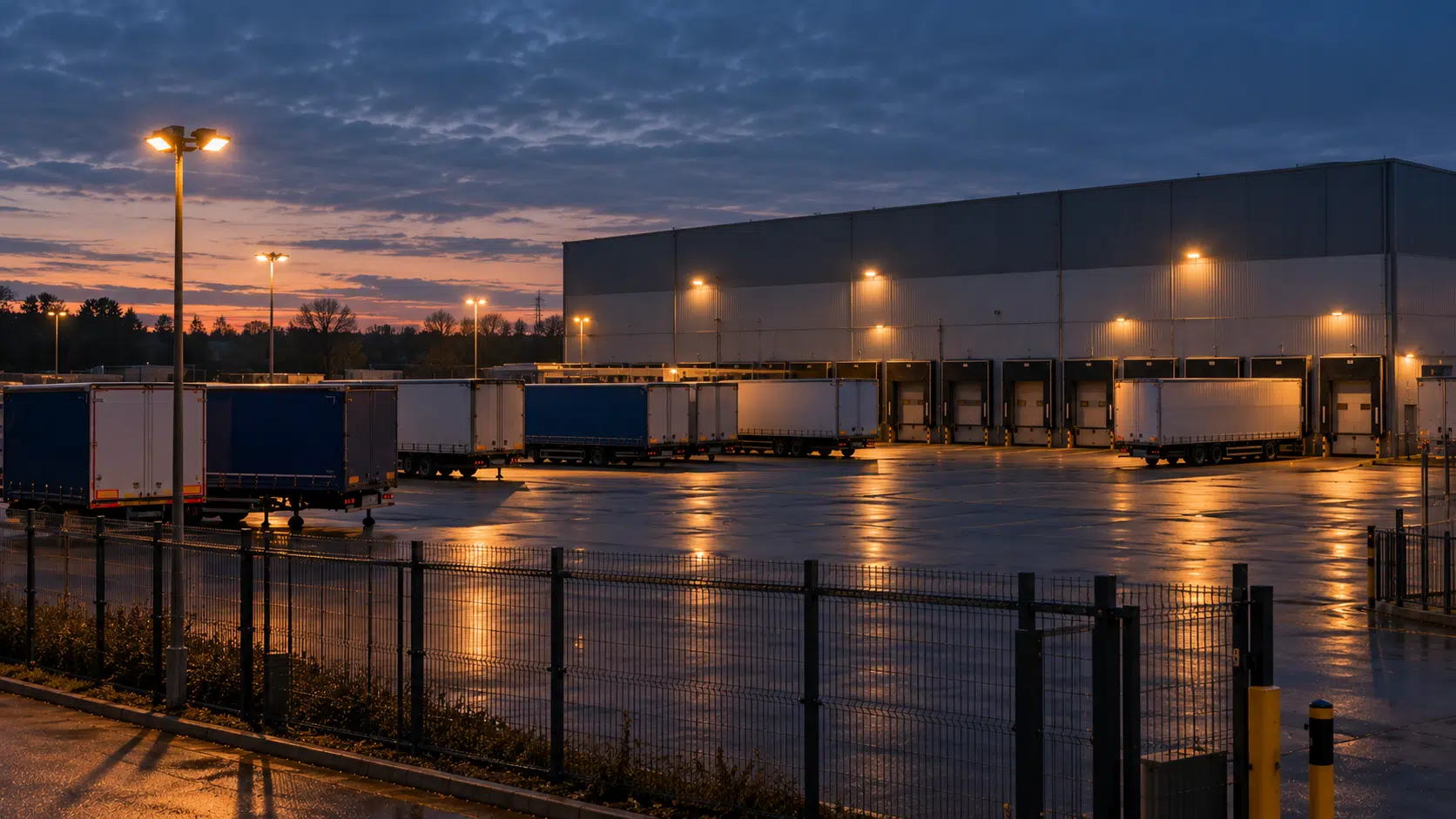
Then there is the yard. A large external area can contain trailers, vehicles, pallets, containers and other assets without anyone having a clear view of every corner from a fixed position.
The answer is not to put a guard beside every door. It is to understand where movement happens, where valuable assets sit and where somebody could exploit the gap between the two.
That is the starting point for effective warehouse security.

What Are the Biggest Security Risks for Glasgow Warehouses?
The main warehouse security risks include stock theft, unauthorised access, cargo theft, vehicle-related crime, trespassing, vandalism and weaknesses in delivery or visitor procedures.
These risks can overlap. For example, a weak vehicle verification process is not just an access-control issue. If an unauthorised vehicle reaches a loading area, it may also create an opportunity for stock or cargo theft.
Current freight-security data shows why this deserves attention. The 2025 BSI Consulting and TT Club Cargo Theft Report recorded the UK among Europe’s countries with the highest volumes of reported cargo theft, while warehouses accounted for 33% of recorded theft locations across Europe. The report also identified theft from facilities, theft from vehicles and vehicle theft among common incident types.
The risks worth examining include:
- Unauthorised access: people entering through poorly controlled gates, doors or restricted areas.
- Stock theft: internal or external loss involving valuable or easily resold goods.
- Cargo theft: goods disappearing during loading, unloading or dispatch.
- Vehicle theft: trucks, trailers, forklifts and other vehicles left on site.
- Trespassing: people entering yards or restricted areas without legitimate business.
- Vandalism: damage to buildings, vehicles, equipment or infrastructure.
- Visitor and contractor risks: people gaining access without adequate verification.
The important thing is to consider how these risks interact rather than treating each as a separate problem.
How Should Warehouse Access Control Work?
Effective warehouse access control should establish who is allowed onto the site, why they are there, where they need to go and when they should leave.
This is particularly important at sites where the front gate handles several different types of traffic. Employees, contractors, delivery drivers, visitors and collection vehicles should not necessarily follow the same process.
A well-run access arrangement may include:
- Employee identification checks
- Visitor sign-in procedures
- Contractor verification
- Driver checks
- Delivery and collection records
- Vehicle inspections where required by site procedures
- Restricted areas for authorised personnel
- Clear escalation when someone arrives unexpectedly
There is a practical reason for this.
A warehouse team can become very busy when several vehicles arrive together. The temptation is to wave somebody through simply because the queue is building up. That is precisely when a procedure needs to be simple enough to follow under pressure.
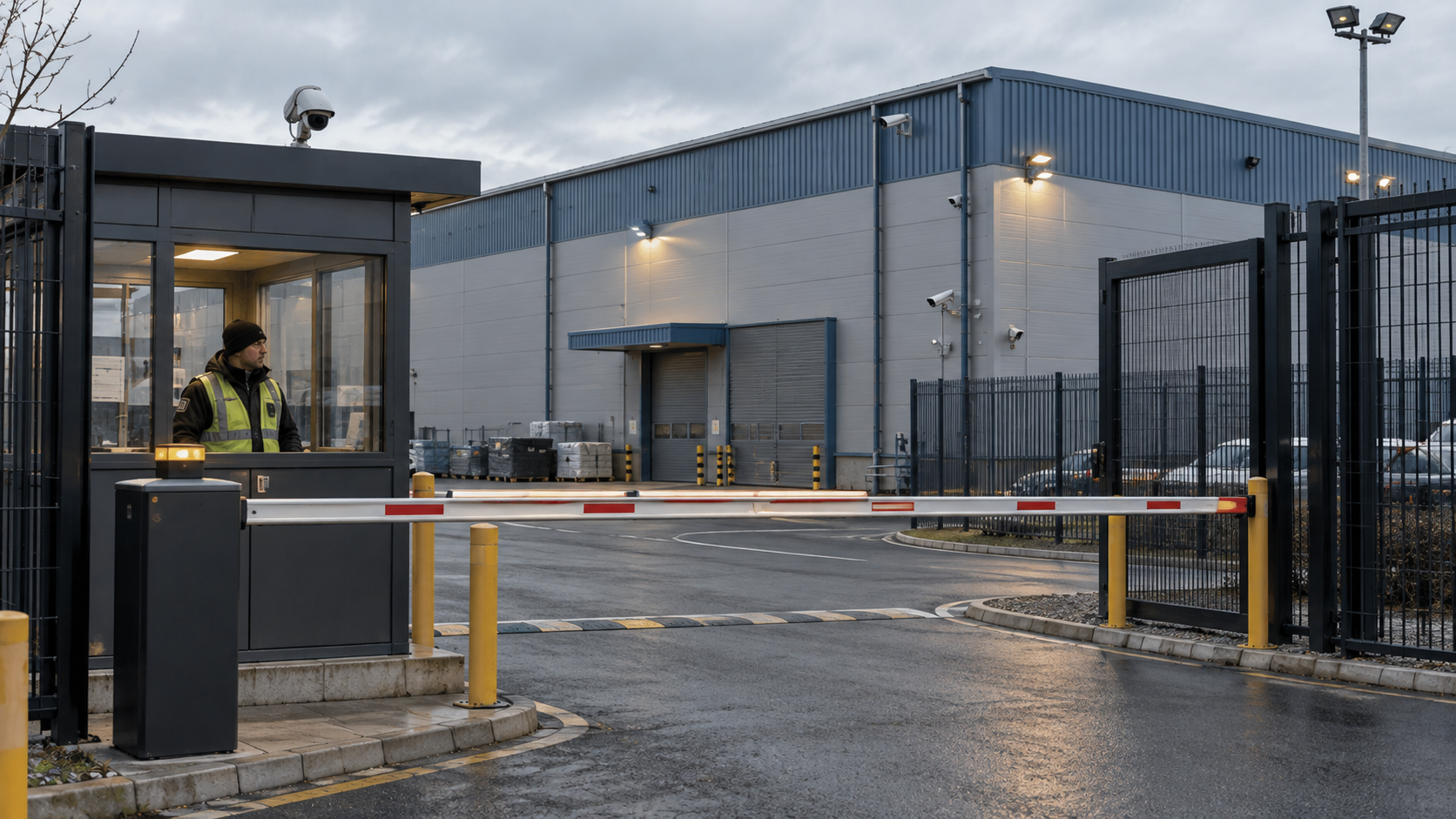
Region Security Guarding’s warehouse security service describes access control and visitor management around staff verification, visitor sign-in, driver management, delivery monitoring, vehicle inspections and access logs.
The objective is not to make every arrival difficult. It is to make sure the business knows who is on the site and why.
Why Are Loading Bays a Key Security Point?
Loading bays deserve particular attention because they bring together valuable goods, vehicles, drivers and time pressure in one place. A busy loading area can be difficult to supervise properly.
Forklifts are moving. Staff are loading or unloading. Drivers are waiting. Paperwork needs checking. Another vehicle may already be reversing into position. In that environment, security can easily become secondary to getting the job done.
That does not mean every loading bay needs a permanent security officer. It does mean the business should understand what happens there and where the opportunities for loss or unauthorised access might occur.
A sensible loading-bay review should consider:
- Who can enter the loading area?
- How are drivers identified?
- How are delivery and collection details verified?
- Who checks unusual or unexpected vehicles?
- Can somebody access stock without passing through another controlled point?
- Are loading areas visible through CCTV or regular patrols?
- What happens when a discrepancy is identified?
UK government guidance for businesses involved in international trade similarly recommends securing entry and exit points, perimeter fencing and cargo storage areas, while logging the movement of goods and inspecting vehicles and visitors where appropriate.
Does CCTV Provide Enough Warehouse Security?
CCTV is an important part of warehouse security, but it works best when it supports physical access controls, guarding, patrols and a defined response process.
Large warehouses can have dozens of cameras and still have gaps.
The question is not simply how many cameras are installed. It is whether they cover the areas that matter.
That can include:
- Vehicle entrances
- Pedestrian entrances
- Loading bays
- External yards
- Perimeter sections
- Stock areas
- Restricted access points
- Areas where vehicles or trailers are parked
There is also the issue of what happens after something is spotted. If a camera shows someone entering a restricted yard at 2am, who reviews the footage? Who checks the area? Who decides whether the incident requires escalation?
That is where technology needs to connect with the rest of the security arrangement.
For larger Glasgow warehouses, CCTV can therefore be valuable as a detection and verification layer, while physical security personnel provide the eyes and presence on the ground.
When Should a Glasgow Warehouse Use Security Guards?
A warehouse is more likely to benefit from manned guarding when access, deliveries, stock, people or the physical size of the site require continuous human oversight.
The role should be clearly defined. At one site, a guard may work primarily from the gatehouse, checking drivers and visitors. At another, the officer may patrol loading areas, monitor access points and carry out internal or external checks.
On a larger distribution site, the arrangement might combine fixed guarding, mobile patrols and CCTV monitoring. That flexibility matters because warehouses rarely operate in exactly the same way from one site to another.
Region Security Guarding’s warehouse service specifically combines warehouse security with gatehouse security and static guarding to address vehicle movements, loading bays, stock protection and logistics operations.
The experienced approach is to start with the security task, then decide what deployment makes sense.
Are Mobile Security Patrols Useful for Warehouse Yards?
Mobile patrols are particularly useful for warehouses with large yards, multiple buildings or perimeter areas that cannot be continuously supervised from one fixed position.
A fixed guard can do an excellent job at a gate. They cannot, at the same time, walk the far side of the yard, check a remote fence line and inspect a parked trailer.
That is where mobile coverage can add another layer.
Patrols can be used to check:
- Perimeter fencing
- Rear access points
- Vehicle and trailer areas
- Loading bays
- Isolated buildings
- External storage areas
- Areas with limited natural visibility
The timing also matters. A patrol at predictable intervals provides a different type of protection from one that varies appropriately around known risk periods. The exact arrangement should reflect the site rather than follow an arbitrary schedule.
How Can Warehouses Reduce Unauthorised Access?
Warehouses can reduce unauthorised access by combining controlled entrances, clear visitor procedures, perimeter protection, surveillance and physical security checks rather than relying on a single gate or camera.
Start at the boundary.
Is the fencing intact? Are gates secured? Can somebody reach a loading area without passing through a controlled point? Are there pedestrian routes that bypass the main entrance?
Then look inside.
Once someone enters the site, can they move freely into storage areas, offices or loading zones?
This is where warehouse visitor management becomes important. Visitors should have a clear reason for being there. Contractors should be identifiable. Drivers should know where they are expected to go. Staff should understand what to do when somebody attempts to bypass the normal process.
It is the boring stuff that often makes the difference. Security failures are not always dramatic break-ins. Sometimes they begin with somebody being allowed through the wrong door because everyone assumes somebody else has checked them.
What Should a Glasgow Warehouse Security Assessment Look At?
A warehouse security assessment should examine the complete movement of people, vehicles and goods across the site, with particular attention to access points, loading areas, perimeter weaknesses and out-of-hours exposure.
A useful assessment should cover:
- The perimeter: Check fencing, gates, boundary lines, lighting and areas that are difficult to observe.
- The entrances: Identify every pedestrian and vehicle access point, including entrances that are rarely used.
- The loading operation: Look at how deliveries arrive, how drivers are verified and how goods move from vehicles into storage.
- The yard: Consider trailers, parked vehicles, external storage and areas that become quiet after working hours.
- The workforce: Review staff access, contractors, temporary workers and procedures for visitors.
- Out-of-hours security: Ask what happens once the warehouse closes, during weekends, bank holidays and reduced-staffing periods.
- Incident response: Establish who receives an alarm, who checks suspicious activity and how incidents are recorded and escalated.
This is much more useful than simply asking whether the site has “enough security”.

How Should Glasgow Warehouses Build Security Around Their Actual Risk?
Glasgow warehouses should build security around their specific operations rather than adopting a standard package of guards, cameras and patrols.
A useful way to think about the arrangement is:
Risk | Possible control |
Unauthorised entry | Access control and gatehouse security |
Busy vehicle movements | Driver verification and managed vehicle access |
Loading-bay theft | Guarding, CCTV and delivery monitoring |
Large external areas | Mobile patrols |
Perimeter vulnerabilities | Fencing, lighting, surveillance and patrols |
Out-of-hours incidents | Alarm response and keyholding |
Restricted stock areas | Controlled internal access |
Visitor uncertainty | Sign-in and verification procedures |
The strongest arrangement is rarely about adding every possible measure. It is about making sure each important weakness has somewhere to go.
- If CCTV identifies something, someone needs to know what happens next.
- If an access-control system prevents entry, there needs to be a procedure for legitimate exceptions.
- If a patrol finds a damaged gate, the issue needs to be recorded and acted upon.
That is how physical security becomes part of the warehouse operation rather than something bolted onto it
When Should a Warehouse Review Its Security Arrangements?
A warehouse should review its security arrangements whenever its operation, layout, stock profile, access requirements or working patterns change.
It is particularly sensible to review security when:
- A new loading area is introduced
- The site begins operating longer hours
- The business starts storing higher-value goods
- Vehicle traffic increases
- New contractors or logistics partners are introduced
- A perimeter or access point changes
- There has been an attempted intrusion or theft
- The site experiences a change in occupancy or staffing
Security risks do not stand still. The warehouse that was reasonably protected two years ago may have a very different exposure today because the business has grown, taken on more stock, changed its delivery model or extended operating hours.
TT Club and BSI’s recent cargo-theft research also points to increasingly sophisticated tactics, including deception and fictitious pickups, reinforcing the need for businesses to look beyond straightforward perimeter intrusion when reviewing supply-chain security.
Final Thoughts: What Does Good Warehouse Security Look Like?
Good warehouse security is not simply about putting a guard at the gate. It is about controlling the movement of people, vehicles and goods while maintaining enough visibility and response capability to deal with problems when they arise.
For a Glasgow warehouse, that might mean combining gatehouse security with CCTV, controlled access, loading-bay supervision and mobile patrols. Another site may need a different arrangement because its layout, operating hours or stock profile presents a different risk.
The important thing is to understand the site first.
- Look at the gate.
- Look at the loading bay.
- Walk the perimeter.
- Watch what happens when three vehicles arrive together.
- Then look at what happens at midnight when the yard is quiet.
Those are the moments that tell you far more about a warehouse’s security than a list of equipment ever will.
For businesses reviewing their arrangements, Region Security Guarding provides warehouse security services covering access control, visitor management, static guarding, mobile patrols and other site-specific measures. Its security company in Glasgow service also supports warehouses and commercial premises across the city and surrounding areas.