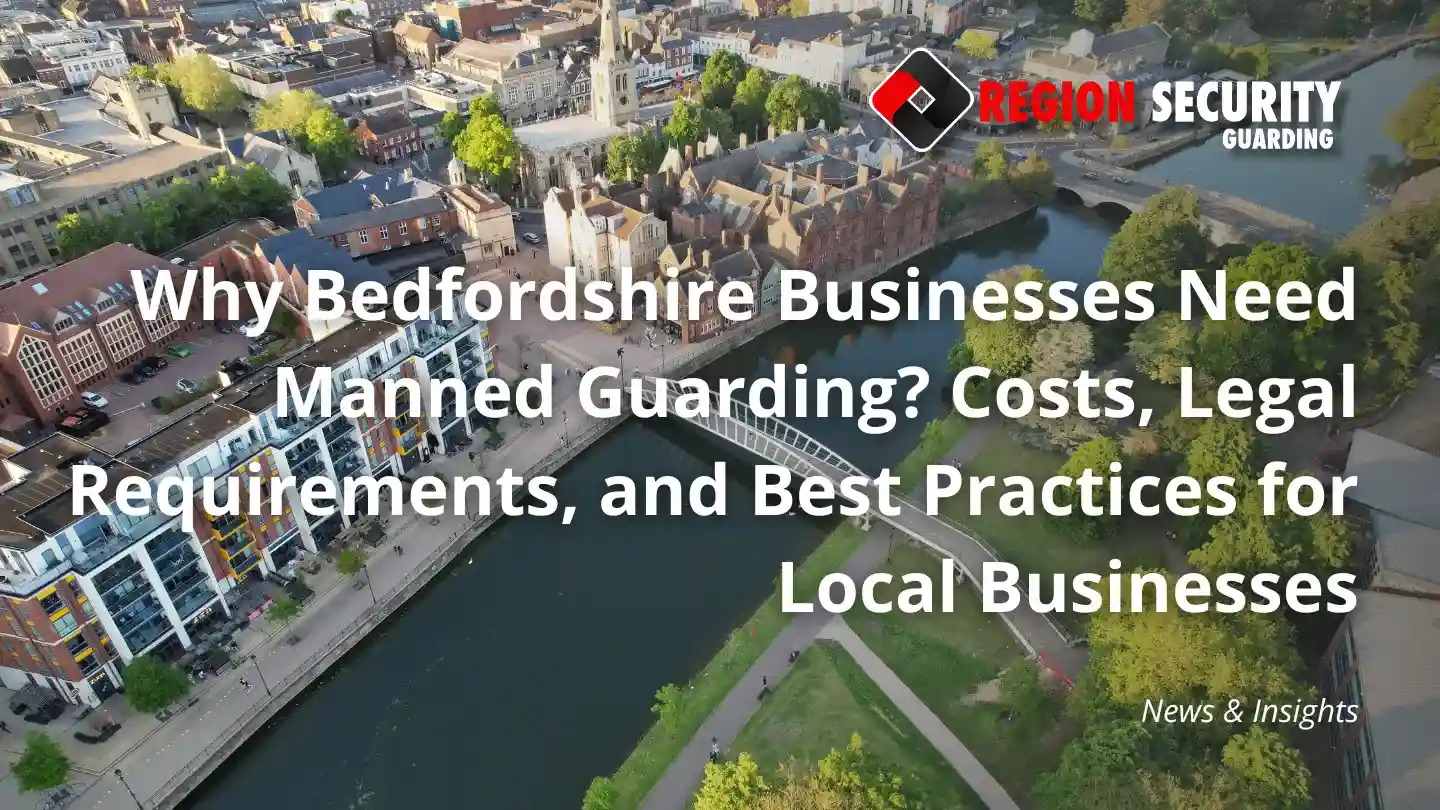
For many organisations across Bedfordshire, security is no longer a background concern. It sits right alongside staffing, insurance, and continuity planning. The county’s business mix is broad. Retail parks, logistics hubs, and light industry and tech-led firms bring uneven risk. This is why Bedfordshire businesses need manned guarding.
Manned guarding matters here because local crime is rarely static. Areas close to the M1 motorway attract fast, opportunistic offending. Vehicle theft, yard intrusion, and late-night trespass are common patterns, not one-off events. Cameras record incidents, and guards utilise them to prevent threats. This is the way many site uses to secure their businesses.
There’s also the human side. Antisocial behaviour doesn’t always look dramatic. But repeated low-level disruption wears sites down. Guards trained in Antisocial Behaviour (ASB) hotspotting can find early signs before they escalate. This can prevent damage, loss, or staff safety issues. That kind of judgment doesn’t come from a control room.
For shopkeepers, Retail & Warehouse Loss Prevention depends on visible presence and routine. For offices and tech firms, guards act as the first physical layer of access control. And they also act as supporting digital identity systems rather than replacing them. And in higher-risk zones, insurers increasingly expect active Vehicle Crime Mitigation.
In Bedfordshire, manned guarding isn’t about looking secure. It’s about staying operational when conditions change often without warning.
Understanding Manned Guarding Basics in Bedfordshire
Manned guarding in Bedfordshire is not a generic service. It shifts with local crime patterns, transport links, and the way businesses actually operate day to day. To understand why demand keeps rising, it helps to strip things back to basics.
What Manned Guarding Means in Bedfordshire
Static security relies on fixed systems: cameras, alarms, and locked doors. Manned guarding adds movement, judgment, and response. In a county connected by the M1 motorway, that difference matters. Offenders often test sites quickly and leave just as fast. A guard can challenge, delay, and escalate in real time. Static systems can only log what has already happened.
How Bedfordshire’s Crime Profile Changes Security
Local crime is mixed rather than concentrated. Retail theft, vehicle crime, and low-level intrusion often overlap. This is where Vehicle Crime Mitigation and visible patrols outperform passive measures. Businesses aren’t dealing with one threat to close. They are managing patterns.
Peak Crime Hours Businesses Should Plan Around
Most incidents cluster around predictable windows:
- Early morning (04:00–07:00) during shift changes
- Late afternoon retail peaks
- Evenings when staffing thins but sites remain open
Manned guards fill those gaps when systems alone are weakest.
Warehouse-Specific Vulnerabilities Across The County
In the East of England region, manned guarding is more essential than paperwork. Because most warehouses near arterial roads face repeat risks:
- Curtain-side vehicle breaches
- Yard access during loading lulls
- Tool and fuel theft
This directly ties into Retail & Warehouse Loss Prevention, where routine patrols reduce losses simply by being seen.
Addressing antisocial behaviour in retail parks
Retail parks struggle less with organised crime and more with persistent disruption. Antisocial Behaviour (ASB) hotspotting allows guards to identify threats easily. They find repeat locations, times, and triggers, then intervene early. That prevents minor issues from becoming police matters or insurance claims.
Why rising retail theft drives daytime patrol demand
The shift is noticeable. Theft no longer waits for closing time. Daytime manned patrols now focus on:
- Deterrence through presence
- Staff reassurance
- Rapid escalation when patterns repeat
This also aligns with the local Business Crime Reduction Partnership activity. It is where shared intelligence matters for better security.
Day versus night guarding: different risks, different mindset
Day guards manage people. Night guards manage space. Daytime focuses on interaction, theft prevention, and access control. Night shifts deal with isolation, perimeter breaches, and silent intrusion. Mixing the two without planning is where businesses slip up.
Seasonal events and temporary risk spikes
Large local events like Bedfordshire Pride increase footfall, traffic, and opportunistic crime near venues and transport routes. Temporary guarding isn’t about crowd control alone. It’s about spillover risk to nearby businesses.
Transport hubs and the Luton DART factor
While Bedfordshire has no tram network, the Luton DART has changed movement patterns. Higher passenger flow means:
- More transient foot traffic
- Increased ASB risk near hubs
- Greater need for visible guarding during peak travel times
- Economic growth and industrial demand
As Bedfordshire continues to attract larger threats. Logistics, tech, and light industry become high target sites. And that’s why Bedfordshire businesses need manned guarding. They become part of operational planning, not an afterthought. Growth brings opportunity and exposure. Guards help keep that balance under control.
Legal and Compliance Requirements in Bedfordshire
Legal compliance isn’t optional for manned guarding in Bedfordshire. It’s the baseline to ensure your site safety. Businesses that treat security and guarding as paperwork are not good. It often ended up learn in the hard way. They face trouble after an incident, an inspection, or an insurance refusal.
SIA licensing: the non-negotiable starting point
All frontline security officers must hold a valid licence. It is issued by the Security Industry Authority. This applies across Bedfordshire, whether the site is a retail park, warehouse, or office campus.
Using unlicensed guards carries real consequences:
- Civil penalties running into thousands
- Contract termination by insurers
- Reputational damage that lingers
For clients, mandatory licensing shifts liability. If a provider cuts corners, the business still shares the risk.
DBS checks and background screening
DBS checks are not legally required for every guard role. But in practice, many Bedfordshire and Norfolk sites insist on them. Retail parks, logistics hubs, and tech offices often require enhanced screening. This is due to theft risk, access to assets, or sensitive areas. It’s become an expectation rather than a bonus.
Insurance requirements when hiring manned guards
UK businesses hiring guards must ensure that providers carry the essential points. They need:
- Public liability insurance
- Employer’s liability insurance
- Professional indemnity (where advisory duties apply)
In risk areas, insurers favour sites with documented Vehicle Crime Mitigation and manned coverage. Especially, they do so on sites near major transport routes.
Data protection and CCTV integration
Manned guarding frequently overlaps with CCTV monitoring. Compliance with UK data protection law depends on how footage is accessed, recorded, and stored. Guards must be trained to:
- Avoid unauthorised viewing
- Follow retention limits
- Log incidents accurately
Poor handling doesn’t just breach policy; it can invalidate evidence. This is the reason why Bedfordshire businesses need manned guarding with professional knowledge.
VAT and financial compliance
Manned security services are VAT-rated in the UK. Businesses should expect VAT to apply to guarding invoices. And they need to ensure suppliers are properly registered. Attempts to bypass this often raise red flags during audits.
Local authority and construction site rules
There are no blanket county-wide rules unique to Bedfordshire councils. But construction sites must comply with local planning conditions and health and safety expectations. Councils expect visible guarding around the site as they identify threats. This helps prevent theft, trespass, or ASB risk, especially in phased developments.
Proving a security firm’s compliance history
Reputable providers can demonstrate compliance through:
- Valid SIA licences (officer and contractor)
- Training records
- Incident logs and patrol reports
- Insurance certificates
This documentation matters when claims or disputes arise.
Labour law, overtime, and post-Brexit rules
UK labour law governs guard pay, rest periods, and overtime. Mismanaged rotas expose clients to service gaps. Post-Brexit, EU nationals working as guards must meet right-to-work requirements. Clients should expect providers to handle this without disruption.
Police and partnership collaboration
Private guarding doesn’t operate in isolation. Bedfordshire Police data informs patrol timing, hotspot coverage, and ASB trends. Many deployments align with insights shared through local Business Crime Reduction Partnership schemes. This improves the response and intelligence flow and ensures the safety of businesses.
Event licensing rules in cities like Manchester don’t apply here. Bedfordshire businesses follow local authority and police guidance instead. That local focus is exactly why compliant manned guarding remains effective.
Costs, Contracts, and Deployment in Bedfordshire
Cost conversations around manned guarding in Bedfordshire tend to start with hourly rates and end with risk. That’s sensible due to the county’s mix of town centres, logistics, and out-of-town estates. It means pricing and deployment are rarely one-size-fits-all.
Typical costs: town centres versus suburbs
Rates vary by location and risk profile. Sites closer to transport hubs or the M1 motorway generally cost more. It is due to higher incident frequency and response expectations.
- Town centres / retail parks: higher visibility, more interaction, greater ASB exposure
- Suburban offices / industrial estates: steadier patrols, fewer confrontations
- Warehouses and yards: premiums for night cover and Vehicle Crime Mitigation
The difference isn’t dramatic, but it’s consistent. Higher risk demands tighter coverage.
How fast teams can be hired and deployed
Deployment speed depends on the scope. A single static guard can be mobilised quickly. Larger teams take longer due to vetting, rota planning, and site induction. In Bedfordshire, most providers can deploy within days, not weeks.
Common contract lengths across the county
Short contracts still exist, but stability is preferred. Typical arrangements include:
- 3–6 months for temporary risk spikes
- 12 months for standard operations
- Multi-year agreements for logistics and public-sector sites
Longer terms often unlock better rates and continuity.
Notice periods and contract flexibility
Notice periods are usually straightforward. One to three months is common, depending on scale. Flexibility matters more than headline terms. Businesses with seasonal trade or shared estates benefit from it. They have the adjustable coverage rather than hard exits.
Wage increases and 2025 cost pressure
Security wages have risen, and that trend continues into 2025. Higher minimum pay, training costs, and retention pressures all feed through. It’s not profiteering but the arithmetic. Under-priced contracts tend to fail quietly, then suddenly.
Inflation and long-term pricing
Inflation affects uniforms, fuel, supervision, and back-office compliance. Long-term contracts increasingly include review clauses. That protects both sides and avoids sudden renegotiation when costs move.
Insurance savings: where guarding pays for itself
Insurers look for active risk control. In Bedfordshire, sites with 24/7 guarding often see:
- Reduced premiums for vehicle-related claims
- Better terms for retail and warehouse stock
- Faster claims handling due to incident logs
This is where Retail & Warehouse Loss Prevention and visible patrols show tangible value.
Public sector contracts and the Procurement Act 2023
Public bodies now operate under the Procurement Act 2023. For Bedfordshire clients, that means:
- Greater emphasis on compliance history
- Transparent pricing and performance metrics
- Fewer “race to the bottom” bids
Quality is not just about cost; it carries weight.
Deployment that reflects local economics
Bedfordshire continues to attract logistics, tech, and mixed-use development. Guarding sure demand follows growth. Economic expansion brings footfall, assets, and pressure points. Sensible contracts anticipate that reality instead of reacting late.
In short, manned guarding costs here aren’t arbitrary. They’re shaped by location, labour, and how quickly things can go wrong and how well a business wants to stay ahead of that curve.
Training, Operations, and Daily Duties in Bedfordshire
Manned guarding in Bedfordshire is built on routine, but not monotony. Guards here are trained to expect variation. Different sites have different pressures, but guards share same responsibility on every shift.
Training standards for retail and mixed-use sites
Retail-focused guards must meet SIA standards, but that’s only the starting line. In Bedfordshire, additional training usually covers:
- Conflict management and de-escalation
- Theft Pattern Recognition for Retail & Warehouse Loss Prevention
- Customer-facing communication
- Antisocial Behaviour (ASB) hotspotting techniques
Retail parks don’t fail because of major incidents. They fail when small problems repeat unchecked.
What happens the moment a guard starts a shift
There’s no easing in. On arrival, a guard’s first job is awareness. That means reading the site before touching anything. The very first check is usually the handover log. If you miss that, the context is lost.
After that, priority checks tend to follow a familiar order:
- Site perimeter and access points
- Doors, shutters, and emergency exits
- Obvious signs of tampering or forced entry
Shift handovers and patrol rhythm
Handover is verbal and written for site safety. Guards brief on incidents, suspicious behaviour, and anything unresolved. Patrol frequency depends on risk, but most Bedfordshire sites expect visible movement at least hourly. And the higher-risk zones get even more.
In industrial areas, the first patrol focuses outward:
- Fence lines
- Vehicle gates
- Yard lighting and blind spots
This is where Vehicle Crime Mitigation starts paying off early.
Daily records and equipment checks
Logbooks are not busywork. A professional guards record everything from the task to checks:
- Patrol times
- Access issues
- Alarm activations
- ASB observations
At shift start, equipment checks are routine. Radios, body-worn cameras (where issued), torches, and alarms are tested. If something doesn’t work, it’s logged immediately. Silence later helps no one.
Alarm response and early hours incidents
Early shifts often catch alarms triggered by cleaners, deliveries, or genuine intrusion. Guards verify, assess, and escalate based on procedure. The key is judgment, as overreaction causes disruption and underreaction causes claims.
CCTV, access control, and visitor logging
Where CCTV is present, guards confirm cameras are live and recording. They don’t monitor constantly. But they verify readiness and ensure the safety around the site is still intact. Visitor logging follows site policy, usually digital, sometimes manual. Consistency matters more than format.
Internal access checks come next. Doors between zones, badge readers, and restricted areas are confirmed secure.
Fire safety and lighting checks
Fire exits are checked early. So are extinguishers and panel indicators. In car parks, lighting inspections are a quiet priority. Poor lighting invites trouble faster than broken locks.
Supervision, reporting, and emergencies
Night guards report to supervisors at agreed intervals. Not constantly, but enough to confirm safety and continuity. Emergency procedures are reviewed at the start of duty, not during a crisis.
Utilities are checked for signs of interference. Power boxes, meters, exposed cabling, small details, big consequences.
End-of-shift and 24/7 coverage
Secure-down at shift end mirrors start-up: doors, logs, and handover notes. For 24/7 coverage, shifts rotate to manage fatigue. Continuity beats heroics.
Response times across neighbouring counties like Hertfordshire or Cambridgeshire are broadly similar. What separates Bedfordshire operations is preparation. Guards who know the site rarely need to rush. They’re already where they should be.
Performance, Risks, and Challenges in Bedfordshire
Measuring manned guarding performance in Bedfordshire goes beyond asking whether incidents happened or not. The real question is whether risk was managed quietly, consistently, and without disruption. When security works, very little appears to happen. That makes performance tracking essential.
KPIs that actually matter for manned guarding
Some metrics look good on paper but say very little about real protection. The most useful KPIs tend to be practical and slightly uncomfortable:
- Patrol completion rates with time stamps
- Incident response times, not just outcomes
- Number of early interventions (before damage or loss)
- Repeated ASB locations flagged through Antisocial Behaviour (ASB) hotspotting
- Vehicle-related incidents are prevented, supporting Vehicle Crime Mitigation
If reporting only shows “nothing to report,” something is missing. A reliable guard knows how to act in a situation. That’s why Bedfordshire businesses need manned guarding to secure the site.
Weather as a quiet risk multiplier
Bedfordshire weather doesn’t make headlines. But it affects patrol effectiveness more than many expect. Heavy rain reduces visibility, and fog limits perimeter checks. Following this, in winter, ice changes patrol routes entirely. Guards adjust movement, timing, and coverage without needing instruction. But it can happen only if procedures allow it.
How guards document weather-related risk
Weather conditions are logged when they alter patrol behaviour. That also includes:
- Reduced visibility areas
- Slippery surfaces near loading bays
- Temporary lighting failures during storms
These notes matter later, especially if an incident overlaps with environmental conditions.
Long shifts and physical performance limits
Extended shifts take a toll on guards. And fatigue slows reaction time and dulls judgment. Guarding roles focused on Retail & Warehouse Loss Prevention. And this drop-off shows up as missed cues rather than dramatic failures. Smart rotas reduce consecutive long shifts and build recovery time.
Mental health pressures on night-shift guards
Night work brings isolation. In quieter Bedfordshire industrial zones, guards may go hours without interaction. Best operators now recognise mental health as an operational issue, not an HR footnote. Support usually includes:
- Regular supervisor check-ins
- Predictable shift patterns
- Access to confidential support services
A mentally drained guard is still present but less effective. So, as providers, consider that every possibility is also a task.
Environmental rules affecting outdoor patrols
Outdoor guarding must align with health and safety expectations. High winds, heatwaves, or extreme cold trigger modified patrol schedules. This isn’t about comfort. It’s about preventing injury and maintaining alertness.
Labour shortages and retention pressure
Recruitment is tight across the region. Bedfordshire firms retaining guards tend to focus on basics done well. Many sites tend to suffer due to fewer guards on duty. Also, according to recent Bedfordshire crime statistics, the county’s vehicle crime rate currently stands at 151% of the national average.
Churn creates gaps, and these gaps create risk. Without reliable guards, your site faces constant threats. So, having a trustworthy provider is as essential as aiming for robust protection.
Balancing performance with reality
One challenge rarely discussed is over-policing security teams with KPIs. Too many metrics create box-ticking. Too few create blind spots. The balance lies in measuring what links directly to prevention, reassurance, and continuity.
In Bedfordshire’s mixed business landscape, guarding performance is shaped by many factors. Such as weather, workload, and people, as much as policy. The firms that understand that don’t just react to incidents. They quietly reduce how often those incidents ever get the chance to happen.
Technology and Future Trends in Bedfordshire
Manned guarding in Bedfordshire hasn’t been replaced by technology. It’s been reshaped by it. The role of the guard now sits between digital systems and real-world judgment. Especially, it is vital in urban and mixed-use sites.
How technology has changed day-to-day guarding
Urban sites across Bedfordshire rely less on static presence and more on informed movement. Guards now arrive with live dashboards instead of clipboards. Access alerts, patrol prompts, and incident history are available in seconds. That shift matters when dealing with repeat theft patterns or Antisocial Behaviour (ASB) hotspotting.
Post-COVID changes that stayed
Some pandemic-era protocols never went away. Guards are still expected to manage flow, not just access. Touchless entry systems, queue monitoring, and visibility around high-traffic areas remain part of daily duties. It’s subtle, but it changed how guards interact with people, less confrontation, more guidance.
AI surveillance and the human layer
AI-driven CCTV flags unusual behaviour faster than a human ever could. But it doesn’t decide what to do next. In Bedfordshire sites, AI supports:
- Early detection of loitering or vehicle circling
- Alert prioritisation during busy periods
- Reduced false alarms
The guard remains the decision-maker. That balance keeps Vehicle Crime Mitigation practical rather than theoretical.
Remote monitoring and hybrid coverage
Remote monitoring centres now handle overnight CCTV for many urban locations. On-site guards respond only when something needs eyes and feet on the ground. This hybrid approach works well for retail parks and offices. It can keep coverage lean without losing control.
Drones: limited but growing
Drone patrols are appearing on larger industrial estates, mostly as scheduled perimeter sweeps. They don’t replace guards but extend reach. When a drone flags an issue, a guard investigates. The value lies in speed, not spectacle.
Predictive analytics and risk planning
More Bedfordshire businesses now use data to decide where guards are needed, not just how many. Predictive tools analyse:
- Past incidents
- Time-of-day risk
- Seasonal activity spikes
That insight supports Retail & Warehouse Loss Prevention by placing guards where loss is most likely, not where it looks neat on a rota.
Upskilling and modern certifications
Guards today need more than a licence to ensure the site’s safety. Increasingly common skills include:
- Digital reporting systems
- Data protection awareness
- Basic cyber–physical risk understanding
This matters in a county with growing tech and logistics sectors.
Green security and outdoor patrols
Environmental awareness is creeping into guarding. Electric patrol vehicles, energy-efficient lighting checks, and smarter patrol routing reduce emissions without reducing coverage. It’s practical sustainability, not marketing.
Martyn’s Law and future expectations
Proposed legislation like Martyn’s Law will likely increase formal risk planning for public venues. In Bedfordshire, that points toward:
- Better-trained guards
- Clearer response protocols
- Stronger coordination with local authorities
The future of manned guarding here isn’t about choosing between people and technology. It’s about making sure each sharpens the other.
Conclusion
For businesses across Bedfordshire, manned guarding has become less about formality and more about control. Crime here isn’t dramatic every day, but it’s persistent. Vehicle crime, low-level theft, and repeat disruption test sites quietly. This disturbance affects the sites often when attention slips. That’s why Bedfordshire businesses need manned guarding.
Good guarding supports Vehicle Crime Mitigation, strengthens Retail & Warehouse Loss Prevention. And work alongside local Business Crime Reduction Partnership efforts rather than in isolation. It also deals with Antisocial Behaviour (ASB) hotspotting before it drains staff time and morale.
In the end, manned guarding isn’t a reaction. It’s a steady presence that keeps businesses operational. When conditions shift, security needs to be upgraded.
Frequently Asked Questions
1. Do I really need manned guarding if I already have CCTV in place?
We see this a lot. CCTV shows me what happened; guards change what’s about to happen. In Bedfordshire, especially near fast exit routes, that difference matters. A visible guard disrupts behaviour before it turns into loss.
2. Is manned guarding only necessary at night?
No. We are seeing more issues during the day now, particularly retail theft and repeat nuisance behaviour. Daytime patrols help with Retail & Warehouse Loss Prevention. And it improves staff confidence; it is not just after-hours security.
3. How does manned guarding help with vehicle crime?
Guards actively monitor car parks, yards, and delivery areas. That’s practical Vehicle Crime Mitigation, not passive deterrence. Criminals notice patterns quickly, and they avoid sites that watch back.
4. Will having guards really reduce my insurance premiums?
Often, yes. We have seen insurers offer better terms where 24/7 manned guarding is in place, especially in higher-risk Bedfordshire areas. Good logs and incident reports make a real difference.
5. How quickly can guards be deployed if my risk suddenly increases?
In most cases, fairly quickly. If expectations are clear, providers can scale coverage within days. Delays usually come from unclear scope, not availability.
6. Do guards work with local police or operate separately?
They work alongside. Information often feeds into Bedfordshire Police activity and local Business Crime Reduction Partnership schemes. It does especially for repeat ASB or theft patterns.
7. Are guards trained to deal with antisocial behaviour without escalating it?
Yes, when done properly. Antisocial Behaviour (ASB) hotspotting focuses on early intervention. The goal is to calm situations down, not turn them into incidents.
8. Is manned guarding still relevant as technology improves?
Absolutely. Tech helps guards make better decisions, but it doesn’t replace judgment. In Bedfordshire’s mixed business environment, people on the ground still close the gap between alerts and action.