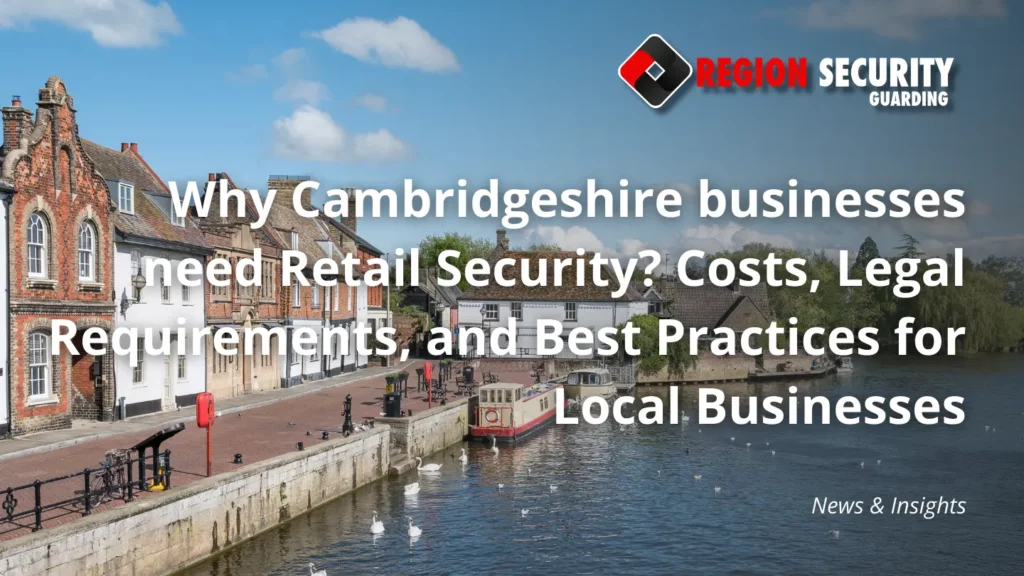
At first glance, the county feels disarmingly gentle. Cambridgeshire appears calm with cathedral spires, neat market squares, student bikes slipping through narrow streets, and warehouse units circling the A14. The county looks settled, but owners and managers across Cambridge, Peterborough, Huntingdon and St Neots know better. They deal with challenges that never show up in glossy photos.
Patterns shift. Footfall spikes one week and thins the next. Students come and go. Tourist season packs the pavements. Paydays trigger rushes that change the tone of a shop floor. One long weekend of hot weather can lead to more stock walking out the door than a month of quiet trading.
That’s the heart of why Cambridgeshire businesses need retail security. Risk doesn’t sit in one place. It creeps in unexpectedly, and retail staff rarely have spare capacity to deal with it. Retailers here face opportunistic theft, organised push-outs, night-time trespass, and the kind of anti-social behaviour that rattles staff confidence.
Security isn’t a blunt tool. It provides help when teams are stretched and coverage when gaps open. It gives fast judgment when situations get loud before anyone can take control.
Table of Contents
Retail Security Basics in Cambridgeshire
What Retail Security Is and What It Is Not
Retail security is present in motion. It means having someone skilled on-site who is always watching and listening. They step in early, before a tiny problem becomes a major headache.
Static posts have value, doors need watching, stockrooms need protection, but retail space is fluid. People drift in and out, distractions pile up, and trouble rarely stays still long enough for a guard rooted to a single point.
Remote monitoring matters and has real value. But a screen can’t calm an argument, redirect a lost shopper, or shadow someone heading for a quick escape.
Retail security services in Cambridgeshire work best when they’re visible on the shop floor. They move through car parks, service corridors and loading areas. They also patrol the hidden gaps between units where problems tend to start.
Crime Conditions Shaping Retail Decisions
Cambridge’s central streets experience weekend surges, the kind that pack shelves and stress nerves. Peterborough’s mixed retail corridors see a different rhythm: lunchtime bursts, early evenings where tempers run hotter.
Move north or east into March, Wisbech, Ely or St Ives, and the pattern shifts again. Fewer staff, wider car parks, quiet spells punctuated by sudden pockets of theft or vandalism. Some stores there report clusters of losses that vanish when an officer turns up proof that deterrence alone can save more stock than a dozen cameras.
That is retail crime protection for businesses in practice. It’s not theoretical: the demand rises where population churn meets access, where lone staff cover wide floors, and where day shifts slip into evenings with no backup. Shared risks across the East of England show how theft groups move from county to county following opportunity.
When Risk Peaks Not Always After Dark
The myth that thieves wait for night is long outdated. Cambridgeshire shops now report:
- Midday lift-and-leave attempts during peak queues
- After-school flashpoint hours
- Early evenings when teams are tired
- Quiet mornings with deliveries blocking sightlines
This is a textbook trading hours vulnerability, and it punishes routine. Night brings a new menu: shutter testing, slip-in trespass through service yards, and vandalism that costs more to clean up than the damage itself. The right guard doesn’t wait for alarms. They catch patterns forming.
Local Vulnerabilities that Fly Under the Radar
Cambridge’s science parks and tech clusters bring highly mobile workers lots of footfall, little familiarity, and anonymity that emboldens quicker theft. University towns add a student tide, seasonal, unpredictable, and almost impossible to forecast week to week.
Retail parks in Ely, Huntingdon, St Neots and Peterborough share the same design flaw: open expanses, wide sightlines, no “eyes on the street.” That is where shoplifting and anti-social behaviour sprout first, often shielded by groups or vehicle access.
Retail Parks, Loitering and the Escalation Curve
Anti-social behaviour rarely begins with crime. It starts with lingering. A raised voice. A driver double-parked, waiting for “someone inside.” A group that looks like they’ve claimed a bench.
The guard steps in early, not combatively, just visibly. Presence loosens tension, reminds people they’ve stepped into watched space, and prevents the slow build toward confrontation. That vulnerability mirrors retail parks across Essex, where car-borne theft groups treat open layouts as easy escape routes.
Day Vs Night: Risk Wears Two Faces
Daytime demands softness, de-escalation, awareness, subtle following, and calming sharp edges of frustration.
Night rewards predictability, door checks, shadowed patrol loops, and a second sense for unusual movement.
Both worlds prove how retail security reduces theft in Cambridgeshire stores, even when a guard never lifts a hand.
Seasonal Churn and Event Pressure
Christmas markets and Cambridge graduations bring a rush of people. Add Newmarket race days and Ely Cathedral festivals, and retail teams feel the strain. Retailers rarely get extra hands; they get extra risk. These seasonal surges echo pressures in Hertfordshire, but Cambridge’s academic calendar amplifies them more often.
Transport Network Influence
Train stations and guided busway stops funnel movement into shops. Theft-and-exit cases spike around them. Retail sometimes feels like a public corridor. That’s where on-site security personnel are worth their weight. People travel in from Bedfordshire every day. Shops then face a moving crowd that’s tough to read without support.
Economics and Business Growth
Boom periods carry as much risk as downturns. Growth breeds new stores, extended opening hours, and fresh staff learning on the job. That alone explains why brick-and-mortar stores need guards in Cambridgeshire even when business feels strong.
Legal & Compliance Requirements for Retail Security in Cambridgeshire
SIA Licensing
Every deployed guard must hold a valid SIA licence. No exceptions, city shop or rural petrol-station forecourt, the rule binds all.
Penalties for Ignoring Licensing
Unlicensed deployment traces back to the business that allowed it. That can mean enforcement action, insurance refusal, and headlines no retailer wants. A competent security company in Cambridgeshire should prove its compliance without being asked twice.
DBS and BS 7858 Screening
DBS shows background suitability; BS 7858 confirms employment history, identity, right to work, and follow-up due diligence. Retail demands those steps because guards stand close to cash, stock and customers.
Insurance and Document Trails
Insurers today want proof, not promises.
- Patrol logs
- Visitor records
- Incident write-ups that show timing, escalation, handover and outcome
That is proper retail risk management, not paperwork for its own sake.
CCTV and Data Protection
Once cameras capture people, GDPR and the Data Protection Act apply. Footage storage, access limits and lawful purpose all matter, especially when cameras catch public spaces by accident.
The Information Commissioner’s Office provides guidance on lawful CCTV use, which is particularly important on retail parks and mixed-use sites where cameras may border public space.
VAT
Retail security services carry standard-rate VAT across the UK. Cambridgeshire retailers should plan for it upfront, rather than treat it as a surprise extra. There are no exemptions or location-based reductions to soften the invoice impact.
Local Rules and Tacit Expectations
Cambridge’s controlled night-time economy requires documented plans. Temporary stalls and pop-up events in market squares often operate under strict licences. Many of those licences expect security to be present.
Compliance History
Retailers should ask for proof, not promises. A credible provider shares
- Licence numbers,
- Insurance,
- Vetting and training evidence,
- Working procedures.
Those documents matter far more than glossy websites or sales claims when risk or liability lands at your door.
Events and Coordinated Security
Markets, student nights, and late trading blur the line between public streets and private shop floors. Retail guards end up doing more than watching doors. They guide crowds, manage access points, prevent bottlenecks, and spot tension early so incidents never gain momentum. Their presence keeps shared spaces usable and calm.
Information Sharing
Local police networks and Shopwatch groups quietly steer how retail security works each day. Shared alerts and repeat-offender lists help guards focus their patrols where trouble is likely to surface. This cooperation isn’t loud or formal, but it often prevents the kind of afternoon that turns messy fast.
Costs, Contracts & Deployment Across Cambridgeshire
Money shapes every decision, and security is no different. Retailers across Cambridgeshire don’t ask about cost because they want a number. They ask because they want to know what they’re paying for. And more than that, what that spending protects, prevents, or saves.
Cost Drivers
Prices do not track neat boundaries on a map. Retail guards cost more in Cambridge and Peterborough for a reason. Heavy footfall, extended trading hours, and increased confrontation raise the bar for what’s required. On a busy Saturday, a shop floor can feel like a tidal river. Staff get stretched, tempers fray, and theft becomes easier to mask. A guard needs to be alert, mobile, and plugged into the rhythm of the space rather than simply “present.”
Move outward, and the shape of the job changes, not the importance. Places like Wisbech, March and St Neots look calmer at first glance. Yet a single guard may be responsible for huge areas across car parks, access roads and service yards. Wider patrols mean more movement and more vigilance, not less work.
That’s why the cost of hiring retail security teams in Cambridgeshire follows risk, not postcode reputation. A “quiet” location can demand twice as much walking and checking as a city-centre unit.
City vs Town Differences
The contrast is simple. Urban stores experience steady friction, a background hum of risk. Theft attempts, after-work rushes, late trade, and full visibility to passing crowds.
Market towns don’t stay steady for long. Quiet spells often break into a run of thefts, threats, or coordinated shoplifting across several stores. When a guard steps into that environment, they are the only visible line between routine and disruption. That unevenness shapes pricing more than postcodes ever will.
Mobilisation Speed
Speed matters to shop teams looking for support. The trigger often comes after a tough shift or stock loss they didn’t see coming. It’s true that a provider can scramble guards on site within forty-eight hours. The risk is that speed often means compromises.
The safer pattern sits between one and two weeks:
- Site walk-throughs,
- Incident briefings,
- Contact sheets,
- CCTV access rules, and
- Realistic coverage plans.
A smooth start tends to cost less over time than a panicked one.
Contract Shapes
Retailers seldom commit to a single rhythm. Retail demand jumps in December. Student cycles and tourists then change footfall again without notice. To match that:
- Short bursts of manned guarding cover peaks
- Six to twelve months gives retailers consistency
- Multi-year arrangements suit retail parks where guard turnover harms continuity more than hourly cost
Notice Periods
Contract ends shouldn’t yank guards away mid-shift. A couple of weeks’ notice works for temporary support, while longer-term cover needs at least a month. That time allows schedules to be built without leaving gaps.
Wage & Inflation Pressure
Security follows labour markets. When retail wages rise, so do guarding rates. The service is a human skill, and there’s no shortcut. On-site security personnel need to be paid, vetted, trained, and retained. If a price looks suspiciously low, checks or wages are being compromised somewhere.
Insurance Impact
Insurers notice when a business invests in prevention. When guards keep proper logs and follow a clear escalation path, premiums may fall. Claims are also harder for insurers to push back on. The savings aren’t always on the invoice; they show up months later.
Procurement Act & Governance
Public-facing zones, transport hubs, council-managed retail districts, and mixed civic spaces now sit under tighter scrutiny. The Procurement Act brings transparency expectations that ripple into private contracts, too. Cost matters, but so does governance, training, proof of competence and fair practice.
Security spend, when broken down, becomes less a mystery and more a controlled lever. Retailers aren’t buying a warm body in a uniform. They pay for quiet days and fewer stock walking out the door. And they want to know the next day won’t be ruined by problems from the last one.
Training, Daily Operations & Guard Duties
Retail security isn’t a fixed list you tick off. It shifts with the space, the pace, and the people walking through a site. A guard can’t live on instinct or rely on training made for gates and quiet depots. Cambridgeshire’s mix of cities, villages and edge-of-town retail parks needs more than that.
Training That Fits Retail
The best training prepares guards for everyday contact as much as rare emergencies. Conflict management sits near the top of the list. Most problems have a soft start. A return dispute, a crowd near the counter or an upset kid can grow into something bigger. A well-trained guard reads intent and mood long before escalation.
Safeguarding awareness sits close behind. Retail attracts all ages, all backgrounds, and sometimes vulnerable individuals. Guards must support, not intimidate. Independent traders feel this benefit acutely.
With thin staffing, one tense chat can knock a whole shift off balance. That’s when a guard turns into the space the team needs to breathe. That’s why the best retail security options for independent shops often pair training with presence, not sheer numbers. One steady guard can calm a space faster than technology ever could.
Shift Beginnings
A guard does not simply clock in and walk forward. They absorb context first. Last night’s incident notes. Names or descriptions of individuals barred from entry. A handover mention of a shutter that sticks or a light that keeps flickering over a rear exit.
Did the CCTV system flag any movement outside normal hours? These details steer the next eight or twelve hours. They shape where attention goes and which corners receive early scrutiny.
The First Sweep
Before the shop comes alive, guards walk the perimeter and interior. They check entrances, emergency exits, stairwells, service corridors and lighting blind spots. They tidy up trip risks and keep walkways open. At the same time, they make sure nothing blocks the CCTV view. These minutes, while quiet, often prevent the most common losses: the propped door, the unattended loading bay, the forgotten side gate.
The Handover
Handover is a baton pass, and it matters. Keys switch hands, yes, but more importantly, so does knowledge. “A group checked entry twice around six,” or “The middle fire door didn’t latch fully,” might feel mundane until the pattern continues tomorrow. Those moments are the glue that holds the work together. Take them away, and the team is left to improvise.
Patrol Rhythm
Patrols are not laps. They are dynamic loops that stretch and contract with activity. During busy trading windows, guards stay visible and mobile on the shop floor. When crowds thin or the weather turns, attention shifts outward to car parks, yard entrances, and blind corners between units.
Predictable timing is a gift to opportunists. So guards break their own patterns, choosing variation over routine. Each movement contributes to store protection and loss prevention, nudging would-be offenders away before a hand reaches a shelf.
Perimeter and Car Parks
Cambridgeshire’s retail parks, Ely, Huntingdon, and Peterborough, often sprawl across open space. In those places, risk sits outside as often as in. A vehicle left idling too long. Individuals lingering near stock cages. Delivery drivers are unsure where to wait. Patrols loop outward because ignoring the car park is the fastest route to stock disappearing or confrontation brewing.
Logging and Reporting
Logs must be lived-in, not robotic. They capture time, action, observation, and outcome.
- What did the guard see?
- What changed?
- Was any access point secured differently?
Insurance assessors don’t want paragraphs; they want proof a human was present, alert and documenting reality.
Alarm Response
When alarms trigger, guards do not assume intruders nor dismiss false signals. They move safely, survey the space, verify the cause, and note the response. Even a false alarm has value; patterns of malfunction often point to deeper security flaws.
Fire and Safety
Retail security covers more than theft. A blocked exit or overloaded stockroom can halt trade faster than shoplifting ever could. Guards scan for hazards with the same seriousness as suspicious activity auditors, and insurers expect as much.
Supervision and Communication
Even in sites that fall quiet after sunset, guards maintain a lifeline to supervisors. Regular check-ins make sure guards are safe and not working alone. They also show who to call when something doesn’t feel right.
Leaving the Shift Well
A shift ends with a final sweep, security checks, and a handover note that threads tomorrow to today. The best guards leave clues for the next, not questions. They secure, observe, and step away knowing the next person won’t start blind.
Performance, Risks & Operational Challenges
Performance in retail security is rarely measured by spectacle. Most of the time, the only sign that a guard has done a good job is the absence of chaos. Nothing escalated, and nothing walked out unnoticed. Staff got through the shift without stress piling up. Yet you cannot manage a service on feelings alone, and retailers need more than anecdotes or gut instinct. They need indicators that show whether the hours they’ve paid for are making a difference.
KPIs That Tell The Truth
The best performance measures are simple, even blunt. You do not need a dashboard full of metrics to understand whether a retail operation is under control or drifting. Four tell most of the story.
Patrol coverage tracks whether guards are moving where risk occurs, and whether they adjust patterns as the day shifts. A guard who loops the same circuit at the same pace every time misses the subtleties that thieves exploit. Coverage shows engagement.
Incident accuracy matters next. When something happens, a suspicious interaction, a shoplifting attempt, even a verbal confrontation, the report should read cleanly. Names were known, locations, timing, actions taken and outcome. Vague language usually means vague awareness.
Judgment calls are harder to quantify, but they show up in patterns.
- Did a guard act early to defuse a situation?
- Did they escalate too fast or not at all?
- Did they catch the moment where a crowd shifted tone?
Judgment separates a uniform from a trained presence.
Impact on shrinkage ties everything together. You can’t remove every loss. But patterns ease off, trouble groups stay away, and the team stands taller under pressure. Loss that changes shape rather than escalating is often the first sign the system is working.
Weather and Terrain
Cambridgeshire’s geography affects risk more than newcomers expect. Wide, flat retail parks and exposed car parks collect frost, trap fog, and turn shadows into blind pockets. Roads and footpaths between stores slow patrols and give thieves more room to vanish.
Guards note whether or not to pad notebooks, but to defend decisions. Frost means slower sweeps. Fog forces tighter contact with staff. Wind rattles shutters and triggers alarms. Documentation gives insurers and managers context.
Long Shifts and the Creeping Drag of Fatigue
Awareness does not fail loudly. It erodes, layer by layer. The longer the shift, the more strain builds. Fatigue makes details blur, dulls instincts and stretches reaction time. The answer isn’t heroic endurance; it’s rotation, breaks, and shared load. A tired guard cannot outperform a tired shift.
Mental Load and Isolation
Night shifts in towns that go quiet after six carry a different kind of risk. There are fewer people around to help or witness, and more imagination fills the silence. Guards shoulder responsibility while cut off from normal support. Good supervision plugs that void. Scheduled check-ins, reachable supervisors, and simple conversations make a measurable difference.
Environmental Vigilance
Security doesn’t stop with spotting those who shouldn’t be there. Many hazards are first picked up by the guard. A dark stair, a slick floor or fuel on the ground is on their radar. They don’t fix the issue directly, but their word triggers action.
Watching the space stops slips, falls and insurance calls. Those hits hurt a shop more than one lost product.
Technology & Future Retail Security Trends
Retail security is shifting, but not in a way that replaces people. Instead, the county is moving toward a blended approach where trained guards, everyday technology, and smarter systems work together. Each tool fills a gap rather than claiming the whole field.
CCTV + People
Cameras are tireless. They watch entrances, aisles and corridors far longer than a human eye could. But a camera can’t read intent. It can notice a figure hovering near a blind spot, but not whether they’re waiting for a partner or planning a grab-and-run. Guards bring lived judgment. Screens spot movement; people decide what that movement means.
Post-Covid Shifts
The pandemic scrambled footfall patterns across Cambridgeshire. Offices emptied, then refilled at odd tempos. Shops that relied on lunchtime peaks saw those periods go quiet, while early evenings became the new rush. Security now follows people, not tradition. Guards adjust patrols to actual demand rather than received wisdom.
AI and Smart Monitoring
AI tools are being trained to flag unusual behaviour, repeat loitering, suspicious route changes, and movement at odd hours. This doesn’t make guards obsolete. It reduces wasted time spent staring at empty scenes, pulling humans toward the areas that warrant attention.
Remote Monitoring
Many multi-unit retail parks and roadside developments now use off-site support teams. They provide a second wave of awareness, confirming alarms, guiding guards toward exact problems, and keeping multiple cameras in view at once. The human and remote layers reinforce one another.
Drones
Still rare, but growing at the edges, particularly near logistics hubs and large shopping plots. Drones give guards an aerial scan in seconds, rather than a twenty-minute walk.
Predictive Analytics
Past incidents leave trails. Analytics turns those trails into patterns: which entrances trigger theft attempts, when crowds peak, and where to station officers on Fridays versus Mondays.
Upskilling
Retail guards now learn more than security fundamentals. Digital reporting, emergency readiness, safeguarding and calm de-escalation sit alongside physical presence.
Green Guarding
Quiet revolutions matter too: electric patrol vehicles, portable solar-powered lighting, and paperless reporting help stores meet broader sustainability expectations.
Martyn’s Law
Even retail environments, markets, malls, and busy squares may fall under new duties. Guards will play a central part in awareness, access management and rapid response when crowds gather.
Conclusion
Cambridgeshire retail never sits still. City centres boom on weekends, market towns thicken during events, and university rhythms reshape footfall with little warning. Shops feel safe until a run of theft, a patch of anti-social behaviour, or a quiet evening turns uneasy.
This is the thread connecting why Cambridgeshire businesses need retail security across the county. Not as overkill, nor as a sign of fear, but as the steadying human presence that sees trouble first, acts early, reassures staff, and treats risk as something to manage rather than dread. The right balance of trained people, sound routines, and smart tech keeps doors open, shelves stocked, and days predictable.
Talk to our team if you need guidance.
Frequently Asked Questions
1. Do Cambridgeshire shops need licensed guards on-site to operate legally?
They do if guards perform licensable activities; SIA licensing applies countywide.
2. Are retail security guards required to hold SIA licences in Cambridgeshire?
Yes, every officer on duty must be licensed.
3. Does my insurance improve if I use trained retail security teams?
Most insurers respond favourably when risk control is demonstrable.
4. Is retail security useful for small independent shops, or only major stores?
Smaller shops can gain more from visible deterrence than national chains.
5. What’s the average cost of retail security in Cambridgeshire towns?
Rates track risk and coverage needs; city centres cost more per hour.
6. Can retail guards intervene directly if shoplifting occurs?
They can observe, deter and manage safely; force must be proportionate.
7. Does Martyn’s Law affect everyday high-street retailers yet?
Full impact is pending, but preparation already shapes staffing and planning.
8. How quickly can a security company in Cambridgeshire provide trained retail guards?
Urgent cover may arrive in days; structured deployment usually needs a week.