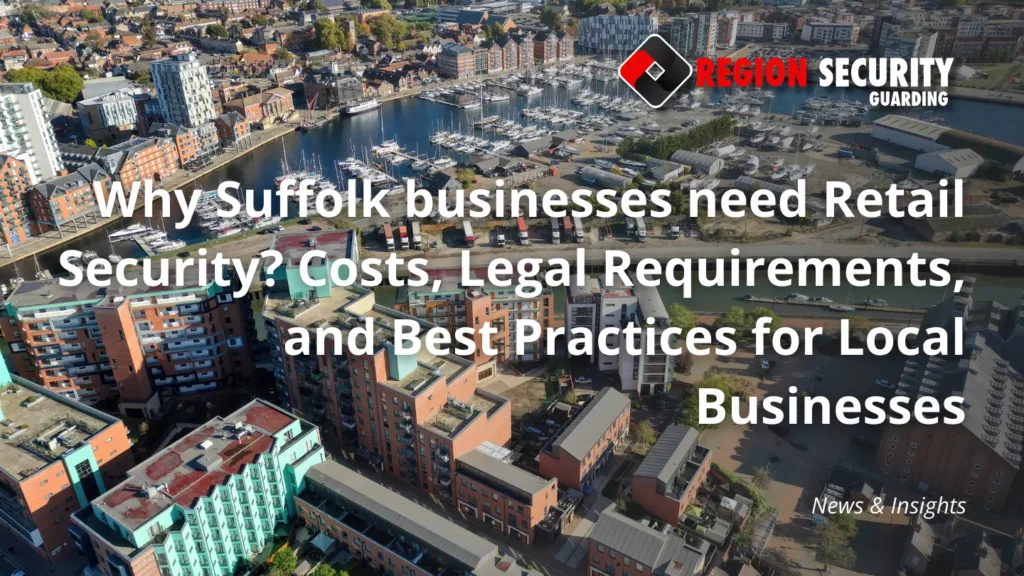
Retail security in Suffolk is rarely about dramatic crime spikes. It is about control. Control over stock movement, customer flow, staff safety, and the quiet gaps that appear during ordinary trading hours. Suffolk’s retail landscape is spread out, not dense. Market towns, destination stores, coastal shopping areas, and commuter-linked centres all operate on different rhythms. That matters.
Retail crime here is shaped less by volume and more by timing. A short window. A quiet aisle. A car park with no one watching. These are the moments that matter most. In many locations, police presence is limited, and response times are not built for retail loss prevention.
Cameras help, but they do not intervene. They record what has already happened. For businesses weighing real control against growing exposure, the question is no longer theoretical. It is practical. That is why conversations around Why Suffolk businesses need Retail Security? are now happening at the board level, not just after incidents.
Retail Security Basics in Suffolk
Retail Security in a Suffolk Business Environment
Retail security in Suffolk works differently from larger urban centres. The landscape is spread out. Stores sit in market towns, coastal retail zones, and commuter corridors rather than dense city blocks. That layout shapes how security functions day to day. Visibility matters more than volume. Timing matters more than numbers. A guard’s role here is not to manage crowds but to manage moments.
Many Suffolk retailers operate with limited on-site staff and long trading hours. That creates quiet gaps where risk can surface without warning. Retail manned guarding fills those gaps by providing presence, judgement, and control where technology alone cannot adapt.
What retail manned guarding actually means in Suffolk
Retail-focused guarding is built around people and behaviour. Guards move through sales floors, entrances, and shared spaces. They observe patterns. They engage when needed. Static presence, by contrast, stays fixed. It reassures but does not adjust. Remote monitoring watches from afar. It records. It alerts. It does not intervene.
In Suffolk stores, discretion matters. A heavy-handed approach disrupts trade. A passive approach invites loss. Guards here rely on calm interaction, early intervention, and quiet authority. Customer-facing judgement is not an add-on. It is the role.
How Suffolk retail crime patterns influence guard deployment
Retail crime across Suffolk is largely opportunistic. It is shaped by chance rather than scale. Repeat offenders do exist, but most incidents happen when a store appears unobserved. Smaller towns often face longer response gaps, which increases the value of on-site decision-making.
Across the wider East of England, retail pressure varies. In Norfolk, coastal footfall changes risk patterns seasonally. In Essex, higher density brings different challenges. Suffolk sits between those extremes, which makes localised guarding models more effective than generic ones.
Timing risks for Suffolk retailers
Timing is the real driver of loss. Midday theft peaks often align with staff rotation and delivery overlap. Late evenings bring anti-social behaviour, especially in shared retail areas. Stock movement windows create exposure when attention shifts away from the shop floor.
In commuter-linked centres, which also appear across Cambridgeshire and Hertfordshire, risk follows routine rather than volume. Guards who understand these rhythms reduce loss simply by being present at the right time, in the right place, for the right reason.
Retail-Specific Vulnerabilities Across Suffolk
Where Retail Risk Concentrates Locally
Retail risk in Suffolk does not spread evenly. It clusters, and certain environments create pressure points where staff feel exposed, and losses quietly grow. These risks are shaped by layout, timing, and how visible authority appears during everyday trading.
Understanding where these vulnerabilities sit allows retailers to place security where it actually changes behaviour, rather than spreading coverage thin and hoping for the best.
High streets and market town retail
Market towns form the backbone of Suffolk’s retail economy. They attract steady footfall, familiar faces, and repeat customers. That familiarity can be misleading. Verbal abuse and staff intimidation often appear here precisely because environments feel informal. Offenders test boundaries where they expect tolerance.
Guards in these settings rarely intervene physically. Their value lies in presence and calm control. De-escalation becomes a commercial tool, not a security tactic. A measured conversation, an early interruption, or quiet authority near a till often stops an incident before it becomes visible to customers or staff morale takes a hit.
Similar patterns appear across parts of the wider East of England, though Suffolk’s smaller scale makes timing even more critical.
Retail parks and destination shopping areas
Retail parks operate differently. Push-out theft is more common, often linked to vehicle access and fast exits. Shared car parks create blind spots where responsibility feels blurred. A store may be secure inside, yet exposed the moment someone steps outside with unpaid goods.
Vehicle-linked crime adds another layer. Offenders know escape routes. They know when staff numbers drop. Guards positioned to observe movement rather than stand still disrupt that certainty. Visibility across entrances, walkways, and parking areas changes risk calculations in ways cameras alone cannot.
In higher-density counties such as Essex, volume drives pressure. In Suffolk, opportunity does.
Seasonal retail pressure is unique to Suffolk
Seasonality reshapes Suffolk retail more than many realise. Summer coastal trade brings unfamiliar faces and temporary footfall surges. Events draw visitors who do not know the layout or expectations of local centres. These shifts create short windows where normal controls weaken.
Retailers see similar seasonal strain in counties like Norfolk, though Suffolk’s dispersed geography spreads that pressure across multiple locations. By contrast, South West seasonal retail often concentrates risk into single destinations, which changes how security is deployed. Suffolk requires flexibility instead.
Understanding these structural differences allows retailers to plan security that adjusts with the calendar, rather than reacting after patterns repeat.
Retail Security Compliance Suffolk Businesses Must Understand
Legal compliance in retail security is rarely the part business owners enjoy reviewing, yet it is the part that carries the longest shadow. When something goes wrong, whether that is a staff incident, a serious theft, or an insurance claim, the first questions are not about intent or effort. They are about licensing, vetting, and documented processes. In Suffolk, where retail sites are often spread out, and police response is not immediate, compliance becomes a form of risk control in its own right.
Retail security that is compliant is easier to defend, easier to insure, and far less likely to unravel under scrutiny. That is why this section matters.
SIA licensing for retail security guards
Anyone carrying out security duties in a retail space must hold a valid Security Industry Authority SIA licence. There are no grey areas here. If a guard is watching entrances, walking the shop floor, checking behaviour, or stepping in during an incident, the role is licensable. The badge is not optional. It is the legal starting point.
Using an unlicensed guard creates real risk. It is a criminal offence, not an admin slip. Responsibility also sits with the retailer. If a business allows unlicensed guarding, even through oversight, it can face fines, damaged reputation, and insurance problems. In Suffolk, where on-site presence often matters more than fast outside response, that exposure grows quickly.
These rules apply everywhere in the East of England. Market towns, coastal shops, and commuter centres all follow the same standard. There are no local shortcuts. If security is present, licensing must be in place.
Vetting standards (BS 7858) and DBS expectations
Licensing is the entry point. Vetting is the deeper layer. Retail environments involve regular interaction with staff, customers, and cash-handling areas. That level of access requires higher trust thresholds than many other outsourced services.
BS 7858 screening is widely recognised as best practice for security roles. It covers identity verification, employment history, and criminal background checks over a defined period. While individual guards undergo DBS checks as part of licensing, BS 7858 adds structure and assurance for businesses that need confidence, not assumptions.
What matters for clients is not holding sensitive personal data. Retailers should verify that vetting has taken place, not store certificates themselves. A clear statement of compliance from a provider is usually sufficient. This approach protects privacy, reduces administrative risk, and still provides assurance.
Across neighbouring counties such as Cambridgeshire, larger retail centres often insist on this level of screening as a condition of contract. Suffolk retailers benefit from applying the same standard, even when scale feels smaller.
Security company licensing and audit readiness
Compliance is not limited to individuals. Security companies supplying retail guards must also meet licensing and regulatory expectations. A properly licensed provider should be able to demonstrate a clear compliance history without hesitation.
Documentation that proves this includes current SIA licences, evidence of screening processes, insurance certificates, and written operating procedures. These records matter most when pressure arrives. Insurers, local authorities, and investigators will all look for consistency between what was promised and what was delivered.
Retailers engaging in retail security guarding in Suffolk often underestimate the value of audit readiness. It is not about anticipating failure. It is about ensuring that, if scrutiny comes, there is nothing to explain away. This level of preparedness is increasingly expected, not exceptional.
In counties with higher retail density, such as Essex, audit expectations have tightened in recent years. That shift is slowly influencing standards across the region.
CCTV, GDPR, and guard interaction with footage
Most retail sites now operate CCTV systems. When guards interact with those systems, compliance with data protection law becomes part of daily operations. Lawful use of CCTV requires clear signage, a defined purpose, controlled access to footage, and sensible retention periods.
Guards may review footage to support incident response, verify events, or assist investigations. That interaction must sit within documented policy. Footage should not be accessed casually or stored indefinitely. Retailers remain responsible for how data is handled on their premises, even when third parties are involved.
In dispersed retail environments like those common in Suffolk, CCTV often fills visibility gaps. However, without compliant handling, it can introduce new risks rather than reduce them. Proper alignment between guarding and data protection protects both staff and customers.
Martyn’s Law and retail venues in Suffolk
Martyn’s Law, also known as the Protect Duty, will reshape expectations for venues that host the public. While its primary focus is counter-terrorism preparedness, retail spaces are firmly within its scope where footfall is high or events are hosted.
For shopping centres and event-hosting retailers in Suffolk, this means clearer planning, stronger documentation, and defined response roles. Manned guards are likely to play a central role in meeting these expectations. Not through force, but through awareness, coordination, and early intervention.
Retailers in counties such as Hertfordshire, where mixed-use developments are common, are already adjusting policies in anticipation. Suffolk businesses will face similar expectations as guidance becomes clearer.
The key point is simple. Compliance is not a burden added after security decisions are made. It is part of deciding what effective retail security actually looks like. When licensing, vetting, data protection, and future obligations align, security becomes defensible, insurable, and sustainable.
Costs, Contracts & Deployment in Suffolk Retail Security
Understanding Retail Security Costs in Suffolk
Cost is often the hardest part of retail security to discuss openly, not because it is unclear, but because it is shaped by many quiet variables that do not appear on a rate card. In Suffolk, those variables are tied to geography, trading patterns, and how visible a retail site really is during the hours that matter.
Retail security here is not priced on volume alone. It is priced on exposure. Two stores with the same floor space can face very different costs if one sits on a busy town centre street and the other on the edge of a retail park with shared access and long sightlines. Understanding that difference is what allows retailers to budget without surprises.
What actually drives retail guarding costs locally
Location is the first driver. Town centre retail usually requires a more visible presence. Guards here are part of the customer environment. They interact, observe, and intervene early. Retail parks operate differently. Coverage often focuses on entrances, car parks, and movement between units. The risk profile shifts from confrontation to loss prevention and vehicle-linked theft.
Time of day matters just as much. Daytime cover often supports staff during peak footfall and delivery overlap. Evening cover shifts toward deterrence and control, especially where footfall drops and natural surveillance fades. A store that trades late will usually see higher exposure after dark, even if daytime incidents are rare.
Skill expectations complete the picture. Retail guarding is not simply about standing watch. It demands discernment, restraint, and communication. Guards expected to de-escalate situations, support staff, and protect the customer experience command different rates than static coverage. This is where working with an experienced provider offering retail security guarding in Suffolk makes a practical difference, because expectations are clearer from the outset.
Across the wider East of England, these drivers appear consistently, though their weight varies. In areas such as Norfolk, seasonal trade alters the balance. In more densely populated counties, pressure comes from volume. Suffolk sits between these models, which is why local context matters.
Inflation, pricing stability, and budget forecasting
Retail security costs do not jump overnight, but they rarely stand still. Inflation influences wages, training requirements, and compliance costs. In labour-led services, these changes flow directly into pricing over time.
What distinguishes Suffolk is the pace rather than the direction of change. Cost movement tends to be gradual, which makes forecasting possible if contracts are structured sensibly. Many retailers now plan for steady adjustments rather than renegotiating from scratch each year. This approach avoids sudden gaps in coverage and supports continuity.
By comparison, South West retail markets often experience sharper seasonal swings. Tourist-heavy areas see demand spike, then drop, which pushes pricing up and down more abruptly. Suffolk’s retail environment is steadier. That stability allows businesses to plan security spend as part of long-term operational control rather than a reactive expense.
Retailers operating across multiple counties, including Cambridgeshire, often note that Suffolk offers more predictable cost behaviour, provided expectations are set early.
Contract structures and mobilisation timelines
Retail security contracts in Suffolk tend to fall into two broad categories. Short-term cover is used for store openings, refurbishments, or temporary risk increases. These contracts are flexible but usually cost more per hour due to rapid mobilisation and shorter commitment.
Long-term arrangements support stability. They allow guards to learn the site, understand staff routines, and recognise patterns. From a business perspective, this continuity often delivers better value than rotating short-term cover, even if the headline rate appears higher.
Mobilisation timelines are another practical concern. In urgent situations, cover can often be arranged quickly if providers already operate in the area. Planned deployments take longer, not because of reluctance, but because induction, site knowledge, and compliance checks matter. Rushing these steps increases risk rather than reducing it.
Retailers with estates spread into counties such as Hertfordshire often apply the same logic across sites, favouring consistency over speed when planning long-term cover.
Insurance positioning for guarded retail sites
One benefit of on-site retail security that is often overlooked is how it shapes insurance decisions. Insurers do not assess risk based only on whether a guard is present. They look at how security is organised, how incidents are recorded, and whether procedures are followed in a consistent way. Well-managed security reduces uncertainty, and uncertainty is what insurers price for.
Clear patrol records, detailed incident logs, access control notes, and defined escalation steps all help show that risks are being actively managed. For retail sites that handle valuable or fast-moving goods, this level of documentation can influence both premiums and how smoothly claims are handled. It provides evidence that loss was not left to chance.
In Suffolk, where response times can vary depending on location, insurers place extra weight on immediate on-site intervention. Guards who understand the layout, routines, and weak points of a site reduce not only loss, but doubt. That reduction in doubt is what underwriters respond to most.
Viewed this way, retail security is not just an operating cost. When it aligns with risk planning and insurance expectations, it becomes a practical tool for financial stability rather than an expense absorbed and forgotten.
Training, Daily Operations & Retail Guard Duties
How Retail Security Operates Day-to-Day in Suffolk
Retail security works best when it feels ordinary. Not invisible, but familiar. In Suffolk, that familiarity matters because many retail environments rely on routine rather than constant supervision. Guards become part of the daily rhythm, which means their training and operations must support consistency without becoming predictable.
Suffolk’s retail settings are varied. Market towns operate on trust and regular faces. Retail parks rely on shared spaces and movement. Coastal centres change with the season. Across these environments, good security is rarely loud. It is steady. It supports staff. It reduces loss by removing opportunity rather than reacting after the fact.
Retail-specific guard training focus
Retail guard training begins with conflict handling, but not in the way many imagine. The emphasis is on prevention. Guards learn to recognise early signs of tension, read behaviour, and intervene before situations escalate. This approach protects staff and customers without disrupting trade. In Suffolk, where stores often value a calm atmosphere, that balance is essential.
Customer interaction is another core focus. Retail guards are not separate from the shopping experience. They are part of it. Clear communication, polite authority, and an understanding of store culture allow guards to act without creating discomfort. This skill is particularly important in smaller communities, where reputation travels quickly, and heavy-handed responses can do lasting harm.
Safeguarding awareness completes the picture. Retail environments bring together vulnerable people, young staff, and the public. Guards must understand how to respond appropriately when concerns arise, whether that involves lost children, distressed customers, or staff facing intimidation. Training here is about awareness and escalation, not enforcement.
Across the wider East of England, retailers increasingly expect this blend of skills. In counties such as Norfolk, seasonal trade adds pressure, while in Essex, higher footfall brings different challenges. Suffolk sits between these realities, which makes adaptable training especially valuable.
Shift starts, handovers, and continuity
The first minutes of a shift often determine how effective the rest will be. Guards arriving on site review handover notes, assess the environment, and confirm that nothing feels out of place. This process is not ceremonial. It builds situational awareness before problems surface.
Handover quality has a direct impact on loss prevention. Clear notes about earlier incidents, repeat visitors, delivery schedules, or maintenance issues allow incoming guards to pick up where the last shift ended. When handovers are rushed or vague, small gaps appear. Those gaps are where loss tends to occur.
Continuity matters even more in Suffolk’s retail settings because staffing levels are often lean. Guards who understand the site reduce reliance on reactive measures. Over time, patterns become visible. Quiet hours. Busy corners. Predictable risks. This accumulated knowledge is one of the reasons retailers choose ongoing cover rather than rotating short-term presence, especially when working with an experienced provider offering retail security guarding in Suffolk.
Retailers operating across counties like Cambridgeshire often apply the same principles, valuing continuity because it supports both security and customer confidence.
Patrol logic in retail environments
Patrols in retail settings are not about constant movement. They are about purposeful visibility. Guards position themselves where presence changes behaviour. Entrances, high-value areas, and shared spaces receive attention, while timing remains flexible enough to avoid predictability.
Visibility reassures staff and customers. It also signals to potential offenders that someone is paying attention. Predictability, however, invites exploitation. Effective patrol logic balances the two. Guards vary routes and timing while maintaining a consistent presence where it matters most.
In retail parks, patrols often extend beyond store interiors. Walkways and parking areas become part of the security envelope. In town centres, movement focuses more on entrances and shared access points. These choices are shaped by layout rather than theory.
Retail environments across Hertfordshire and other commuter-linked areas show similar patterns, but Suffolk’s dispersed geography places extra value on guards who understand how spaces connect.
Reporting, logs, and evidence trails
Documentation is the quiet backbone of retail security. Patrol logs, incident reports, and access records provide more than a paper trail. They create evidence. Evidence supports insurance claims, internal reviews, and informed decision-making.
Good reporting is clear and factual. It records what happened, when it happened, and how it was handled. Over time, these records reveal trends that might otherwise go unnoticed. Repeat issues in the same area. Incidents tied to specific times. Patterns linked to deliveries or staffing changes.
For retailers, this information has practical value. It informs adjustments to coverage. It supports conversations with insurers. It provides reassurance that security is doing more than occupying space. In Suffolk, where retail risks are shaped by timing and opportunity, these insights often matter more than raw incident counts.
The daily work of retail security may appear routine, but its impact builds quietly. When training, operations, and documentation align, security becomes part of how a store runs smoothly rather than a separate function reacting to problems.
Performance, Risks & Operational Challenges
Measuring Retail Security Effectiveness
Retail security performance is rarely about dramatic intervention. Most of the time, success looks quiet. Fewer incidents. Calmer staff. Fewer losses that never quite show up on a report. For Suffolk retailers, where risk is shaped by timing and opportunity rather than constant pressure, measuring effectiveness means looking at the right signals, not just counting events.
Security that performs well does not draw attention to itself. It supports daily operations in ways that are easy to overlook until they disappear. That is why performance needs to be measured deliberately, with metrics that reflect real control rather than surface activity.
KPIs Suffolk retailers should track
Response time is one of the most practical indicators. How quickly a guard notices an issue and moves to address it often determines whether an incident stays small or grows. In Suffolk, where sites can be spread out and external response may take time, on-site reaction speed matters more than escalation volume.
Presence verification is another key measure. This is not about checking boxes. It is about knowing that guards are where they should be, when they should be there. Consistent presence in the right places changes behaviour. Gaps, even short ones, invite testing.
Incident clarity completes the picture. Clear, factual reporting allows retailers to understand what actually happened rather than relying on assumptions. Good reports show patterns over time. Poor reports hide them. This clarity supports internal decisions and external conversations, especially with insurers.
Retailers across the wider East of England increasingly use these indicators because they reflect outcomes, not activity. In counties such as Norfolk, where seasonal change alters risk, these measures help businesses adapt without overreacting.
Weather and environmental effects on retail patrols
Weather is an underestimated factor in retail security performance. In Suffolk, rain, wind, and reduced daylight change how spaces are used. Footfall shifts. Visibility drops. Certain areas become quieter while others draw more activity.
These changes affect patrol effectiveness. Poor lighting after early dusk increases blind spots. Wet conditions slow movement and alter where people gather. Guards who understand these patterns adjust naturally. Those without local awareness may miss subtle shifts that create opportunity.
Environmental awareness is not about forecasting storms. It is about recognising how conditions affect behaviour. Retailers who factor this into performance reviews gain a clearer picture of why incidents rise or fall at certain times, rather than assuming changes are random.
Similar considerations appear in neighbouring areas such as Cambridgeshire, though Suffolk’s mix of coastal and inland retail makes these effects more pronounced.
Fatigue and shift balance
Fatigue is not a staffing issue here. It is a service reliability issue. Tired guards are slower to notice changes and slower to respond. In retail environments that rely on early intervention, even small delays matter.
Well-balanced shifts support consistency. They reduce errors in observation and reporting. They maintain calm interaction with staff and customers. For Suffolk retailers, this consistency is part of what they are paying for when they engage a professional provider offering retail security guarding in Suffolk.
Retailers operating across counties like Essex or Hertfordshire often take a similar view, treating guard reliability as a performance factor rather than an internal concern. The principle is the same everywhere. When guards are alert and supported, security works quietly. When they are not, gaps appear.
Performance, in the end, is about trust. Trust that someone is watching. Trust that they will respond. Trust that issues will be recorded clearly. When those elements align, retail security becomes a stabilising force rather than a reactive cost.
Technology & Future Trends in Suffolk Retail Security
How Retail Security Is Evolving in Suffolk
Technology has not replaced retail security in Suffolk. It has changed how it works. The shift is subtle, and that subtlety matters. Retailers are not looking for futuristic systems that promise everything. They are looking for tools that improve visibility and reduce gaps that occur during ordinary trading hours.
Suffolk’s retail landscape, shaped by market towns, coastal centres, and dispersed retail parks, does not benefit from one-size-fits-all solutions. Technology here succeeds when it strengthens on-site presence rather than competing with it.
CCTV and manned guarding as a system
CCTV on its own records. Manned guarding on its own observes. Together, they form a system. Guards use cameras to extend their awareness beyond line of sight, while cameras rely on guards to interpret context and act.
In many Suffolk retail sites, CCTV covers entrances, stock areas, and car parks, but it cannot judge intent. Guards can. When systems are integrated properly, guards use footage to verify concerns quickly, rather than reacting late or escalating unnecessarily. This reduces disruption and improves control.
Across the wider East of England, retailers increasingly expect this blended approach. In places such as Norfolk, where seasonal footfall changes risk patterns, the combination provides flexibility without constant staffing changes.
AI analytics supporting theft detection
AI analytics now play a quiet supporting role in retail security. These systems highlight unusual movement, repeated behaviour, or patterns that deviate from the norm. They do not make decisions. They point out attention.
For Suffolk retailers, this matters because risk often appears in short windows. AI tools can flag those windows earlier, allowing guards to focus where it counts. The benefit is not automation. It is prioritisation.
Used carefully, analytics reduce the time spent watching screens and increase the time spent managing the floor. That balance aligns well with retail environments where customer experience still matters.
Remote monitoring for multi-site retailers
Remote monitoring has become more relevant as retailers manage multiple locations with lean on-site teams. Monitoring centres can verify alarms, observe after-hours activity, and support lone-worker safety.
In Suffolk, where sites are often spread out, remote monitoring works best when paired with on-site response. It provides oversight without delay, while guards provide action. Retailers operating across counties such as Cambridgeshire often adopt this hybrid model to maintain consistency without overextending resources.
The value lies in coordination. When systems talk to each other, the response becomes smoother and less reactive.
Drones and large retail parks
Drones are not common in everyday retail security, but they are appearing in larger retail parks and edge-of-town developments. Their role is simple. They provide rapid visibility across wide areas, especially after hours.
For Suffolk retail parks with shared access roads and expansive car parks, drones can identify issues quickly and guide on-site response. They do not replace foot patrols. They reduce uncertainty.
Retail environments in more densely populated counties such as Essex face different constraints, but Suffolk’s open layouts make aerial support more practical in specific cases.
Green security practices
Sustainability is becoming part of procurement conversations, even in security. Retailers are increasingly aware of energy use, lighting efficiency, and paper reduction.
Green security practices include motion-activated lighting, digital reporting, and low-emission patrol vehicles. These changes rarely affect day-to-day operations, but they influence long-term cost and compliance. For Suffolk retailers, where sites may operate late into the evening, efficient lighting alone can improve both safety and sustainability.
Martyn’s Law and future retail expectations
Martyn’s Law, also known as the Protect Duty, will shape future expectations for public-facing spaces. Retail environments that host events, seasonal markets, or high footfall will need clearer plans and better documentation.
In Suffolk, this does not mean a dramatic change. It means preparation. Guards will be expected to understand escalation routes, observe behaviour, and support evacuation planning where required. Retailers in counties such as Hertfordshire are already adjusting policies in anticipation.
The broader trend is clear. Technology will continue to support retail security, but it will not replace human presence. In Suffolk’s retail environments, the future belongs to systems that enhance awareness, strengthen response, and keep control where it belongs, on the ground.
Conclusion
Retail security in Suffolk is not about chasing headlines or copying big-city playbooks that do not match local life. It is about keeping everyday control. Timing matters here. Layout matters. Visibility matters. Market towns, retail parks, coastal centres, and commuter routes all face different pressures, but the risk shows up in the same way. When oversight is unclear, small gaps repeat. Loss follows routine.
Across the East of England, businesses are taking a harder look at how they protect people and stock during normal trading hours. Not after something goes wrong. Suffolk is part of that shift. Police presence is limited. Cameras help, but only show what has already happened. Store teams cannot be asked to manage conflict while serving customers and keeping shelves moving.
That is why the question of Why Suffolk businesses need Retail Security has moved into boardroom conversations. It is a business decision. The right approach brings calm, continuity, and real control. It helps owners see risk as it is, not as it is sold. And it supports choices that fit how each site truly works, day after day, without noise or pressure.
Frequently Asked Questions
Do retail security guards in Suffolk need SIA licences?
Yes. Any guard carrying out licensable activity must hold a valid SIA licence. This applies whether the role involves patrolling, controlling access, or dealing with incidents on the shop floor. For retailers in Suffolk, this is a legal baseline, not a quality upgrade.
Are DBS checks required for retail guarding roles?
DBS checks form part of the wider vetting process. Most reputable providers also follow BS 7858 screening. Retailers do not need to hold these records themselves, but they should always confirm that checks are completed and current.
How fast can retail security be deployed locally?
Deployment speed depends on urgency and scale. Short-term cover can often be arranged within days if providers already operate nearby. Planned, long-term cover usually takes longer so that induction, site knowledge, and compliance are handled properly.
Can retail guarding reduce insurance risk?
Often, yes. Insurers look favourably on documented on-site presence, clear reporting, and consistent patrols. Guarding does not remove risk, but it can reduce uncertainty, which matters during claims.
Is CCTV alone enough for Suffolk retailers?
CCTV records events. It does not intervene. In areas with limited police presence, cameras work best when supported by people who can assess and act in real time.
How does Martyn’s Law affect retail premises?
For venues with public access or events, Martyn’s Law raises expectations around preparedness. This includes clearer procedures, awareness, and defined response roles, often supported by trained on-site staff.
What hours pose the highest retail risk in Suffolk?
Risk often peaks during busy midday periods and again in the evening when footfall drops. Delivery windows and staff changeovers also create short exposure gaps.
How should retailers assess value versus cost?
Value comes from fit, not price alone. Retailers should look at coverage quality, documentation, response consistency, and how well security aligns with how the site actually operates.