Sheffield’s industrial heritage runs deep. From the world‑renowned Advanced Manufacturing Park to the sprawling estates at Tinsley, Holbrook and Carbrook, the city remains a powerhouse of UK manufacturing and logistics. But with that industrial strength comes constant vehicle movements, contractor visits, shift changes and deliveries a daily rhythm that creates real security challenges.
Gate security is no longer simply about controlling entry. It plays a vital role in operational efficiency, health and safety, visitor accountability and protecting valuable assets. A poorly managed gate causes delays, compromises safety and leaves sites exposed to theft and unauthorised access. Get it right, and it becomes a seamless part of your operation.
This guide explores gate security for Sheffield industrial estates, covering access control, vehicle management, visitor handling and the practical steps that keep sites secure without slowing production.
Table of Contents
Why Gate Security Matters for Sheffield Industrial Estates
Sheffield’s industrial estates are home to a diverse mix of occupiers: precision engineers, steel processors, logistics firms, advanced manufacturers and independent workshops. These sites share access roads, rely on constant vehicle movements and see a steady flow of contractors, suppliers and delivery drivers.
The risks are varied. Legacy buildings and repurposed mills often have multiple informal access points and awkward sightlines that make monitoring difficult. Daytime issues include distraction theft during busy loading periods, unauthorised access by contractors, and delivery disputes. Night‑time brings trespass, break‑ins, utility tampering and vehicle theft. Industrial and logistics estates at Tinsley, Temple Hborough and Rotherham Road face persistent exposure to plant theft and unauthorised access.
The gate is the first operational control point. It determines who enters, who leaves and what happens in between. For estates managing high-value manufacturing operations, specialist factory security services provide the expertise needed to protect both assets and daily operations.”
Industrial Estate Access Control: Building the First Layer of Protection
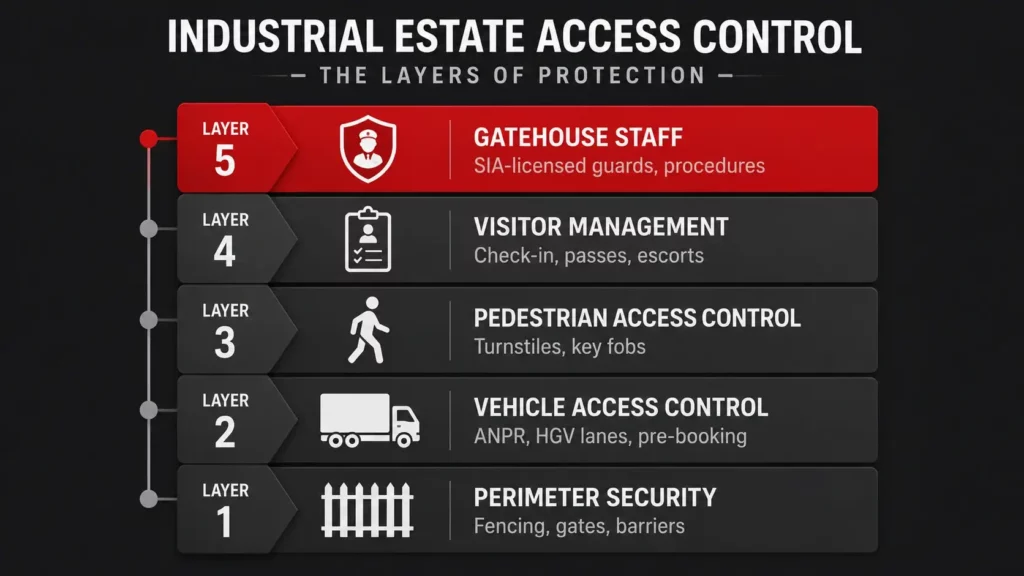
Access control is about knowing who is on your site at all times. For a multi‑tenant industrial estate, that means managing multiple workforces, visitors and vehicles through a single controlled entry point.
Key components include:
- Controlled entry points: One or two gates that funnel all traffic through a check‑in process.
- Pedestrian vs vehicle access: Separate lanes for foot traffic and vehicles reduce congestion and improve safety.
- ID verification: All employees, contractors and visitors should be identifiable on entry.
- Temporary passes: Short‑term access for contractors and visitors with clear expiry dates.
- Access barriers: Boom gates or rising kerbs that physically control vehicle entry.
- ANPR systems: Automatic number plate recognition logs every vehicle that enters and exits.
- Access logs: Digital records provide accountability and support incident investigations.
- Employee credentials: Key fobs, cards or mobile credentials for authorised staff.
Access barriers and boom gates are essential components of industrial estate access control. However, they must be installed and maintained to the correct safety standards. The HSE safety standards for powered gates and barriers provide detailed guidance on compliance and risk assessment.
Commercial Vehicle Access Management Without Delaying Operations
Industrial estates see high volumes of HGVs, supplier vans, and service vehicles. Managing commercial vehicle access without creating bottlenecks is a balancing act.
Common challenges include:
- HGV arrivals: Peak delivery times that coincide with shift changes.
- Delivery scheduling: Multiple deliveries arriving simultaneously.
- Supplier verification: Confirming that drivers and vehicles are legitimate.
- Courier access: Fast‑turnaround vehicles that need quick entry.
- Peak‑hour congestion: Vehicles queuing on public roads outside the estate.
- Emergency vehicle access: Keeping routes clear for fire, ambulance and police.
- Driver identification: Verifying driver credentials quickly.
Practical solutions include:
- Pre‑booked delivery slots: Spreading HGV arrivals across the day to avoid congestion.
- ANPR integration: Known vehicles are automatically recognised and processed.
- Driver self‑service kiosks: Drivers can check in without waiting for gatehouse staff.
- Separate HGV lanes: Keeping freight traffic separate from employee and visitor vehicles.
The goal is to verify vehicles and drivers thoroughly without holding up the operation. A good system processes vehicles in seconds, not minutes.
Gatehouse Security Procedures That Support Daily Operations
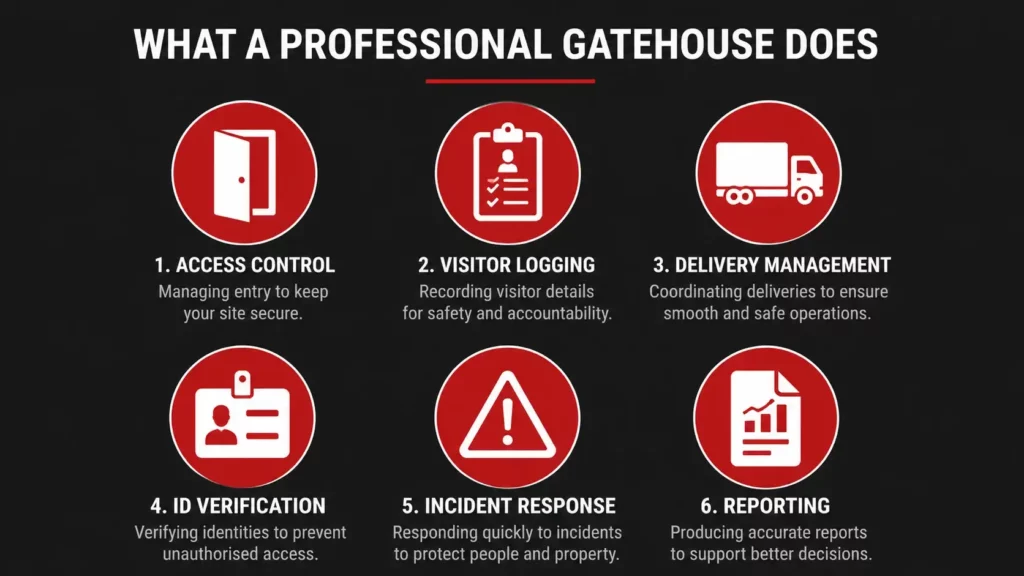
A gatehouse is not a reception desk. It is an operational control point that manages the flow of people and vehicles through the site. Consistent procedures are more important than complex ones.
Effective gatehouse security procedures include:
- Visitor check‑in: All visitors sign in, state their purpose and receive a pass.
- Delivery documentation: Delivery notes and manifests are checked before vehicles enter.
- Contractor sign‑in: Contractors are logged with their company, vehicle and expected duration.
- Incident logging: Every incident, near‑miss and security concern is recorded.
- Lost access cards: Clear process for reporting and replacing lost credentials.
- Emergency procedures: Gatehouse staff know their role in fire, medical and security emergencies.
- Shift handovers: Staff going off duty brief the arriving staff on any important matters and pending tasks.
It is very important that the procedures be performed every single time. This makes the gatehouse predictable and reliable. Failing to perform them in the midst of busyness makes the site unpredictable.
Industrial Site Visitor Management: Protecting People and Productivity
Visitor management is not just signing a list. Industrial sites attract all kinds of visitors: contractors, engineers, maintenance workers, auditors, customers and delivery drivers.
Effective visitor management includes:
- Visitor passes: Visible identification for all non‑employees.
- Escort policies: Contractors in restricted areas are accompanied by authorised staff.
- Pre‑registration: Visitors booked in advance with their details pre‑verified.
- GDPR considerations: Visitor data is collected, stored and disposed of properly.
- Accountability: Every visitor is linked to a sponsor or point of contact.
Poor visitor management leads to unauthorised access, security breaches and health and safety risks. A structured approach protects both people and productivity.
The Importance of SIA Licensed Security Guards at Industrial Gatehouses
Security Industry Authority (SIA) licensing is a legal requirement for front‑line security operatives in the UK. Any guard working at an industrial gatehouse must hold a valid SIA licence.
Legal responsibilities aside, SIA‑licensed guards bring professionalism and accountability. They are trained in conflict management, incident reporting and emergency response. They understand the importance of customer service and site familiarity.
For an industrial gatehouse, an SIA‑licensed guard provides:
- Professional conflict management: De‑escalating disputes with drivers, visitors or staff.
- Incident reporting: Clear, accurate logs that support investigations and insurance claims.
- Emergency response: Trained to act quickly in fire, medical or security emergencies.
- Customer service: Presenting a good image to visitors and contractors.
- Site familiarity: Understanding the site layout and its personnel and procedures.
The use of unlicensed and untrained staff means increased liability under Health & Safety and Corporate Manslaughter legislation. The SIA-licensed staff can help the site manager know that the gatehouse is in good hands.
Why 24/7 Industrial Estate Monitoring Complements Gate Security
Gate security is most effective when supported by 24/7 monitoring. Technology does not replace the gatehouse – it extends its reach.
Key monitoring elements include:
- CCTV: Covering entry points, loading bays, yard areas and perimeter blind spots.
- Lighting: Well‑lit areas deter intruders and support camera coverage.
- Alarm systems: Perimeter and building alarms alert staff to unauthorised access.
- Patrolling: Mobile guards monitor areas which cannot be monitored using fixed cameras.
- Monitoring: Remote teams are able to monitor several sites at once.
- Presence: Guards patrolling the site send a strong message of protection.
Technology helps with gate security by giving an extra set of eyes and ears. Technology also helps to gather evidence in case of any incident. But technology should act as a supplement, not a substitute, to on-site security.
Industrial Yard Security: Extending Protection Beyond the Gate
Protection does not end after going through the gate. The yard, storage and loading areas also need protection.
Key yard security considerations include:
- Storage compounds: High‑value materials and equipment stored in secure, locked areas.
- Plant equipment: Machinery, vehicles and tools are secured when not in use.
- Loading areas: Monitored and controlled to prevent unauthorised access.
- Fuel storage: Fuel tanks and drums are kept in secure, well‑lit locations.
- Vehicle parking: Employee and visitor vehicles are parked in monitored areas.
- Blind spots: Areas out of sight of the gatehouse are covered by CCTV or patrols.
Yard security is about protecting the assets that sit between buildings. It requires a combination of physical measures, monitoring and active patrols.
Best Practices for Effective Gate Security
Effective gate security is built on consistent practices. Use this checklist to review your current arrangements:
- Keep visitor records updated by regularly reviewing and purging old records.
- Confirm whether contractors are scheduled to come to the site and whether they are expected and authorised.
- Create separate walkways and drive lanes in order to minimise possible conflict areas.
- Check access rights on a consistent basis and deny access for employees who have quit their job.
- Provide training for the gatehouse staff, including training in procedures, customer service and emergency procedures.
- Carry out security audits in order to detect any weak spots.
- Test emergency procedures including evacuation drills.
- Track delivery trends in order to discover any abnormalities.
These steps are not difficult, yet they do demand discipline and precision. For estates looking to implement these measures, working with a professional security firm in Sheffield ensures local expertise and reliable gatehouse staffing.
Frequently Asked Questions
1. What is the most effective security measure for an industrial estate?
A combination of access control, SIA‑licensed gatehouse guards, CCTV monitoring and clear procedures. No single measure works alone – a layered approach is most effective.
2. How do I choose the right gatehouse security provider?
Look for SIA Approved Contractor status, experience with industrial sites, clear reporting processes and a flexible staffing model. Local knowledge of Sheffield’s estates is a bonus.
3. What are the legal requirements for gatehouse security?
All front‑line security guards must hold a valid SIA licence. Gatehouse procedures must comply with health and safety regulations and data protection laws.
4. How does access control work in a multi‑tenant industrial estate?
Each tenant’s employees are issued with access credentials. Visitors and contractors are logged on arrival and escorted as required. Access is monitored and reviewed regularly.
5. How can I manage HGV access without causing bottlenecks?
Use pre‑booked delivery slots, ANPR to speed known vehicles and separate lanes for freight and employee traffic. A well‑designed gatehouse processes vehicles quickly without compromising security.
6. What is the role of CCTV in gatehouse security?
CCTV covers entry points, loading bays and yard areas. It provides evidence in the event of an incident and acts as a deterrent. It supports, rather than replaces, the gatehouse guard.
Conclusion
The concept of gate security is more than just keeping unauthorised people out; it increases efficiency, provides protection for people and property, and helps build up overall resiliency within the industrial estate itself.
In the case of Sheffield industrial estates, which house some advanced manufacturers and logistics companies as well as precision engineers, gate security is a fundamental operational need.
Businesses reviewing their gate security arrangements may also benefit from professionally managed industrial security solutions. Whether you need gatehouse security or factory security, the right approach combines people, procedures and technology to keep your site secure.