London’s office market is undergoing its most significant supply squeeze in a decade. Grade A space is scarcer than it has been in years, and demand for premium offices continues to outpace supply. When office space becomes this valuable, the people, data and assets inside become more attractive targets.
Corporate security London is no longer about locking doors at night and trusting a receptionist during the day. In a market where a single floor can command premium rents, protecting people, property, and reputation demands a layered approach. This article explores the current state of London’s corporate office market, the evolving security risks facing multi‑tenant and hybrid‑working buildings, and the professional security solutions from access control London to front-of-house security that safeguard high‑value assets.
Table of Contents
London’s Office Market Reality: Why Security Has Never Mattered More
The numbers tell a clear story. London’s office market is tightening in ways that directly impact security priorities.
Key data points:
| Metric | Figure |
| City core all‑grade vacancy | 8.5% |
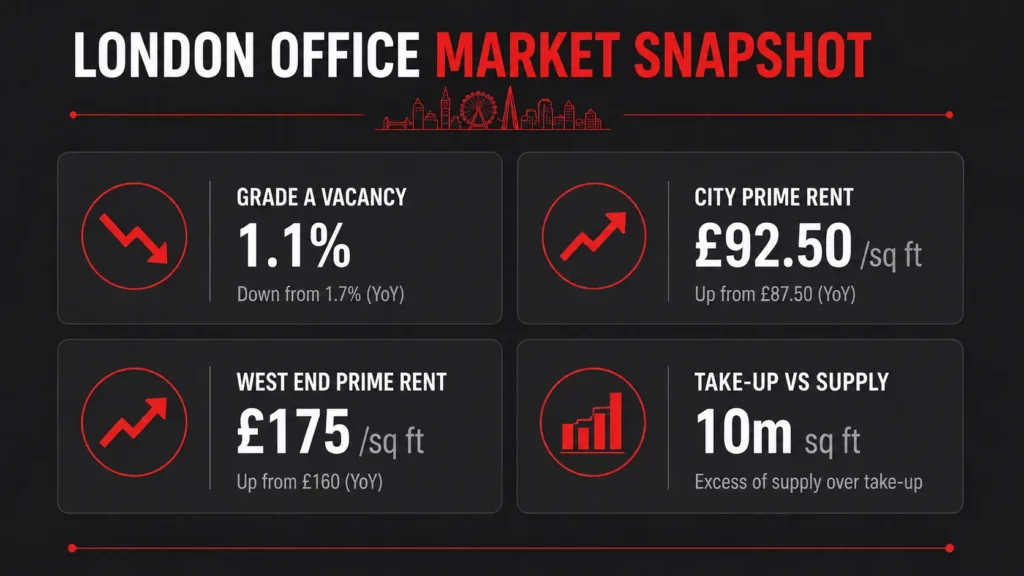
| City core new Grade A vacancy | 1.1% (5‑year low) |
| West End Grade A vacancy | 1.1% |
| Mayfair Grade A vacancy | 0.3% |
| City prime rent growth (YoY) | +8.8% to £92.50/sq ft |
| West End prime rent growth (YoY) | +6.1% to £175/sq ft |
| Central London vacancy (Q1 2026) | 6.3% |
| Space completed but available | Only 35% |
Source: Colliers, BNP Paribas Real Estate, Avison Young
Take‑up continues to outpace supply: Since 2021, take‑up has exceeded new supply by over 10 million square feet. Despite 5.9 million square feet of offices being completed in 2025, 70% of this was already pre‑let. Looking ahead, the stock coming online in 2026 is already 50% pre‑let, and in 2027, 25% is already pre‑let.
Tech and creative sectors are driving demand: These sectors accounted for 28% of Central London office take‑up in Q1 2026. The technology sector alone leased just over 500,000 square feet in Q1 2026, a 26% market share, the highest quarterly volume since Q4 2021. AI giants like Anthropic and OpenAI have taken almost 250,000 square feet in April alone.
What this means for security: When office space is scarce and valuable, the contents, people, data, and physical assets become more attractive targets. Criminals and unauthorised individuals follow the money. A tightening Grade A market means higher asset value, which demands higher security standards.
The Hidden Security Risks in London’s Corporate Offices
London offices may appear secure, but the threat landscape has evolved. Traditional security measures such as a receptionist, a key card, and a few cameras will no longer address the risks that matter.
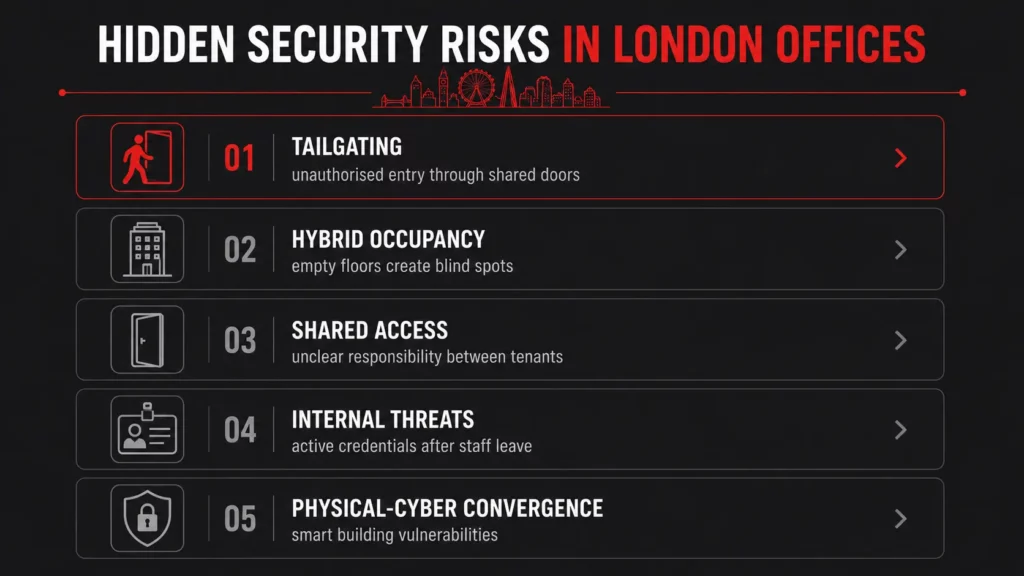
1. Tailgating and unauthorised access
Someone tailgates into a secure zone, or colleagues share badges to save time. These are not hypothetical risks; they are recurring realities in financial institutions and corporate headquarters. Tailgating, where an unauthorised individual follows an employee through a secure entry point, remains one of the most common physical breaches.
2. Hybrid working patterns
Hybrid work patterns have introduced inconsistent occupancy levels. Some days are heavily staffed, others leave floors nearly vacant. These changes affect how and when security vulnerabilities emerge. Empty floors create blind spots; reduced natural surveillance gives criminals more opportunities to move undetected.
3. Shared building access
In multi‑tenant buildings, security responsibilities are frequently unclear. Grey areas between landlord and tenant control create gaps. Shared entrances, basement parking, and loading bays are accessed by multiple organisations, each with different security cultures and standards.
4. Internal threats
Access credentials often remain active long after staff or contractors leave. A former employee’s card that was never returned remains a silent vulnerability. A poorly secured plant room, an exposed building management system, a tailgated entry point, or a contractor with excessive access permissions can all serve as open doorways into sensitive corporate networks.
5. Physical‑cyber convergence
Smart building technologies create interconnected vulnerabilities. A compromised badge system can open access to server rooms. A poorly secured building management system can give insight into physical office layouts or meeting schedules. The threat landscape facing London’s corporate sector in 2025 looks materially different from five years ago. Working with a professional Security company London that understands these evolving risks is essential for protecting people, assets and reputation.
The Front‑of‑House Difference: Why Concierge Security Matters
First impressions, first line of defence.
A professional concierge team at reception does more than greet visitors. They verify identities, manage access, and deter unauthorised entry. They are the visible, approachable face of security, something a camera can never be.
What front‑of‑house security delivers:
| Responsibility | Why It Matters |
| Visitor verification | Prevents unauthorised access before it happens |
| Identity checks | Ensures only authorised individuals enter |
| Parcel and delivery management | Prevents theft and ensures secure storage |
| Lockout assistance | Reduces management call‑out costs |
| Pastoral care | Provides reassurance to tenants and visitors |
24/7/365 coverage: In high‑value buildings, security isn’t a 9‑to‑5 function. It’s a round‑the‑clock operation. Professional concierge security London teams provide a consistent presence across all hours, ensuring that the building is never left vulnerable.
Beyond security: Concierge teams enhance tenant satisfaction and retention. They manage reception, handle deliveries, monitor access gates, assist with lockouts, and provide pastoral care. A well‑run front desk signals that the building is professionally managed, and tenants notice.
Access Control: The Digital Gatekeeper for London Offices
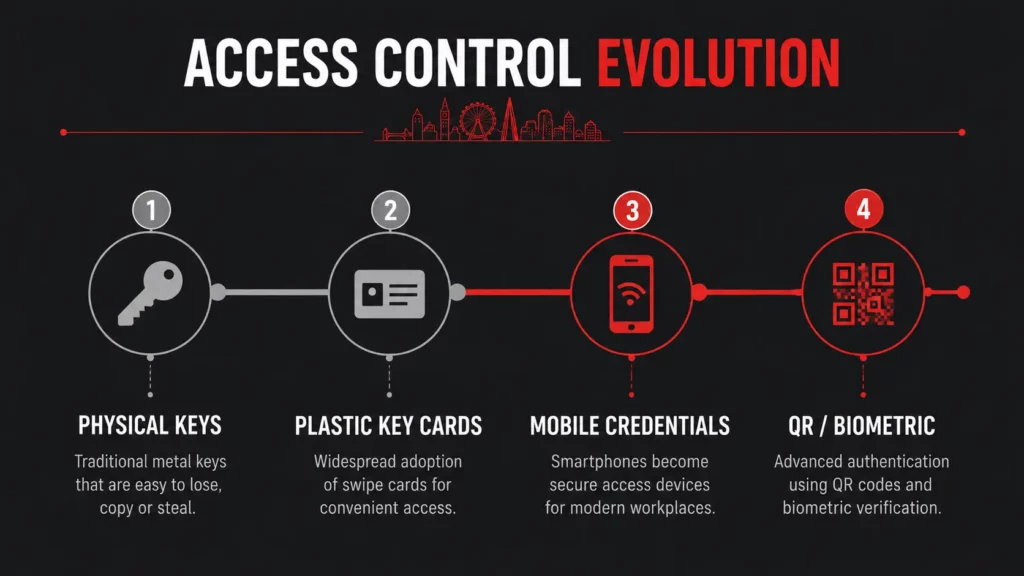
Access control London has evolved far beyond plastic key cards. Modern access control is about validating movement, not just locking doors.
Mobile wallet credentials are transforming the market:
At 40 Leadenhall, a 900,000‑square‑foot London megastructure with over 10,000 daily occupants, occupiers can use mobile wallet credentials for frictionless entry, while visitors receive QR‑code passes that remove the need for temporary plastic cards. The building manages more than 250 doors and 2,600 data points centrally.
Key trends in building access control:
| Trend | Impact |
| Mobile credentials | Users carry access on their smartphones – no lost cards |
| QR‑code visitor passes | Time‑limited, expires after use – no sharing |
| Lift access integration | Employees only access their floor; contractors access only what they need |
| Cloud‑based management | Real‑time visibility across multiple sites |
| Visitor pre‑registration | Speeds up entry and creates an audit trail |
Multi‑tenant complexity: Managing disparate access control systems across different tenants and landlords is a common challenge. A unified platform like the one deployed at 40 Leadenhall integrates access control, visitor management, and CCTV into a single system.
What this means for security: Building access control is no longer about keeping people out. It is about knowing who is in the building, where they are, and why they are there. Modern systems provide that visibility in real time.
The Human Element: Why Technology Alone Isn’t Enough
Technology detects. Humans respond.
| Technology | Human Security |
| Detects | Responds |
| Records | Intervenes |
| Automates | Assesses |
| Alerts | Resolves |
| Monitors | Protects |
Cameras and alarms are passive: They record what happened. They alert someone to a problem. They cannot stop a crime in progress, de‑escalate a confrontation, or provide reassurance to a worried employee.
Guards and concierge teams are active: They challenge suspicious individuals, intervene in real time, and provide a visible deterrent. They are the difference between a building that is watched and a building that is protected.
Behavioural security matters: Access controls are only as effective as the behaviours that support them. If employees share badges or hold doors for strangers, the most sophisticated access control system is useless. Front-of-house security teams reinforce positive security behaviours through visible presence and professional engagement.
Human expertise remains irreplaceable: Security personnel are critical for interpreting AI insights, managing crises, and maintaining trust. In an era of hybrid working and smart buildings, the human element is not a cost to be minimised; it is an asset to be invested in.
Protecting London’s Corporate Hubs: A Practical Checklist for Property Managers
Use this checklist to assess and improve security across your London office portfolio.
Step 1: Conduct a site‑specific security risk assessment
Identify vulnerabilities. Occupancy levels, high‑risk areas, delivery routes, access routes, and emergency planning all need to be assessed. Conduct this at least annually, or whenever the building changes use, occupancy, or layout.
Step 2: Upgrade to mobile‑enabled access control systems
Replace plastic key cards with mobile wallet credentials. Implement QR‑code visitor passes that expire after use. Ensure lift access is integrated with access control.
Step 3: Deploy 24/7 front‑of‑house concierge and reception security
Professional reception security at the front desk verifies identities, manages access, and deters unauthorised entry. This is not a luxury – it is a necessity for high‑value buildings.
Step 4: Integrate CCTV with access control and alarm systems
A unified platform like the one at 40 Leadenhall provides real‑time visibility across all security systems. When an access control event triggers, CCTV footage should be immediately available.
Step 5: Implement visitor management with digital check‑in and QR passes
Pre‑registration speeds up entry and creates an audit trail. Walk‑in visitors can be checked against watchlists. Digital passes eliminate the need for lost or shared plastic cards.
Step 6: Train staff on security awareness
Tailgating, phishing, and suspicious behaviour: staff should know what to look for and how to respond. Regular training reduces human error.
Step 7: Review and revoke access credentials regularly
Former employees, contractors, and temporary staff should have their access revoked immediately. Conduct regular audits of active credentials.
Step 8: Ensure compliance with Martyn’s Law and Health & Safety regulations
If your building has capacity for 200 or more people, you may fall within the scope of the Terrorism (Protection of Premises) Act 2025. Standard Tier requires basic security training, evacuation procedures, and incident response plans. The Home Office published final statutory guidance on 15 April 2026, so there is no excuse for delay.
Frequently Asked Questions
1. Why is corporate security in London more complex than in other UK cities?
London’s high‑density, multi‑tenant buildings, hybrid working patterns, and high‑value Grade A assets create unique security challenges that require specialised expertise.
2. What’s the difference between concierge security and traditional guarding?
Concierge security combines hospitality with protection, visitor management, parcel handling, lockout assistance, and pastoral care. Traditional guarding focuses on access control and incident response.
3. How do I choose the right security company for my London office?
Look for SIA Approved Contractor status, ISO 9001 certification, and experience with London’s multi‑tenant, high‑value office buildings. Local knowledge of the City, West End, and Canary Wharf matters.
4. What access control system is best for a multi‑tenant building?
A unified platform that integrates mobile wallet credentials, QR‑code visitor passes, lift access, and CCTV like the system deployed at 40 Leadenhall.
5. How does Martyn’s Law affect London office buildings?
If your building has capacity for 200 or more people, you may fall within scope. Standard Tier requires basic security training, evacuation procedures, and incident response plans. Enhanced Tier (800+ capacity) requires documented security plans and physical measures.
6. What’s the ROI of investing in front‑of‑house security?
Reduced theft, lower insurance premiums, higher tenant retention, and improved staff morale, all of which protect the building’s long‑term value.
Conclusion
London’s office market is tightening. Grade A space is scarcer and more valuable than it has been in years. Protecting that value requires a layered security approach: people, technology, and procedures working together.
Professional corporate security London, including front‑of‑house concierge, modern access control, and SIA‑licensed guarding, is not a cost. It is a competitive advantage. Tenants notice when a building is professionally managed. Staff feel safer. The building’s reputation improves.
Don’t wait for an incident to expose the gaps. Act now.