Introduction
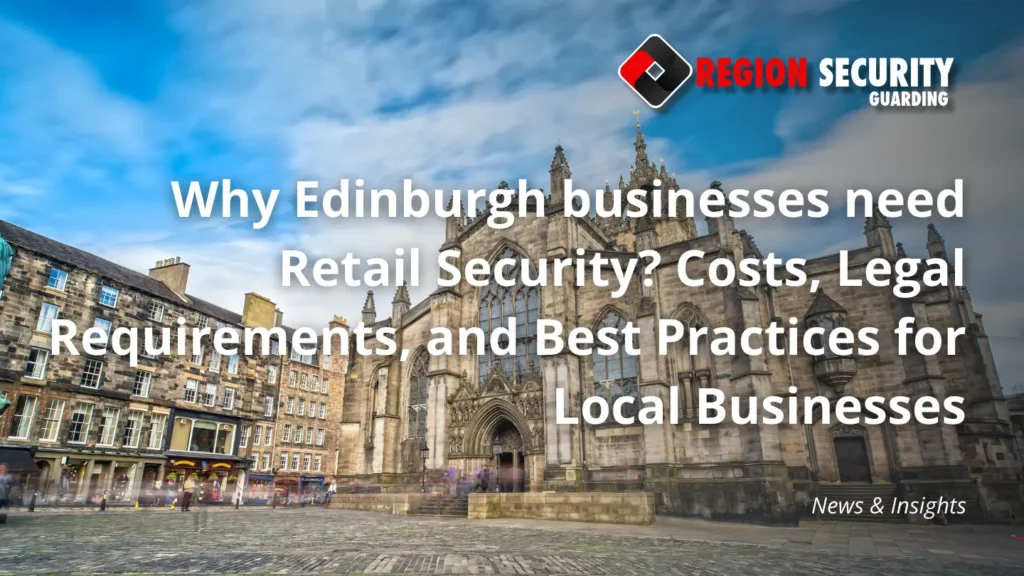
Retail businesses across Edinburgh operate in a complex risk environment shaped by a dense city centre, high tourist volumes, seasonal events, and a mix of independent retailers and national chains. Areas such as Princes Street, the Old Town, Leith, and major retail centres experience sharp fluctuations in footfall throughout the day, with additional pressure during weekends, festivals, and peak tourist seasons. These conditions create predictable exposure to shoplifting, antisocial behaviour, and staff confrontation.
Police Scotland data consistently shows that shoplifting and retail-related theft account for a significant share of recorded offences in Edinburgh city centre each year, reinforcing the ongoing exposure faced by high-footfall retail locations. Retail security in Edinburgh is therefore less about reacting to isolated incidents and more about managing day-to-day operational risk. Businesses must protect staff, safeguard stock, and maintain a safe trading environment while operating in open, publicly accessible spaces. This is particularly important for retailers trading late, handling high-value goods, or operating near transport hubs where transient footfall is high.
Unlike purely remote or technology-only solutions, on-site retail security provides real-time judgement. A visible security presence helps manage behaviour as it occurs, supports staff confidence, and reduces the likelihood that minor issues escalate into operational disruption. For many Edinburgh retailers, this human element is central to maintaining stable, uninterrupted trading.
Understanding Retail Security Basics in Edinburgh
Retail Security Versus Static and Remote-Only Measures
Retail security in Edinburgh typically combines physical presence with supporting technology. Static measures such as CCTV, alarms, and access controls are valuable for monitoring and evidence, but they do not actively manage behaviour. On-site retail security provides immediate observation, intervention, and situational awareness, which is particularly important in busy city-centre stores and tourist-heavy locations.
Crime Patterns Influencing Retail Security in Edinburgh
Retail crime in Edinburgh is predominantly opportunistic. Shoplifting, distraction theft, and antisocial behaviour make up the majority of incidents, particularly in high-footfall areas. These issues are driven by crowd density, ease of access, and anonymity rather than organised criminal activity. As a result, security needs are closely linked to trading patterns rather than overnight vulnerability.
Peak Risk Periods for Edinburgh Retailers
Retail risk in Edinburgh tends to peak during daytime and early evening trading hours. Weekends, tourist seasons, festival periods, and major city events significantly increase exposure due to higher footfall and reduced staff visibility across shop floors. Unlike industrial or warehouse environments, overnight risk plays a smaller role for most retail premises.
Retail Environments with Higher Exposure in Edinburgh
City-centre stores, shopping centres, tourist-focused retail, convenience stores, and fashion outlets face the highest exposure. Retailers operating near transport hubs or within mixed-use developments often experience additional challenges related to loitering and unauthorised access, increasing the need for visible, coordinated security measures.
Managing Antisocial Behaviour in Edinburgh Retail Locations
Antisocial behaviour is a key concern for Edinburgh retailers, particularly in busy pedestrian areas and during evening trading. Retail security plays a preventative role by maintaining visible authority, discouraging loitering, and intervening early when behaviour risks affecting staff or customers. This presence helps maintain order without creating a hostile retail environment.
The Shift Toward Daytime Retail Security Coverage
Rising retail theft has reinforced the importance of daytime security in Edinburgh. Many incidents rely on speed, distraction, or exploiting busy environments rather than forced entry. As a result, retailers increasingly focus security resources on peak trading hours rather than relying solely on after-hours measures.
Differences Between Day and Evening Retail Security Risks
Daytime risks centre on theft, refund abuse, and staff intimidation, while evening risks are more closely linked to reduced staffing levels, alcohol-related behaviour, and nearby hospitality venues. Effective retail security strategies in Edinburgh account for these differences rather than applying uniform coverage across all hours.
Impact of Seasonal Events and Festivals on Retail Security
Edinburgh’s festivals, seasonal tourism, and major public events significantly alter retail risk profiles. Temporary increases in footfall, unfamiliar visitors, and extended trading hours all contribute to higher exposure. Many retailers adjust security coverage during these periods to maintain control and support staff under increased pressure.
Transport Connectivity and Retail Security Pressure Points
Retailers located near railway stations, tram stops, and major bus routes experience short but intense spikes in footfall. These pressure points reduce staff oversight and increase opportunities for theft. On-site retail security helps manage these fluctuations by maintaining visibility during peak commuter periods.
Economic Factors Shaping Retail Security Decisions
Edinburgh’s competitive retail environment means security spend is closely scrutinised. Retailers often deploy security selectively, focusing on locations, times, and seasons where risk is highest. This risk-led approach allows businesses to balance cost control with effective loss prevention.
Retail Growth and Its Impact on Security Demand
Ongoing retail development and mixed-use projects across Edinburgh increase footfall concentration and shared public spaces. As retail environments become more complex, the need for coordinated, on-site security presence grows to manage access, behaviour, and operational continuity.
Legal and Compliance Requirements for Retail Security in Edinburgh
SIA Licensing Requirements for Retail Security Personnel
All individuals carrying out licensable retail security activities in Edinburgh must hold a valid Security Industry Authority (SIA) licence. This includes roles involving guarding against theft, managing access, and intervening in incidents within retail premises. Although policing and criminal justice are devolved in Scotland, SIA licensing applies consistently across the UK. For retailers, verifying that on-site security personnel hold the correct licence is a legal obligation rather than a contractual detail.
Legal Consequences of Using Unlicensed Security Staff
Using unlicensed security personnel exposes Edinburgh retailers to significant legal and financial risk. Penalties can include fines, criminal liability, and reputational damage, particularly if an incident occurs. From a commercial perspective, insurers may also challenge claims if security arrangements are found to be non-compliant. For retail businesses, licence verification should form part of routine compliance checks rather than reliance on supplier assurances alone.
Vetting Standards and DBS Expectations in Retail Settings
While a DBS check is not legally mandatory for all retail security roles, enhanced background screening is widely expected, particularly in customer-facing environments. BS 7858 vetting is the recognised British Standard for security personnel screening and is commonly required by insurers, landlords, and large retail operators. For Edinburgh retailers, adherence to BS 7858 demonstrates due diligence and supports defensible risk management.
Licensing and Compliance of Security Providers
Beyond individual licensing, retailers should ensure that their security provider operates within recognised compliance frameworks. Membership of accredited bodies, evidence of audited processes, and transparent compliance records all reduce client-side risk. While mandatory company licensing is not yet in force, retailers increasingly face scrutiny over the suppliers they appoint, particularly within managed shopping centres and mixed-use developments.
Insurance Requirements for Retail Security Arrangements
Retailers engaging security services should confirm that appropriate insurance cover is in place. This typically includes public liability insurance, employer’s liability insurance, and professional indemnity where applicable. From a retail perspective, insurers often assess security arrangements when underwriting policies, meaning poorly documented or informal security provision can increase premiums or restrict cover.
Data Protection and CCTV Compliance in Retail Environments
Retail security in Edinburgh frequently operates alongside CCTV systems, bringing UK GDPR and Data Protection Act obligations into scope. Retailers remain data controllers for footage captured on their premises, even when security operations are outsourced. Clear signage, lawful purpose, controlled access to recordings, and proper retention policies are essential to avoid regulatory breaches and complaints.
VAT Treatment of Retail Security Services
Retail security services are subject to VAT at the standard rate in the UK. For Edinburgh retailers, this has direct cost implications when budgeting for security provision. VAT treatment should be factored into procurement decisions, particularly for multi-site or long-term contracts, to avoid underestimating total spend.
Local Authority and Licensing Considerations in Edinburgh
While retail security is not governed by separate Edinburgh Council licensing schemes, certain locations such as shopping centres, late-trading premises, and mixed-use developments may impose additional security conditions through lease agreements or planning requirements. Retailers operating within these environments must ensure their security arrangements align with site-wide policies and local authority expectations.
Event Licensing and Temporary Retail Security
Retailers operating during major events, festivals, or temporary trading periods may face additional licensing or safety requirements. Edinburgh’s festival calendar significantly increases footfall and alters risk profiles. Temporary retail security arrangements during these periods should align with event management plans and local authority guidance to ensure compliance and operational continuity.
The Impact of Martyn’s Law on Edinburgh Retail Venues
Martyn’s Law is expected to introduce clearer obligations around terrorism preparedness for publicly accessible venues, including larger retail spaces and shopping centres. For Edinburgh retailers, the practical impact is likely to involve improved risk assessments, clearer incident planning, and better coordination with site operators rather than overt security measures. The focus will be on proportionate, risk-based preparation.
Collaboration with Police and Local Business Groups
Retail security in Edinburgh often operates alongside Police Scotland initiatives and local business crime reduction partnerships. While private security does not replace policing, information sharing and coordinated reporting support more effective responses to repeat offending and antisocial behaviour. Retailers benefit when security arrangements align with these local frameworks rather than operating in isolation.
Costs, Contracts, and Deployment for Retail Security in Edinburgh
Cost Drivers for Retail Security in Edinburgh
Retail security costs in Edinburgh are influenced by location, trading hours, footfall levels, and the complexity of the retail environment. City-centre locations such as Princes Street, George Street, and the Old Town typically attract higher rates due to increased footfall, higher incident frequency, and the need for greater visibility during peak trading periods. Suburban centres and out-of-town retail parks generally face lower baseline costs, though extended opening hours or large shared spaces can offset this difference.
City-Centre Versus Suburban Retail Security Costs
The primary distinction between city-centre and suburban retail security lies in risk concentration rather than geography alone. Central Edinburgh retailers often require coverage aligned with commuter flows, tourist activity, and evening trade, while suburban retailers tend to focus on predictable daytime patterns. As a result, city-centre security deployment is often more intensive but shorter in duration, whereas suburban sites may prioritise consistent coverage during peak shopping hours.
Mobilisation and Deployment Timeframes
Retail security deployment in Edinburgh is typically faster than in construction or industrial environments due to standardised site layouts and operating procedures. In many cases, coverage can be mobilised within days once scope, hours, and compliance checks are agreed. However, complex retail environments such as shopping centres or festival-linked trading locations may require longer lead times to coordinate access permissions, inductions, and site-specific protocols.
Contract Lengths for Retail Security Services
Retail security contracts in Edinburgh commonly range from short-term seasonal agreements to multi-year arrangements for high-risk or flagship locations. Many retailers favour flexible contracts that allow coverage to scale during sales periods, festivals, or peak tourist seasons. Longer-term contracts are typically used where persistent loss, staff safety concerns, or insurance requirements justify ongoing presence.
Notice Periods and Contract Flexibility
Standard notice periods for retail security contracts typically range from four to twelve weeks, depending on contract length and scope. Flexibility is particularly important for retailers responding to changing trading patterns or risk levels. Overly rigid contracts can limit a retailer’s ability to adjust coverage efficiently, increasing the importance of clear exit and variation clauses during procurement.
Impact of Wage Increases on Retail Security Costs
Security wage increases directly affect retail security pricing, particularly in customer-facing environments where trained, licensed personnel are required. In 2025, wage pressures are expected to continue influencing rates, making underpriced contracts a potential risk to service continuity. For retailers, sustainable pricing is often a more reliable indicator of service quality than the lowest headline rate.
Inflation and Long-Term Pricing Considerations
Inflation affects long-term retail security contracts through wage adjustments, insurance costs, and operational overheads. Retailers entering longer agreements in Edinburgh should expect index-linked pricing or review mechanisms rather than fixed multi-year rates. Transparent pricing structures help avoid sudden cost increases and support more predictable budgeting.
Retail Security and Insurance Premium Considerations
Effective retail security can support insurance negotiations by demonstrating proactive risk management. While security does not guarantee premium reductions, insurers often view documented on-site security, incident reporting, and CCTV integration as positive risk controls. For Edinburgh retailers, this can be particularly relevant in high-footfall or high-value trading environments.
Public Sector and Regulated Retail Environments
For retailers operating within publicly owned buildings or council-managed sites, procurement rules may influence how security services are appointed. The Procurement Act 2023 affects public sector contracting processes rather than private retailers directly, but it can impact tenants within public retail spaces by shaping approved supplier frameworks and contract structures.
Training, Operations, and Daily Duties for Retail Security in Edinburgh
Training Standards for Retail Security Personnel
Retail security personnel operating in Aberdeen and Glasgow must meet recognised training and licensing standards appropriate for customer-facing environments. This includes SIA licensing, conflict management training, and awareness of retail-specific risks such as theft, antisocial behaviour, and staff safety incidents. From a retailer’s perspective, training quality directly affects how confidently incidents are handled and how well a security presence integrates with store operations.
Shift Commencement and Initial Site Awareness
At the start of each shift, retail security focuses on understanding current site conditions rather than routine formalities. This includes reviewing store layouts, noting staffing levels, and identifying any immediate risk factors such as peak footfall periods, promotions, or known local issues. For Edinburgh retailers, this situational awareness is particularly important in busy city-centre locations and tourist-heavy areas.
Handover Procedures and Continuity of Coverage
Effective handovers ensure continuity rather than repetition. Security teams review recent incidents, patterns of concern, and any changes to trading conditions or store operations. For retail environments, this reduces the risk of repeat incidents being missed and helps maintain consistent standards across shifts, especially during extended trading hours.
Patrol Routines Within Retail Environments
Retail patrols in Edinburgh are typically dynamic rather than fixed. Movement is adjusted based on customer flow, store layout, and known risk zones such as entrances, fitting rooms, and high-value displays. This flexible approach allows security presence to remain visible without disrupting customer experience or store operations.
Monitoring Access Points and Internal Movement
Retail security routinely monitors entrances, exits, and internal access points, including staff-only areas and stockrooms. In busy Edinburgh retail locations, these areas are common pressure points for theft and unauthorised access. Consistent oversight helps reduce shrinkage and limits opportunities for opportunistic behaviour.
Use and Verification of Security Equipment
Retail security personnel check that relevant systems such as radios, body-worn cameras (where used), panic alarms, and CCTV displays are functioning correctly. From a business perspective, this ensures incidents can be responded to and documented properly, supporting both internal reviews and insurance requirements.
Incident Awareness and Alarm Response
In retail settings, alarm activations are often linked to access points, stock areas, or after-hours triggers. Security personnel respond by verifying the cause, securing the area, and escalating appropriately. Clear procedures reduce unnecessary disruption while ensuring genuine risks are addressed promptly.
Visitor and Contractor Oversight
Retail environments regularly receive contractors, delivery drivers, and temporary staff. Security oversight supports controlled access without slowing operations. For Edinburgh retailers operating within shopping centres or shared buildings, this coordination is essential to maintaining site-wide standards.
CCTV Oversight and Observational Support
Retail security works alongside CCTV systems by monitoring live feeds where applicable and responding to observed behaviour rather than passively reviewing footage. This real-time integration allows potential incidents to be addressed early, reducing loss and confrontation.
Fire Safety and Emergency Readiness
Security personnel maintain awareness of fire exits, evacuation routes, and assembly points. In retail environments with high public occupancy, this readiness supports compliance and ensures a calm, coordinated response if evacuation is required.
Reporting, Logging, and Documentation
Accurate reporting underpins effective retail security. Incident logs, patrol records, and notable observations provide retailers with visibility over risk trends and recurring issues. This documentation also supports insurance discussions and internal decision-making.
End-of-Shift Secure-Down Procedures
At the end of a shift, retail security ensures that access points are secured, outstanding issues are recorded, and relevant information is passed on. This structured closure reduces gaps in coverage and helps maintain consistent standards across trading days.
Shift Patterns and Coverage Models
Retail security shift patterns in Edinburgh are typically aligned with trading hours rather than traditional night-only coverage. Extended hours during festivals, late-night shopping, or peak seasons may require adjusted patterns to ensure coverage matches risk exposure.
Emergency Response Expectations in Retail Settings
Retail security Edinburgh response times focus on immediate containment and de-escalation rather than enforcement. In Edinburgh’s retail environments, rapid visible response helps reassure staff and customers while allowing escalation to emergency services when necessary.
Performance, Risks, and Challenges for Retail Security in Edinburgh
Measuring Retail Security Performance Effectively
Retailers in Edinburgh should assess security performance using outcomes rather than activity volume. Key indicators typically include reductions in repeat theft, fewer staff safety incidents, improved incident response times, and consistency of reporting. Customer complaints, staff feedback, and insurance claim history also provide useful signals. These KPIs help businesses evaluate whether security measures are supporting stable trading rather than simply being present on-site.
The Impact of Weather on Retail Security Effectiveness
Edinburgh’s weather can influence retail risk patterns, particularly in exposed high streets and retail parks. Poor weather often concentrates customers indoors, increasing congestion and reducing staff visibility across shop floors. This can raise the likelihood of opportunistic theft and customer frustration, making active observation and situational awareness more important during adverse conditions.
Recording Environmental Conditions and Incident Context
Accurate incident reporting should include contextual factors such as crowd density, weather conditions, and unusual trading circumstances. For retailers, this documentation helps explain why incidents occur and supports informed decisions about adjusting security coverage during similar conditions in the future. It also strengthens the quality of evidence provided to insurers or landlords.
Managing the Impact of Long Trading Hours
Extended trading hours, late openings during festivals, and seasonal peaks can increase pressure on retail operations. From a performance perspective, fatigue-related issues are best managed through appropriate coverage planning rather than overstretching security presence. Retailers benefit when security deployment matches risk periods instead of maintaining uniform coverage regardless of exposure.
Mental Wellbeing and Operational Stability
While retailers are not responsible for managing security staff wellbeing directly, operational stability is affected when fatigue or stress leads to inconsistent performance. Clear incident procedures, predictable deployment patterns, and realistic coverage expectations all contribute to more reliable security outcomes without requiring retailers to manage internal workforce matters.
Environmental and Public Space Considerations
Many Edinburgh retail locations operate within pedestrianised zones, historic areas, or open public spaces. Environmental regulations and local site rules can affect how security presence is deployed, particularly regarding lighting, signage, and vehicle use. Retail security strategies must align with these constraints while still maintaining visibility and effectiveness.
Common Operational Risks for Edinburgh Retailers
Retail security challenges in Edinburgh often stem from high footfall, shared public access, and seasonal population surges rather than severe crime. These conditions increase the risk of distraction theft, antisocial behaviour, and staff confrontation. Security performance is strongest when focused on early intervention and visible control rather than reactive response.
Avoiding Underperformance Through Unrealistic Expectations
One of the most common challenges in retail security is misalignment between expectations and deployment. Under-resourced or underpriced security arrangements can lead to inconsistent presence, gaps in coverage, or limited incident response. Retailers should view security performance as a reflection of planning quality rather than individual actions.
Adapting Security Performance Over Time
Retail risk profiles are not static. Changes in store layout, trading hours, surrounding businesses, or local footfall patterns can all affect exposure. Ongoing review of incident data and performance indicators allows Edinburgh retailers to adapt security arrangements proactively rather than waiting for problems to escalate.
Technology and Future Trends in Retail Security in Edinburgh
How Technology Has Changed Retail Manned Guarding in Urban Centres
In cities like Edinburgh, technology has shifted manned guarding from passive presence to informed oversight. Guards are increasingly supported by live data, access control systems, and integrated CCTV rather than relying solely on line-of-sight observation. For retailers, this means earlier detection of risk, clearer incident evidence, and more consistent control across busy trading environments.
Post-COVID Changes to Retail Security Protocols
Post-COVID retail operations have introduced wider store layouts, self-service points, and reduced staffing in some locations. These changes have increased the need for security to monitor behaviour rather than fixed entry points alone. In Edinburgh, where stores often combine tourists and local shoppers, this has reinforced the importance of adaptable, technology-supported security rather than static guarding models.
The Role of AI Surveillance Alongside Retail Security Staff
AI-enabled CCTV analytics are increasingly used to flag unusual movement patterns, repeat dwell behaviour, or crowd congestion. In retail environments, these tools support guards by highlighting areas that require attention rather than replacing human judgement. For Edinburgh retailers, AI is most effective when used to prioritise observation during peak footfall rather than as a standalone solution.
Remote Monitoring as a Support Layer for On-Site Security
Remote monitoring allows off-site teams to oversee alarms, CCTV feeds, and access events outside peak trading hours. For retailers with multiple locations or extended opening times, this creates continuity without requiring constant on-site presence. In Edinburgh, remote monitoring is often used to support early mornings, late evenings, or closed-store periods while retaining on-site coverage during trading hours.
The Emerging Role of Drones in Retail-Adjacent Security
Drone use remains limited in retail settings due to airspace, privacy, and public safety restrictions, particularly in Edinburgh’s historic and densely populated areas. Where relevant, drones are more commonly associated with retail parks or large mixed-use developments rather than high streets. Their role is supplementary and situational, not a replacement for ground-level security presence.
Using Predictive Analytics to Plan Retail Security Deployment
Predictive analytics tools use historical incident data, footfall trends, and seasonal patterns to forecast risk periods. For Edinburgh retailers, this is particularly useful during festivals, holiday trading, and peak tourism months. These tools support better planning decisions by aligning security coverage with likely exposure rather than maintaining uniform staffing year-round.
Technology Expectations and Retail Insurance Requirements
Insurers increasingly expect retailers to demonstrate reasonable preventative measures, which may include CCTV integration, alarm monitoring, and documented incident response. Technology supports compliance by improving record-keeping and response verification. However, insurers still view manned guarding as a critical control where customer interaction and real-time judgement are required.
Green and Low-Impact Security Practices
Sustainability considerations are becoming more relevant for retail estates and city-centre developments. Low-energy surveillance systems, reduced vehicle patrols, and efficient lighting integration are examples of greener security practices. In Edinburgh, where environmental and planning sensitivities are high, retailers benefit from security solutions that minimise visual and environmental impact while maintaining effectiveness.
The Impact of Martyn’s Law on Retail-Facing Venues
Martyn’s Law is expected to increase expectations around risk assessment and preparedness for publicly accessible locations. While retail stores may not face the same obligations as large venues, those within shopping centres or high-footfall areas may see increased scrutiny. Technology that supports monitoring, communication, and incident documentation will play an important role in meeting future compliance expectations alongside trained personnel.
Technology as a Force Multiplier, Not a Substitute
The most effective security company Edinburgh combines technology with human oversight. Cameras, analytics, and monitoring systems extend awareness, but decision-making, customer interaction, and conflict management remain human responsibilities. Retailers should view technology as a way to enhance consistency and coverage rather than reduce on-site capability.
Conclusion: Making Informed Retail Security Decisions in Edinburgh
Retail security in Edinburgh is shaped by a unique combination of dense urban layouts, seasonal tourism, major events, and a strong mix of local and national retailers. From the city centre and shopping centres to retail parks and neighbourhood parades, risk is driven less by isolated incidents and more by predictable patterns of theft, antisocial behaviour, and staff exposure during peak trading periods. Effective security planning therefore depends on understanding timing, footfall, and site layout rather than relying on generic deterrence measures.
On-site retail security continues to play an important role because it provides real-time judgement in environments where customer interaction, open access, and shared spaces are unavoidable. When combined with appropriate technology, clear operating routines, and compliance with legal and insurance expectations, retail security helps businesses maintain safe trading conditions while protecting staff confidence and operational continuity.
For Edinburgh retailers, the most resilient approach is not about maximum coverage at all times, but about proportionate, well-planned security that reflects local risk, trading hours, and future regulatory expectations. Taking the time to assess exposure properly allows businesses to justify spending, demonstrate due diligence, and support long-term operational stability.
Frequently Asked Questions: Retail Security in Edinburgh
Do all retail businesses in Edinburgh need on-site security guards?
Not all retailers require on-site guards. Security is most commonly justified where there is high footfall, repeat theft, extended opening hours, lone working, or previous incidents. Smaller stores may rely on technology alone, while higher-risk locations often benefit from a visible human presence.
Is retail security more important in Edinburgh city centre than in suburban areas?
City-centre locations typically face higher footfall, tourism-related theft, and antisocial behaviour, while suburban areas may experience lower-frequency but more targeted incidents. Risk varies by layout and trading hours rather than location alone.
Can retail security help reduce insurance premiums?
In some cases, yes. Insurers may view professional on-site security as a risk-reduction measure, particularly for high-value stock or repeat claims histories. While premium reductions are not guaranteed, proper security can support more favourable underwriting decisions.
What legal requirements apply to retail security guards in Scotland?
Retail security guards must hold valid SIA licences and be appropriately vetted. Businesses also have responsibilities around data protection when using CCTV and must ensure that security arrangements align with health and safety obligations.
How quickly can retail security be deployed in Edinburgh?
Deployment timelines vary depending on coverage requirements, site complexity, and compliance checks. Straightforward retail assignments can often be mobilised relatively quickly, while larger or multi-site deployments require more planning.
Does CCTV replace the need for retail security guards?
CCTV supports observation and evidence gathering but does not replace real-time intervention. In retail environments, guards provide immediate judgement, customer interaction, and conflict management that technology alone cannot deliver.
How does seasonal tourism affect retail security needs in Edinburgh?
Tourism increases footfall and anonymity, particularly during festivals and peak holiday periods. Many retailers adjust security coverage temporarily during these periods to reflect higher exposure rather than maintaining year-round increases.
Will Martyn’s Law affect retail businesses in Edinburgh?
Most individual stores will not face the same obligations as large venues, but retailers in shopping centres or high-footfall areas may see increased expectations around preparedness and risk awareness. Security planning should consider future compliance trends.
Is it acceptable to use security staff only during peak hours?
Yes. Many retailers use targeted security during high-risk periods such as evenings, weekends, or seasonal peaks. This approach can be cost-effective when based on clear risk assessment rather than fixed assumptions.