UK construction sites lost over £1 billion to theft in 2025. That figure, which includes direct equipment losses, project delays, and higher insurance premiums, represents the worst year on record. Behind the headline number is a more troubling trend: opportunistic theft has given way to organised crime.
Criminal networks now treat construction sites as soft targets. The BauWatch Crime Report 2025 surveyed 500 industry professionals across the UK and found that 67% witnessed an increase in site crime over the past year, nearly double the European average. 55% of sites experience theft at least twice per year. From telehandlers to copper cable, gangs are stealing higher volumes, more frequently, and with greater sophistication.
This article breaks down what is being stolen, how organised crime operates, the hidden costs beyond the stolen goods, and the construction security solutions that actually work.
Table of Contents
Quick Facts: The Scale of the Problem
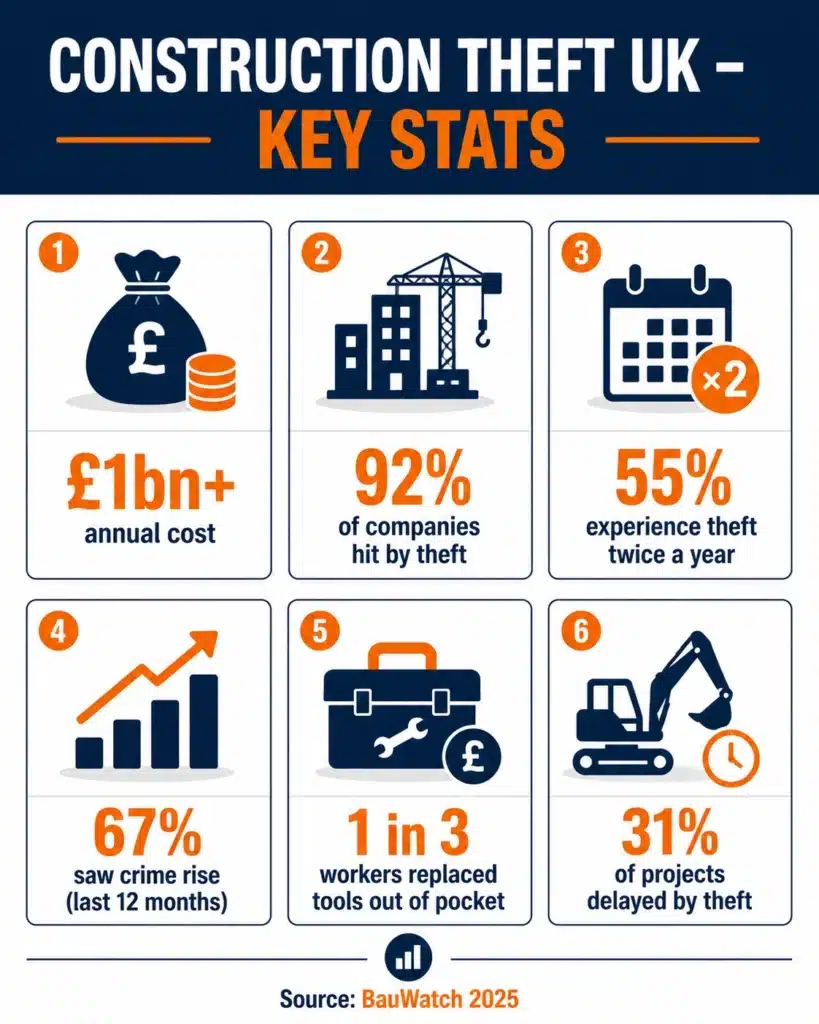
Before exploring the details of who is stealing what and how, here is a snapshot of the crisis. These figures show the scale of the challenge facing UK construction.
| Key Statistic | Figure |
| Annual cost of construction theft (direct + indirect) | £1 billion+ |
| Reported plant & equipment theft incidents annually | Over 11,000 |
| Construction companies that have experienced site theft | 92% |
| Sites experiencing theft at least twice per year | 55% |
| Professionals who witnessed increased site crime (last 12 months) | 67% |
| Construction projects delayed due to crime-related incidents | 31% |
| The average project cost increases from theft-related delays | 5% |
| Workers who have replaced stolen tools out of pocket | 1 in 3 |
| UK plant theft cost (Home Office estimate, 2025/26 prices) | £675 million |
Source: The BauWatch Crime Report 2025
The headline figures tell a clear story: no site is immune. This industry-wide issue is driving up insurance premiums, delaying critical projects and forcing some smaller firms out of business. Areas with high concentrations of development, like a security company in Birmingham, would be well aware of and face particular pressure. Ultimately, the most reliable way to protect assets, budgets and staff is through a layered construction site security strategy built around proactive, professional guarding.
What Gets Stolen: The Most Targeted Assets on UK Sites
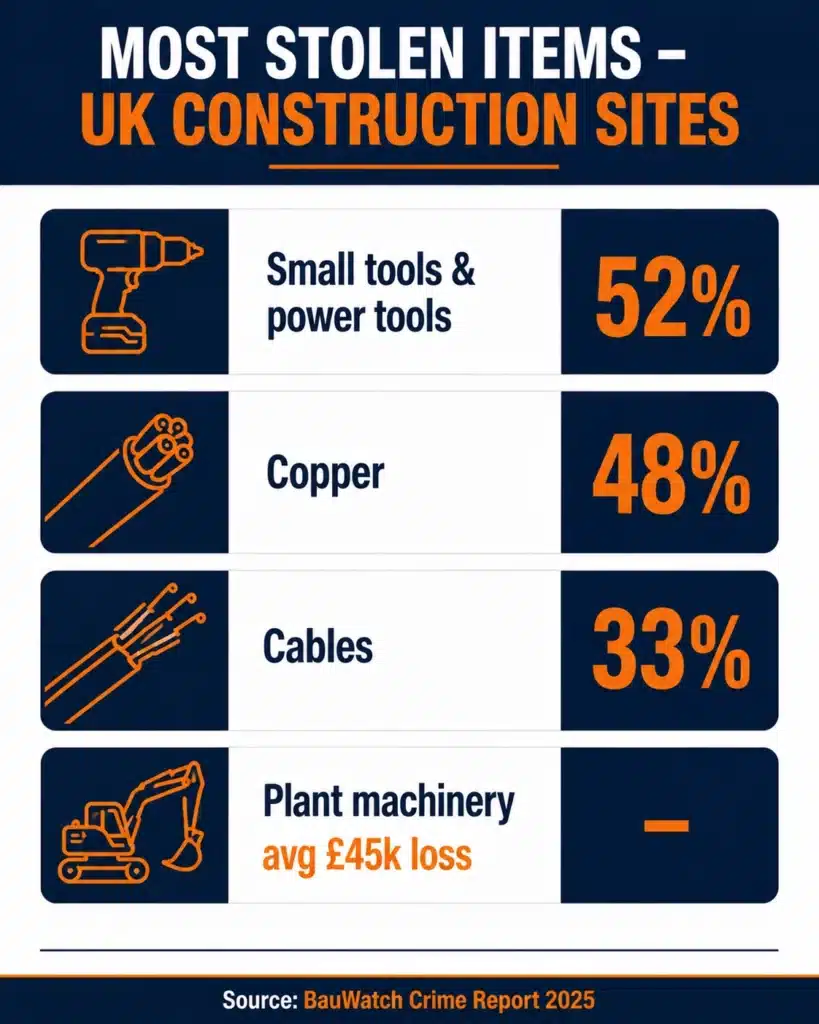
Not all theft is equal. Some items are stolen because they are small and portable. Others are targeted for their high resale value. The BauWatch Crime Report 2025 identifies the most commonly stolen items from UK construction sites.
- Small tools and power tools (52%): Drills, angle grinders, batteries, saws. These items are easy to conceal, difficult to trace, and in constant demand on the black market. A single van break‑in can clear £3,000–£4,000 worth of kit.
- Copper (48%): High scrap value and relatively easy to strip and transport. Theft of copper cabling from wind farms, rail networks, and telecom infrastructure has surged dramatically. Insurers have begun capping coverage for copper theft due to frequency.
- Cables (33%): Often stolen alongside copper for raw material value. The disruption caused by cutting live cables can halt an entire site for days.
- Plant machinery: Mini excavators, telehandlers, dumpers, rollers. The average loss per incident is £45,000. These are not opportunistic grabs. Gangs arrive with low‑loaders, often disguised as legitimate hauliers, and remove multiple machines in a single operation.
There were over 11,000 reported cases of plant and equipment theft annually. Industry estimates suggest the true figure is two to three times higher due to underreporting, especially among smaller subcontractors who absorb losses rather than face insurance complications.
One major plant theft claim cost an insurer £650,000; several items were stolen during the Christmas shutdown at a quarry site. That was a single incident.
How thieves dispose of high‑value plants:
Once serial numbers are removed or altered, tracing becomes virtually impossible. The National Crime Agency reports that international and UK‑based organised crime groups continue to work together to steal and export construction machinery from the UK to Eastern Europe and Cyprus. A digger stolen from a site in the West Midlands can be in a container bound for the Balkans within 48 hours.For site managers, this means every piece of plant equipment is a potential export commodity. Protecting these assets requires more than a fence and a padlock. That is why many major contractors now integrate K9 security teams into their site-protection strategies. Trained dogs provide an additional layer of detection and deterrence, disrupting organised theft operations.
The Hidden Costs: What Theft Really Does to Your Project
Replacing a stolen digger is expensive. The real damage goes deeper.
1. Project delays:
The BauWatch Crime Report 2025 found that 31% of sites experienced delays as a direct result of theft, vandalism or intrusion, with disruption often caused by stolen materials or damaged infrastructure. The resulting interruptions contribute to an approximate 5% increase in overall project costs, including extended labour, equipment hire, and rescheduling. For a £10 million project, that is £500,000 in unforeseen expenses.
2. Insurance consequences:
Following a significant theft incident, claims handling time can take four to six weeks, during which plant insurance for new or replacement equipment is often unavailable or extremely expensive. Contractors find themselves stuck. Insurers may impose strict conditions, cap coverage limits for copper theft, or apply high deductibles. Some smaller contractors have reported that their premiums doubled after a single claim.
3. The human toll:
One in three UK construction workers has replaced stolen tools out of their own pocket. For small contractors operating on thin margins, losing £3,000–£4,000 worth of tools can push a business into insolvency. The National Federation of Builders says tool theft has already put companies out of business. Beyond the financial hit, there is the loss of trust and morale when employees feel their employer cannot keep them safe.
These hidden costs, delays, insurance hikes, and business failure are why leading construction site security providers now emphasise a layered, proactive approach. Waiting to recover from a theft is far more expensive than preventing one.
The Organised Crime Connection: From Opportunity to Operation
According to the BauWatch Crime Report 2025, 63% of UK construction professionals now report seeing professional criminal tactics on site. Opportunistic theft has been replaced by industrialised crime. Here is how the gangs operate.
The Criminal Playbook – Five Tactics Gangs Use Today
- Drone reconnaissance (21%): Gangs fly drones over sites at night to map security gaps, identify high-value equipment, and plan access points. UK professionals report drone use at nearly twice the European average. One site manager described watching a drone hover over their tool storage area for 20 minutes; three days later, the same area was raided.
- Hacking security systems (28%): Criminals disable or bypass CCTV, alarm systems, and access controls. This is not casual interference; it involves technical knowledge of security infrastructure.
- Cloning digital access credentials (22%): Using insider information or stolen devices, gangs copy keycards and fobs, sometimes gaining access with legitimate-looking credentials.
- Multi-vehicle coordinated thefts: Gangs arrive with low-loaders, forklifts, and multiple vehicles. They can clear an entire plant inventory in under an hour. One operation in the West Midlands involved three lorries, five men, and took 47 minutes to strip a site of £180,000 worth of machinery.
- “Protection” rackets: Nearly half (49%) of UK construction workers report being approached with offers of “protection” that, if refused, lead to vandalism or theft.
Mim Mogul, UK Managing Director at BauWatch, describes the situation as the “industrialisation of construction crime”. He warns: “These are not petty thefts. They are calculated operations run by well-organised networks.”
Insider Collusion: The Hidden Vulnerability
Gangs recruit insiders who already have access to the site.
How insider collusion happens:
- Current employees share security schedules, camera blind spots, and alarm codes
- Former workers retain knowledge of site layouts after leaving
- Subcontractors are approached and offered cash for information
- Temporary staff are vetted less thoroughly and exploited
The TT Club/BSI 2025 Cargo Theft Report found that more than a fifth (22%) of global cargo theft incidents involved insider cooperation. On construction sites, the figure is likely higher because sites rely on transient labour and multiple subcontractors.
A security company in Birmingham dealing with the city’s many development zones would confirm that insider knowledge is a recurring factor in major theft investigations.
The Black Market: Where Stolen Goods Go
Stolen tools, copper, and plant machinery flow through established resale networks that are difficult to dismantle.
The BauWatch Crime Report 2025 found that nearly one-third (31%) of professionals say stolen goods regularly circulate within underground networks.
How stolen goods are sold:
- Market stalls and car boot sales (small tools, power tools, copper)
- Online marketplaces (often using fake seller profiles)
- Export to Eastern Europe and beyond (plant machinery, high-value equipment)
- “Back door” sales directly to other tradespeople
The National Crime Agency reports that international and UK‑based organised crime groups continue to work together to steal and export construction machinery from the UK. A digger stolen from a site in the West Midlands can be in a container bound for the Balkans within 48 hours.
The Psychological Toll: Living Under Siege
Beyond the financial losses, there is a human cost that statistics do not capture. SMEs and sole traders describe the feeling of “living under siege”. Workers report anxiety, hypervigilance, and a loss of trust in their own industry. One in three UK construction workers has replaced stolen tools out of their own pocket.
For small contractors, a single significant theft can push a business into insolvency. The National Federation of Builders says tool theft has already put companies out of business.
Security Solutions: What Actually Works
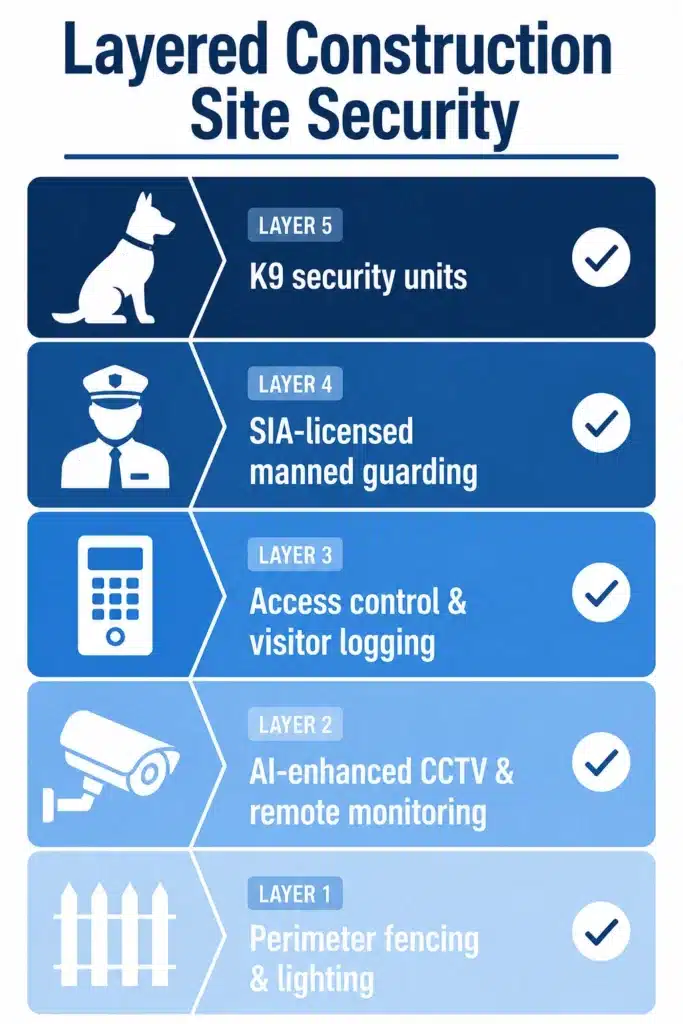
For years, many sites relied on a single security camera and perimeter fencing. That approach fails against organised gangs equipped with drones, cloned access credentials, and insider intelligence. A full construction site security strategy requires a layered defence that combines physical barriers, surveillance, personnel, and intelligence sharing.
The most effective approach is a layered defence with multiple countermeasures that work together. If one layer fails, others still protect the site.
The Four Pillars of Modern Construction Site Security
Pillar 1: Robust Physical Perimeter Security
- Anti‑climb perimeter fencing: Extend fencing underground to prevent digging. Use anti‑climb coatings and ensure gates are as secure as the fence line.
- Motion‑activated perimeter lighting: Illuminates intruders immediately, removing darkness as cover.
- Clear security signage: Visible warnings about CCTV, alarm systems, and patrols act as a psychological deterrent.
Many site managers overlook the basics. A BauWatch survey found that sites with visible perimeter security measures reduced opportunistic intrusion by over 40%.
Pillar 2: Intelligent, Proactive Surveillance
CCTV alone is not enough. 48% of UK firms deploy fixed CCTV systems, yet remain under constant siege. The issue is not cameras – it is how they are used.
- AI‑enhanced CCTV: Distinguishes between authorised personnel, wildlife, and genuine intruders. Sends real‑time alerts when something is wrong.
- Remote monitoring centres: Live operators watch multiple sites simultaneously, issuing audio challenges to intruders before theft occurs.
- Mobile CCTV towers: Deployable to high‑risk zones. Often used during shutdown periods or on large‑scale infrastructure projects.
AI‑enhanced CCTV can detect loitering, vehicle movement at odd hours, and perimeter breaches instantly. That means the response happens in seconds, not the next morning.
Pillar 3: Visible Deterrence: SIA‑Licensed Manned Guarding
Uniformed SIA‑licensed guards provide a human deterrent that criminals recognise instantly. According to the SIA, having a visible security presence can reduce the risk of theft by up to 70%.
What guards do that cameras cannot:
- Challenge suspicious individuals: A guard can ask, “Can I help you?” before a criminal enters the site.
- Verify delivery paperwork: Ensures that only authorised vehicles transport materials or equipment.
- Respond to alarms: Investigates and secures the site immediately.
- De‑escalate conflicts: Prevents confrontations from becoming violent.
- Maintain access logs: Creates an audit trail for police and insurers.
For high‑value or high‑risk sites, static guarding at entry points combined with mobile patrols across the wider site provides both fixed‑point control and wide‑area coverage.
A security company in Birmingham operating across the city’s many development zones would tailor the guard ratio to each site’s specific risk profile, rather than a one‑size‑fits‑all number.
Pillar 4: K9 Security Units: The Ultimate Deterrent
For sites with repeated break‑ins, high‑value plants, or large perimeters, K9 security units add an unparalleled layer of protection.
Why dogs work differently:
- Superior detection: A dog can have up to 300 million scent receptors, compared to a human’s 5 million. They detect intruders hiding in shadows, containers, or vegetation.
- Psychological impact: The sound of a barking dog is one of the most powerful deterrents. Criminals choose easier targets.
- Speed and agility: A K9 unit can cover large areas faster than a human patrol, especially over rough terrain.
One logistics site in the West Midlands reduced its overnight intrusion rate by 85% after deploying K9 units during peak risk hours. Dogs do not just assist guards – they transform the security posture.
The Layered Approach in Practice
| Layer | Function | Best suited for |
| Perimeter fencing & lighting | Prevent unauthorised entry | All sites |
| AI‑enhanced CCTV | Detect and alert | High‑value storage, blind spots |
| Remote monitoring | Real‑time intervention | Sites without 24/7 guards |
| SIA‑licensed manned guarding | Deter, intervene, document | Entry points, night shifts |
| Mobile patrols | Wide coverage, unpredictable timing | Multi‑area sites, out‑of‑hours |
| K9 security units | Detection, psychological deterrence | Large sites, high‑risk zones |
Intelligence Sharing – Joining the Wider Fight
The fourth pillar is often overlooked. Individual sites cannot fight organised networks alone. Collaboration multiplies effectiveness.
- Engage with local police: Share intelligence on local crime patterns, suspicious vehicles, and known offenders.
- Join the National Construction and Agricultural Theft Team (NCATT): A police unit dedicated to construction and rural crime.
- Document security measures: Not just for insurers, but to demonstrate due diligence.
Share alerts across sites: If a gang is active in the area, neighbouring sites need to know.
How to Prevent Construction Site Theft
This checklist provides a practical starting point for how to prevent construction site theft effectively. Work through these steps in order. Start with the basics, then add layers based on your site’s specific risk profile.
Step 1 – Conduct a Security Risk Assessment
Walk your site as if you were a thief. Look for weak points.
- Where are the blind spots in CCTV coverage?
- Are there gaps in perimeter fencing?
- Can gates be forced open or climbed?
- Are high‑value tools and plants left in accessible areas overnight?
Document everything. The assessment becomes your roadmap.
Step 2 – Secure the Perimeter
Criminals look for easy entry. A strong perimeter forces them to work harder.
- Install anti‑climb fencing (minimum 2.4 metres) with locked, secure gates.
- Add motion‑activated lighting along fence lines and near storage areas.
- Post clear signage: “CCTV in operation”, “Security patrols active”, “Trespassers will be prosecuted”.
Sites with well‑lit, well‑maintained perimeters deter most opportunistic intruders.
Step 3 – Deploy AI‑Enhanced CCTV
Cover all entry points, loading zones, material storage areas, and perimeter blind spots.
- Choose cameras with night vision and vehicle registration recognition.
- Ensure footage is stored securely off‑site (prevents criminals from destroying evidence).
- Use AI that distinguishes between people, animals, and vehicles – reducing false alarms.
Do not rely on passive recording. Active monitoring (by a person or AI) alerts you to threats in real time.
Step 4 – Implement Strict Access Control
Know who is on your site at all times.
- Use a digital check‑in/check‑out system for all personnel and vehicles.
- Issue photo ID passes that expire at the end of each project phase.
- Log visitor registrations and delivery vehicle details.
- Restrict access to high‑value storage areas to named individuals only.
Access control is not just about keeping unauthorised people out. It also creates an audit trail for police and insurers after an incident.
Step 5 – Hire SIA‑Licensed Security Personnel
Technology alone will not stop a determined criminal. A visible, uniformed guard provides a human deterrent that cameras cannot match.
- Static guards: Positioned at entry points or near high‑value assets.
- Mobile patrols: Cover wider areas, including remote storage zones.
- Combined approach: Use static guarding during peak hours and mobile patrols overnight.
For large or high‑risk sites, integrate K9 security units to add detection and psychological deterrence.
Step 6 – Adopt Forensic Tracking for Tools and Plant
Marking equipment makes it harder to sell and easier to recover.
- Use forensic marking solutions (e.g., SmartWater, SelectaDNA) on tools, plants, and copper.
- Display signage warning that all equipment is forensically marked.
- Install GPS trackers on high‑value plant machinery (mini excavators, telehandlers, rollers).
Marked equipment is less attractive to organised gangs because it cannot be easily resold.
Step 7 – Maintain Active, Varied Patrol Schedules
Predictability is a criminal’s best friend.
- If patrols happen at the same time every night, gangs will work around them.
- Randomise patrol times and routes.
- Use a guard tracking system (e.g., REMS) to log check‑ins every 30–45 minutes at random points.
Random timing means criminals cannot be certain when the site is empty.
Step 8 – Secure High‑Value Assets Individually
Do not rely solely on perimeter security for your most valuable items.
- Lock tools and small plants in reinforced metal containers.
- Immobilise plant machinery (remove batteries, lock cabs, use wheel clamps).
- Park vehicles and plant in well‑lit, high‑traffic areas where possible.
Layered security means an intruder who breaches the perimeter still cannot easily take what they came for.
Step 9 – Share Intelligence with Local Partners
No site fights organised crime alone.
- Join the National Construction and Agricultural Theft Team (NCATT) alert network.
- Share information about suspicious vehicles or individuals with neighbouring sites.
- Report all incidents to the police, even small ones. Data builds patterns.
Organised gangs move between regions. Intelligence sharing disrupts their operations.
Step 10 – Document Everything for Insurers
Insurance claims are harder to deny when you can prove due diligence.
- Keep logs of patrols, access records, and CCTV footage retention.
- Maintain a file of security policies, risk assessments, and guard contracts.
- Photograph security measures (fencing, lighting, signage) regularly.
Insurers increasingly require documented security measures as a condition of coverage.
Conclusion
Construction theft has industrialised. Organised gangs now operate across the UK, using drones, insider intelligence, and professional resale networks to strip millions of pounds from the industry each year. The hidden costs of project delays, insurance premiums, and business failures often exceed the value of the stolen goods.
The good news is that layered security works. Anti‑climb fencing, AI‑enhanced CCTV, SIA‑licensed manned guarding, and K9 security units each close specific gaps. No single measure is enough. But together, they form a defence that organised criminals will avoid.
Waiting for the next break‑in is not a strategy. The question is not whether your site will be targeted, it is whether you will be ready.
Frequently Asked Questions
1. What is the single most effective way to prevent construction site theft?
No single measure works alone. A layered strategy, including fencing, AI CCTV, SIA‑licensed guards, and K9 units, is the most effective approach.
2. How can I calculate the ROI of hiring SIA security guards for my site?
A medium site losing £100,000 annually to theft, with a guard costing £40,000 and achieving a 60% reduction, yields a £20,000 net benefit before insurance and compliance savings.
3. Are security guards or CCTV cameras more effective for my construction site?
CCTV is reactive (records incidents). Guards are proactive (deter and intervene). The best combination uses both for complete construction site security.
4. My site was recently targeted. What should I do immediately?
Report to police, document everything (photos, logs), contact your insurer, and review your security with a professional security company in Birmingham or your local provider.
5. How can I protect my construction site over the Christmas shutdown?
Increase security during shutdowns: deploy mobile patrols, AI CCTV with remote monitoring, lock all plant, and consider K9 security units for high‑risk periods.
6. What does the Equipment Theft Prevention Bill mean for my site?
The Bill proposes harsher penalties for tool theft. However, it does not replace the need for robust onsite security measures; prevention remains your responsibility.
7. How can SIA‑licensed manned guarding integrate with K9 security units?
Manned guarding provides access control and visible deterrence. K9 units add detection and psychological impact. Together, they form a comprehensive package of construction security solutions.
8. What is the most commonly stolen item from UK construction sites?
Small tools and power tools (52% of incidents) are most common, but plant machinery accounts for the highest value losses, averaging £45,000 per incident.
9. How do organised gangs target construction sites?
Gangs use drone reconnaissance, cloned access credentials, insider intelligence, and multi‑vehicle coordinated thefts. They operate professionally and across regions.
10. Why should I choose an SIA‑approved contractor for my site?
SIA‑approved contractors meet rigorous standards for training, vetting, and operational quality. For reliable construction site security, accreditation matters.