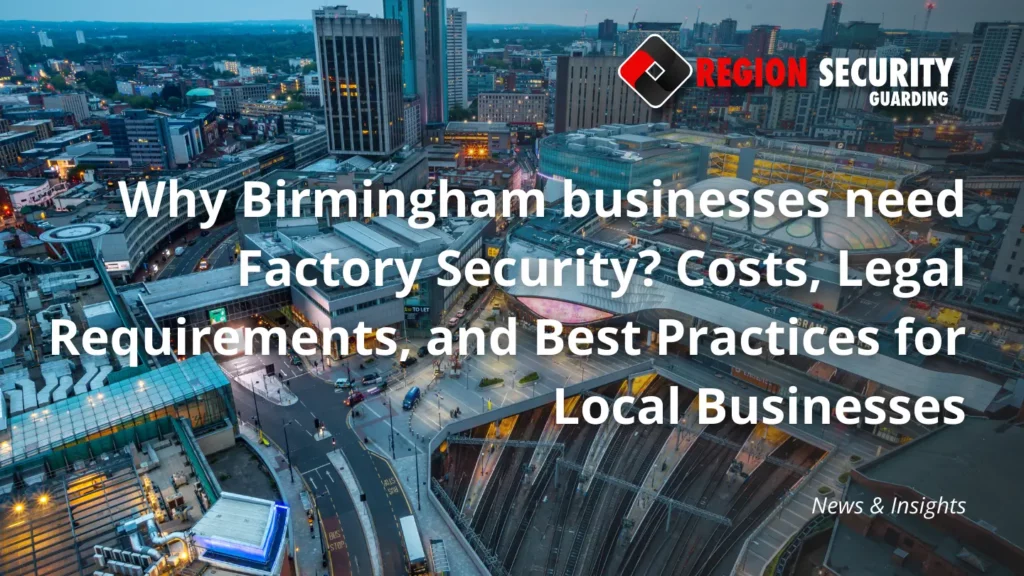
Birmingham has always been a working city. From the automotive supply chains running through Longbridge and Tyseley to the metal and engineering units clustered around Aston, Nechells, Smethwick and the Coleshill corridor, much of the region’s economy still depends on factories that operate long after offices have gone dark.
These sites are not quiet places. Forklifts move through loading yards at midnight. Contractors arrive before dawn. Finished components sit beside raw materials worth more than many retail stockrooms.
In that environment, factory security becomes less about visible deterrence and more about continuity, keeping production running, protecting contractual deadlines, and avoiding the kind of incident that quietly turns into an insurance dispute six months later.
For most Birmingham manufacturers, security is not a last-minute reaction to crime. It is part of financial planning, regulatory compliance and risk governance. Insurers expect it. Auditors ask about it. Health and safety frameworks depend on it.
The question is rarely whether protection is needed. It is how much is proportionate, where the real exposure sits, and how guarding, systems and procedures should be aligned with the way a site actually operates.
This article looks at factory security through that practical lens, grounded in local industrial conditions, legal duties and operational reality, not alarmism or sales language.
Factory Security Basics In Birmingham
The Role And Scope Of Factory Security In Manufacturing Environments
Factory security, in practice, rarely looks like the textbook version. On a live manufacturing site, protection is woven into how the place runs. Doors open because production needs them open. Vehicles queue where space allows, not where a security plan once suggested. Contractors arrive early. Agency staff rotate in and out.
Across Birmingham, Coventry, Wolverhampton and Solihull, the job is less about standing still and more about managing movement. Factory security differs from static security because it follows the rhythm of the site.
Guards are expected to understand which bays handle high-value components, which access routes must stay clear for fire safety, and which areas insurers quietly worry about most.
In older estates around Smethwick or Dudley, where factories sit close to housing or mixed commercial use, the role becomes even more delicate. A guard is not there to “police” the site.
They are there to keep production stable, preventing the kind of small failure that later shows up as a missed delivery, a rejected insurance claim, or an uncomfortable audit question.
Birmingham Crime Patterns Affecting Industrial Sites
Industrial crime in the West Midlands is rarely dramatic. It tends to be practical. Offenders target what can be moved, sold, or stripped. Metals when scrap prices rise. Fuel when costs spike.
Pallets of finished goods that sit too close to a perimeter fence. Estates near fast exits, Aston, Nechells, parts of Walsall and the Coleshill corridor, see repeat pressure because vehicles can enter and leave quickly.
What pushes many manufacturers toward factory security is not headline crime figures, but patterns that build quietly:
- Regular trespass through unfenced service roads
- Vandalism that interrupts plant safety systems
- Stock discrepancies traced back to access failures
- Opportunistic theft during busy delivery windows
Over time, these losses stop being “incidents” and start to look like operational risk.
Timing Patterns And Peak Risk Hours On Industrial Estates
Risk does not rise evenly across the day. It moves with production cycles. In Digbeth, Coventry and Wolverhampton, early-morning delivery windows create exposure before supervisors arrive.
Mid-afternoon shift changes increase tailgating and access confusion. Night shifts bring different problems: fewer staff, larger perimeters, and slower response if something goes wrong.
Peak vulnerability tends to cluster around:
- 04:00–06:00, when yards are active but oversight is thin
- Shift handovers, when responsibility blurs
- Planned shutdowns, when equipment sits idle and unguarded
This is why factory security planning is built around timing, not just headcount.
Structural Vulnerabilities In Birmingham Warehouses And Factories
Much of the region’s industrial stock predates modern security design. Estates expanded in phases. Temporary buildings became permanent. Fencing aged. Access points multiplied.
Common weaknesses include:
- Rear boundaries hidden by adjoining plots
- Roller shutters are shared between tenants
- Unlit yards used for overflow parking
- Fire exits that double as informal staff entrances
In places like Dudley, Walsall and older parts of Solihull, technology alone rarely fixes this. Cameras see only what lighting allows. Alarms trigger only after something has moved.
This is where factory security becomes less about force and more about awareness. Knowing which gate sticks. Which fence panel has shifted? Which corner attracts trespass?
The aim is not to seal a site completely. That is rarely possible. The aim is simpler: fewer blind spots, slower intrusions, cleaner audit trails, and enough control that production, insurers and regulators can all rely on the same answer when something goes wrong.
Crime, Risk Patterns & Timing In Birmingham
Boundary Intrusion, Trespass, And Antisocial Behaviour Near Industrial Estates
Industrial estates across Birmingham and the wider West Midlands rarely have clean edges. In places like Nechells, Smethwick, Sandwell and parts of Dudley, factory fences back directly onto housing, canal paths, disused yards or informal parking areas. That closeness creates low-level disorder long before serious crime appears.
Trespass usually starts small. A cut through a yard to save five minutes. A dumped van was left overnight. Teenagers are climbing a fence to explore an empty unit. Over time, these habits turn into access to knowledge. People learn which gates are never locked, which alarms trigger late, and which corners are never lit.
Factory security addresses this by doing something unglamorous but effective: keeping boundaries alive. Regular perimeter walks. Quiet conversations with neighbouring tenants. Early removal of dumped vehicles and scrap piles that attract scavengers. None of this stops production. All of it reduces the chance that a casual intruder becomes something more organised.
Operating-Hours Theft, Loading-Bay Exposure, And Daytime Supervision Risks
Most losses in manufacturing happen while the site is busy. Across Coventry, Wolverhampton and Walsall, insurers see the same pattern repeated. Pallets disappear during peak loading. Tools walk out with contractors. Fuel siphoned from parked plant between deliveries. Finished goods loaded onto the wrong vehicle and never seen again.
Daytime factory patrols exist because supervision thins when production speeds up. Supervisors focus on output. Drivers queue. Temporary staff rotate through unfamiliar layouts.
Effective factory security during working hours tends to focus on:
- Watching loading bays, not entrances
- Tracking vehicle flow, not just people
- Verifying paperwork before stock leaves the yard
It is not theft prevention by force. It is theft prevention by attention.
Day-Shift Versus Night-Shift Factory Risk Profiles
Day and night create different problems. In daylight, risk usually comes from inside. Access cards shared. Contractors are escorted once, then forgotten. Vehicles waved through to keep lines moving. Mistakes compound quickly.
At night, the threat changes. Fewer staff. Longer perimeters. More time for someone to test a fence, a shutter, a blind corner. Organised groups favour yards in Solihull, the Coleshill corridor and outer Birmingham estates where they can load and leave fast. The guard’s role shifts with the light. By day, control and verification. By night, deterrence, detection and response.
Seasonal Shutdowns, Production Cycles, And Temporary Risk Spikes
Factories are not open all year. Christmas closures, summer maintenance weeks, and model changeovers in automotive plants each create a short window when assets sit idle and supervision drops. In Longbridge and parts of Coventry, insurers now routinely ask how shutdowns are guarded, not just how normal shifts are covered.
Risk rises because:
- Equipment is powered down and easier to access
- Fewer managers are on site to spot anomalies
- Temporary contractors move freely between units
Factory guarding during these periods is often tighter than during full production.
Transport Corridors, Logistics Routes, And Offender Mobility
The West Midlands is built around movement. M6, M42, A45. Rail freight hubs near Birmingham International. Tram depots cutting through mixed-use zones.
For offenders, this matters. A yard near a fast exit is more attractive than one buried deep in an estate. Vehicle-enabled theft relies on speed. Security planning increasingly maps routes, not just fences.
Economic Conditions And Industrial Crime Demand In Birmingham
Industrial crime follows the economy. When scrap prices rise, metal disappears. When fuel costs spike, tanks are drained. When production slows or firms struggle, insider theft becomes harder to detect and easier to justify.
Across Sandwell, Dudley and Wolverhampton, factory security demand often rises quietly during downturns. Not because crime explodes overnight, but because pressure builds inside sites.
That is why risk planning now looks beyond crime statistics. It looks at markets, margins and people, and adjusts guarding before losses become headlines.
Sector-Specific Vulnerabilities In Birmingham
Manufacturing Growth And Estate Expansion Pressures
Manufacturing across the West Midlands has expanded in uneven waves. Automotive suppliers return to Longbridge and Solihull. Metals and fabrication spread across Walsall and Dudley. Cold-chain operators take larger units in Sandwell. Logistics yards keep pushing outward from Birmingham and Coventry.
Growth brings exposure. New units open before fencing is finished. Temporary delivery routes become permanent shortcuts. Estates subdivide yards, and suddenly, five tenants share one gate.
In bonded storage, a single unsecured door can trigger customs breaches as well as losses. Factory security demand rises quietly because expansion creates:
- More access points than supervision can cover
- Higher contractor turnover and badge sharing
- Mixed tenants with uneven security standards
- Increased vehicle flow through poorly designed yards
High-Risk Manufacturing Segments In The West Midlands
Not all factories face the same pressure. Automotive plants worry about prototype loss and component diversion. Metal yards attract scrap scavenging when prices spike.
Food processors manage hygiene breaches, contamination risk and unauthorised line access. Bonded warehouses carry customs exposure alongside theft. What links them is sensitivity. Small lapses create big consequences.
Supply-Chain Dependency And Single-Site Exposure
Many Birmingham, Wolverhampton and Coventry manufacturers now sit inside tight supply chains. One intrusion can stop a line, delay exports, or breach client contracts.
This is why factory security planning increasingly starts with a simple question: Which part of this site, if compromised, would stop production tomorrow? Answer that well, and guarding stops being reactive. It becomes part of resilience.
Legal & Compliance Requirements
SIA Licensing Obligations For Factory Security Officers
In Birmingham and across the wider West Midlands, the starting point for any factory guarding arrangement is simple: the officer must be licensed by the Security Industry Authority.
There is no local exemption and no informal workaround. If a person controls access, patrols a site, monitors CCTV as part of guarding, or intervenes during incidents, they must hold the correct SIA badge.
For manufacturers in Coventry, Wolverhampton or Solihull, this is not only the provider’s problem. Under current enforcement practice, clients who knowingly allow unlicensed guards onto the site can face scrutiny themselves.
Insurers increasingly ask for licence numbers at renewal. Large customers now sample guard credentials during supplier audits. In practical terms, compliance begins before the first shift starts: check the licence, confirm the role category, and keep a copy on file.
Enforcement Action And Penalties For Non-Compliance
The SIA has become more visible in the region. Joint inspections with West Midlands Police now target industrial estates in Walsall, Dudley and inner Birmingham, where temporary guarding and subcontracting are common.
Penalties can include:
- Criminal prosecution of the provider
- Fines and imprisonment for serious breaches
- Contract termination for the client
- Insurer’s refusal to settle theft or damage claims
For factories handling export goods or bonded stock, a licensing failure can ripple into customs compliance and client accreditation. What begins as a staffing shortcut can become a contractual problem.
Vetting And DBS Screening In Manufacturing Environments
DBS checks are not legally mandatory for every guard, but manufacturing sites rarely treat them as optional.
Plants dealing with prototypes, pharmaceuticals, food processing or defence-linked supply chains often require enhanced screening. In Sandwell and Wolverhampton, insurers now routinely expect background vetting on night-shift teams where supervision is thin.
The real value of vetting is not only criminal history. It confirms identity, employment gaps, right to work and address stability, all critical where insider theft or sabotage is the bigger risk than outside intrusion.
Insurance And Liability Expectations For Factory Guarding
Insurance quietly shapes how factory security is designed. At a minimum, providers should carry employers’ liability, public liability and professional indemnity cover. But manufacturers also need to look at alignment.
If a guard misses a forced shutter or waves through the wrong vehicle, liability depends on how the contract, training records and insurance clauses interact.
Across Birmingham and Solihull, underwriters increasingly reward structured guarding with lower premiums or reduced excess, particularly for yards, fuel storage and overnight operations. Poor compliance does the opposite.
Data Protection And CCTV Compliance On Factory Sites
Almost every factory now blends guarding with cameras. That brings data law into daily operations. Under UK GDPR and the Data Protection Act, manufacturers must ensure:
- Clear signage across all monitored zones
- Restricted access to live feeds and recordings
- Defined retention periods linked to operational need
- Secure handling when footage is shared with police, insurers or HR
The risk is rarely a headline fine. It is an evidential failure. Mishandled footage can weaken prosecutions, undermine dismissals, or expose the business to employee claims.
VAT Treatment And Financial Compliance
Security services attract VAT, but factory contracts are rarely straightforward. Multi-site agreements across Birmingham, Coventry and Wolverhampton often bundle guarding, monitoring, mobile patrols and key holding.
Depending on how invoices are structured, different elements may be treated differently for tax. Finance teams increasingly review guarding contracts for VAT accuracy during audits. Errors surface years later, not at the procurement stage, and often with interest attached.
Birmingham Council And Planning-Linked Security Controls
Local planning conditions now shape factory security more than many managers realise. On construction-linked manufacturing sites in Digbeth, Smethwick and parts of Sandwell, councils often impose security obligations tied to:
- Out-of-hours working permits
- Access and noise management plans
- Temporary building licences
- Public safety conditions near mixed-use zones
Missing these controls can delay commissioning, trigger enforcement notices, or block handovers long after the plant opens.
Compliance Documentation And Audit Readiness
Good factory guarding leaves a trail. Manufacturers should expect access to:
- SIA licence registers and expiry dates
- Right-to-work and vetting records
- Training certificates and site inductions
- Patrol logs and incident reports
- Insurance schedules and renewal confirmations
This paperwork matters most after an incident. Claims, investigations and client audits depend on it. Without records, even well-run security becomes hard to defend.
Mandatory Company Licensing And Client Due Diligence
The UK is moving steadily toward mandatory licensing of security companies, not just individuals. The direction of travel is clear: fewer operators, tighter oversight, higher accountability.
For Birmingham clients, that changes procurement. Due diligence now extends beyond price and availability to:
- Corporate licensing status
- Financial resilience
- Subcontracting arrangements
- Enforcement history
Underpriced contracts tend to collapse first when regulation tightens.
SIA Reform Impact On Workforce Availability
Recent SIA reforms, longer training, stricter renewals, and enhanced identity checks have narrowed the guard pool.
In Walsall, Dudley and outer Coventry, this already affects mobilisation times. Sites that delay planning often struggle to cover shutdowns, expansions or sickness spikes. Compliance pressure now influences staffing risk as much as pay rates do.
Employment Law And Overtime Compliance
Factory guarding relies on long shifts. That brings employment law into the foreground. Working Time limits, rest periods, holiday pay and overtime premiums all apply. When guards are fatigued or underpaid, mistakes multiply, and liability rises.
Several recent tribunal cases in the West Midlands have involved clients drawn into disputes because timesheets, supervision and subcontracting controls were weak.
Post-Brexit Workforce Eligibility Controls
Right-to-work checks tightened after Brexit. Guards who once qualified automatically may now need visas or settled status.
For manufacturers running large night operations in Birmingham and Wolverhampton, workforce eligibility is no longer theoretical. A failed check can invalidate coverage on the very night an incident occurs.
Visitor Licensing And Event-Linked Factory Operations
Factories increasingly host product launches, audits, client tours and media visits. In Solihull and central Birmingham, guarding teams now manage temporary licensing requirements covering:
- Visitor accreditation
- Crowd movement near live production
- Liaison with council licensing officers
Short events often carry higher regulatory risk than routine shifts.
Police Collaboration And Escalation Frameworks
West Midlands Police maintain formal liaison routes with industrial security providers. Effective factory plans define:
- When guards escalate to police
- How evidence is preserved
- Who authorises detention or pursuit
- Which incidents trigger intelligence sharing
This coordination shortens response times and strengthens prosecutions.
Crime Intelligence And Deployment Planning
Deployment is no longer guesswork. Manufacturers now receive anonymised intelligence covering:
- Yard theft clusters near freight corridors
- Scrap crime linked to commodity prices
- Repeat trespass locations on mixed-use estates
Security planning increasingly follows data, not anecdotes.
Business Crime Partnerships And Coordinated Patrols
Finally, many Birmingham, Sandwell and Wolverhampton estates now operate within Business Crime Reduction Partnerships. These schemes share alerts, fund joint patrols and coordinate response vehicles. For isolated factories, they often provide the missing bridge between private guarding and public policing.
Compliance, in this environment, is not paperwork alone. It is participation, and participation often decides whether security supports production or becomes its next liability.
Costs, Contracts & Deployment
Location-Based Pricing Across Birmingham Industrial Zones
Factory guarding costs in the West Midlands rarely follow a single rate card. Geography still matters.
City-edge estates in Aston, Digbeth and inner Smethwick tend to be priced higher. Access is tighter, crime pressure is heavier, and guards often work around heavy traffic and mixed-use boundaries.
Out toward Solihull, Walsall or parts of Dudley, rates ease slightly, but travel time, lone-worker cover and yard size quickly pull them back up. What usually drives the spread is not the postcode alone, but context:
- Proximity to freight corridors such as the M6 or M42
- Night-shift coverage on exposed yards
- Bonded or export handling with added supervision
For most Birmingham manufacturers, pricing is less about “cheap or expensive” and more about whether the rate reflects real risk.
Recruitment And Mobilisation Timelines (Client Impact Only)
Deployment speed depends on compliance, not just availability. In quiet periods, a single-site factory in Wolverhampton or Sandwell can often be staffed within two to three weeks. Larger operations, automotive clusters around Solihull or multi-shift plants in Coventry, take longer.
The delays usually come from:
- SIA licence verification and renewals
- Right-to-work checks post-Brexit
- Site-specific inductions and safety clearance
- Insurance approval for night and yard duties
Fast mobilisation is possible, but only when documentation is ready. The factories that struggle are the ones that wait until shutdown week to start planning.
Contract Duration And Service Planning
Most factory guarding contracts in Birmingham sit between twelve and thirty-six months. Short contracts suit seasonal operations and refurbishment phases. Longer terms appear where guarding ties into insurance conditions, export licences or long production cycles.
The hidden decision is service planning. Longer contracts allow providers to stabilise teams, learn layouts and adjust patrol logic. Short contracts keep flexibility, but turnover rises and knowledge resets.
Many West Midlands manufacturers now choose rolling two-year terms with break clauses. It gives continuity without locking the business into a structure that no longer fits.
Termination Clauses And Notice-Period Exposure
Notice periods matter more than most buyers expect. Standard clauses range from thirty to ninety days. On paper, that feels reasonable. In practice, ending a contract during a shutdown, audit or expansion phase can leave a site uncovered at exactly the wrong moment.
Factories in Dudley and Walsall with shared estates face an added risk. Ending one guarding contract often affects neighbours who rely on joint patrols or shared gates. The quiet advice from procurement teams is simple: never sign a notice clause you could not manage during a security incident.
Wage Pressure And 2025 Cost Forecasting
Wages now drive more than half the cost of guarding. Across Birmingham, Coventry and Wolverhampton, pay rates continue to rise under minimum wage changes, pension rules and overtime enforcement. Night shifts, lone working and fire-trained roles command premiums.
For 2025, most providers forecast steady upward pressure rather than sudden spikes. The bigger risk is volatility. Sites that rely heavily on agency cover or short contracts often see sharp increases when labour tightens. Stable teams cost more per hour, but usually less per incident.
Inflation And Long-Term Contract Pricing
Inflation has changed how long contracts are written. Fixed-price guarding for three or five years is now rare. Most Birmingham manufacturers accept indexed pricing tied to wage and CPI movements. The detail matters.
Poorly written clauses allow full uplifts with little notice. Better contracts cap annual rises, require evidence, and link increases to audited cost drivers.
Long-term pricing works when both sides understand that guarding is labour first, technology second. Lock wages too tightly, and service quality slips. Leave them open-ended, and budgets drift.
Insurance Alignment And Premium-Reduction Benefits
Insurers quietly shape many guarding budgets. Well-structured factory security can reduce:
- Theft and sabotage excess levels
- Night-shift risk loadings
- Yard and fuel-store premiums
In Solihull and central Birmingham, several underwriters now require documented patrol regimes before offering cover on export yards and prototype stores.
The savings rarely appear on the guarding invoice. They appear months later, in renewals that rise less sharply than expected. For finance directors, that matters more than the hourly rate.
Public-Sector Procurement Reform Impact
The Procurement Act 2023 has started to change public-sector factory security buying across the region.
Councils and NHS manufacturing sites in Birmingham, Sandwell and Wolverhampton now apply stricter transparency rules, performance scoring and exclusion checks. Social value, workforce stability and compliance history carry more weight.
For private manufacturers supplying the public sector, this flows downstream. Guarding contracts is increasingly needed:
- Auditable pricing structures
- Formal performance KPIs
- Proof of ethical employment practice
Cheap bids without compliance depth are being screened out early.
Training, Daily Operations & Guard Duties
Training Standards, Site Readiness, And Industrial Safety Competence
Factory security in Birmingham and the wider West Midlands begins with one quiet assumption: the guard must understand the environment before they try to control it. Manufacturing floors are not offices. Forklifts reverse without warning. Compressed air lines hiss. Hot work flares in corners most visitors never see.
Across Coventry, Wolverhampton and Dudley, insurers now look closely at industrial safety competence. Guards are expected to recognise moving plant hazards, understand lock-out zones, and know when a fire risk is procedural rather than accidental. This matters because the first incident on many sites is not theft. It is an injury, smoke, or a machine left running during a shutdown.
Good factory security reduces claims by preventing accidents before they become emergencies. That reassurance, that someone on the ground understands how production works, often carries more weight with insurers than any visible patrol.
Shift Starts, Handovers, And Continuity Of Risk Control
The most fragile moment in factory guarding is the handover. In Aston, Smethwick and Sandwell, many incidents trace back to a simple gap. A missed note. An unlocked door is assumed to be checked. An alarm that triggered an hour before the new shift arrived.
Effective handovers usually follow a rhythm:
- Walk the perimeter together
- Review open faults and previous incidents
- Confirm which areas are restricted tonight
- Recheck emergency contacts and escalation routes
At shift start, the first checks are rarely dramatic. Gates. Fire exits. Yard lighting. But these early minutes decide whether risk is controlled or quietly carried forward. Factories that audit handovers tend to suffer fewer “unexplained” losses later.
Patrol Planning, Perimeter Control, And Access-Risk Management
Patrols are not about covering distance. They are about covering uncertainty. In Walsall, Solihull and outer Birmingham estates, guards plan routes around blind corners, shared yards and delivery choke points. The aim is deterrence through presence and discovery through repetition.
Most patrol logic focuses on:
- Long rear boundaries are hidden from the road
- Contractor entrances used outside office hours
- Temporary fencing near expansion zones
- Staff doors that slowly become informal exits
Visitor logging and access checks matter just as much. On busy sites, the real risk is not intrusion from outside, but uncontrolled movement inside. Badge sharing, tailgating, and forgotten escorts.
Factory security works best when patrols reduce choice. Fewer blind spots. Fewer unsupervised paths. Fewer excuses.
Monitoring Systems, Alarms, And Incident Response Discipline
The first job at the start of a shift is usually silent. Across Coventry and Wolverhampton, guards begin by checking that alarms are armed, cameras are live, and last night’s faults are closed. False alarms are treated seriously, not because they waste time, but because they train people to ignore the real ones. Early response discipline matters for insurance and policing. Guards are expected to:
- Verify alarms before escalation
- Preserve scenes without contaminating evidence
- Coordinate calmly with the control rooms and the police
When responses are sloppy, insurers notice. When responses are consistent, premiums quietly stabilise. Technology supports guarding. It does not replace judgement.
Reporting, Documentation, And Audit-Ready Compliance Records
Most of factory security lives on paper. In Dudley, Sandwell and inner Birmingham, the strongest defence after an incident is not footage or fences. It is records. It includes logbooks, patrol stamps, handover notes, and time-stamped checks.
Guards typically record:
- Perimeter and access inspections
- Alarm activations and resets
- Visitor movements outside normal hours
- Safety hazards and temporary fixes
These entries protect everyone. They defend claims. Support prosecutions. Satisfy auditors. They also reveal patterns, the same door failing, the same yard attracting trespass, long before losses become visible.
Fire Safety, Infrastructure Protection, Supervision, And Secure-Down Controls
Fire remains the highest-impact risk on most factories. Night guards in Solihull, Aston and Smethwick routinely check extinguishers, hot-work zones, isolation panels and emergency lighting. Small faults matter. A blocked exit during a shutdown can shut a plant for weeks.
Infrastructure checks are quieter but just as critical:
- Utilities inspected for tampering
- Lighting failures logged before darkness spreads
- Lone workers monitored during long night shifts
At secure-down, the routine repeats: gates sealed, shutters locked, alarms armed, keys counted. Shift patterns are built around fatigue control and response times. On most West Midlands estates, insurers expect emergency attendance within minutes, not half an hour.
This is where factory security proves its value. Not in dramatic arrests, but in the calm prevention of the incident that never makes a report. And in manufacturing, that quiet outcome is usually the one that matters most.
Performance, Risks & Operational Challenges
Performance Measurement And KPI Frameworks
Factory security performance is rarely measured by arrests or incident counts. In Birmingham, Coventry and Wolverhampton, most managers care about quieter signals, the ones that show whether risk is being controlled before it turns into loss.
Useful KPIs tend to focus on consistency and prevention:
- Patrol completion rates and missed checkpoints
- Alarm response times, day and night
- Number of access breaches or tailgating incidents
- Quality and timeliness of incident reporting
What matters most is trend, not volume. A single theft may say little. A steady rise in minor breaches often says everything. In Walsall and Dudley, insurers increasingly ask to see these dashboards before renewing yard and fuel-store cover. Good metrics do not chase activity. They track stability.
Weather And Environmental Impact On Patrol Effectiveness
Weather changes how factories behave. Heavy rain in Sandwell floods service roads and pushes patrols closer to buildings. Fog in Solihull reduces camera range and slows vehicle checks. Ice in Wolverhampton turns routine perimeter walks into safety hazards.
The risk is not discomfort. It is a distraction. Poor visibility hides intruders. Wind masks alarms. Cold shortens attention spans. Experienced guards adjust routes and timing when conditions shift.
In winter, many sites quietly add extra checks around lighting, drainage and temporary fencing. The weather is not an excuse. It is part of the risk model.
Environmental Reporting And Patrol Documentation
Environmental conditions now form part of the audit trail. Across Birmingham and Coventry, guards routinely log:
- Visibility levels affecting CCTV coverage
- Flooded access routes or standing water
- High winds near temporary structures
- Ice or heat affects response times
These notes protect everyone. They explain delayed patrols. They justify altered routes. They defend decisions made under pressure.
When insurers investigate claims, weather logs often explain why an alarm was missed or a fence failed. Silence on those pages usually works against the site.
Fatigue And Long-Shift Performance Risks
Fatigue remains one of the hardest risks to control. Factory guarding relies on nights, weekends and long rotations. In Dudley and Walsall, twelve-hour shifts are common on yards and shutdowns. Attention fades long before clocks say it should.
The effects are subtle:
- Slower alarm verification
- Missed perimeter faults
- Poor judgement on access challenges
- Delayed escalation
Manufacturers who track fatigue tend to schedule relief cover earlier, rotate posts, and avoid stacking overtime on the same teams. It costs more. It also reduces the incidents that never appear in reports but quietly damage insurance history.
Mental-Health And Welfare Obligations
Night guarding is isolating work. In Birmingham and Wolverhampton, welfare audits now look beyond uniforms and training. They ask about rest facilities, lone-worker checks, supervisor contact and mental health support.
Stress in factory guarding usually comes from monotony rather than danger. Long, silent hours. Repetitive routes. High responsibility with little feedback.
Good providers now build in:
- Regular welfare calls on night shifts
- Supervisor visits during long rotations
- Access to confidential support services
- Mandatory breaks away from high-risk posts
These measures protect performance as much as people. A tired, disengaged guard is a liability long before they are a welfare case.
Environmental Regulation And Outdoor Patrol Compliance
Outdoor patrols bring environmental law into daily operations. Across Sandwell and Solihull, guards working near waterways, protected land, or waste-handling zones must follow specific controls. Spills, drainage interference and wildlife disturbance all carry reporting duties.
Key obligations often include:
- Recording fuel or chemical leaks immediately
- Avoiding vehicle use on restricted ground
- Preserving evidence near protected habitats
- Coordinating with the site environmental officers
Mistakes here trigger fines faster than theft ever would. Factory security now plays a small but growing role in environmental compliance.
Service Continuity And Labour-Market Pressure (Client Impact Only)
Labour pressure shows up first in continuity. In Coventry, Dudley and outer Birmingham, factories now plan guarding cover the same way they plan production staffing. Sickness spikes, licence delays and visa checks all disrupt rotas.
Clients manage this by:
- Using core teams familiar with the site
- Avoiding last-minute shutdown cover requests
- Building relief capacity into contracts
- Auditing subcontracting chains
Continuity matters because knowledge matters. Guards who know which gate sticks and which alarm lies are worth more than any extra camera. Performance, in the end, is not about perfection. It is about resilience.
Factories that track fatigue, weather, welfare and data tend to suffer fewer surprises. And in the West Midlands, where supply chains are tight and margins thinner than they look, that quiet reliability is often the difference between a near miss and a shutdown.
Technology & Future Trends
CCTV Integration And Hybrid Guarding Models
Across Birmingham and the wider West Midlands, factory security is no longer planned as “guards or cameras”. It is planned as a blend.
On large estates in Coventry, Wolverhampton and Solihull, cameras now handle wide coverage while guards focus on judgement: access checks, vehicle verification, and response.
Hybrid models work because each side compensates for the other’s blind spots. Cameras see constantly but understand nothing. Guards understand context but cannot be everywhere. Most sites now design layouts around three layers:
- Fixed cameras covering yards, bays and long boundaries
- Mobile patrols checking blind corners and temporary structures
- Gate staff controlling flow during peak movements
The value is not technology. It is coordination. When footage, patrol routes and access logs tell the same story, insurers trust the system.
AI-Supported Surveillance As A Force Multiplier
Artificial intelligence has arrived quietly on West Midlands factory estates. In Sandwell and Dudley, AI tools now flag unusual movement, abandoned objects and out-of-hours activity. The important point is what they do not do. They do not replace guards. They filter noise.
Most Birmingham manufacturers use AI to:
- Reduce false alarms from weather and wildlife
- Highlight patterns humans miss on long shifts
- Prioritise live incidents over routine movement
The guard still decides what matters. AI simply shortens the time between something changing and someone noticing. Used well, it reduces fatigue. Used badly, it floods control rooms with alerts no one trusts.
Remote Monitoring And Escalation Workflows
Remote monitoring has become the quiet backbone of factory guarding. Sites in Walsall, Coventry and outer Birmingham now route alarms and cameras to central control rooms that run through the night. Guards on site become the hands. Control rooms become the eyes.
Good escalation workflows usually follow a simple ladder:
- Alarm verified remotely
- Guard dispatched locally
- Supervisor alerted if response stalls
- Police are called only when thresholds are met
This matters because insurers and police both track false call-outs. Factories that manage escalation cleanly tend to get faster responses when something real happens.
Drone Use On Large Industrial Estates
Drones are no longer experimental on some estates. On larger logistics parks near the M42 and rail freight hubs around Birmingham International, short drone flights now check rooflines, perimeter fencing and isolated compounds. They are not used for pursuit. They are used for visibility.
The limits are clear. Airspace rules apply. Privacy rules apply. The weather cancels flights more often than planned. Where drones add value is simple: fast inspection after alarms in places no guard can reach safely in minutes.
Predictive Analytics And Deployment Planning
Security planning is slowly becoming data-led. Manufacturers across Wolverhampton, Sandwell and Solihull now feed incident logs, access records and alarm histories into predictive tools that show where problems cluster. Yard theft near one exit. Trespass along one canal path. Repeat alarms on one shutter.
The practical output is modest but useful:
- Patrol routes are adjusted monthly
- Extra cover added during shutdown weeks
- Lighting upgrades targeted where losses repeat
Prediction here does not mean forecasting crime. It means stopping the same mistake twice.
Workforce Upskilling And Certification Trends
Technology has changed what guards need to know. In Birmingham and Coventry, factory teams increasingly train in:
- CCTV system operation and fault diagnosis
- Evidence handling and digital continuity
- Fire risk and machinery-adjacent safety
- Data protection awareness for monitored staff
The shift is subtle. Fewer “watchmen”. More technicians with judgement. Insurers now ask not only how many guards are on site, but what they are qualified to manage.
Green And Sustainable Factory Guarding Practices
Sustainability has reached security, slowly and without fanfare. On estates in Dudley and Sandwell, guarding contracts now include:
- Electric patrol vehicles for large yards
- Low-energy lighting tied to motion detection
- Reduced idling at gates and loading bays
- Paperless reporting systems
The gains are small individually. Together, they cut fuel, reduce glare, and support environmental audits that many manufacturers already face. Green guarding rarely saves money immediately. It protects compliance scores.
Martyn’s Law And Future Compliance Exposure
Martyn’s Law will change expectations, even for factories. While aimed at public venues, its principles, risk assessment, protective planning, and staff preparedness already influence large manufacturing sites with visitors, tours or shared campuses.
In central Birmingham and Solihull, factories that host audits, client visits or public events are beginning to align guarding with future duties:
- Formal threat assessments
- Clear evacuation and lockdown procedures
- Guard training in hostile-incident response
- Documented coordination with police
The shift is philosophical. Security is no longer only about theft and trespass. It is about resilience against rare, high-impact events.
Conclusion
In Birmingham and across the wider West Midlands, factories run on thin margins and tighter schedules than most people realise. A late delivery in Coventry, a shutdown in Wolverhampton, a disputed claim in Solihull, any one of these can ripple through a supply chain in ways that never show up in crime statistics.
That is why factory security matters here in a very practical sense. Not as a show of strength, and not as a reaction to fear, but as part of how a site stays open, insured and credible.
The risks are rarely dramatic. More often, they are ordinary failures: a gate left open on a mixed estate in Walsall, a contractor badge shared in Sandwell, a shutter that sticks during a Christmas closure. Taken alone, they seem minor. Together, they are how losses begin.
Good security planning accepts that every factory is different. An automotive supplier near Longbridge does not face the same pressures as a food processor in Dudley or a bonded store near the M42. What works in one place can be wrong in another.
The businesses that handle this well do something simple. They look closely at how their site actually works, the shifts, the yards, the people, the contracts, and build protection around that reality.
When that happens, security stops being something separate from the operation. It becomes part of how the factory runs, day after day, without drama and without interruption.
Frequently Asked Questions
What Is The Cost Of Factory Security In Birmingham?
Most factories pay by the hour, with rates shaped by location, night work, yard size and risk level. Inner Birmingham and freight corridors usually cost more than outer estates.
What Are The Legal Requirements For Factory Security In The UK?
Guards must hold valid SIA licences, providers must meet insurance and employment law duties, and CCTV use must comply with UK data protection rules.
Do Manufacturing Sites Need Manned Guarding Or Is CCTV Enough?
Cameras help, but most insurers still expect trained guards for access control, response and supervision, especially on night shifts and high-value yards.
What Is The Best Security Setup For Industrial Estates In Birmingham?
There is no single model. The strongest sites blend guarding, cameras and access control, adjusted to traffic flow, shift patterns and shared boundaries.
How Quickly Can Factory Security Be Deployed?
Single-site cover can sometimes start within two to three weeks, but licensing checks, inductions and insurance approval often set the pace.
What Insurance Benefits Come From Factory Guarding?
Well-planned guarding can reduce theft excess, stabilise premiums and support claims by providing supervision, patrol routines and documented control.
How Does Factory Security Reduce Insider Theft Risk?
Access checks, patrol visibility, visitor control and audit logs make diversion harder and create early warning when patterns start to shift.
How Will Martyn’s Law Affect Industrial Sites?
Larger factories hosting visitors or shared campuses may need formal risk plans, staff preparedness and closer coordination with police.
Do West Midlands Estates Face Different Risks?
Yes. Sites in Coventry, Wolverhampton, Walsall, Dudley, Sandwell and Solihull each face different pressures linked to transport routes, layout and workforce mix.