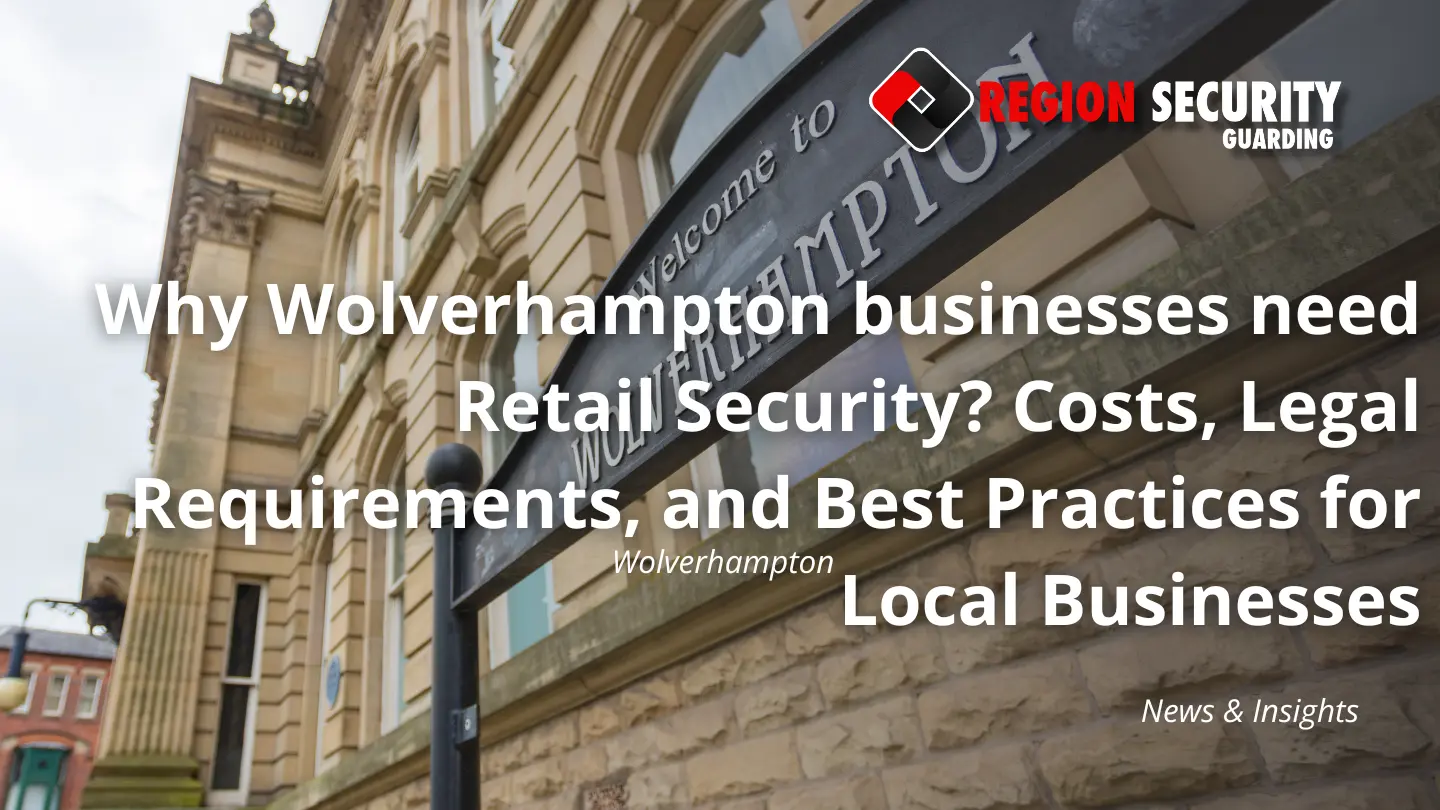
Why Wolverhampton businesses need Retail Security is the question behind every operations meeting. It also happens with the insurance review and board pack. These are the places where loss, liability and public safety meet a tight budget. Retail life in Wolverhampton looks different from street to street. High streets, retail parks and local convenience outlets each have their own hazards.
This article is for local business owners, facilities managers, and finance directors. It explains what effective retail security does. It also shows how to weigh costs, meet legal duties, and build plans that insurers can accept. Recent data indicates a material rise in shop theft across England and Wales. That trend is visible. Planning with that context matters.
Retail Security Basics in Wolverhampton
Retail security is the set of measures businesses use to reduce losses. It also helps to stop improper behaviour and manage incidents. It is not one thing. It is a blend of people, processes, and tools. For a shop on High Street, this might mean a visible guard during busy hours. It also protects tighter stock control behind the counter. For a retail park, it might mean CCTV linked to a monitoring hub with rapid-response patrols. This is why Wolverhampton businesses need retail Security.
How retail security differs from other forms of protection
- Static guarding: Fixed at entrances or a reception desk. Useful for access control and night-time protection.
- Remote monitoring: Cameras watched from a control room. Good for evidence and after-hours oversight.
- Retail security: Staff who work in trading hours observe and pick up early warning signs. This role combines visibility with judgement.
Using the right mix matters. Remote systems can capture incidents. But a guard on site interrupts a theft before it becomes a loss. A guard also reduces staff risk by managing confrontations. It also further provides a clear escalation route.
Local crime patterns and high-risk sectors
Wolverhampton’s retail risk is not uniform. Convenience stores, small grocers and multi-outlet discount chains often face repeated low-value thefts. Higher-value goods like electronics and beauty products attract organised activity. Retail parks with many exits can let offenders escape quickly. Nightlife areas bring different challenges: late opens, intoxicated customers and sporadic violence.
Data shows Wolverhampton shoplifting reports in the most recent year-on-year period. It happens with a slight rise over the prior 12 months. This local rise reflects broader regional trends. It is reported by West Midlands forces and national organisations. Planning must match those patterns.
What are the peak crime hours for businesses needing retail security in Wolverhampton?
Peak hours are not a single block. For many shops, the riskiest windows are when the store is busiest. Late mornings and the evening window overlap with deliveries and high footfall. These moments create gaps in attention.
For example, a convenience store near a school can see activity between 3pm and 5pm. A city-centre fashion retailer may notice more incidents when lunchtime footfall is high. Night-time risks play out differently. It has lower footfall, but a higher chance of confrontation or vandalism.
Match cover to the rhythm of your business. Guarding during a true peak gives a higher return than blanket cover at low-risk hours.
How has rising retail theft in Wolverhampton increased demand for daytime retail security?
The rise in daytime offences has changed buying behaviour inside retail firms. This is why Wolverhampton businesses need retail security to buy cover for day shifts. Daytime theft often involves concealment and quick exits. Organised offenders use many stores in rotation. Staff cannot both serve customers and watch several exits at once.
The British Retail Consortium and national crime records show an increase in theft. Violent incidents affect retail staff. Crime facts drives procurement teams to request visible, customer-facing security during trading hours. The aim is to reduce shrinkage and keep staff safe.
What are the differences between day and night retail security risks?
Daytime:
- High footfall.
- Opportunistic concealment.
- Staff are distracted by trading tasks.
Nighttime:
- Lower footfall.
- Higher risk of damage or forced entry.
- Different tactics: alarms, locks, and patrols.
A daytime guard blends into the store operation. At night, the focus is on perimeter checks, alarm response and clear evidence capture. A mix of both is often needed for businesses that extend hours.
How do economic factors in Wolverhampton influence retail security demand?
Economic stress changes behaviour. When living costs rise, low-value theft tends to increase. That puts pressure on thin-margin retailers. But it also reshuffles budgets. Tight budgets mean owners must choose where to invest. One sound choice is targeted security. It reduces shrinkage without adding friction for customers.
Finance directors want predictable costs. Procurement leads want documented service levels. A good security plan meets both. Prepare a clear statement of loss reduction and expected outcomes when requesting quotes. This helps justify the spend against other operational needs.
Legal and compliance requirements
Security is not a practical matter. It is a legal one. For retail businesses, in and around Wolverhampton some requirements are statutory. Others are industry best practices, but are still material to insurers and contract partners.
Core statutory and regulatory points
- SIA licensing: Anyone doing licensable security work must be SIA-licensed. This covers many guard roles on the shop floor and at entrances. Check licences for each guard working on your site. Recent changes added a refresher training need for those renewing licences.
- BS 7858 vetting: This standard guides background checks for people in security roles. It is not a legal need for all clients, but it is widely expected by insurers and larger tenants. Look for it in provider documentation.
- DBS checks: Criminal record checks are common for roles with vulnerable people exposure. They can appear in tender documents and landlord requirements.
- Insurance conditions: Insurers may need specific mitigations. Documented evidence of security activity can influence premiums and claims handling.
Martyn’s Law
Martyn’s Law places new duties on specific public venues and events. It introduces a tiered approach. It is where larger expected numbers will need to take extra protective steps. At the same time, the law targets places of mass attendance. It mainly covers Birmingham, Wolverhampton, Walsall, and some other places. There is an implementation window for premises to put measures in place.
How do VAT rules apply to retail security in the UK?
Security services are standard-rated for VAT. For VAT-registered businesses, this is usually recoverable. But it still affects the cash flow and the way you compare supplier quotes. Ask providers for VAT-exclusive and VAT-inclusive pricing to avoid mix-ups.
What documentation proves a security firm’s compliance history?
Ask for:
- Copies of SIA licences for deployed staff.
- Proof of public and employers’ liability insurance.
- BS 7858 vetting statements or a summary of vetting processes.
- Training records and refresher training evidence (post-April 2025 changes).
- Sample incident logs and reports to show the quality of reporting.
These documents give procurement leads and finance teams confidence and support insurer queries.
How do labour laws affect retail security overtime payments?
Labour rules affect shift design. Overtime payments, working time limits and rest breaks must be honoured. Providers usually factor overtime into their rates. If your business runs extended hours at short notice, expect higher costs. This helps to maintain compliance. This is a normal commercial feature.
How do West Midlands police and private security work together in Wolverhampton?
Private security is a first response and an information source for police. When incidents exceed the private provider’s remit, guards must escalate to police. West Midlands Police and local forces have acted to improve response. This helps increase arrests and targeted operations. Clear escalation paths and good relationship management improve outcomes and reduce duplication.
Costs, contracts, and deployment in Wolverhampton
Security costs are not a single line. They break down into staff, training, compliance overhead, and equipment integration. Local conditions, late trading versus daytime-only trading, and other factors move the price.
Main cost drivers
- National wage changes and SIA training requirements.
- Type of cover: Visible floor staff costs more than remote alarm monitoring alone.
- Contract length and volume: Longer contracts usually give better unit rates.
- Site complexity: multi-entrance sites need more resources than a single shop front.
- More services: keyholding, alarm response, and asset escorts add cost.
City centre vs suburban rates
City-centre rates are often higher. The reasons: higher demand, late trading and more complex compliance needs. Suburban stores can often negotiate lower rates. Logistical travel time and response windows for mobile patrols must be factored in.
Inflation and wage pressures
Recent national changes to SIA training and refresher requirements add cost. Providers pass some of that on. Procurement should model price sensitivity and assess the level of service they need.
How long does it take to hire and deploy a retail security team in Wolverhampton?
For a simple daytime rota, a competent provider can mobilise in a matter of days. This happens once checks and inductions are complete. For complex malls or multi-site operations, expect a planning phase of several weeks. Useful steps to speed mobilisation:
- Provide a clear site induction list.
- Share health and safety files early.
- Agree on a phased handover if the site has special needs.
What are common contract lengths for retail security in Wolverhampton?
Common terms are 6, 12 or 24 months. Shorter terms suit temporary needs but come with higher hourly rates. Longer terms give stability and easier financial forecasts for finance teams.
Procurement leads should insist on clear exit terms and performance review points. This helps to reassess service quality without undue cost.
How does retail security support business insurance premium reductions?
Security is evidence. Insurers look for credible mitigation. It covers documented patrols, visible presence during risk windows, and reliable incident logs. These reduce the chance of a claim and can sometimes be reflected in lower risk ratings. Security is rarely the sole factor in premium reductions. But it is a meaningful lever when combined with alarms, access control, and staff training.
How does the Procurement Act 2023 affect public sector retail security contracts in Wolverhampton?
Public procurement changes emphasise value and transparency. Tenders must show how security delivers measurable outcomes. It happens where city assets or council-managed retail units are involved. This shifts attention from the lowest price to documented performance and compliance.
Training, daily operations, and guard duties
Good training makes guards effective. It gives them judgment, not rules. For retail settings, the emphasis is on observation, de-escalation and clear reporting.
Key training themes
- Customer-facing judgement: how to observe without blocking trade.
- Evidence gathering: taking brief, accurate notes and securing CCTV clips.
- Liaison: how and when to call the police.
- Health and safety: guards often act as responders until emergency services arrive.
What does a retail security do immediately upon starting a shift in Wolverhampton?
Start by checking the brief. This is not bureaucratic. It records recent incidents, known threats and any store changes. Then the guard checks exits, sightlines and any temporary stock displays. Finally, a short chat with the duty manager sets priority areas for the shift.
This routine aligns expectations and reduces missed details.
What is the first thing a security guard checks when arriving at a Wolverhampton site?
They check the environment for obvious problems. It includes open exits, temporary obstructions and recent damage. If deliveries are scheduled, they note where staff will unload. Small things spotted early prevent bigger problems later.
What fire safety checks are priority for retail security on duty?
Guards verify that exits, fire doors and fire routes are functioning. They add an extra layer of assurance between periodic inspections.
How frequently do guards report to supervisors during Wolverhampton night shifts?
Reporting varies by contract. Typical practice is scheduled with check-ins every two to four hours. This happens with immediate updates after incidents. Technology makes this easier. Short incident entries can be shared live with supervisors and store managers.
What post-patrol documentation do retail security complete hourly?
Hourly entries are brief. Notes cover suspicious behaviour, customer counts, and maintenance or health and safety issues. Over time, these entries build a pattern that can show repeated concerns. As a result, it justifies changes to layout or staffing.
How do shift patterns work for 24/7 retail security coverage?
For continuous cover, rotate shifts to avoid fatigue. Overlap handovers to pass on context. Ensure handovers include not facts but judgment: what was felt as unusual. This human detail helps building managers and procurement make better choices.
Performance, risks, and staffing challenges
For boards and finance teams, performance matters more than the number of patrols. The right KPIs are those that show outcomes and cost efficiency.
What KPIs should businesses track for retail security performance?
Practical KPIs include:
- Incident frequency – pre- and post-deployment.
- Time to escalation – how fast an issue moved from detection to action.
- Loss reduction – measured over months, not hours.
- Customer and staff satisfaction – simple crime surveys after a period of coverage.
- Reporting quality – judged by the clarity and usefulness of logs.
These are accessible to finance and operations. They show whether security supports the business or adds cost.
How does weather in Wolverhampton affect retail security effectiveness?
Weather changes footfall. Heavy rain, snow and extreme heat create local spikes or dips. When the weather drives more people indoors, pressure points and losses can increase. Conversely, poor weather reduces footfall. But it can also lead to more staff shortages and logistics delays. Planning for weather reduces surprises.
What health impacts long shifts have on retail security performance?
Long shifts increase fatigue and reduce vigilance. They also make judgments less reliable. From a client perspective, insist on healthy shift patterns. This keeps performance steady and reduces errors that cost time and money.
What strategies are Wolverhampton firms using to retain retail security amid labour shortages?
Retention lies mostly with the provider, but clients can help stabilise it. It happens by offering predictable schedules and fair terms in the contract. Continuity benefits the client. Guards who know a site are faster to notice subtle changes. And this tends to build trusted relationships with staff.
Providers who underprice work often struggle to keep staff. And this shows up as turnover and weaker service. Procurement teams should look beyond price and ask for evidence of staffing stability.
Technology and future trends in Wolverhampton retail security
Technology is a tool, not a replacement. In Wolverhampton and nearby cities, it is already changing what is possible.
Key trends
- CCTV & On-site integration:
Cameras linked to guard stations allow quicker, targeted interventions. - AI analytics:
Pattern detection helps to highlight unusual behaviour. It includes repeated visits to the same aisle. Use this as a prompt, not a verdict. - Remote monitoring:
Low-risk periods can be covered with remote guards. This triggers local patrols when needed. - Drones:
Applicable for large sites and retail parks. They are not a common retail tool yet but have niche uses for wide perimeter checks. - Green security practices:
Using low-energy devices and electric patrol vehicles for sustainability targets. - Martyn’s Law implications:
Premises that fall into scope will need clearer plans. And it may use technology to show readiness.
How do remote monitoring systems complement traditional retail security in urban Wolverhampton?
When paired with good local knowledge, remote monitoring reduces unnecessary patrols. And they focus guard time where it matters. A camera alert can send a nearby guard to a specific aisle, making response faster and more discrete.
How are drone patrols integrating with ground-level retail security in nearby cities?
In nearby regions, drones have been tested for perimeter sweeps. It happens for large retail parks and warehouses like Wolverhampton and Birmingham. They provide fast overhead views and can spot vehicle movements or suspicious gatherings. Wolverhampton retailers should watch these pilots. Drones are not a universal fix but can add value for large multi-acre sites.
What predictive analytics tools help Wolverhampton businesses assess retail security needs?
Tools that combine data, incident logs, and calendar events can flag higher-risk days. Use analytics to plan targeted cover rather than blanket spend. Analytics show when to add hours and where to harden exits.
What impact will Martyn’s Law have on retail security requirements for Wolverhampton venues?
Martyn’s Law introduces clearer duties for certain venues and events. For retailers, it means an obligation to document risk assessments and prepare measures. Larger spaces and shops that host events should review their plans now. They must treat security as part of regulatory compliance.
Conclusion
Why Wolverhampton businesses need Retail Security? Because local patterns and national trends show that retail threats are evolving. Theft is not an after-hours problem any more. It is a trading-hours issue. It touches staff safety, insurance exposure and the bottom line.
Good retail security in Wolverhampton reduces shrinkage. It supports staff and shows insurers and landlords that you take risk seriously. It is a set of choices: where to have people, where to put cameras, and where to rely on analytics. Make those choices with clear data, documented compliance and measured goals.
Consider your risk, match cover to the times that matter, and keep records that show value. That is how security moves from a cost line to a management tool. And that answers the question Why Wolverhampton businesses need retail security. Because it helps justify operations, costs, and decisions in insurer meetings.
Frequently Asked Questions
1. Do I need retail security if I already have CCTV?
CCTV records events. Staff and guards prevent them. Cameras help with evidence; guards reduce the chance of loss. Both work best together.
2. Will security guards scare customers away?
Not if they are trained for retail. The right guard blends visibility with approachability. Good guards reassure customers and support staff, not intimidate shoppers.
3. How long does it take to see a return on security spend?
Look beyond weeks. Many retailers measure impact over months. Reduced shrinkage, fewer incidents and improved staff retention show up over time.
4. What paperwork should I ask a security provider for?
SIA licences for staff, insurance certificates, BS 7858, and sample incident reports. These items show compliance and quality.
5. Can security help reduce insurance premiums?
Yes, when combined with other mitigations and clear documentation. Insurers want evidence of active risk management, not devices.
6. Are AI and analytics safe to use with customer data?
Use tools that respect GDPR. Analytics that flag patterns are useful, but personal data must be handled lawfully. Get legal advice for high-risk deployments.
7. How does Martyn’s Law affect shops?
Martyn’s Law targets venues with public access and events. Many shops will only need basic preparedness. Larger venues with big crowds must take more steps and document them.
8. Should I expect higher rates in the city centre?
Yes. City-centre work often costs more due to demand, hours and logistical complexity.
9. Is keyholding necessary for retailers?
It helps. Fast, vetted responses to alarms reduce damage from forced entry and limit time premises are unattended.
10. How often should I review my security plan?
Review annually, and after any incident. Reassess cover when trading hours change or the product mix shifts.