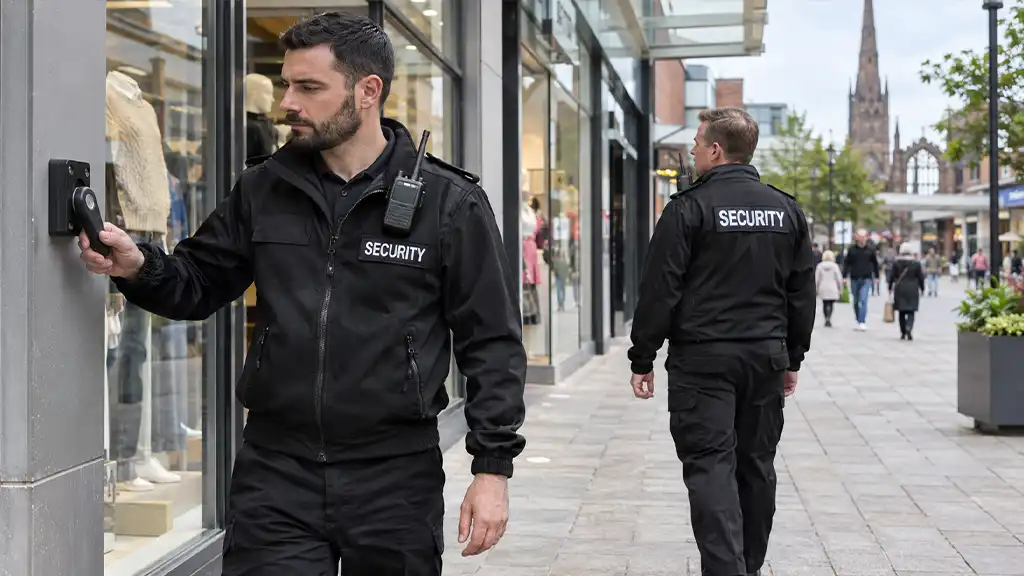
A Security Patrol Strategy in Coventry should reflect those differences rather than rely on a standard route. Patrols need to be planned around the layout of the premises, vulnerable areas and the times when security activity is most useful.
Good patrol planning is also about more than deciding where an officer should walk. The strategy should help identify potential weaknesses, maintain visibility across key areas and provide a clear response when an issue is found.
How Coventry’s Retail Environment Shapes a Security Patrol Strategy in Coventry
Coventry has a long history as a centre for trade. By the end of the 14th century, the city had become one of England’s most important commercial centres, with textiles and the wool trade playing a major role. Broadgate also developed as a key marketplace and remained central to city life for centuries.
Retail continued to shape Coventry as the city changed. By the late 1800s, Smithford Street had become a popular shopping area. Much of the city centre was later redesigned after heavy bombing during the Second World War. Donald Gibson’s post-war plan helped create a pedestrian shopping precinct, which Coventry City Council describes as the first of its kind in Europe and the world’s first large-scale shopping precinct.
That history is still reflected in Coventry’s retail landscape today. Businesses operate across pedestrianised shopping areas, traditional streets, shopping centres, retail parks and local neighbourhoods. Each setting can create different security considerations.
For example, a city-centre retailer may need regular attention around entrances, customer areas and nearby pedestrian routes. A retail park may have wider external areas, car parks, loading points and less visible sections. Smaller local stores may have fewer access points but still need checks around doors, stock areas and surrounding spaces.
This is where retail security patrols in Coventry need to be planned around the individual business rather than a fixed template. The layout of the premises, surrounding environment, trading hours and previous security concerns can all influence where officers patrol and when checks take place.
What Can Coventry Retailers Learn From Local Security Risks?
Coventry retailers operate in a changing security environment. The risks around a city-centre shop can differ from those facing a supermarket, retail park or independent store. Local conditions, trading patterns and nearby activity can all affect how a business should plan its security.
West Midlands Police data for St Michael’s in Coventry shows how risks can vary within the city. In July 2026, 130 shoplifting offences were recorded in the area, alongside 380 violence and sexual offences and 62 other theft offences. In August 2026, shoplifting increased slightly to 137 reported offences. These figures provide local context, but they do not mean every retailer faces the same level or type of risk.
For an individual business, its own incident history can be more useful when planning patrol coverage. Repeated thefts, suspicious behaviour, damage to doors, attempted unauthorised access or concerns raised by staff can help identify areas that need closer attention.
The surroundings should also be considered. Busy pedestrian routes, public spaces, transport links, car parks and shared access areas can influence how people move around a retail site. Delivery periods, staff changes and evening trading can create further changes in security needs.
This is why a security company in Coventry should plan patrols around the conditions of each individual site. Local crime information can provide the wider picture, while incidents and observations from the premises can help determine where patrols should focus.
How Should Patrol Strategies Differ Across Coventry Retail Locations?
A patrol should change with the way a retail site operates. In Coventry, city-centre shops, retail parks and local stores can present different security challenges. The layout, footfall, access points and daily activity can all affect where patrols are most useful.
- City-centre shops: Focus visibility around entrances, busy customer areas and pedestrian-facing sections during peak trading periods. Customer movement can change quickly throughout the day.
- Retail parks: Include car parks, loading areas, rear access and wider external spaces within the patrol route. Larger sites may have areas that are further from the main entrance and less visible.
- Supermarkets: Consider multiple entrances, stockrooms, delivery areas and periods of high customer activity. Delivery movements can temporarily change how staff, vehicles and contractors use the site.
- Convenience stores: Give closer attention to entrances, high-value goods and areas that may be harder for a small staff team to monitor. The immediate surroundings can also form part of the patrol check.
- Shopping centres: Consider shared entrances, customer movement, surrounding units and connected areas. Activity outside an individual shop can also affect the wider security environment.
What Makes Patrol Planning More Effective?
The earlier sections show that there is no single patrol pattern that works for every Coventry retailer. A good strategy brings together the risks of the premises, the way the site operates and what officers learn during their patrols.
Four principles can help turn those factors into a structured patrol strategy:
- Purpose: Every patrol should have a reason. Officers should know what they are checking, why it matters and which concerns require action. This prevents patrols from becoming routine walks with little security value.
- Adaptability: Patrol activity should respond to changes at the site. A delivery, unusual customer activity, an access problem or a recent incident may temporarily change where attention is needed.
- Controlled variation: Important checks should not be missed, but every patrol does not have to follow exactly the same sequence or timing. Some variation can prevent the routine from becoming completely predictable.
- Evidence and review: Patrol reports should show what was checked, what was found and whether further action was required. Over time, these records can reveal recurring issues and help retailers decide whether patrol arrangements need to change.
Conclusion
A good security patrol strategy in Coventry should reflect the realities of each individual retail site. There is no single patrol route or schedule that suits every business.
City-centre shops, retail parks, supermarkets and smaller stores can face different risks. Across Coventry and the wider West Midlands, patrol planning should consider the layout, trading patterns, access points, previous incidents and changing activity around the premises. Businesses with wider security requirements can also consider a security company in West Midlands when reviewing their overall protection.
The most effective approach is structured but not rigid. Patrols need a clear purpose, sensible variation and useful reporting. Regular reviews can also help retailers adjust their approach when risks or site conditions change.