Introduction: retail risk in a shift-driven city
Retail risk in Aberdeen follows a different clock. Early mornings bring offshore and port workers into convenience stores and cafés. Late evenings see staggered footfall as shifts end, ferries arrive, or flights turn over. Between those peaks, trading can be quiet, spread out, and weather-dependent. That uneven rhythm shapes where problems emerge and why static controls don’t always keep pace.
For local decision-makers, Retail Security is less about reacting to headline crime and more about managing exposure at the edges of the trading day. Staff are often working with reduced cover. Sites sit close to transport routes, industrial areas, or waterfronts. Response times can stretch, especially when conditions turn. In those moments, a visible, trained presence can prevent small issues from becoming incidents that disrupt trading or harm staff confidence.
This guide is written to support practical decisions. It explains how manned Retail Security fits Aberdeen’s business mix, how it supports insurance and compliance expectations, and where it genuinely changes outcomes and where it doesn’t. Rather than assuming constant cover is the answer, it focuses on timing, site layout, and risk concentration across a city shaped by shift work and movement.
That context is why “why Aberdeen businesses need Retail Security” is ultimately a question of judgement. When human presence is applied proportionately and at the right moments, it can stabilise operations, protect people, and make retail risk easier to manage, even when the city isn’t operating on a nine-to-five routine.
Retail Security Basics in Aberdeen: Three Operating Rhythms that Change Everything
Aberdeen’s retail environment moves to three different beats: the shift rhythm (offshore, port, and early starts), the waterfront/logistics rhythm (ports, yards, and trade counters), and the quiet-between-peaks rhythm (long gaps that invite opportunistic crime). Understanding how each rhythm shifts through a day is more useful than a generic list of duties; it tells you where human presence actually matters.
How Retail Security is different from static or remote-only cover
At its core, Retail Security in Aberdeen is about timely human judgement. That usually means:
- Visible staff-facing presence during trading peaks.
- Mobile oversight in mixed-use sites (moving between shop floor, delivery zones, and car parks).
- Immediate, proportionate intervention to prevent escalation.
How this differs from other models:
- Static security is great at controlling access or guarding a single point (back door, gate). In Aberdeen, it struggles when problems move, for example, from a dock delivery bay into a nearby convenience store.
- Remote monitoring flags incidents quickly, but often after behaviours have already shifted. It helps evidence, not always deterrence.
In short, Aberdeen needs people who can interpret transient behaviour and act before incidents harden.
How local crime patterns shape demand
Aberdeen’s recorded crime profile isn’t about high-frequency city-centre thefts so much as opportunistic and timing-driven incidents. Key pressures are:
- Transient worker populations (offshore/port staff) who create concentrated windows of activity.
- Vehicle-enabled thefts around retail parks and service yards.
- Opportunistic theft in quieter hours when stores are attended by fewer staff.
These patterns make flexible, presence-first solutions more effective than static or purely remote options.
Peak hours and where to place guards
Peak risk windows in Aberdeen typically align with shift changes and transport timetables:
- Early morning: convenience retail sees contractor/crew purchases.
- Late afternoon / early evening: shift finishes create another surge.
- Weekend mid-day: leisure and food outlets attract mixed crowds.
Putting trained, visible staff where those flows concentrate, entrances, pay points, and car parks prevents many incidents before they start. Retail sites in Dundee face similar timing-led risks, particularly around commuter flows and late-afternoon trading peaks.
Warehouse, port, and trade-counter vulnerabilities
Aberdeen’s industrial edges have specific weaknesses:
- Poorly lit service yards and delivery bays.
- Multiple access points are used by staff, couriers, and contractors.
- High-value goods staged outdoors awaiting collection.
Retail Security for these sites focuses on perimeter checks, visible presence during deliveries, and liaison with site managers to reduce opportunistic access.
Tackling anti-social behaviour in retail parks
Retail parks here often attract loitering or vehicle-based nuisance after stores close. Comparable challenges are reported at retail parks in Stirling, where visible evening patrols are often used to reduce nuisance behaviour. Practical guard duties that work:
- High-visibility patrols through car parks at closing times.
- Early engagement with groups (verbal de-escalation, movement-on notices).
- Co-ordination with CCTV and council community safety teams, where available.
Visible, proportionate contact usually calms things more effectively than late enforcement.
Day vs night: different problems, different answers
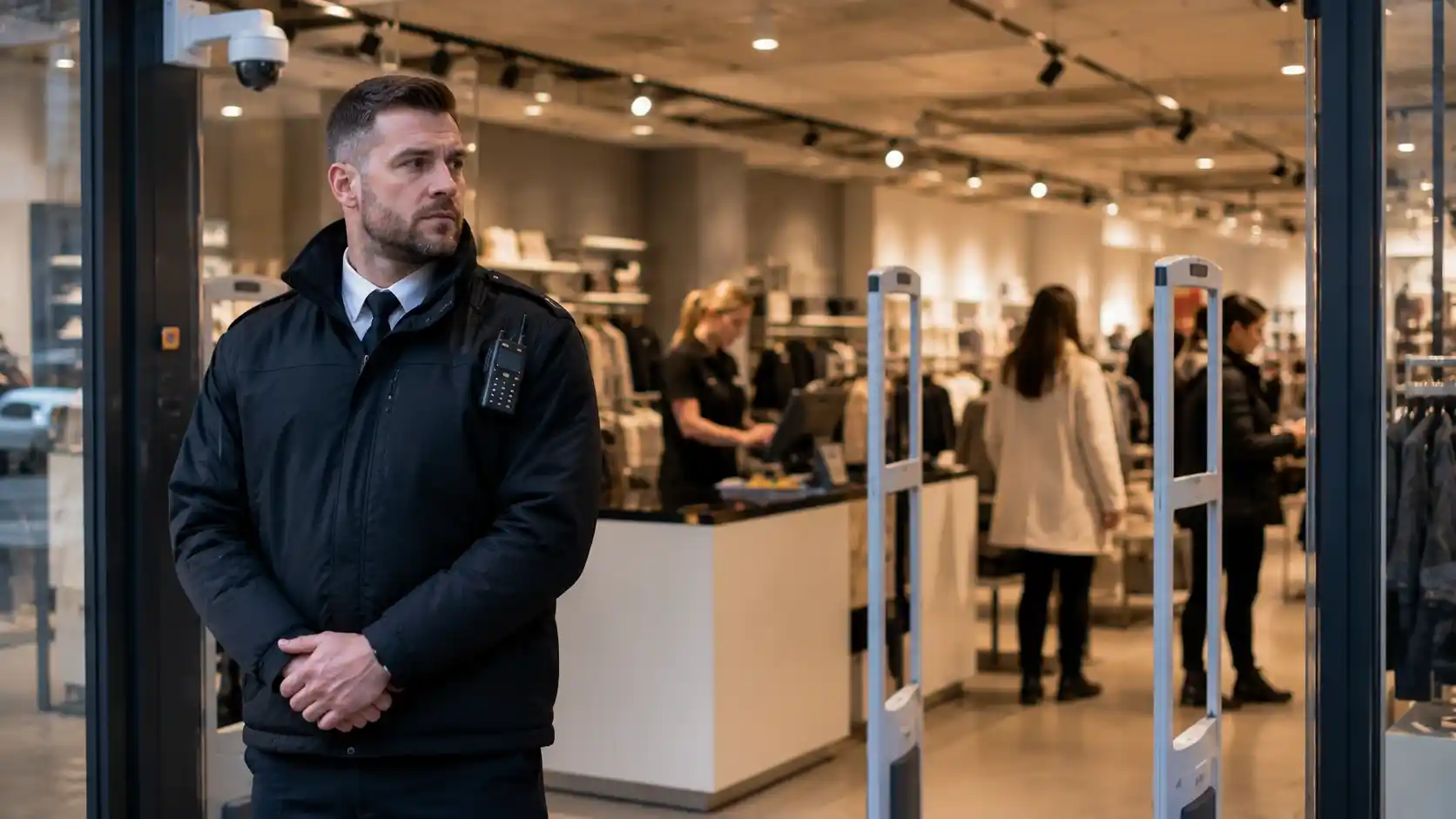
- Daytime: theft, refund fraud, staff abuse, distraction techniques. Human presence prevents escalation and supports immediate evidence capture.
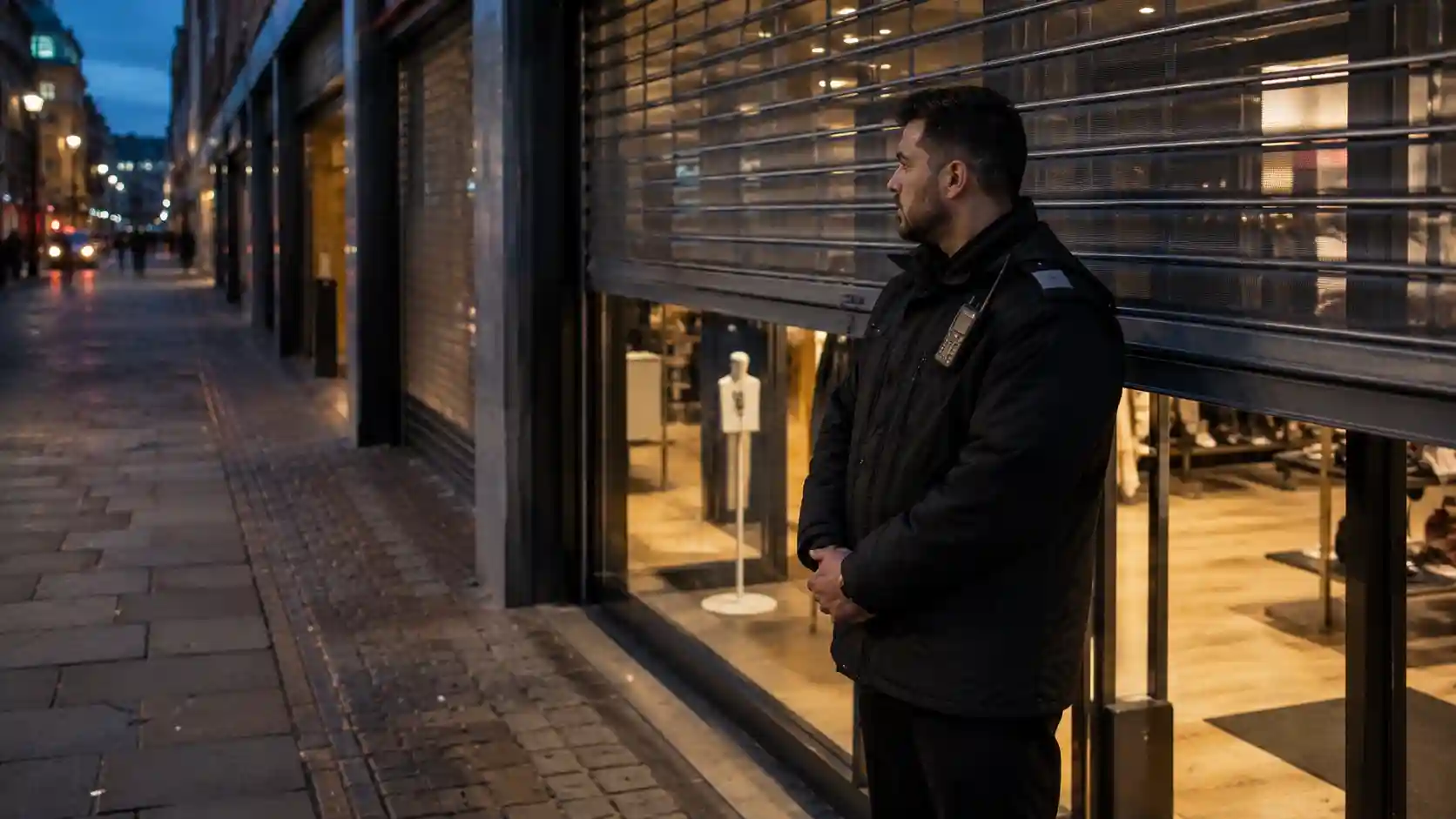
- Night-time: vandalism, break-ins, trespass. Deterrence and robust secure-down procedures win here.
Aberdeen’s sweet spot is deploying guards at transition moments, not blanket 24/7 coverage unless justified by site risk.
Seasonal & event effects
Aberdeen sees seasonal bumps tied to industry cycles and local events (crew rotations, short-term projects, occasional festivals). This mirrors the experience of retail venues in Edinburgh, where short-term events and visitor surges require carefully timed manned security cover. During these times:
- Increase daytime presence.
- Tighten perimeter checks at yards and pop-up retail.
- Pre-plan liaison with port/airport security if movements spike.
Transport links and retail hub security
There’s no tram system here, but airport, ferry, rail and port links create transient footfall. That matters because rapid, short-duration crowds are where theft and disorder concentrate. Security plans should focus on arrival/departure times and adjacent retail edges.
Economic forces and industrial demand
Local economic swings, especially in energy and maritime sectors, change staffing patterns and footfall. When industry booms, demand for manned security in industrial areas rises. When it softens, opportunistic theft can spike as cost pressures bite.
Similar demand patterns can also be seen in Glasgow, where mixed retail and industrial zones face comparable peak-driven security pressures.
Legal and Compliance Requirements for Retail Security in Aberdeen
Legal compliance in retail security rarely feels urgent until it suddenly is. In Aberdeen, questions about licensing, vetting, or insurance usually surface after an incident. Usually, during a claim or when an event licence is reviewed. At that point, paperwork stops being theoretical and starts affecting whether a business is protected or exposed.
When SIA licensing becomes a real risk
If a guard is involved in a confrontation, an injury, or a disputed removal, the first question is not what happened, but who was responsible.
Anyone carrying out licensable guarding duties must hold a valid licence issued by the Security Industry Authority. This applies across the UK, including Aberdeen.
From a buyer’s perspective, licensing issues usually surface in three situations:
- Following a customer complaint or use-of-force allegation
- During an insurance claim
- When police or council officers request incident details
Using an unlicensed guard is treated as a criminal offence. Responsibility does not rest solely with the provider; businesses are expected to demonstrate that they carried out reasonable checks.
Vetting and DBS checks: what’s expected in practice
Most reputable providers screen staff to BS 7858, the recognised vetting standard maintained by the British Standards Institution. This confirms identity, employment history, and right-to-work status.
DBS checks are not mandatory for every retail role. However, in Aberdeen, they are commonly expected where:
- Guards work closely with the public
- Sites are near transport hubs or mixed-use developments
- Insurers or landlords request additional assurance
The key principle is to match proportionality checks to site risk.
Insurance: where compliance failures become expensive
Insurance is often where non-compliance has the biggest financial impact.
Guidance reflected by bodies such as the Association of British Insurers assumes that guarding arrangements are lawful and properly insured.
Most businesses should expect providers to carry:
- Public liability insurance
- Employer’s liability insurance
- Clear contractual responsibility for incidents
If guards are unlicensed or deployed outside the agreed scope, insurers may dispute claims—even if the incident itself is unrelated.
CCTV, data protection, and sharing footage
Retail Security in Aberdeen frequently operates alongside CCTV, bringing UK GDPR obligations into play. Oversight sits with the Information Commissioner’s Office.
From a business perspective, compliance usually hinges on:
- Clear signage explaining the monitoring
- Defined retention periods
- Restricted access to footage
- Documented procedures for sharing material with Police Scotland
Poor data handling can trigger regulatory scrutiny even when incidents are minor.
VAT, labour law, and cost transparency
Manned Retail Security services are typically VAT-rated, which affects procurement and budgeting.
Contracts should also clearly address:
- Overtime and rest-period compliance
- Night-work considerations (relevant in Aberdeen’s shift economy)
- Right-to-work checks following post-Brexit rules
While businesses don’t manage guards directly, failures at the provider level can still disrupt coverage or create reputational risk.
Events, construction sites, and council expectations
Retail Security often forms part of licensing or planning conditions for:
- Events using retail-adjacent spaces
- Temporary or pop-up retail
- Construction sites open to the public
Aberdeen City Council uses multi-agency safety processes for events. If security is referenced in a licence condition, failure to deliver it properly can affect permission to operate.
Working with Police Scotland and local partnerships
Retail Security operates alongside Police Scotland, not instead of it.
In practice, collaboration focuses on:
- Incident escalation thresholds
- Evidence handling standards
- Sharing information on repeat offending
Clear protocols make these interactions smoother and reduce delays during investigations.
Martyn’s Law and future obligations
The forthcoming Protect Duty (Martyn’s Law), introduced by the UK Government, will apply across Scotland.
While final details continue to develop, the direction is clear:
- Documented risk awareness
- Proportionate mitigation measures
- Clear coordination between people, procedures, and systems
Retail Security is likely to support compliance as part of a broader safety framework, especially for venues that manage public access.
Costs, contracts & deployment in Aberdeen
Aberdeen’s security pricing logic is shaped by a simple reality: when retail busiest windows don’t follow a 9–5 clock, costs reflect getting the right cover to the right place at the right time. Ports, shift-work, deliveries and changeable weather mean you’re buying responsiveness and continuity as much as an hourly patrol.
Typical cost drivers (city centre vs suburbs/port & industrial edges)
Costs aren’t only about geography; they are about how easy it is to sustain cover.
- Aberdeen city centre
- Higher baseline expectations (professional front-of-house conduct, multi-site clients) can push hourly rates up slightly.
- But the density of available staff and shorter travel times often reduce standby and relief costs.
- Port, retail parks & suburban/shire sites
- Longer travel, fewer nearby relief resources, and the need for vehicle-equipped patrols raise total delivery costs.
- Perimeter and delivery-bay checks during shift changes add operational time that shows up in pricing.
Practical takeaway: a suburban/port site can cost more per shift to run reliably than an equivalent city location, because you’re buying resilience (backup staff, travel, and induction time).
How quickly can a team be hired and deployed?
Timescales depend on urgency and paperwork:
- Emergency short-notice cover: 24–72 hours possible for basic presence, but limited by vetting and licence checks.
- Planned mobilisation: 7–21 days is typical to allow inductions, site-specific risk briefing, and documentation.
- Seasonal scaling: plan 4–8 weeks ahead for dependable capacity during major industry rotations or local events.
Why it’s longer than it looks: SIA licence verification, BS7858 vetting, and site induction, especially for port or industrial access, take time. If you need guaranteed quick cover, expect a mobilisation premium.
Common contract lengths & notice periods
Design tends to balance flexibility and continuity:
- Short-term/seasonal: 1-3 months (for targeted peaks). Termination: typically 7–30 days.
- Medium-term: 6–12 months (most retail arrangements). Termination: usually 30–60 days.
- Longer agreements: rolling 12+ month contracts with performance KPIs and indexation. Termination: 60–90 days.
Include explicit mobilisation and exit clauses so a last-minute contract end doesn’t leave you exposed.
Wages, 2025 pressures, and inflationary effects
Labour is the single biggest cost driver. Recent statutory wage increases, higher fuel costs, and new training/qualification requirements are pushing baseline costs up.
- Short-term effect (2025): vendors pass increased wage bills into higher hourly rates and higher standby/relief charges.
- Long-term effect: expect more contracts to include escalation or CPI-linked clauses rather than fixed multi-year rates.
Practical step: insist on clear cost-escalation triggers (CPI, National Living Wage changes) and set review windows rather than open-ended price increases.
How guarding can help with insurance costs
Guards don’t automatically cut premiums, but they create a defensible risk posture:
- Strong, visible guarding, along with evidence-rich reporting, reduces the frequency and severity of claims.
- Insurers favour documented deterrence: time-stamped patrol logs, CCTV-linked evidence, and incident-resolution records.
- For some risks (retail parks, high-value goods staging), a consistent guarding regime can materially improve underwriting conversations.
Practical ask: get your supplier to provide a “security evidence pack” (patrol logs + incident reports) for your insurer as part of the contract.
Procurement Act 2023
Public procurement changes emphasise value, transparency and service continuity. For public-sector retail or council-managed sites, this means:
- Tenders will demand clear mobilisation plans and evidence of continuity (no “we’ll find someone at short notice”).
- Scoring will favour demonstrable resilience, social value and performance metrics, not just the lowest hourly rate.
- Contracts increasingly include KPI dashboards, audit rights, and structured mobilisation/exit plans.
If you supply to public bodies (or want alignment with their standards), prepare to demonstrate how your contract ensures continuous, auditable cover, not just the cheapest hours.
Training, daily operations & guard duties in Aberdeen
Aberdeen’s retail rhythm is driven by shifts, ports and weather. That changes what training matters and how daily routines work. Instead of a linear checklist, think in phases: pre-shift (brief & kit), peak windows (presence & movement), transition periods (crowd & deliveries), quiet/night (verification & deter), and handover/secure-down. Below are the practical standards and the real actions guards take in each phase.
Training standards you should insist on
Guards working in Aberdeen retail (especially port/shift-adjacent sites) should have:
- SIA licence for the role.
- Conflict management and verbal de-escalation tailored to mixed workforces (crew, contractors, tourists).
- Lone-worker & fatigue awareness (for early/late shifts).
- Digital reporting and CCTV evidence handling (bodycams where used).
- Site-specific basics: port/yard access rules, permit-to-work awareness for industrial edges.
These skills prioritise judgement in crowded or weather-hit moments, not drill-style enforcement.
Pre-shift: immediate actions on arrival
A guard’s first minutes in Aberdeen focus on situational orientation, not a full patrol.
They will:
- Read the handover/highlights: recent incidents, expected deliveries, vessels/shift rosters.
- Test communications and kit: radio, bodycam, torch, panic alarm.
- Verify CCTV is recording and live (quick playback).
- Walk key sightlines: main entrance, till areas, and the delivery yard (quick lighting check).
Any fault is logged and escalated before customer flows ramp up.
Peak windows: presence, movement & crowd micro-management
During early-morning crew surges or late-evening shift end:
- Guards focus on mobile visibility, moving with arrival/departure flows rather than fixed loops.
- Attention zones: entrances, payment points, taxi/coach drop areas, and service-yard handover points.
- Short-intervention rule: verbal de-escalation and movement-on before formal reporting unless an offence occurs.
Patrol cadence here is high (often every 10–20 minutes through hotspots) and flexible by observed crowding.
Transition periods & deliveries (where most issues start)
When deliveries, shift changes, or ferry arrivals occur:
- Prioritise perimeter checks of loading bays and gate controls.
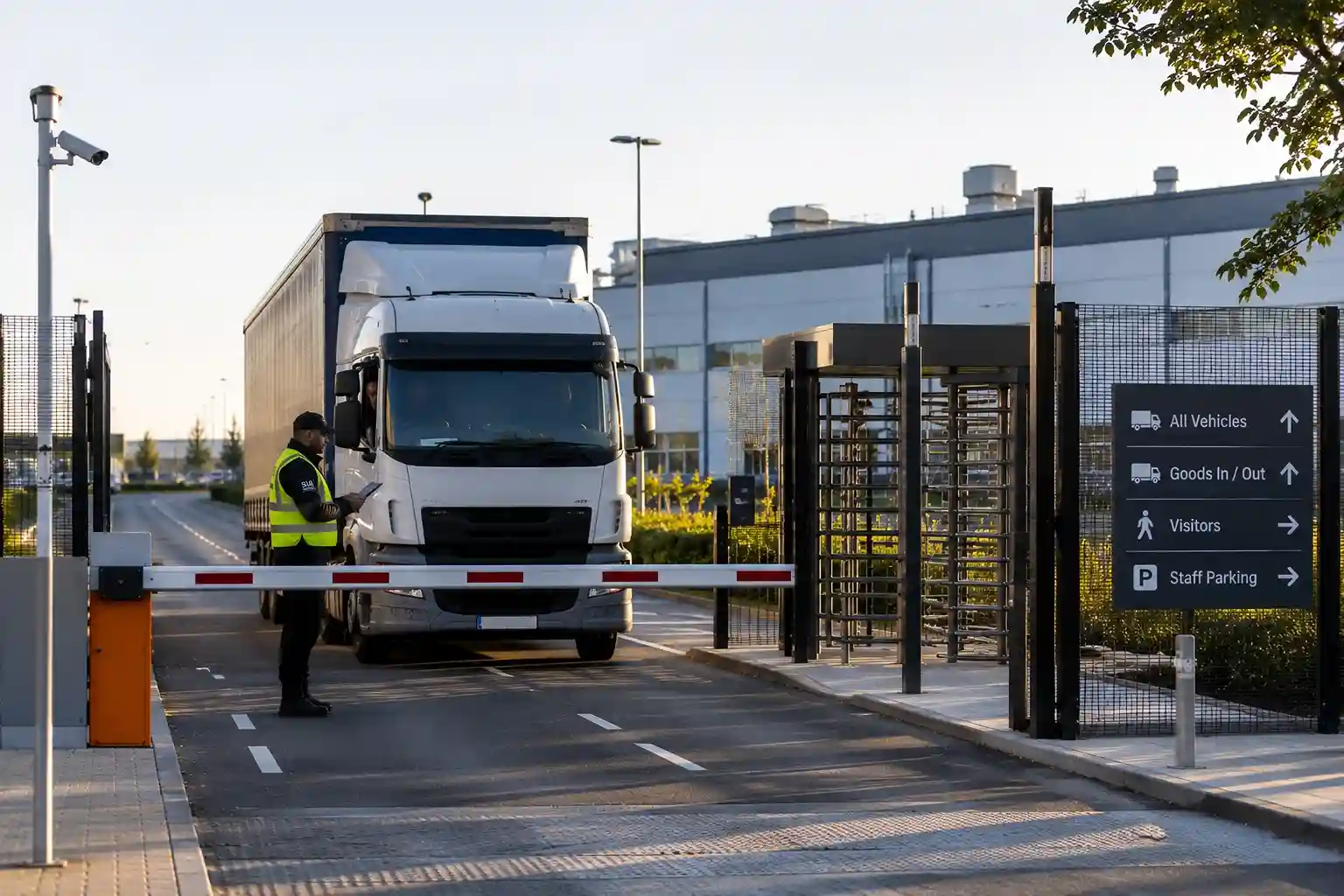
- Verify vehicle manifests and log vehicle registrations when required.
- Brief staff on temporary blind spots (e.g., crates blocking sightlines).
These actions reduce opportunistic theft and prevent incidents that start in service areas and spill into retail space.
Night & quiet periods: verification, not bravado
During quiet hours, guards concentrate on:
- Alarm verification protocols (safe verification before approach).
- Short, evidence-focused patrols (photographing/recording tamper signs).
- Regular welfare check-ins with remote supervisors for lone posts.
Typical patrol gaps widen (e.g., 45–90 minutes), but they also include targeted checks of known weak points.
Handover & secure-down discipline
A good handover in Aberdeen is concise and actionable:
- Outgoing highlights 3 issues (incidents, faults, actions).
- Incoming confirms understanding and records acceptance.
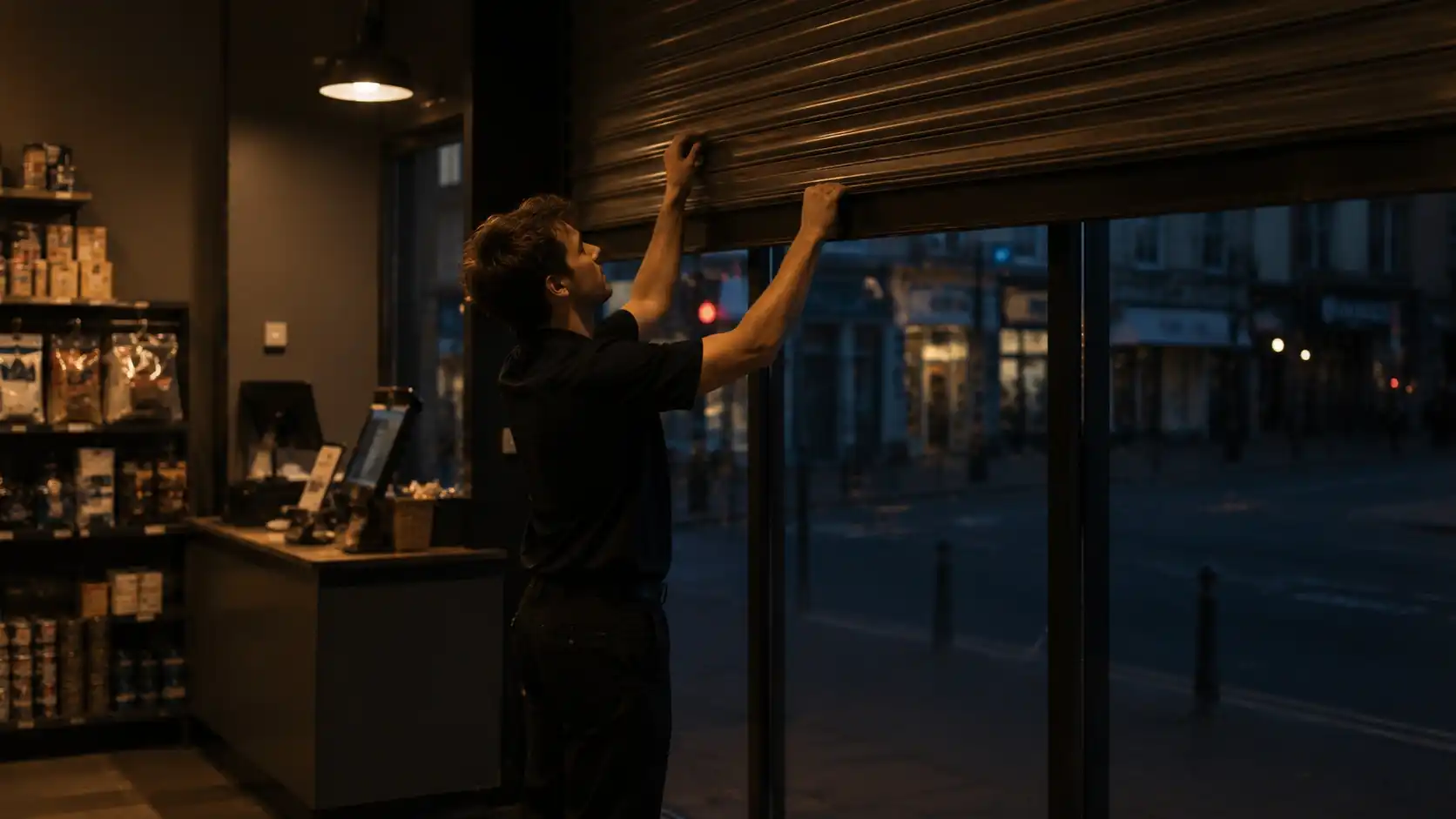
- Secure-down checklist: doors/gates secured, high-value goods locked, CCTV logged, and a final lighting sweep.
Complete logs and evidence packages are handed to supervisors and are available to insurers if needed.
Reporting, equipment checks & tamper detection
Guards are expected to:
- Hourly or post-patrol log key observations (including weather impact).
- Note lighting failures, CCTV blind spots, or utility tampering, photograph and escalate.
- Test radios/bodycams at the start and document their functionality.
These records are the primary defence in post-incident reviews.
Visitor logging & access verification
For deliveries, contractors or large crew movements, guards:
- Log name/company, vehicle reg, arrival/departure times and who escorted them.
- Verify IDs where required and confirm authorised access routes.
This audit trail is vital for port-edge retail operations.
Shift patterns & fatigue management
Aberdeen routines favour:
- Shorter night stints with supervisor check-ins.
- Overlap at peak windows for robust handovers.
- Guaranteed relief/standby during known fleet or crew rotation peaks.
This reduces fatigue-driven drop in judgement during long shift sequences.
Performance, risks & staffing in Aberdeen
Aberdeen’s retail risk is episodic: shift handovers, ferry/flight rotations, weather-driven spikes. So performance is less about “how many patrols happened” and more about whether cover held when it mattered.
Below are the failure modes to watch, the KPIs that actually prove resilience, how environmental factors (especially weather) show up in logs, the real health impacts of long duty patterns, and the market behaviours you’re likely to see from suppliers under labour pressure.
Failure modes (what goes wrong when security degrades)
- Coverage slip: planned patrols missed during peak windows.
- Evidence gap: poor-quality reports and missing CCTV links after an incident.
- Fatigue drift: decision quality falls in long/fragmented shifts.
- Environmental blindspots: weather or local restrictions create unpatrolled areas.
If any of these appear, risk increases even if someone is “on site.”
The handful of KPIs that actually matter (and why)
Track outcomes, not noise:
- Coverage adherence: % of agreed patrols completed during agreed risk windows. (Shows whether cover was present when needed.)
- Mean time to verify/escalate: Time from alert to confirmed action. (Shows procedural speed and whether monitoring works.)
- Incident repeat rate: Number of repeat incidents at the same hotspot per period. (Shows deterrence effectiveness.)
- Report quality index: Scored on completeness: timestamps, witnesses, CCTV linkage, photos. (Supports insurers & prosecutions.)
- Loss per comparable period: Direct commercial measure (£ loss/month compared to baseline). (Shows ROI.)
Request monthly dashboards for these metrics; they tell a clearer story than raw patrol counts.
Weather: how it weakens security and how guards should record it
Aberdeen’s coastal weather (wind, heavy rain, and freezing conditions) quickly affects patrol effectiveness.
Practical recording norms to expect:
- A short weather note is appended to each patrol log when conditions deviate (visibility, flooding, icy surfaces).
- Explicit flags when weather forces route changes (e.g., “north car park: reduced patrols due to standing water”).
- Photographic evidence of lighting/ground hazards was safe to capture.
These entries transform weather from an “excuse” into a verifiable context for incident review and insurer conversations.
Health impacts of long or fragmented shifts
Long or split shifts reduce vigilance and raise behavioural risk:
- Slower reaction times and missed subtleties in crowd behaviour.
- Reduced situational scanning. Guards focus on obvious hotspots and miss pattern changes.
- Increased minor errors in report detail (times, witness names).
For buyers, the symptom is continuity degradation: the same hours covered, but with declining protective value. Contracts that ignore rostering and fatigue create this hidden risk.
Mental health & night-shift welfare
Retail venues near ports or with early/late trading must insist that providers can demonstrate welfare measures rather than prescribe solutions:
Acceptable evidence to request from suppliers:
- Supervisor check-in cadence for night or lone posts (how often and by what method).
- Recorded welfare/incident debrief processes after stressful events.
- Policy showing how fatigue is monitored and mitigated in rostering (not the provider’s HR playbook, simply the evidence that it’s considered).
These items protect your operation by ensuring guard judgement is supported, not strained.
Environmental and regulatory constraints for outdoor patrols
In Aberdeen, expect constraints that affect patrol design:
- Coastal wind and salt exposure can affect lighting and equipment reliability.
- Port/harbour areas may have restricted access or require an escort for certain zones.
- Local planning or conservation rules can limit lighting or nighttime vehicle use.
Ask for documented patrol routes that show how such constraints are handled and how gaps are mitigated (e.g., CCTV cross-coverage, timed checks).
Staffing pressure: What buyers actually observe
Under labour shortages, providers typically respond with market behaviours that clients should evaluate:
- Small relief pools or guaranteed standby teams (costly but stabilising).
- Hybrid models – on-site during peaks; remote monitoring off-peak.
- Premiums for guaranteed short-notice mobilisation.
These are supplier responses, not retention “how-to”s. As a buyer, evaluate whether those behaviours provide continuity and a clean audit trail, not whether they’re cheap.
Technology and future trends in Aberdeen Retail Security
Technology has reshaped Retail Security in Aberdeen, but not in the way many people expect. It hasn’t replaced guards, and it hasn’t turned retail protection into a control-room exercise. Instead, it has changed how early risks are identified, how cover is scaled around shifts, and how decisions are evidenced in a city where timing matters more than density.
How technology has changed everyday Retail Security practice
The biggest change is not more cameras, it’s better direction.
Modern systems help guards:
- Focus attention on the right entrances or zones
- Respond earlier to behaviour that’s starting to drift
- Produce clearer evidence when incidents are reviewed
In Aberdeen, this matters during short, intense pressure windows early mornings, late evenings, and delivery changeovers when a delay of minutes can make the difference between deterrence and disruption.
Post-COVID retail realities still shaping security
Retail behaviour never fully returned to pre-COVID patterns. Across Aberdeen, many sites now experience:
- Leaner staffing during long trading days
- Shorter but sharper footfall peaks
- Increased tolerance challenges around refusal, frustration, and abuse
Security planning has adapted by leveraging technology to enhance visibility and early intervention, while maintaining human presence where reassurance and judgement are essential.
AI surveillance: where it helps, and where it doesn’t
AI-enabled CCTV is increasingly used at:
- Retail parks
- Transport-adjacent shops
- Port-side and mixed-use retail sites
Its practical value lies in:
- Flagging repeated loitering or unusual movement
- Reducing monitoring fatigue during long quiet periods
- Directing guards to the right area quickly
What it does not do is assess intent or manage confrontation. In Aberdeen’s retail environments, AI supports decisions, but it does not make them.
Remote monitoring and hybrid security models
Remote monitoring has become a cost-management tool, not a shortcut.
A typical Aberdeen hybrid model looks like this:
- On-site guards during early-morning and late-evening peaks
- Remote monitoring during extended quiet periods
- Clear escalation routes so alerts become directed guard actions
This approach keeps human judgement available when risk is highest, without paying for constant presence when it adds little value.
Drone use: situational and tightly controlled
Drones are not a default retail solution. Where they are used in Aberdeen, it is usually:
- For large retail parks or waterfront perimeters
- To check hard-to-reach yard areas
- To capture evidence after repeated issues
Weather, airspace controls, and public perception all limit routine use. Drones remain occasional tools, not replacements for ground-level security.
Predictive analytics: planning cover instead of guessing
Some retailers now use predictive tools that combine:
- Historic incident data
- Footfall patterns
- Delivery schedules and local events
For Aberdeen, this supports decisions such as:
- Adding cover during vessel turnarounds
- Increasing patrols during known shift-change windows
- Scaling back presence during extended low-risk periods
These tools guide planning they don’t replace local knowledge.
Upskilling expectations for modern guards
As technology becomes embedded, guard roles have evolved.
Retail Security teams are increasingly expected to:
- Use digital reporting systems confidently
- Understand CCTV playback and evidence export
- Respond to AI or remote-monitoring prompts
- Follow clear data-handling procedures
SIA licensing remains the baseline. These skills sit on top of it.
Green and sustainable security practices
Sustainability in retail security is becoming more practical than political.
Common Aberdeen-relevant measures include:
- Smarter patrol planning to reduce vehicle use
- Energy-efficient lighting that improves CCTV visibility
- Shared monitoring infrastructure across nearby sites
These steps often reduce costs and environmental impact.
Martyn’s Law and what Aberdeen venues should prepare for
The forthcoming Protect Duty (Martyn’s Law) will apply across Scotland and affect venues with public access.
The direction of travel is clear:
- Documented risk awareness
- Proportionate mitigation measures
- Clear coordination between people, procedures, and systems
Retail Security will support compliance by showing who responds, how alerts are handled, and how risks are actively managed, not just listed on paper.
What this means for Aberdeen businesses
Technology is not changing why Retail Security matters in Aberdeen. It’s changing how precisely it can be applied, helping businesses:
- Put people in the right place at the right time
- Reduce unnecessary coverage without increasing risk
- Produce clearer evidence for insurers, landlords, and regulators
Used properly, technology makes Retail Security calmer, more targeted, and easier to justify, which is exactly what a shift-driven city like Aberdeen needs.
Conclusion
Aberdeen’s retail world moves to its own clock. People arrive early, leave late, and often pass through on short rotations. That rhythm changes the problem: it’s not more security that’s needed, it’s the right security at the right times. When guarding is chosen to cover shift peaks, delivery windows, and port-adjacent blind spots, it becomes a tool for reducing loss, protecting staff, and providing insurers with clear evidence, not an open cheque.
If you’re deciding today, start small and precise: map the busiest 3–4 windows in a week, identify the top three access points that draw risk, and trial a focused presence for a month. Then measure coverage adherence, incident repeat rate, and report quality. That practical loop try, measure, adjust is the clearest answer to why Aberdeen businesses need Retail Security that actually pays back.
Frequently Asked Questions
1. Do small Aberdeen shops need manned guards?
Not usually full-time. Short trials during peak windows, event days, or after repeat incidents are a sensible first step.
2. Can CCTV replace a guard?
No, CCTV records and helps investigate. A trained guard deters, intervenes, and manages people in real time.
3. Will guards automatically lower my insurance premium?
Not automatically. Insurers value documented, proportionate guarding and good reporting, which can improve renewal conversations.
4. What licences and checks should I ask a provider for?
Request valid SIA licences for deployed staff, BS 7858 vetting summaries, and insurer certificates (public & employer’s liability).
5. How long does mobilisation typically take?
Planned mobilisations: 7–21 days. Short-notice cover (24–72 hours) is possible but often carries a premium and limits vetting depth.
6. Are drones useful for Aberdeen retail sites?
They can help with perimeter checks or evidence after incidents, but weather, regulation and public sensitivity usually limit routine use.
7. How should weather be reflected in security plans?
Require simple weather notes in patrol logs (visibility, flooding, icy surfaces) and contingency routes if standard patrols are unsafe.