One theft every six seconds. That’s what 5.45 million detected shop incidents a year work out to. Shoplifting alone cost UK retailers £400 million last year.
Then there is the violence. Every day, 1,600 retail workers face abuse or assault. In 118 of those cases, it’s physical. In 36, someone uses a weapon.
The British Retail Consortium (BRC) Crime Survey 2026 lays it bare. Police-recorded shoplifting fell 1% to 509,566 in the year to December 2025, the first annual drop in a while. But the BRC and Association of Convenience Stores (ACS) say that’s just the tip. Most theft never makes it into police logs. Meanwhile, violence and abuse figures are still way above pre-pandemic levels. Organised gangs now drive a huge chunk of the problem.
This blog digs into the latest shoplifting statistics UK, what’s actually happening with retail crime in 2026, the real cost of aggression against staff, how police are responding, and the legal changes coming down the track.
Table of Contents
Why Retail Crime Continues to Rise Across the UK
You can’t pin this on one thing. A few forces are pushing theft numbers up. Recent retail crime statistics show that organised theft and repeat offending continue to pressure retailers across both major cities and smaller towns.
Cost of living still bites: Meat, cheese, baby formula, these keep showing up as top stolen items. People resell them for cash. It’s its own little economy now.
Organised retail crime (ORC) is professional: Gangs don’t just grab and run. They case stores, hit multiple branches in a day, and move goods through established resale networks. Over half of convenience retailers say ORC incidents have gone up year on year. Greater Manchester Police recently nicked seven people suspected of running a nationwide mass shoplifting ring targeting major supermarkets.
Fewer staff on the floor: Self-checkouts and lean rotas create gaps. Fewer eyes mean more chances to steal. It also means a slower reaction when something does happen.
Repeat offenders face few consequences: Only 19.1% of recorded shoplifting led to a charge in the year to June 2025. Yes, that’s up from 17.7%, but it’s still low. Steal small, get away with it. That’s the maths.
Most thefts go unreported: BRC estimates that only 8% of shoplifting incidents are reported to police. Why bother if nothing will happen?
Shoplifting Statistics UK: What the Latest Data Shows
The Office for National Statistics (ONS) recorded 509,566 shoplifting offences in England and Wales for the year ending December 2025. That’s down 1% from 516,611 the year before. But for the year ending June 2025, police recorded 529,994, up 13%. Depends which window you pick. Either way, shoplifting has more than doubled since the pandemic.
BRC data tells a bigger story and highlights how broader UK shoplifting statistics still understate the scale of retail theft affecting stores nationwide. Retailers detected 5.5 million shoplifting incidents last year. Real numbers are almost certainly higher because plenty of theft goes unnoticed or unreported.
Police-recorded vs. detected theft
| Metric | Figure | Period | Source |
| Police-recorded offences (England & Wales) | 509,566 | Year ending Dec 2025 | ONS |
| Police-recorded offences (England & Wales) | 529,994 | Year ending June 2025 | Home Office |
| Police-recorded offences (England & Wales) | 530,000+ | Year to March 2025 | ONS |
| Retailer-detected theft incidents | 5.5 million | 2025 | BRC |
| Direct cost of shoplifting | £400 million | 2025 | BRC |
| Total cost of retail crime (including prevention) | £4.2 billion | 2025 | BRC |
In London, 32% of people witnessed violence or abuse while shopping, the highest in the UK. For shoplifting, London and the West Midlands tied at 29% of shoppers seeing it happen. Yorkshire and Humberside (26%) and the North West (26%) weren’t far behind.
London saw a 42% increase in shoplifting offences in the year to May 2025, to 102,083. Five years earlier? 31,008.
Met Police shoplifting offences: then vs. now
| Period | Offences |
| 2020/21 | 31,008 |
| 2025/26 | 93,626 |
The Financial Impact of Retail Theft on Businesses
The latest retail theft statistics show theft cost retailers £2.2 billion in 2025, according to the BRC Retail Crime Survey. Add prevention spending and the total comes to £4.2 billion.
Convenience retailers alone spent a record £313 million on crime prevention last year, according to ACS. Theft plus prevention adds about 11p to every transaction in local shops. That “crime tax” lands straight on customers.
Where the money goes:
- CCTV and security cameras
- Security tags and protective screens
- Facial recognition and AI monitoring
- Body-worn cameras for staff
- Reinforced kiosks for spirits, tobacco
- Private security guards
But it’s not just stolen goods. Staff turnover from violence and abuse costs the sector at least £235 million a year. Insurance premiums climb after theft claims. Operations get disrupted. Staff morale tanks. Small independents get hit hardest. Rural retailers have spent over a quarter of a billion pounds on crime prevention in recent years.
What one theft does to a store:
Theft happens → Staff stop what they’re doing → They report it (takes time) → Stock is gone (plus cost to replace) → Operations slow down → Customer service suffers → Staff feel anxious → Some leave.
Aggression Against Retail Workers Is Becoming a Daily Risk
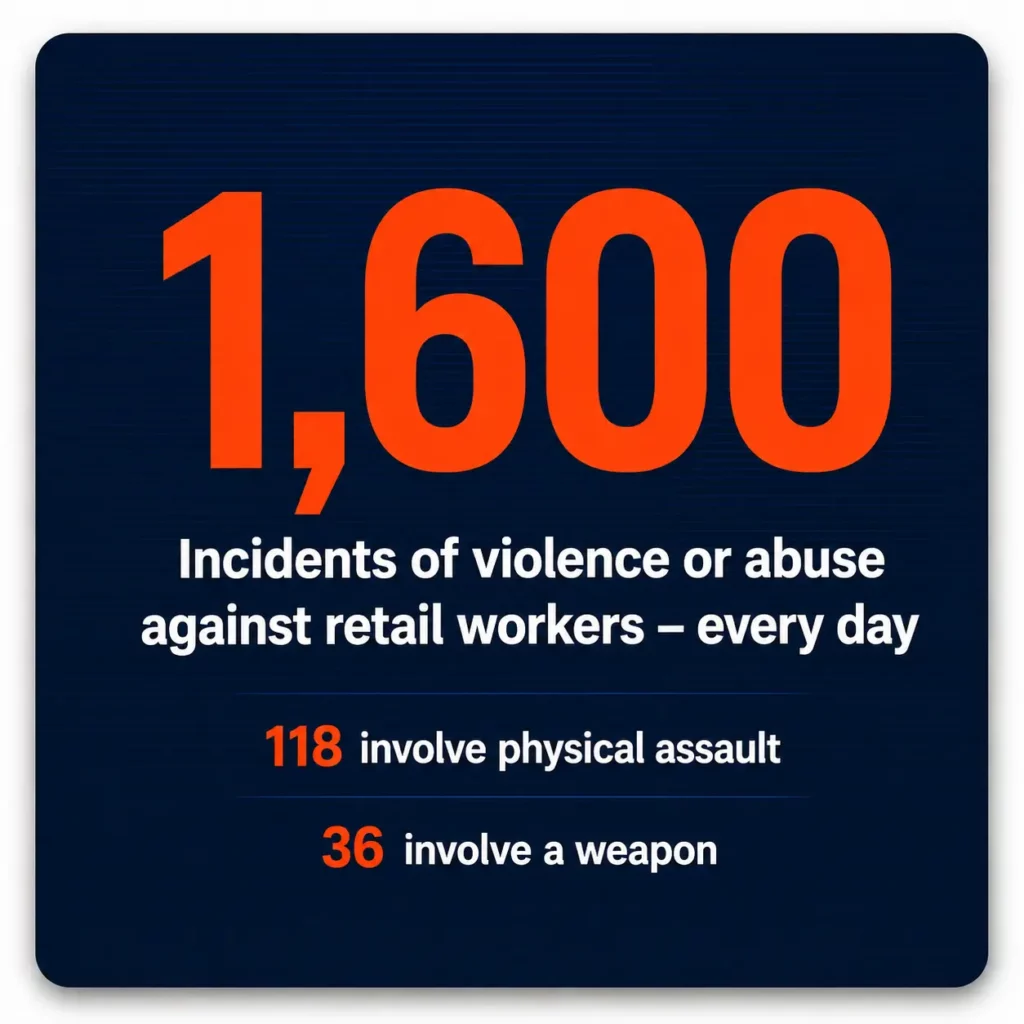
The numbers have come down a bit from last year’s peak. But they are still dangerously high.
BRC data: 1,600 incidents of violence or abuse against retail workers every single day. That’s the second-highest on record. Within that daily figure, 118 involve physical violence, and 36 involve a weapon. Compare that to pre‑pandemic levels, which were 455 incidents per day in 2019/20.
Usdaw surveyed nearly 9,000 retail workers. Nearly 80% said they had been verbally abused last year. 54% had been threatened. 11% physically assaulted. Physical assault has more than doubled since 2019.
One in five UK adults (21%) saw violence or abuse against a retail worker while shopping in the last year. Regional split:
- London – 32%
- Yorkshire and Humberside – 26%
- North East – 23%
- East of England – 13%
Two‑thirds of attacks on retail staff start with theft. Confronting a shoplifter is the single biggest trigger.
From October 2026, employers will be liable for harassment of their employees by customers, including sexual harassment, unless they have taken all reasonable steps to prevent it.
How Retailers Are Responding to Modern Retail Crime
Retailers are throwing money at the problem. Nearly £5.5 billion over the past five years, says the BRC.
CCTV monitoring: ACS says convenience retailers spent a record £313m on crime prevention, with CCTV at the heart. AI‑enabled systems can tell a real threat from a false alarm and trigger live alerts.
Visible security guards: Uniformed SIA‑licensed guards work as a deterrent. Opportunistic thieves think twice when they see a uniform. Co‑op reported a 20% drop in crime after investing in additional guards and other measures.
Access control for retail parks: Gatehouse security prevents unauthorised vehicles from entering. Big help for out‑of‑town retail parks where vehicle‑based theft is common.
Incident reporting systems: REMS tracking and digital platforms give live alerts, images, and police references. Faster reporting means better police response.
Mobile patrols: Random‑interval patrols covering multiple sites. Irregular timing means criminals can’t predict the pattern.
Why Visible Security Presence Still Reduces Theft
Cameras record, but Guards act. That difference matters more now than ever.
Organised crime groups study store layouts. They find camera blind spots. They learn staff shift patterns. A camera cannot walk up to someone and ask what they are doing. It cannot calm down an angry customer. It cannot call for backup during a live incident.
A uniformed guard at the entrance changes behaviour, which is why many retailers continue investing in visible manned guarding services despite advances in surveillance technology.
What visible security actually does:
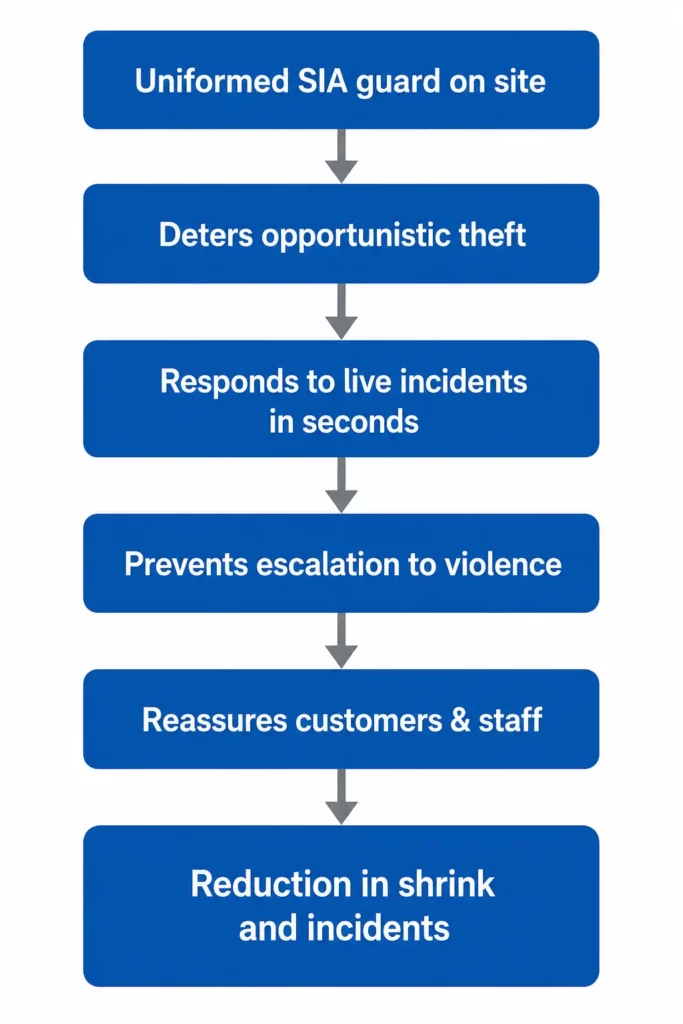
- Deters opportunists: The risk of being caught right now becomes real.
- Responds fast: A guard on the floor is seconds away. CCTV operators watch things unfold but can’t physically intervene.
- Reassures customers: Shoppers feel safer. They stay longer. They spend more.
- Boosts staff confidence: Workers report lower anxiety when guards are around.
- Prevents escalation: Trained guards de‑escalate verbal abuse before it escalates to physical violence.
Retail Crime Challenges in Major UK Cities
Retailers in regional hubs are also increasing investment in visible security, seeking a reliable security company in Manchester that they can depend on for loss prevention, CCTV monitoring, and frontline guarding support.
London: 102,083 shoplifting offences in the year to May 2025, up 42%. Met Police staged the UK’s biggest crackdown on organised shoplifting gangs, raiding 120+ shops, seizing thousands of stolen items, and making 32 arrests. Smash‑and‑grab attacks: 18 in the first three months of 2026 alone, ten with weapons, £3.2 million stolen.
Manchester: Local retail crime statistics showed shoplifting down 7% for the year to September 2025, beating the national average. In Bolton, shoplifting dropped 33.4% to 1,497 after CCTV and enforcement measures. GMP’s retail security forum led to 272 arrests and a 5% reduction in Christmas‑period theft.
Birmingham: West Midlands Police’s Sandwell division charged multiple suspected shoplifters in spring 2026, including one person with 15 shop theft offences. The force has made retail crime a priority under the Crime and Policing Act 2026.
What shoppers have seen (by region)
| Region | Witnessed shoplifting | Witnessed violence/abuse |
| London | 29% | 32% |
| West Midlands | 29% | – |
| Yorkshire & Humberside | 26% | 26% |
| North West | 26% | – |
| North East | – | 23% |
How Manchester Retail Businesses Are Improving Loss Prevention
Manchester stands out. Police, local authorities, and private security have been working together, and it shows.
Greater Manchester Police recorded a 7% drop in shoplifting for the year to September 2025. The national picture was a modest decline at best. Manchester did better.
What’s working in Manchester:
Retail security forum (Feb 2026): Brought together retailers, security teams, and police. Outcomes: 272 arrests, 5% theft reduction over the following holiday period.
Bolton CCTV success: Shoplifting cases fell 33.4% to 1,497 over 2025/26. Retail‑led CCTV investment plus police coordination did it.
Coordinated mobile patrols: Covering shopping centres, retail parks, and supermarket estates across the metro area.
Uniformed guards in the city centre: High‑footfall areas like the Arndale centre and surrounding retail streets now have visible SIA‑licensed guards. Opportunistic and organised theft are both down.
Businesses looking at retail security in Manchester are increasingly combining SIA-licensed guards, CCTV monitoring, and gatehouse security to reduce theft across shopping centres, supermarkets, and retail parks.
What Businesses Should Look for in a Retail Security Provider
If you are investing in security, check these boxes.
SIA approval: Make sure they are an SIA-approved contractor. Covers quality, vetting, and standards.
Incident reporting: Real‑time reports with images, police references, and audit trails. REMS tracking logs guard activity at regular intervals.
CCTV integration: Remote monitoring centres that watch live feeds and flag suspicious activity.
Rapid response: Mobile patrols that arrive in minutes. Keyholding and alarm response for out‑of‑hours.
Sector experience: Have they worked with retail chains, shopping centres, supermarkets, retail parks? Each environment has different risks.
Visible presence: Uniformed, branded guards. Professional look and behaviour are part of the deterrent.
Clear communication: Guards who can talk to store management, police, and remote centres at the same time.
Credentials: Region Security Guarding holds SIA Approved Contractor status, ISO 9001:2015, SafeContractor, SMAS Worksafe, and Constructionline Silver. These mean quality, safety, and ethics.
Legal Changes Coming in 2026–2027
Two major legal shifts are emerging as retailers respond to changing retail crime trends across the UK.
Martyn’s Law (Terrorism Protection of Premises Act 2025)
Got Royal Assent on 3 April 2025. It forces venues, events, and public spaces with 200+ capacity to prepare for terrorist attacks.
Statutory guidance came out in April 2026. For retail premises with 200–799 capacity:
- Evacuation, invacuation, lockdown and communication plans
- Staff who can implement them fast
- Responsible persons must notify the SIA
The law kicks in around spring 2027 (24‑month implementation period). Retailers can start now: review occupancy, assess risks, and put in proportionate measures such as CCTV, bag searches, and vehicle checks.
Crime and Policing Act 2026
Got final scrutiny in April 2026. Three big changes:
No more £200 threshold: The Act scraps the rule that made theft of goods worth £200 or less a summary‑only offence. Retailers called it the “£200 licence to steal”. Gone now.
Attacking a shopworker is a standalone offence: Up to six months in jail or an unlimited fine. Scotland already has a similar law; Northern Ireland’s Sentencing Bill includes it too.
Respect Orders for repeat offenders: Courts can ban offenders from certain places or behaviours.
Charges for shop theft rose 17% in the latest stats. The Prime Minister promised to end the shoplifting “free‑for‑all”.
Conclusion
The latest shoplifting statistics UK retailers are facing show that retail crime remains near record highs. Over 509,000 police‑recorded shoplifting offences last year. Retailers say the real figure is 5.5 million detected incidents. And 1,600 violence‑against‑staff incidents every day, the second-worst on record.
There are some signs of improvement. Police‑recorded shoplifting fell 1%. The charge rate ticked up from 17.7% to 19.1%. The Crime and Policing Act 2026 removes the £200 loophole and brings tougher penalties. Martyn’s Law will force 200+ capacity retail premises to have proper security by spring 2027.
But the gap is still big. Most theft never gets reported. Most recorded offences never lead to a charge. Retailers are spending nearly £5.5 billion over five years on crime prevention, and that 11p “crime tax” on every transaction shows who really pays.
Visible security works. Uniformed SIA-licensed guards, CCTV monitoring, access control, and professional retail security services all contribute to lower theft rates and safer retail environments. Police‑private security partnerships cut theft. Retailers using integrated security models see fewer losses, safer staff, and happier customers.
Frequently Asked Questions
1. How can retail security services help reduce shoplifting?
Professional retail security services combine visible guards, CCTV monitoring, mobile patrols, and incident reporting systems to deter theft, improve response times, and reduce repeat offending in retail environments.
2. Do visible security guards reduce retail crime?
Yes, visible SIA-licensed guards act as a strong deterrent, helping retailers reduce opportunistic theft, de-escalate aggressive incidents, and improve staff and customer safety.
3. What retail security solutions do you provide?
Region Security Guarding provides retail security guards, manned guarding, CCTV monitoring, gatehouse security, mobile patrols, and access control services for retail stores, supermarkets, and shopping centres.
4. Can security guards help with aggressive customer incidents?
Yes, trained retail security guards help manage verbal abuse, aggressive behaviour, and conflict situations while supporting staff safety and maintaining a professional retail environment.
5. Do you provide retail security services across the UK?
Yes, we provide nationwide retail security services across major UK cities, including Manchester, Birmingham, Cardiff, Liverpool, London, Glasgow, and Edinburgh.
6. How does CCTV monitoring support retail theft prevention?
CCTV monitoring helps identify suspicious behaviour, supports evidence collection, improves incident response times, and works alongside on-site security guards to strengthen retail loss prevention.
7. What should retailers look for in a security company?
Retailers should look for SIA-approved contractors with retail-sector experience, real-time incident reporting, CCTV integration, a visible security presence, and rapid response capability.
8. Can retail security services support shopping centres and retail parks?
Yes, retail security services can support shopping centres, supermarkets, retail parks, and high-footfall retail environments through guards, patrols, access control, and loss-prevention strategies.