Retail crime cost UK stores £2.2 billion in direct theft last year, according to the British Retail Consortium (BRC). That’s before you add prevention spending, staff turnover, and insurance hikes. The question every store owner asks: Do retail security guards actually stop theft?
The short answer: yes, by up to 70% in many controlled environments. This article presents the latest retail loss prevention statistics, explains the key duties of a retail security guard, and shows how to prevent shoplifting using visible, SIA‑licensed officers.
Table of Contents
What the Statistics Say? Retail Loss Prevention Data
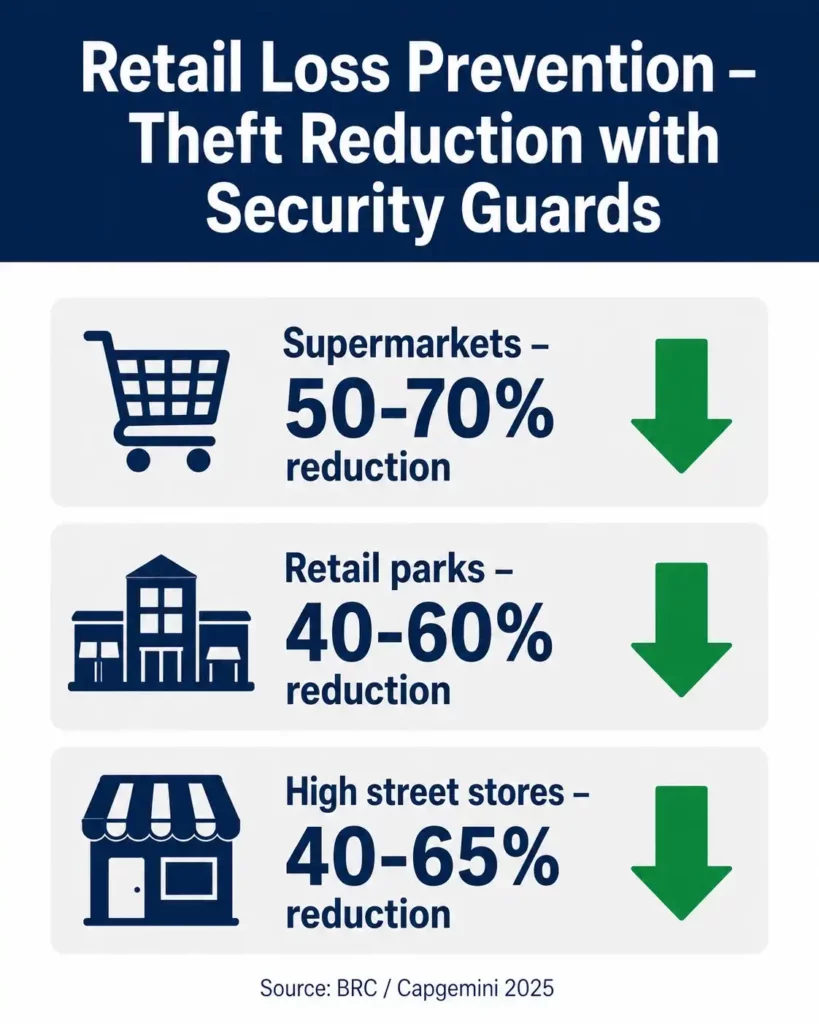
Multiple studies confirm that uniformed retail security guards significantly reduce theft.
A Capgemini survey of 200 large retailers found that almost 80% believe in-store security personnel are the most effective tool for preventing theft, more than twice as effective as any other measure. Retailers who deployed visible security saw shrinkage drop by an average of 50–70%.
In the UK, the BRC’s annual crime survey consistently shows that stores with dedicated security guards report lower rates of shoplifting and violence.
Retail loss prevention statistics: Theft reduction with guards
| Environment | Typical theft reduction |
| Supermarkets | 50–70% |
| Retail parks | 40–60% |
| Shopping centres | 30–50% |
| High street stores | 40–65% |
Sources: BRC Retail Crime Survey, Capgemini ‘2025 Retail Loss Prevention Report’
The data doesn’t claim guards eliminate theft entirely. What it shows is that opportunistic offenders move on when they see a uniformed officer. Retail theft prevention works best when offenders know they are being watched in real time.
Retail Security Guard Duties That Actually Deter Theft
Understanding the duties of a retail security guard helps explain why they are so effective. An SIA‑licensed officer does far more than stand at a door.
Core duties that drive shoplifting prevention:
- Access monitoring: Controlling who enters and leaves, reducing opportunities for “grab and run”.
- Customer observation: Scanning for suspicious behaviour before a theft happens.
- Real‑time intervention: Approaching individuals who appear to be concealing goods, which stops theft in progress.
- De‑escalation: Calmly managing aggressive individuals before violence erupts.
- Incident reporting: Documenting thefts, providing evidence for police and insurance.
- Liaison with police and BIDs: Sharing intelligence on repeat offenders.
These retail security guard duties require guards to be proactive rather than reactive. CCTV records a theft. A guard prevents it. That’s the difference.
Retail Theft Prevention: Guards vs. Technology
Many retailers rely solely on CCTV or electronic article surveillance (EAS) tags. Those tools have value, but they are not enough.
How guards compare to technology:
| Measure | Reactive? | Proactive? | Stops theft in real time? |
| CCTV | Yes | No | No |
| EAS tags | No (alerts after theft) | No | No |
| Uniformed guard | No | Yes | Yes |
EAS tags sound an alarm when someone leaves without paying after the theft has happened. CCTV captures footage again, after the fact. A guard sees the behaviour, challenges it, and stops the theft before the exit.
The most effective retail theft prevention strategy combines technology and human presence. But the human element is irreplaceable.
Real UK Examples: How Retail Security Guards Cut Crime
Let’s look at what happens when retailers invest in retail security guards UK stores trust.
Co‑op: 20% crime reduction
Co‑op increased investment in uniformed guards, body‑worn cameras, and protective screens. Result: a 20% reduction in crime across its stores. The chain now spends £200 million annually on security, but the reduction in loss and harm has made it worthwhile.
Manchester Arndale: 22% drop in retail crime
GMP based 40 student officers at the Arndale Centre. Within four months, they made 182 arrests and delivered a 22% reduction in retail crime. Anti‑social behaviour dropped 46%. Visible presence, not just cameras. Recent Manchester retail security initiatives at the Arndale and Trafford Centre show how manned guarding, when combined with GMP partnership, can dramatically cut retail crime.
Bolton: 33% drop in shoplifting
Bolton town centre invested in CCTV plus visible security patrols. Shoplifting cases fell 33.4% to 1,497 over 2025‑26. The combination of technology and human guards delivered measurable results. Businesses in the North West seeking similar outcomes can explore a professional security company in Manchester specialising in retail environments.
These examples show that the retail security guards UK retailers deploy are not a cost; they are an investment that pays for itself.
How to Prevent Shoplifting: A Practical Checklist for Retailers
If you are a retailer wondering how to prevent shoplifting, here is a practical checklist based on real‑world evidence.
Step 1: Hire SIA‑licensed security guards: This is the single most effective measure. One guard can reduce theft by 50–70%. Professional retail security services provide fully trained, uniformed officers.
Step 2: Position guards at entrances and near high‑value goods: Visibility matters. Offenders should see the guard immediately.
Step 3: Train staff to identify suspicious behaviour: Guards can’t be everywhere. Empower staff to alert security.
Step 4: Use CCTV as a backup, not a primary solution: Cameras are for evidence, not prevention.
Step 5: Implement EAS tags for expensive items: Adds another layer of deterrence.
Step 6: Join a local BID or crime reduction partnership: Intelligence sharing multiplies the effectiveness of guards.
Step 7: Track incidents and review placement: Use reporting systems (e.g., REMS) to adjust guard positioning based on data.
Following these steps will help any retailer improve shoplifting prevention strategies and reduce repeat theft more effectively, and the evidence shows that SIA‑licensed guards are the cornerstone of this approach. Latest shoplifting statistics UK 2026 reveal that police‑recorded offences remain near record highs, making professional guarding more critical than ever.
Conclusion
The evidence is clear: retail security guards reduce shoplifting by 50–70% in most retail environments. They act where CCTV only watches. They de‑escalate where cameras only record. They reassure staff and customers in ways technology cannot.
The duties of a retail security guard include observation, intervention, reporting, and liaison, all aimed at targeting the behaviours that lead to theft. Retail loss prevention statistics from the BRC, Capgemini, and real UK case studies (Co‑op, Arndale, Bolton) all point to the same conclusion: visible, SIA‑licensed guards work.
If you are still asking how to prevent shoplifting, start with the most proven tool: uniformed security officers.
Frequently Asked Questions
1. How effective are retail security guards at reducing shoplifting?
Visible retail security guards can significantly reduce opportunistic theft by increasing offender risk, improving incident response, and supporting staff during suspicious or aggressive situations.
2. Do you provide retail security guards for supermarkets and shopping centres?
Yes, we provide SIA-licensed retail security guards for supermarkets, shopping centres, retail parks, convenience stores, and other high-footfall retail environments across the UK.
3. Can manned guarding help prevent repeat offenders?
Yes, visible manned guarding helps identify repeat offenders, disrupt organised theft, and improve reporting through a consistent on-site security presence and incident tracking.
4. What makes SIA-licensed retail guards different?
SIA-licensed retail guards are trained in theft prevention, customer interaction, conflict management, incident reporting, and retail-specific security procedures designed for busy store environments.
5. Can retail security guards work alongside existing store staff?
Yes, retail security guards support store teams by monitoring suspicious behaviour, responding to incidents, assisting with conflict situations, and improving overall staff confidence.
6. Do you provide temporary retail security cover during busy periods?
Yes, we provide short-term and seasonal retail security cover for sales events, holiday trading periods, staffing shortages, and periods of increased theft risk.
7. How do your guards support retail theft prevention strategies?
Our guards support retail theft prevention through entrance monitoring, visible patrols, rapid response, incident reporting, and coordination with CCTV monitoring systems.
8. Why do retailers invest in visible security guards?
Retailers invest in visible security guards because they deter theft, improve customer reassurance, reduce staff anxiety, and provide immediate response during live incidents.