Liverpool’s industrial boom has a criminal underbelly. The £5bn Liverpool Freeport, the deep‑water Liverpool2 terminal, and sprawling logistics hubs in Knowsley and Speke have created a goldmine for organised gangs.
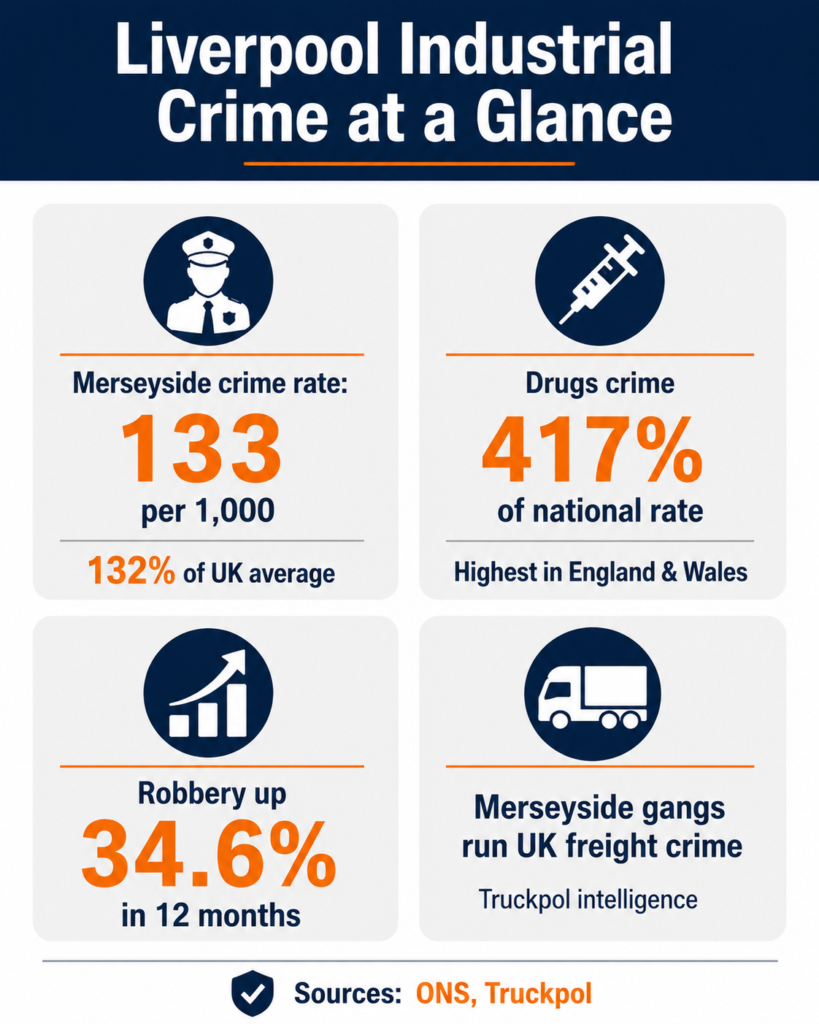
Merseyside’s crime rate: 133 crimes per 1,000 people, 132% of the national average.
Drug crime ranks 1st in England and Wales at 417% of the national rate.
Robbery surged 34.6% in the last 12 months.
For site managers, these numbers translate directly into risk. Warehouse security Liverpool is no longer a back‑office concern; it’s a boardroom priority. This article uses real Liverpool incidents, outlines the security measures that prevent them, and provides a practical checklist to protect your site.
Quick Facts
| Risk | Liverpool figure | National comparison |
| Overall crime rate | 133 per 1,000 | 132% of the UK average |
| Drugs crime | 417% of the national rate | Highest in England/Wales |
| Robbery increase (12 months) | +34.6% | Well above average |
| Freight crime | Merseyside gangs responsible nationally | Truckpol intelligence |
Why Liverpool’s Industrial Sites Are Different
Most UK cities face opportunistic theft. Liverpool faces organised, professional freight crime. Here’s why your secure storage warehouse in Liverpool needs a tailored approach.
- Merseyside gangs run freight crime across the UK. Truckpol (the national intelligence unit) states: “Historically and currently organised gangs from Merseyside are responsible for freight crime all over the UK.” One gang member could earn in a single haul what an average person would take five years to earn legitimately.
- The Liverpool Freeport is a high‑value target. Freeports attract legitimate business and counterfeiters. A 2023 report found freeports linked to a nearly 6% increase in counterfeit goods trafficking. The Freeport’s customs‑friendly zones also appeal to criminals looking to move stolen goods across borders.
- The Port of Liverpool moves millions daily. In 2022, a lorry driver stole a £70,000 shipping container after his family was threatened. The port area still shows a crime rate of 125 per 1,000 residents. The adjacent Liverpool2 terminal, designed for the world’s largest vessels, sees constant flows of high‑value electronics, pharmaceuticals, and luxury goods, prime targets.
- Knowsley and Speke are repeat targets. Industrial parks in these areas have suffered tuna thefts, whisky thefts, and organised break‑ins. Liverpool Industrial Security must account for these local hotspots. Knowsley alone recorded over 8,000 “other theft” offences in 2025, many linked to warehouse crime.
The takeaway: generic security packages won’t work here. You need a layered, Liverpool‑specific defence.
Three Real‑Life Attacks on Liverpool Sites
Let’s look at what actually happened. These three incidents show exactly how criminals operate.
1. Knowsley tuna heist (2025)
- What happened: Thieves spent 3.5 hours (2 am – 5.30 am) stealing more than 20 pallets of Kingfisher tuna.
- How they did it: A truck arrived to load the goods. No alarm triggered. No guard on site. The perpetrators used the site’s own loading equipment.
- The cost: £5,000+ stolen, plus a “devastating ripple effect” of lost jobs and rising prices (Detective Chief Inspector Leanne Toole). The warehouse later suffered a major fire in 2026, highlighting the compound risks of poor security.
2. Port of Liverpool container theft (2022)
- What happened: A lorry driver stole a £70,000 shipping container containing £56,000 of tyres.
- How they did it: Criminals threatened the driver’s family. He drove the trailer off Maritime Transport’s site.
- The cost: Driver jailed for 28 months. The container and goods were never recovered. This highlights why Liverpool port security must go beyond fences and cameras. The driver’s coercion shows that insider threats are not always willing – sometimes they are victims too.
3. Speke whisky theft (insider job)
- What happened: Warehousemen on night duty stole 123 cases of whisky.
- How they did it: They knew camera blind spots and security protocols. They disabled certain alarms and used a forklift to load the whisky into a van.
- The cost: Internal theft accounts for 40% of UK shrinkage, and this was textbook. The whisky, valued at over £15,000, was sold through unlicensed retailers.
These are not isolated anomalies. They follow a pattern: organised, well‑planned, and exploiting security gaps.
The Security Layers That Stop Each Attack
Different threats require different countermeasures. Here’s a direct match.
| Attack type | How it happened | Which layer stops it |
| Overnight break‑in (Knowsley tuna) | 3.5 hours, no guard, truck arrived | Mobile patrols at random times + gatehouse |
| Port container theft (coerced driver) | Insider forced to cooperate | Staff vetting + alarm response |
| Night‑shift employee theft (Speke whisky) | Employee knew blind spots | Digital access logs + random vehicle searches |
| No alarm activation | The alarm wasn’t triggered or monitored | Remote CCTV with AI loitering detection |
Key takeaway: No single layer works on its own. You need perimeter fencing, alarms, CCTV, manned guarding, and mobile patrols altogether. That’s the core of effective security for factories, Liverpool.
Five Signs Your Warehouse Needs Better Security
Walk your site and check these:
- No gatehouse at night: Vehicles can enter freely after hours. Many Speke facilities already operate 24‑hour gatehouse security with barrier entrances; if yours doesn’t, you’re an outlier.
- Patrols happen at the same time every day: Criminals watch the schedule. Random intervals are essential.
- Employees bypass access points: They prop open doors or share codes. This is a red flag for insider collusion.
- CCTV blind spots exist: Especially around loading bays and perimeter corners. Test your coverage by walking the perimeter after dark.
- No contract for alarm response: If an alarm goes off, who attends? Police response times for commercial alarms have lengthened.
If you ticked two or more, you have a gap. Time to upgrade your secure storage warehouse in Liverpool’s protection.
What Actually Works in Liverpool: A Tiered Checklist
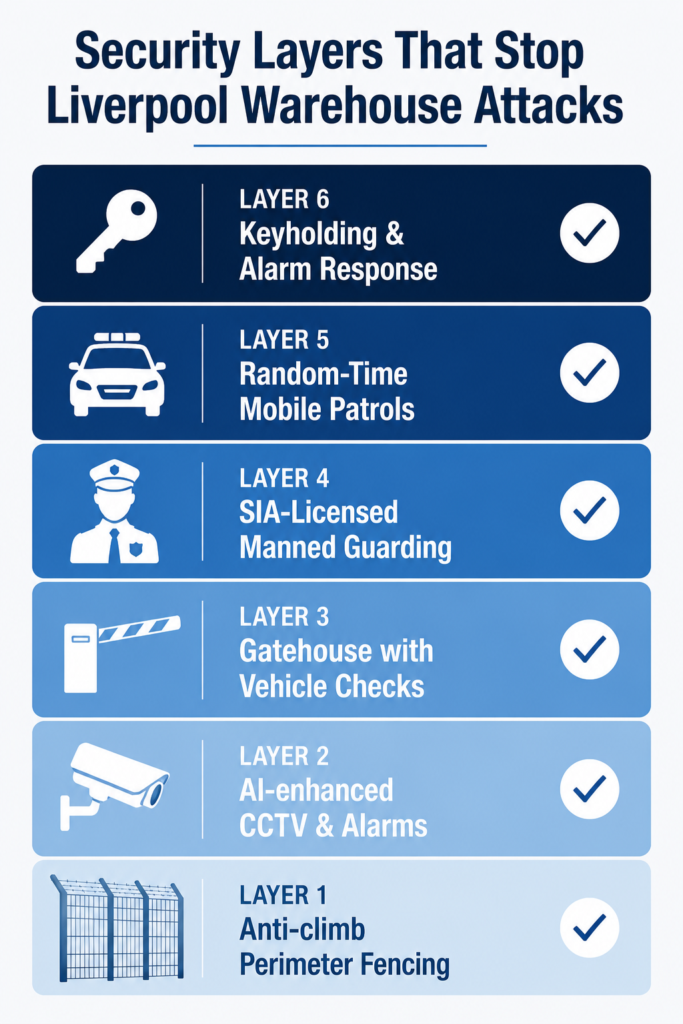
Implement these layers in order. Start with the basics, then add specialised measures.
- Layer 1 – Anti‑climb perimeter fencing: Makes casual intrusion difficult. Extend it underground to prevent digging.
- Layer 2 – AI‑enhanced CCTV: Covers all entry points, loading bays, and blind spots. Alerts on loitering. Choose cameras with night‑vision and vehicle plate recognition.
- Layer 3 – Gatehouse with vehicle checks: A manned gatehouse stops unauthorised vehicles. Officers verify paperwork and log visitors. Many Liverpool sites have reduced theft by 40% after installing a gatehouse security system.
- Layer 4 – SIA‑licensed manned guarding: Uniformed guards at key points. Visible deterrence and real‑time intervention. Region Security Guarding provides SIA officers across Liverpool, trained in conflict management and lone working. These officers are part of a broader warehouse security strategy that includes layered defences.
- Layer 5 – Random‑time mobile patrols: Patrol multiple sites on irregular schedules. Criminals can’t predict the pattern. A single patrol car can cover five sites in a shift, making it cost‑effective.
- Layer 6 – Keyholding & alarm response: For out‑of‑hours coverage. A designated keyholder attends within a guaranteed timeframe. Insurers often mandate this.
If you operate in the Knowsley or Speke areas, speak to a security company in Liverpool that knows the local crime patterns and can tailor a solution to your site’s layout and risk profile.
Quick Answers to Common Liverpool Questions
1. Why is Liverpool different from other cities?
Merseyside organised gangs run freight crime across the whole UK. The combination of a major port, Freeport, and dense warehousing creates a unique threat.
2. How fast can you deploy guards?
Typically, within 48 hours. Customised cover with SIA‑licensed officers for short or long terms.
3. What’s the difference between gatehouse and mobile patrols?
Gatehouse controls a single access point. Mobile patrols cover multiple sites at random intervals, ideal for operators with several locations.
4. Do you cover the Freeport and port areas?
Yes, we serve all Liverpool industrial zones, including the Freeport, Liverpool2, Knowsley, Speke, and wider Merseyside.
5. Can guards help with cyber‑physical threats?
Yes, guards enforce access control policies and can report suspicious digital activity. Modern security integrates physical and digital monitoring.
6. How does Martyn’s Law affect industrial sites?
If your site has a public capacity of over 200 (visitor centre, staff canteen), you need evacuation and lockdown plans. Our guards are trained in these procedures.
7. What’s the ROI of hiring industrial security guards?
For a medium-sized warehouse losing £100,000 annually, a guard costing £40,000 with a 60% reduction yields a net benefit of £ 20,000 before insurance and compliance savings.
8. How do I know which security layer my site needs?
A security risk assessment identifies vulnerabilities specific to your site, goods and operations. Contact us for a free, no‑obligation assessment.
What’s Next? Freight Crime Bill & Cyber Threats
Several developments will shape industrial security over the next two years.
- Freight Crime Bill (second reading Nov 2025): Aims to give police stronger powers to tackle cargo theft. Expect more scrutiny on your security documentation. The Bill proposes mandatory reporting of certain thefts and enhanced penalties for organised cargo crime.
- AI‑powered attacks: Criminals now use AI to find weaknesses and automate intrusions. For example, AI can scrape social media for employee shift patterns and identify when sites are least guarded.
- Supply chain cyberattacks: Logistics infrastructure is a direct target. Ports, distribution centres, and freight carriers are all at risk. In 2025, a ransomware attack on a major logistics provider halted shipments across three UK ports for 48 hours.
- Legacy OT hardware: Many warehouses run on old tech, “never designed for the internet”. When connected, they become open doors. A single unpatched access-control server can give attackers the ability to remotely unlock every door.
Conclusion
Liverpool’s industrial growth is real. So is the threat. Merseyside gangs have run freight crime nationwide for years. The Knowsley tuna theft, the port container heist, and the Speke whisky job are not anomalies; they are a pattern.
But a layered security approach works. Fencing, AI CCTV, gatehouse officers, SIA guards, random mobile patrols, and keyholding each layer closes a gap.
For Liverpool operators, the question is not whether to invest. It’s how quickly you can close your gaps.