Here‘s a number that should keep every logistics manager awake at night. Warehouses across the UK now account for 41% of all recorded cargo theft incidents in Europe. That’s almost half of all freight crime hitting facilities just like yours.
Internal theft alone makes up 40% of UK shrinkage, costing logistics operators an estimated £3.2 billion annually. When you add external burglaries, cargo theft, and emerging cyber‑physical attacks, the picture becomes alarming. The question isn‘t whether your warehouse will be targeted. The question is when.
This article breaks down what’s really happening in UK warehousing. We‘ll look at the numbers, the methods criminals use, the insider threat most operators overlook, and the security measures that actually work.
H2: The Numbers Behind the Crisis
The Transported Asset Protection Association (TAPA EMEA) recorded 5,865 cargo crime incidents in the UK alone between October 2023 and September 2025. That‘s across more than 110 countries. Major logistics hubs such as Liverpool remain particularly vulnerable due to their concentration of warehouses, freight movements, and portside distribution activity, which increases demand for a professional security company in Liverpool.
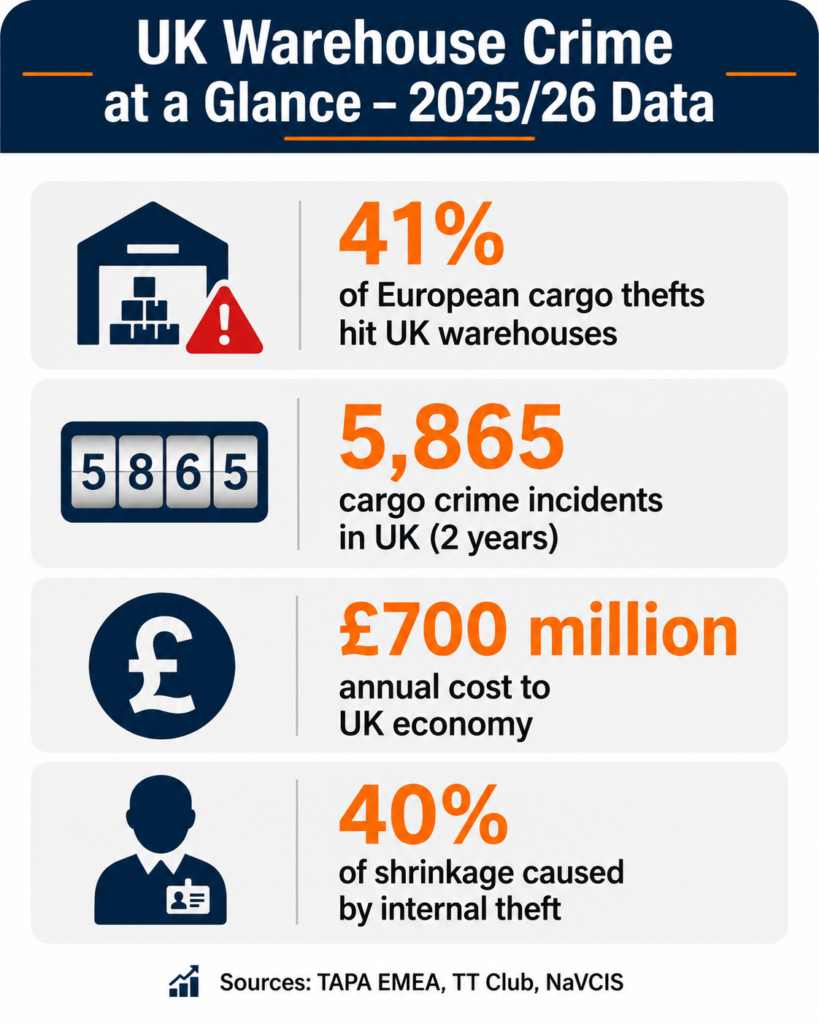
Loss values were reported in only 9% of UK cases. Even with that incomplete reporting, losses still totalled more than €72 million (approximately £60 million). Major incidents averaged €775,736 each.
The National Vehicle Crime Intelligence Service recorded 5,373 cargo theft cases in 2023 alone, totalling an estimated £68 million in stolen goods.
Other key statistics:
| Metric | Figure | Source |
| Warehouses as cargo theft hotspots (Europe) | 41% of all incidents | TT Club/BSI 2025 Report |
| Cargo crime incidents in the UK (2 years to Sept 2025) | 5,865 | TAPA EMEA |
| Losses from reported UK incidents | €72M+ (£60M) | TAPA EMEA |
| Internal theft share of UK shrinkage | 40% of losses | UK retail/logistics data |
| Business break‑ins increase (past year) | 14% | BES Security 2025 |
| Cargo theft losses in the UK (2024) | $149M (£110M) | TT Club/BSI Report |
The parliamentary All‑Party Group on Freight and Logistics estimates that freight‑related crime cost the UK economy £700 million in 2023. A proposed Freight Crime Bill had its second reading in November 2025, aiming to give police and prosecutors stronger powers to tackle cargo theft.
H2: Physical Breaches: The Most Common Threat
Business break‑ins rose 14% over the past year. Shops, cafés, and warehouses are the main targets because they hold valuable stock and often have weak access points. Let’s look at real incidents from 2025.
The £46,000 Sunderland vape warehouse raid
A gang broke into a warehouse in Washington, Tyne and Wear, in February 2025. They stole almost £46,000 worth of vapes and caused £3,600 in building damage. The owners were alerted by their security firm, rushed to the scene, and caught the thieves red‑handed. One of the owners had to jump out of the way as the gang drove a van directly at him. Four men from Rochdale and St Helens received suspended sentences. The other van and its occupants have never been found.
The £60,000 Hull supplement warehouse theft
In August 2025, thieves used a lorry to steal £60,000 worth of stock from Discount Supplements in Hull. That represented up to 15% of their entire inventory. The owners watched CCTV footage for about 2.5 hours, showing intruders inside loading products into a lorry using the warehouse’s own trolleys. A marketing director for the employee‑owned business said the team was “devastated” and described the operation as “really organised”.
The £10,000 Pokémon card heist
Thieves cut through fencing and removed bricks from a wall to steal Pokémon cards worth more than £10,000 from a warehouse in Retford, Nottinghamshire, in December 2025. Police tracked the van to a storage yard in South Yorkshire and arrested two men from Leeds within hours.
These are not isolated incidents. They show a pattern of organised, well‑planned attacks on UK warehouses.
H2: Organised Criminal Networks: The Real Drivers
The Sunderland vape raid and Hull supplement theft both point to organised gangs.
TAPA EMEA‘s UK Regional Lead says criminal networks treat cargo theft as a “highly profitable enterprise”. These groups are often well‑equipped and strategically plan their strikes. Common tactics include:
- Surveillance of warehouse schedules – gangs watch shift patterns and delivery times.
- Cloned vehicle number plates make tracking stolen goods harder.
- Insider information – employees who share security protocols, alarm codes, or camera blind spots.
The TT Club/BSI 2025 Cargo Theft Report notes that more than a fifth (22%) of global cargo theft incidents involved the cooperation of insiders. Trucks remain the dominant target, accounting for roughly 70% of all incidents globally.
In the UK, cargo theft losses reached USD 149 million (£110 million) in 2024. A USD 9 million smartphone heist at Heathrow airport ranked among the highest‑value incidents of 2025.
Criminals are also using technology: fraudulent documents, impersonation tactics, fictitious pickups, and double-brokering schemes. The TT Club‘s Managing Director of Loss Prevention warns that “criminal networks are adapting faster than ever, exploiting new commodities, new technologies, and new vulnerabilities”.
H2: Insider Threats: The Problem No One Wants to Talk About
Internal theft accounts for 40% of UK shrinkage. That’s billions of pounds lost to employees who walk past security every day.
The Amazon Gourock case from 2025 shows how it happens. A warehouse picker stole £17,418 worth of electrical goods over several months. Security staff eventually watched him on CCTV entering a high‑value area, removing items, and failing to properly scan them. He later admitted to stealing a Nintendo Switch and headphones from his pockets during a search.
Why insider theft is so hard to stop:
- Employees know the blind spots. They‘ve worked there long enough to know where cameras don’t reach.
- They understand alarm schedules and shift rotations.
- They have legitimate access – a picker, a forklift driver, and a night shift supervisor all have reasons to be anywhere in the warehouse.
- Theft doesn‘t have to happen during a break‑in. It happens during a normal shift, on a normal day, with normal paperwork.
Mitigating insider risk requires layered controls:
- Digital access logs record every entry and exit
- Randomised vehicle searches at the gate – not the same time every day
- Segregation of duties – no single employee should have both access and dispatch authority
- Regular rotation of alarm codes and access credentials
These measures don‘t eliminate insider theft. But they make it much harder to organise and easier to detect.
H2: Cyber‑Physical Threats: The New Frontier
Warehouses aren’t just buildings with racks anymore. They‘re digitised environments with networked access control, automated storage systems, warehouse management systems, IoT sensors, and CCTV that connect to remote monitoring centres. Each digital touchpoint is a potential entry point.
The Cyber Security Breaches Survey 2025 found that 43% of UK businesses reported experiencing a cyber breach or attack in the past 12 months. For medium‑sized firms, that figure rises to 70%; for large enterprises, 74%.
UK transport and storage companies appear surprisingly unconcerned. An ONS Business Insights Survey found that just 3.9% of logistics, haulage, warehousing, and parcel firms said they were concerned about cyberattacks affecting their supply chains. That’s a dangerous gap.
Specific risks for warehouses:
- Ransomware targeting OT – can halt sortation systems, lock gatehouse terminals, and disable security cameras.
- Supply chain attacks – exploit software updates or third‑party integrations.
- Unsecured APIs – allow attackers to manipulate dispatch records, making theft invisible.
- Legacy OT hardware – many UK warehouses run on operational technology “never designed for the internet”. When connected for remote maintenance, they become open doors.
In December 2025, UK cyber authorities reinforced that threat volume is rising and supply‑chain compromise remains a primary concern for 2026.
For warehouse operators seeking secure warehouse storage, cyber resilience is no longer optional.
H2: Warehouse Security Solutions That Actually Work
Effective warehouse security solutions combine multiple layers. No single measure is enough.
| Security Measure | Primary Function | Best suited for |
| Anti‑climb perimeter fencing | Prevent unauthorised entry | All warehouse sites |
| SIA‑licensed manned guarding | Deterrence, real‑time intervention, and incident response | Gatehouses, night shifts |
| Mobile patrols | Cover multiple sites at random intervals | Multi‑site operators |
| CCTV with AI analytics | Monitor activity and detect anomalies | High‑value storage areas |
| Mobile‑enabled access control | Restrict entry to authorised personnel | Large distribution centres |
| Staff vetting and access logging | Detect insider threats | All sites |
| Cybersecurity (firewalls, patching) | Prevent IT/OT intrusions | Digitised warehouses |
Here‘s why each matters.
SIA‑licensed manned guarding. Technology alone fails. A visible, uniformed guard at the gatehouse or on patrol changes behaviour. Guards challenge suspicious individuals, respond to alarms in real time, and de‑escalate conflicts before they escalate. For warehouse operators exploring professional warehouse security solutions, SIA-licensed officers provide the human layer that cameras can’t replace.
Mobile patrols work well for operators with multiple sites. Random‑interval patrols mean criminals can‘t predict the pattern. They cover several locations per shift, and irregular timing makes pattern recognition difficult.
Gatehouse security controls vehicle access, checks paperwork, and maintains visitor logs – essential tasks that automated systems can’t fully replace. A gatehouse security officer manages identity checks and contractor passes, creating a systematic process that logging alone cannot match.
CCTV and AI analytics. Comprehensive coverage should include all entry and exit points, loading bays, high‑value storage zones, and perimeter blind spots. AI‑enhanced systems can track goods movement and pinpoint inefficiencies in real time.
The best approach is layered: anti‑climb fencing to keep people out, CCTV to watch, mobile‑enabled access control to manage who enters, SIA guards to intervene, and cyber defences to protect connected systems.