Building sites rarely start behind high, secure fences. If you manage site operations, you know the reality: during early excavation, utility laying, or ground preparation, working on exposed land is often unavoidable. While open access lets heavy plant machinery move in and out without hassle, it creates a massive headache once the sun goes down. It leaves your expensive equipment, fuel, and materials sitting out in the open, completely vulnerable to opportunistic thieves.
Unfenced construction site theft prevention is about striking a balance. You need to keep your valuable assets safe without slowing down daily site operations. When thieves strike overnight, the damage goes far beyond the replacement cost of a stolen generator or a few spools of copper wire. You end up facing severe project delays, idle trade crews, angry project stakeholders, and higher insurance premiums.
This guide breaks down seven practical, straightforward strategies to lock down your exposed site boundaries, keep your project timeline on track, and protect your commercial bottom line.
Table of Contents
The True Cost of Building Site Material Loss
A significant number of site managers tend to believe that a break-in will cost whatever was stolen from the site. On the contrary, stolen materials only constitute a small part of the total bill. One break-in causes an expensive series of events that starts to take place throughout your whole organisation.
- Paid Standstill Labour Hours: The moment subcontractors come to your site at 7:00 AM, having discovered that all power tools are gone, that all fuel tanks are empty, or that the electricity cables are cut, the work stops immediately. Even though your subcontractors are unable to build a single wall or pull any cables, you still need to pay them.
- Penalties for Project Delays Under the Contract: Nowadays, there are extremely strict deadlines in modern commercial construction contracts. The delay of your project for the reason of waiting for three weeks for new parts for machines will cause huge penalties under the contract agreement.
- Insurance Deductible Surges: Filing frequent claims for stolen materials damages your risk rating with insurance providers. Over time, your annual premiums will skyrocket, and your excess deductibles will rise to a point where minor thefts have to be paid entirely out of your own pocket.
Securing an unfenced build is not just about keeping intruders off the grass; it is about keeping your entire financial operation healthy.
1. Install Strategic Perimeter Lighting and Warning Signage
Thieves thrive on darkness. In the event that your construction project is left unlit at night, thieves can come in and easily steal away high-value tools without arousing any suspicion from outside the site.
Use of strategic lighting along the boundaries of the construction project is one of the fastest ways of ensuring that thieves find it difficult and give up on your property.
- Placement of Mobile Lighting Towers: Use solar and battery-operated mobile lights at your construction site by strategically placing them at the most vulnerable parts of the site.
- Removal of blind spots: It is recommended that you do a walk along the perimeter of the construction site at dusk so as to identify vulnerable areas, such as those shielded by scaffoldings, piled topsoil or temporary huts.
- Using Clear, High-Visibility Signage: Put up bold warning signs all around your site boundaries. Signs that clearly state “Warning: 24/7 Security Patrols and Active Guard Tracking in Operation” take away any impression that your site is an easy target. When intruders know someone is actively watching the site, they are much less likely to risk stepping onto the property.
2. Establish Secure Central Laydown Zones
When a site lacks physical boundary fencing, leaving materials scattered across the ground makes life far too easy for thieves. An opportunistic intruder can drive a van onto the dirt, load up exposed copper cabling or diesel drums, and drive away in less than two minutes.
To fix this, stop leaving materials where they drop. Instead, set up a centralised, locked-down storage area right in the middle of your site.
- Move High-Value Assets to the Core: Gather power tools, copper spools, and fuel supplies into one central, well-lit location. Keep this area as far away from public roads and escape routes as possible.
- Invest in Heavy Steel Storage Containers: At the end of every shift, lock your portable tools and materials inside thick steel containers. Use containers fitted with internal anti-drill lockboxes so bolt cutters cannot reach the padlocks.
- Block Access with Heavy Machinery: Park your heavy plant equipment like excavators, dump trucks, and telehandlers in a tight circle around your central storage containers. Lock the cabs, remove the keys, and isolate the batteries. This physically blocks any vehicle from backing up to your high-value storage containers overnight.
3. Deploy Trained On-Site Security Guards
Physical barriers such as lighting, locks, and central storage facilities offer good security; however, they cannot react once one gets past them. The best means of securing a construction site during the night is placing security guards on site.
An active security guard provides a human presence, which is difficult for any camera to provide. They actively inspect for weaknesses in security, detect threats in their initial stages and prevent losses before they occur.
Hiring professionals in Construction Security Services will allow you to put up a physical barrier that will patrol the perimeter, check for late shipments and take measures when any individual tries to get into the construction site.
If your construction site needs to be secured from fixed points around the clock, a combination of mobile patrols and static security guards will ensure that the central storage areas and offices of the site are constantly monitored throughout the night.
4. Enforce Strict Access Control and Delivery Management
It may come as a surprise, but the majority of construction site theft happens during work time. The thief simply arrives on an open construction site during work hours in disguise as a subcontractor, an inspector, or a delivery driver. The thief studies the site layout, where expensive equipment is kept, what spots are hidden and how to get back into the site at nighttime.
To be able to protect your site from overnight thefts, you should have full control over access for visitors during work time:
- Maintain Visitor List: Each delivery driver, trade contractor and each visitor is required to sign in on arrival at the construction site entrance. Their name, company, vehicle number and reason for visitation should be recorded.
- Provide High Visibility Passes: Provide colour-coded high-visibility vests or site passes to all the authorised persons. Visitors will become easily identifiable for your personnel.
- Do Not Allow Deliveries After 3:30 PM: If the site supervisor is not present to accept, check and store deliveries in the storage area, then delivery can take place only before 3:30 PM. An open site with late delivery is a target for theft.
5. Tailor Security Measures to Regional Crime Patterns
Security risks are not the same everywhere. A site situated in a dense city centre faces very different challenges than a rural groundwork project or a large regional commercial build.
For instance, open developments across South Wales frequently deal with trespassers targeting large land footprints. Understanding local crime trends lets you put the right amount of protection where it matters most.
If your company runs active builds or land developments across Wales, take a look at our specialised Cardiff Security Services page to see how local risk assessments keep sites secure.
Pro Tip for Sprawling Sites: For expansive or complex sites across South Wales, read our in-depth breakdown on why Cardiff K9 security for construction perimeters provides the ultimate physical threat deterrent.
6. Use Live Patrol Verification and Guard Tracking Systems
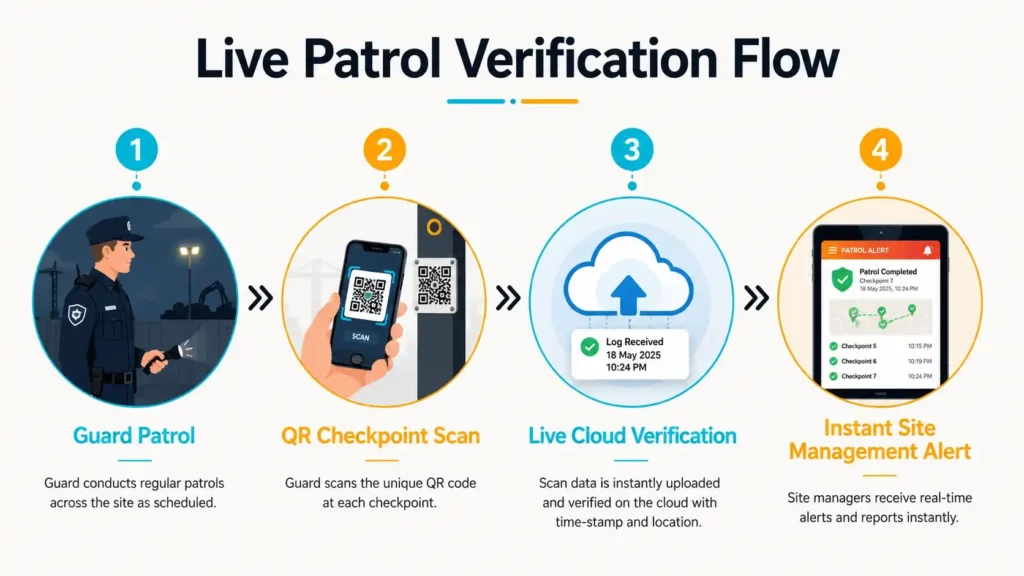
When you hire overnight security for an exposed site, you need absolute confidence that your perimeter is being checked consistently through the night. Reliable site security relies on live guard tracking systems to eliminate patrol blind spots and keep officers accountable.
Systems such as REMS (Real-Time Electronic Monitoring System) use QR checkpoint scans placed across key areas of your site every 45 minutes.
This technology offers two huge benefits for site management:
- Verified Patrol Evidence: You get time-stamped proof showing that every vulnerable corner of your unfenced site was checked on schedule throughout the night.
- Immediate Incident Escalation: If a guard discovers a cut chain, a damaged storage lock, or suspicious activity along the boundary, live photo alerts and reports are sent to site managers instantly so you can react right away.
This verification is also essential when managing inactive or handed-over properties nearby. If your project includes completed units waiting for buyers, combining guard tracking with dedicated construction security Services protects empty buildings from vandalism, squatting, and asset stripping.
7. Partner with Fully Accredited Security Providers
Not all security guarding providers offer the same standard of protection. When you are securing an unfenced site packed with expensive equipment, working with an unaccredited provider can leave you facing legal trouble, poor guard performance, and rejected insurance claims.
Always verify that your chosen security firm holds recognised industry accreditations. Look for contractors approved under the official SIA Approved Contractor Scheme (Gov.uk), which ensures that on-site guards are licensed, thoroughly vetted, and properly trained for tough construction environments.
Partnering with an accredited provider gives you confidence that your site remains safe, meets strict health and safety standards, and stays fully compliant for insurance purposes.
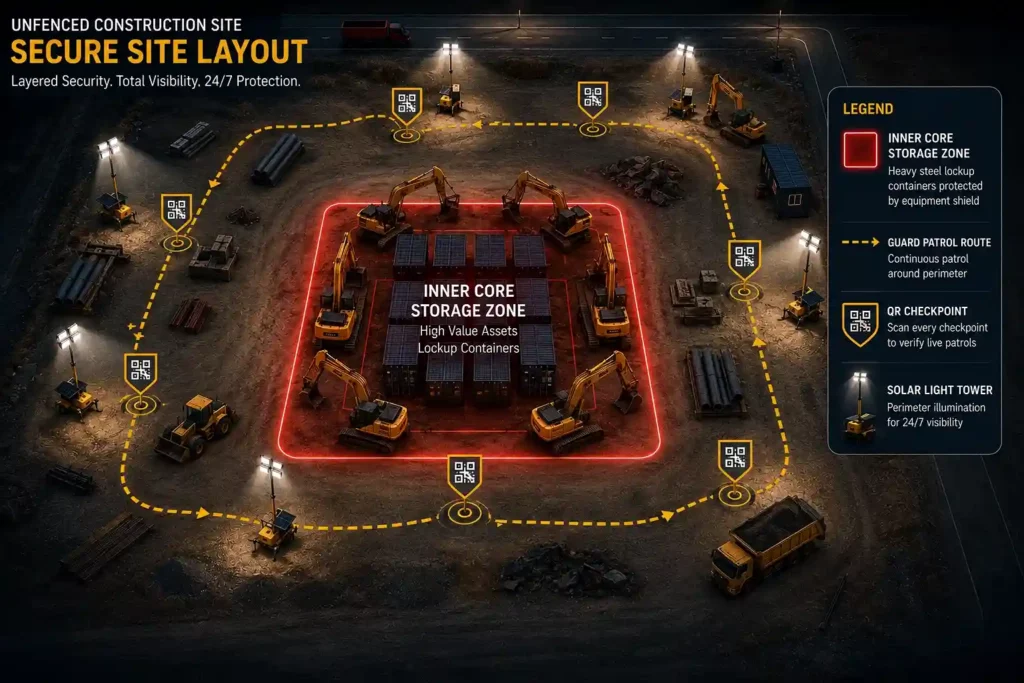
Step-by-Step Practical Scenario: Securing an Unfenced 5-Acre Site
To see how these seven strategies work together, let’s walk through a real-world scenario. Imagine you are managing a 5-acre groundwork site with no perimeter fencing yet. Here is how an integrated security plan operates over a 24-hour cycle:
- 07:00 AM – 04:30 PM (Working Hours): The site entry gate is managed by a supervisor. All sub-contractors and delivery drivers sign in, state their purpose, and wear visible site passes.
- 04:30 PM – 05:30 PM (End of Shift): Sub-contractors return all power tools, copper spools, and testing kits to the central steel storage container. Heavy excavators are parked in a circle around the container, locked, and key fobs are secured in the site office safe.
- 05:30 PM – 06:00 AM (Overnight Shift): Mobile solar light towers illuminate the central core and main pathways. An SIA-licensed security guard begins active perimeter patrols. Every 45 minutes, the guard scans QR checkpoints along the open boundary using the REMS tracking app, confirming the site is clear.
- 06:00 AM – 07:00 AM (Morning Handover): The security officer completes the night log, notes any late delivery arrivals or perimeter checks, and hands over a clean, secure site to the day manager.
By following this daily routine, your open site operates with the same level of protection as a fully walled compound.
Daily Evening Security Checklist for Site Managers
Before locking up your site office and heading home each evening, run through this quick checklist to make sure your site is protected:
| Security Focus Area | Daily Evening Checklist Task | Completed? |
| Perimeter Lighting | Check that all solar/battery light towers are powered up and facing vulnerable paths. | |
| Central Laydown | Ensure all portable tools, cables, and fuel cans are locked inside steel containers. | |
| Plant Machinery | Park heavy plant around storage units; remove ignition keys and lock cabs. | |
| Signage Check | Confirm warning signs regarding 24/7 guard patrols are clearly visible from the main road. | |
| Guard Briefing | Brief overnight security officers on any late material arrivals or planned maintenance. | |
| Logbook Closure | Review day sign-in sheets to verify all visitors and sub-contractors have left the site. |
Frequently Asked Questions (FAQs)
1. How do I secure a construction site before boundary fences are built?
Ensure that your open site is secured through establishment of a brightly-lit central storage area for equipment and materials, installation of heavy-duty steel lock boxes, positioning of your plant machinery near your storage units to hinder access, and hiring of on-site security personnel to conduct nightly patrols.
2. What items are stolen most often from open construction sites?
The most commonly stolen assets include copper wiring, diesel fuel, hand-held power tools, hand tools, and light plant machinery like mini-excavators, rollers, and generators. Storing these items inside a guarded, central container zone overnight stops opportunistic thefts.
3. How do security guards prove they are patrolling an open perimeter?
Security companies make use of live guard tracking systems (such as REMS) to ensure this is done effectively. Security personnel log into QR codes placed in set checkpoints on the site perimeters after specified intervals (e.g. every 45 minutes).
4. Is static security guarding better than CCTV cameras for unfenced sites?
Although CCTV cameras record any criminal activity, they do not have the ability to step in to physically intervene in a case of ongoing theft in the unfenced area. On-site security guards, who are professionally trained, have the advantage of immediate physical presence, which helps in deterring trespassers from entering the premises and investigating the suspicious activity as soon as it is reported.
Protect Your Site and Stop Costly Downtime Today
Prevention of construction site theft in unfenced areas is not a difficult task at all. You simply have to create a central layout of your materials, install bright perimeter lighting, and hire professional on-site security guards to safeguard your valuable property.
Is your construction site fully protected tonight? Contact Region Security Guarding today to speak with our security team and book a free, comprehensive site risk assessment.