Walk into almost any mid-to-large UK manufacturing plant at 13:45 on a Tuesday. The day shift is clocking out, eager to get to the car park before traffic builds up. The late shift is streaming through the turnstiles, coffee mugs in hand, trying to reach their lockers before the 14:00 team briefing. Meanwhile, three articulated lorries are idling outside the main gatehouse waiting for bay assignments, and two contract maintenance engineers are attempting to haul specialised toolboxes past the security barrier.
This 20-minute window is an operational nightmare.
Factory shift change security risks stem from a simple reality: when volume spikes, speed usually wins over security. Security barriers get wedged open, gatehouse guards get overwhelmed by traffic logistics, and the discipline that keeps your site secure for the other 23 hours of the day breaks down completely.
For plant directors, operations leads, and health and safety (HSE) officers, this isn’t just about someone sneaking in for a look around. It is the exact operational window where high-value stock disappears, internal loss spikes, and compliance records break down entirely.
Understanding Factory Shift Change Security Risks
Why does this specific window create such an intense security liability? It comes down to basic human mechanics and friction points during peak throughput.
When 200 people attempt to pass through two turnstile lanes in under ten minutes, system bottlenecks are inevitable. If card readers lag by even a second or two, a queue instantly spills back into the car park. That’s when workers start doing what humans naturally do: holding doors open for colleagues, buzzing friends through on a single swipe, or jamming emergency exit gates open to keep the line moving.
This creates several critical industrial site access risks:
- Social Engineering & Tailgating: Politeness is the enemy of physical perimeter security. Holding a door for someone wearing similar high-vis gear feels natural, but it renders badge-based attendance and access tracking completely useless.
- Diluted Guard Focus: Gatehouse staff who should be monitoring perimeter alarms or verifying delivery manifests suddenly get pulled into managing traffic jams, handling lost access badges, or answering visitor queries.
- Internal Inventory Loss: Thieves, whether opportunistic trespassers or dishonest internal staff, know that bags, toolboxes, and raw materials (like copper spools or alloy stock) are rarely searched thoroughly when a hundred people walk out the door at once.
Smart employee entry and exit management means designing physical access control systems that handle peak volume without forcing guards to make a trade-off between throughput speed and site safety.
Failing to manage perimeter flow during peak hours not only creates security vulnerabilities but also introduces workplace health and safety hazards due to crowd congestion. Aligning your site entry protocols with official HSE guidelines on shift work risk management helps balance operational speed with worker safety during heavy gatehouse traffic.
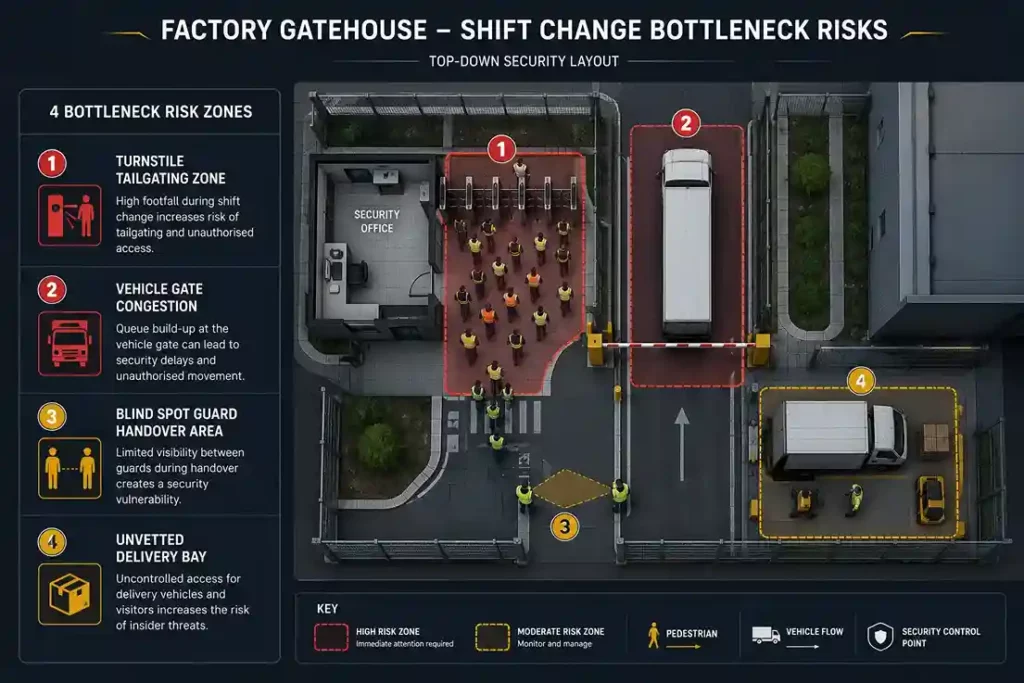
Anatomy of a Shift Swap: Where Access Control Fails
To fix the problem, you have to look closely at what actually happens at the turnstile and the main vehicle gate when shifts rotate.
It isn’t just about foot traffic. It’s the simultaneous collision of incoming personnel, outgoing personnel, third-party logistics trucks, and contractor vans all fighting for the same physical real estate.
Turnstiles and Badge Friction
If your turnstiles rely purely on standard RFID proximity cards, badge sharing becomes an immediate operational headache. One worker swipes, three walk through. Biometric systems (like facial recognition or fingerprint scanners) solve card sharing, but if they are poorly calibrated or struggle with dusty, industrial environments, they slow down entry, causing severe line-bypassing and employee frustration.
Vehicle and Gatehouse Congestion
While turnstiles handle foot traffic, the gatehouse handles rolling metal. When heavy goods vehicles arrive right as workers flood the car park, gatehouse guards face immense pressure to raise the boom gates quickly to clear the main road.
This is where factory access control during shift changes collapses. If an articulated lorry gets waved through without proper driver verification or trailer logging because the queue is blocking a busy local bypass, your site boundary is effectively wide open.
Addressing these bottlenecks early protects your site against stolen stock, unvetted visitors, and severe Health & Safety Executive (HSE) non-compliance penalties.
Financial Impact: Shrinkage and Material Loss During Peak Windows
It is not only the risk of safety that shift changes pose but also a direct threat to profitability. In today’s manufacturing plants, raw materials such as copper wires, nickel, high-quality steel and special electronic components have great potential on the black market.
In ordinary times, material requisitions are recorded and stores locked. However, during the hectic shift changes at 14:00, materials are commonly transported from bay to bay, scraps are cleared out from bins by outside companies, and staging areas remain unsupervised.
While 150 staff members head to the parking lot, security officers are busy with gatehouse logistics, and checks of staff bags and private vehicles become virtually impossible. Organised internal groups of thieves use this time window precisely to take their stolen goods off the property, since security guards cannot stop an entire exodus without making a disturbance on the site.
The introduction of regular bag checks and vehicle boot examinations together with automatic full-height turnstiles drastically reduces internal theft without clogging up factory exits.
The Human Factor: Guard Handover & Communication Gaps
Here is a common operational flaw: many manufacturing facilities schedule their security guard shift changes at the exact same time as the factory production floor swaps over.
That means while 150 machine operators are swapping places, the security team is also sitting in the gatehouse doing their own log handovers, radio transfers, and debriefs.
Executing a smooth manufacturing shift handover security strategy means eliminating this exact operational blind spot. When guard shifts overlap directly with plant shifts, several things go wrong:
- Information Loss: Critical notes about an unsecured fire door on the west wall, a broken badge scanner, or an expected late-night contractor delivery get glossed over during a rushed 5-minute guard handover.
- Fatigue Meets Inattention: Outgoing guards who have worked an 8-to-12-hour shift are eager to wrap up, while incoming guards are still getting context on the day’s events. Neither team is operating at full alertness during the site’s most vulnerable window.
- Contractor Blind Spots: Out-of-hours maintenance crews often arrive right during shift swaps. If visitor logs are mid-transfer, contractors frequently slip onto the factory floor without proper inductions or Risk Assessment & Method Statement (RAMS) sign-offs.
If you are managing complex third-party maintenance teams alongside regular shift swaps, implementing robust factory security protocols prevents unvetted tradespeople from wandering into active hazard zones.
Health & Safety Risks: Emergency Muster and Roll-Call Failure
Securing a factory floor isn’t just about stopping theft; it is an essential pillar of workplace health and safety compliance. Under UK safety regulations, plant managers must maintain an accurate, real-time record of every individual present on-site at any given moment.
If a chemical leak, fire, or major structural failure occurs at 14:05 during the shift swap, an accurate evacuation headcount becomes nearly impossible if entry/exit protocols have broken down.
Consider the dangerous consequences of poor shift-change tracking during an emergency:
- Ghost Personnel: If outgoing employees bypass exit turnstiles or wedge gates open to leave quickly, the access system still lists them as present inside the building. Fire wardens and emergency responders would spend precious time searching these areas for employees when they are actually in their cars heading home from work.
- Unregistered Entrants: On the other hand, workers entering by tailgating into an entry point without registering themselves don’t show up on the automatic muster list. In the event they get trapped inside a hazardous area, emergency services wouldn’t even be aware that they are missing.
Keeping stringent and automated entry and exit procedures for your employees guarantees that your roll call muster list during evacuation is 100% correct.
Standard Operating Procedures: Fixing Shift Transition Protocols
Fixing these vulnerabilities doesn’t mean buying millions of pounds in new tech. Most of the fix comes down to smarter operational design and clear, enforced protocols.
When building robust shift transition security procedures, focus on four structural changes:
1. Stagger Security Guard Schedules
Never rotate your security detail at the same time as the production floor. If the plant shift swaps at 14:00, rotate your security team at 13:00 or 15:00. This ensures your guard force is at 100% alertness, fully briefed, and actively stationed at key choke points when worker volume peaks.
2. Physically Separate Pedestrian and Logistics Lanes
Freight traffic and walking employees should never share a gate or entry lane. Direct all foot traffic through dedicated full-height turnstile banks, leaving vehicle gatehouses to focus exclusively on driver verification, delivery manifests, and vehicle searches.
3. Deploy Full-Height Turnstiles with Anti-Passback
Waist-height turnstiles are easy to jump or lean over. Replacing them with full-height rotor turnstiles equipped with anti-passback technology guarantees that a card swiped for entry cannot be swiped again until it has been used to exit. This instantly eliminates badge-sharing.
4. Implement Digital Headcount & Muster Integration
Manual clipboards at the gatehouse do not work when 200 people cross the threshold in minutes. Integrated access control software provides a live, real-time digital headcount. If an emergency evacuation happens at 14:05, you know exactly who is inside the perimeter walls.
For high-volume manufacturing hubs across South Yorkshire, managing thousands of worker transitions during peak times requires on-the-ground expertise. Implementing tailored SIA-licensed security services in Sheffield ensures that trained guards actively monitor physical access control points during high-risk shift overlaps.
Physical Security vs. Automated Access Control
A common debate among plant directors is whether to invest in automated access technology or rely on physical manned guarding. The truth is that neither works effectively in isolation during high-volume shift changes.
An automated turnstile can check a badge in 0.5 seconds, but it cannot spot a worker attempting to walk out with stolen tools tucked into a jacket. On the flip side, a security guard can perform bag checks and manage traffic, but they cannot physically inspect 200 badges per minute without creating massive bottlenecks.
The solution is a hybrid security model:
- Automated hardware handles the rapid verification and logging of compliant employees.
- Stationed security officers oversee the flow, perform randomised spot checks, handle badge exceptions, and maintain strict control over vehicle lanes.
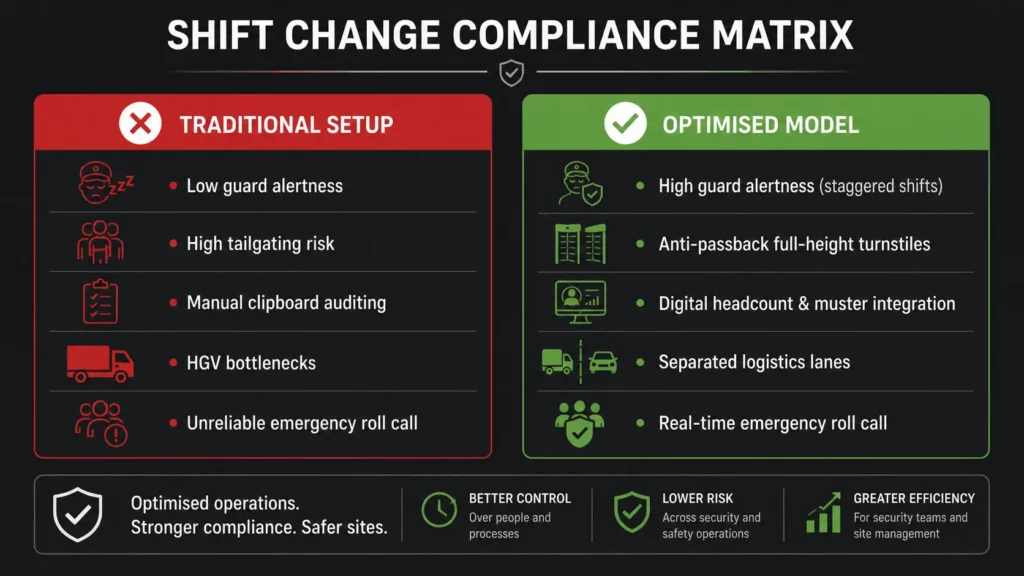
Shift Change Compliance Matrix
| Security Approach | Traditional Unstaggered Setup | Optimised & Staggered Guard Model |
| Guard Alertness at Shift Swap | ❌ Low (Distracted by internal handover) | ✅ High (100% capacity on active duty) |
| Tailgating Protection | ❌ High Risk (Waist-height / Open barriers) | ✅ Fully Secured (Full-height anti-passback) |
| Contractor & Visitor Auditing | ❌ Manual Clipboards (Prone to gaps) | ✅ Digital Badging & Instant RAMS Check |
| HGV & Logistics Gatehouse Flow | ❌ Heavy Traffic Bottlenecks | ✅ Separated Lanes & Dedicated Logistics Vetting |
| Emergency Roll Call Accuracy | ❌ Unreliable During Swaps | ✅ Real-Time Digital Headcount |
Actionable Checklist for Plant & Operations Managers
Before your next shift swap, run through this quick operational health check:
Check Security Shift Timings: Are guard shift timings scheduled for at least 60 minutes after plant production changeovers?
Check Turnstile Time: Are badge readers able to clear badge scanning within 1.5 seconds?
Check Anti-Passback Policies: Is there an effective anti-passback policy being used in your access control system?
Check Perimeter Lighting: Is perimeter lighting adequate for pedestrian and vehicle access areas during late night and early morning shifts?
Check HGV Buffer Space: Does the site have adequate buffer area for HGVs to wait without obstructing the site’s main access routes?
Check Bag Inspections: Are guards authorised to conduct bag inspections during exit windows?
Frequently Asked Questions (FAQs)
1. Why are factory shift changes such a high risk for inventory theft?
Shift change periods lead to chaos, which allows many people to leave at one time. The thieves use the confusion, narrow exit routes, and decreased guard attention to steal the raw materials, tools, or finished products.
2. How do you stop tailgating at factory turnstiles during peak hours?
Installing full-height rotor turnstiles that are equipped with anti-passback software will be the only way to get rid of tailgating.
3. Should security guards change shifts at the same time as factory workers?
No, scheduling security shift rotations at the same time as production floor swaps creates severe operational blind spots. Security shifts should be staggered by at least an hour so that guards are fully briefed, refreshed, and present on the floor during peak worker transitions.
4. What is anti-passback and how does it improve industrial site safety?
Anti-passback is an access control software feature that prevents an access card from being used to enter an area unless it has previously been used to exit that same area. This stops employees from swiping their card and passing it back to an unverified coworker or visitor waiting behind them.
5. How can factory gatehouses maintain fast delivery access without lowering security?
By physically separating logistics traffic from employee foot traffic. Using automated barrier systems, driver self-service kiosks, and dedicated holding bays allows gatehouse staff to verify HGV manifests thoroughly without creating vehicle tailbacks onto public roads.
Secure Your High-Volume Industrial Operations
Managing shift transitions doesn’t have to mean choosing between operational delays and physical site risk. By combining smart access hardware, staggered security scheduling, and rigorous gatehouse procedures, you can keep your workforce moving while keeping your perimeter tight.
Need expert guidance to audit your factory’s gatehouse and access control systems? Contact Region Security Guarding today to schedule a free site risk assessment with our industrial security specialists.