Ask any facility manager about their perimeter security, and they will likely point to their gatehouse logs, ANPR cameras, and automated boom barriers. But if you stand at the main transport entrance during peak shift changes or morning freight deliveries, you will quickly spot the blind spot: drivers and pedestrians bypassing security simply by following closely behind someone else.
Social engineering and tight delivery schedules make tailgating the path of least resistance on busy industrial sites. Preventing tailgating at manufacturing facilities requires addressing both physical gate infrastructure and the everyday human habits that leave gates propped open for unverified entry.
Table of Contents
The Hidden Dangers of Unauthorised Site Access Prevention
When plant managers review site vulnerability, they usually focus on forced entry, cut chain-link fences, broken padlocks, or after-hours yard break-ins. The reality is far simpler: most unverified visitors don’t cut their way onto a site; they walk or drive straight through the front gate behind an authorised user. Flaws in your unauthorised site access prevention strategy quietly undermine your safety systems from the inside out.
Three distinct risk areas open up the moment an unverified entry occurs:
- HSE & Legal Liabilities: In line with UK legislation, employers are required to ensure that all vehicle and pedestrian movements around the site are managed safely. In the event of an untracked delivery driver or contractor tailing onto your property and entering an active loading bay without a safety induction, the responsibility lies with you if there is any kind of injury.
- Disaster Evacuation & Roll-Call Failures: The entire process of responding to an emergency is completely dependent on accurate gate logs. In the event of a chemical spillage or fire alarm requiring the evacuation of the site, an untracked tailgater means there would be somebody missing on the roll call, forcing emergency wardens to search through potentially hazardous buildings.
- Inventory Loss and Intellectual Property Breaches: Untracked access offers complete and total access to scrap metal, valuable stock, machinery, and intellectual property.
How Vehicle Access Control Manufacturing Setups Suffer From Tailgating
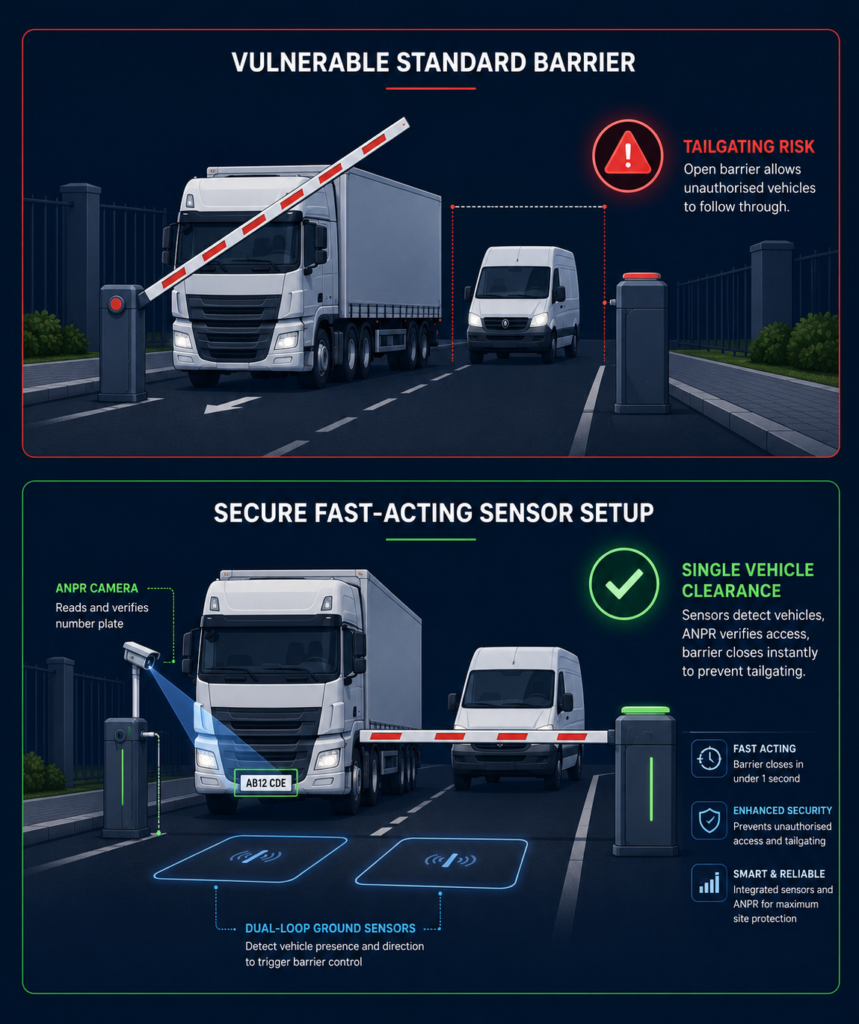
Commercial loading bays and heavy freight gates are naturally susceptible to vehicle tailgating. Standard automatic boom barriers operate on timed delays or simple single-loop floor sensors. Once a heavy arctic lorry passes the sensor, the barrier arm often remains raised long enough for a closely following car or small delivery van to slip through on the very same clearance cycle.
This operational vulnerability is constantly exploited because haulage drivers and busy contractors operate under strict time limits. When delivery trucks start backing up onto public approach roads, drivers feel pressure to bypass gate checks quickly to protect their schedules.
Without targeted vehicle access control manufacturing setups such as fast-acting barrier hydraulics, dual-loop directional sensors, and strict anti-passback logic, your vehicle entrance effectively becomes an open corridor during peak delivery windows.
Rethinking Manufacturing Access Control Systems to Stop Tailgating
Relying solely on standard RFID keycards or fobs isn’t enough to prevent physical tailgating. Modern manufacturing access control systems require intelligent physical hardware engineered to separate vehicles and pedestrians automatically.
- Interlocking Vehicle Airlocks (Mantraps): This layout uses two sequential gate barriers. The inner gate will not open until the outer entrance barrier has fully lowered, verifying that only a single vehicle is sitting in the intermediate holding zone.
- Automatic Number Plate Recognition (ANPR): ANPR cameras scan incoming license plates and match them against pre-cleared tenant and haulage lists. Linking ANPR directly with fast-closing barrier logic ensures the arm drops the moment the verified vehicle’s rear axle clears the sensor.
- Full-Height Anti-Tailgating Turnstiles: For pedestrian footpaths, standard swing doors should be replaced with full-height turnstiles fitted with overhead optical sensors. If two individuals attempt to squeeze through a single rotor turn on one badge scan, the system locks up and triggers a local alarm.
Installing access hardware that aligns with BSIA physical access control standards ensures your barriers meet British industry compliance while providing reliable single-person passage.
Factory Gate Security Procedures That Interrupt Tailgating
While physical technology provides high-speed verification, security personnel deliver necessary operational enforcement. Even sophisticated automated gates eventually encounter edge cases, system overrides, or persistent drivers who ignore barrier signs.
Establishing strict factory gate security procedures ensures your perimeter technology is backed by clear human authority:
- Active Gatehouse Observation: Security officers must visually monitor vehicle barrier clearance in real time, rather than remaining seated inside the gatehouse waiting for intercom buzzes.
- Immediate Barrier Overrides: It is essential that the employees at the gatehouse are immediately provided access to the physical controls in order to operate the barrier lowering function and stop the movement of gates when a second vehicle tries to enter behind another.
- Mandatory Vehicle Spot-Checks: Random physical checks conducted on outgoing trailers will ensure that there are no individuals or stolen goods that exit the premises in trailers.
For any information regarding regulation governing site traffic management and segregation roles, refer to the HSE guidance on workplace transport safety.
Improving Employee and Visitor Access Management Culture
Interestingly, one of the biggest threats to gate security comes from polite employees. “Politeness culture” holding a turnstile open for someone walking behind you, or waving a contractor through a vehicle gate, is responsible for a massive portion of unverified site entries.
Building a secure employee and visitor access management culture requires breaking these informal habits:
- Enforce “One Badge, One Scan”: Make it clear in employee handbooks and site signage that every single worker must scan their own card, even when walking into the building as a group.
- Color-Coded Visual Identification: Distribute distinct, highly visible lanyards or high-vis vests to unescorted contractors, escorted visitors, and full-time site staff. If an unvetted person walks onto a shop floor without a pass, staff can spot them instantly.
- Digital Visitor Kiosks: Replace paper sign-in books with digital kiosks that issue temporary, photo-printed badges. Paper logs leave personal data exposed, breaching GDPR, whereas digital systems log exact check-in times automatically.
Reinforcing Industrial Site Perimeter Security Against Forced and Unauthorised Entry
Preventing tailgating at the main gate is only effective if the rest of your boundary is secured. If your main entrance becomes difficult to bypass, unauthorised visitors will look for secondary weak points, such as side emergency exits, unmonitored fence lines, or rear delivery docks.
Creating a comprehensive industrial site perimeter security strategy requires a layered approach. Outer physical boundaries like full-height fencing, optical turnstiles, and clear wayfinding signs must work directly alongside gatehouse oversight. Having trained SIA gatehouse officers stationed at the gate provides live barrier control, active visitor audits, and immediate intervention when unauthorised entries are attempted.
Deploying trained personnel is vital here. Utilising SIA licensed gatehouse security services ensures that qualified officers are physically stationed at your main entry points to actively manage high-volume shift changes, enforce barrier protocols, and intercept tailgaters immediately.
When integrated alongside broader specialised factory security solutions, site managers can protect active assembly bays, inventory compounds, and blind spots across the entire facility. If your site is based in South Yorkshire, partnering with an established security company in Sheffield brings local operational knowledge and reliable response times directly to your site perimeter.
Key Strategies for Preventing Tailgating at Manufacturing Facilities
Use this checklist to identify and fix tailgating vulnerabilities across your facility:
- Audit Barrier Reset Timers: Ensure vehicle boom barriers drop immediately after a vehicle passes over the sensor loop, rather than relying on standard time delays.
- Install Anti-Tailgating Turnstiles: Upgrade pedestrian entry points to full-height rotors fitted with anti-piggybacking optical sensors.
- Train Guards on Intervention: Update your factory gate security procedures so security personnel actively monitor and stop tailgating attempts at the gate.
- Integrate Fast ANPR Tech: Link plate recognition software directly to your manufacturing access control systems for seamless, single-vehicle clearance.
- Eliminate “Politeness Culture”: Educate staff through safety briefings on why holding doors open undermines site safety under your employee and visitor access management rules.
- Maintain Outer Fencing: Inspect perimeter lines monthly to ensure intruders cannot bypass gate controls by exploiting broken fence panels, reinforcing overall industrial site perimeter security.
- Install Vehicle Airlocks: Use dual-gate airlocks for sensitive loading bays to guarantee complete unauthorised site access prevention.
- Review Freight Protocols: Ensure all haulage trucks follow strict, single-vehicle entry sequences under your vehicle access control manufacturing policy.
Conclusion
Unauthorised tailgating may seem to be a harmless activity or a convenience, but in actuality, it poses a huge weakness for today’s manufacturing plants. Permitting unverified vehicles and people to enter your facility through the front gate is not only a security risk, but it also puts you at risk of HSE liabilities as well as potential asset theft.
Modernising your entry gates into high-speed physical barriers, a digital monitoring and identification system, and professional SIA-trained guards will allow you to remove all weaknesses from your entry process.
Frequently Asked Questions
1. What is the difference between tailgating and piggybacking at factory gates?
Tailgating typically refers to a vehicle closely following another authorised vehicle through a security barrier before it closes. Piggybacking usually describes a person walking closely behind an authorised employee through a pedestrian door or turnstile using a single badge scan.
2. How do anti-passback systems stop tailgating at manufacturing facilities?
In order to be valid for usage at exit readers, anti-passback mandates that access cards be scanned first at entry readers. If a person enters a facility without using his card, he will not be able to leave the facility, since the absence of scanning his card will alert security about a tailgating attempt.
3. Why are standard automatic boom barriers vulnerable to tailgating?
Standard boom barriers often rely on basic timer delays or wide sensor loops that keep the arm raised long enough for a second, closely following vehicle to pass through on the original driver’s authorisation.
4. How do security guards help enforce anti-tailgating rules at industrial entrances?
SIA-accredited security guards monitor the entrance visually, control barriers manually when a second car tries to enter, compare the credentials of drivers to pre-approved lists of deliveries and bar unauthorised personnel from entering manufacturing areas.