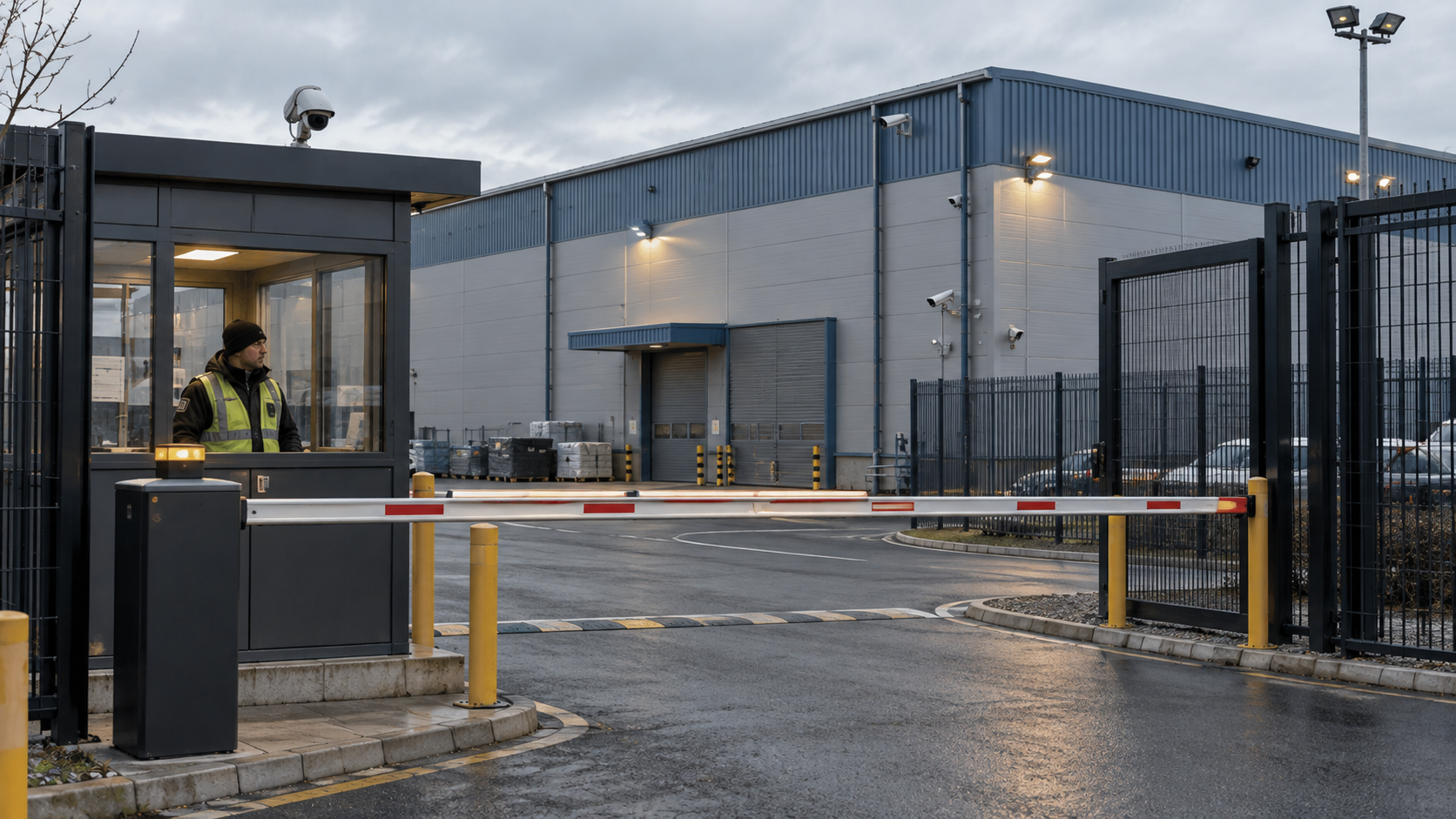
That is where vacant property risks in Manchester industrial areas become a management issue rather than simply a matter of keeping a building locked. Manchester has a substantial stock of commercial, industrial and warehouse premises, with Manchester City Council actively encouraging owners to bring empty commercial properties back into use.
For owners and property managers, the challenge is spotting small changes before they become expensive problems.
Manchester's Industrial Estates Have Their Own Risk Profile
Not every vacant property in Manchester faces the same exposure.
A unit surrounded by occupied businesses benefits from regular movement. A standalone industrial building with a large boundary and little neighbouring activity is different. A property undergoing redevelopment introduces another layer of uncertainty because contractors, temporary fencing and changing access arrangements can alter the site from week to week.
Consider the difference between:
Property situation | What to review |
Multi-occupancy estate | Shared roads, gates and neighbouring activity |
Standalone unit | Boundary condition and natural surveillance |
Vacant warehouse | Loading bays, yards and remaining assets |
Redevelopment site | Temporary access and contractors |
Unit between active tenants | Shared access and maintenance responsibilities |
These are the kinds of factors behind industrial estate property risks Manchester owners need to consider. The surroundings can change as well. A new neighbouring tenant, a road diversion, construction work or a change in shared-gate arrangements can make an old risk assessment outdated.
These differences are why industrial estate property risks Manchester owners face cannot be reduced to one universal checklist. The local environment can change the picture considerably, particularly where a vacant unit sits within a busy industrial estate, near shared access routes or alongside redevelopment activity. Owners and managers who need security support in Manchester can also review locally available options based on the property’s location and risk profile.
Five Red Flags Manchester Property Owners Should Check First

A sophisticated audit is not always necessary to find obvious weaknesses. A careful walk around the site can reveal plenty.
- Secondary entrances: Rear doors, loading-bay access, shutters and service entrances often receive less attention than the main entrance. Check their condition, locks, closing mechanisms and key arrangements.
- Perimeter defects: Inspect fencing, gates, vegetation and shared boundaries. A boundary does not need to be completely broken to become less effective.
- Failed lighting: Check car parks, rear service areas, loading yards and pedestrian routes, particularly where inspections happen outside normal working hours.
- Long inspection gaps: The longer a building goes without a proper visit, the longer a new problem can remain unnoticed. Frequency should reflect the property’s condition, location and insurance requirements.
- Visible signs of neglect: Accumulated post, damaged signage, unmanaged vegetation, overflowing waste and persistent darkness can all suggest that the property has become low priority.
None proves that an incident will occur. Together, they indicate that the normal rhythm of property management has disappeared.
Vacant Property Inspections Manchester Owners Shouldn't Treat as a Tick-Box Exercise
A drive past the building is not necessarily an inspection. For vacant property inspections in Manchester, the useful question is: what has changed since the last visit?
A practical inspection should cover:
- doors, locks and shutters;
- windows and accessible glazing;
- fencing and gates;
- external lighting;
- loading areas and service yards;
- water ingress;
- alarm status and visible faults;
- signs of vandalism, trespass or forced entry;
- waste and other changes around the site.
RICS recommends regular inspections of vacant premises and notes that an external check may not reveal what is happening inside. Accurate records are particularly important where insurance conditions apply.
For larger properties, dated inspection records and photographs can also make handovers easier when several parties are involved.
Commercial Property Vacancy Risks Manchester Owners Often Underestimate
Break-in is the obvious concern, but it is only part of the picture. The wider commercial property vacancy risks Manchester owners face can include:
- Repair costs: broken doors, windows or fixtures can delay re-letting.
- Water damage: a small leak may continue unnoticed when nobody occupies the premises.
- Fire and arson: empty buildings can attract unwanted activity, while warning signs may take longer to discover.
- Redevelopment delays: damage can push back refurbishment, sale or a new tenancy.
- Insurance complications: vacancy may trigger additional conditions or require notification to the insurer.
RICS specifically highlights water damage, vandalism, arson and other issues as reasons vacant properties can present a different risk profile. The cost of a vacant-property incident is therefore not necessarily the value of whatever was taken. It can include lost time, repairs, professional fees and delayed occupation.
Empty Building Break-In Risks Manchester Property Managers Should Watch For
When an empty building shows signs of intrusion, the priority should be a safe, controlled response, not immediately walking through the property alone. There may be damaged services, unknown occupants or other hazards that are not obvious from outside.
A sensible sequence is:
Notice → keep people safe → report → preserve relevant evidence → arrange an appropriate inspection → review the weakness.
Avoid disturbing the scene unnecessarily until the relevant parties have been informed.
For empty building break-in risks that Manchester property managers encounter, the follow-up matters just as much. Repairing a damaged door without addressing why the weakness existed simply leaves the same problem waiting to happen again.
Incident records can help identify recurring weaknesses and support communication between owners, managers, contractors and other relevant parties.
When Routine Inspections Aren't Enough
There are properties that can be managed with a straightforward inspection regime. There are others where the risk is plainly higher.
Consider a building that has already been broken into twice. Or a large industrial property that will remain empty for a year. Or a site containing valuable equipment, with an isolated boundary and limited local oversight.
That is a different proposition. For properties where routine inspections aren’t enough, vacant property security support can provide a more structured response based on the site’s individual risk profile. Additional measures may be appropriate depending on the circumstances, such as:
- scheduled site visits;
- live guard-tracking records;
- keyholding arrangements;
- alarm response;
- mobile patrols;
- monitored CCTV;
- physical security measures;
- professional on-site presence where the risk assessment supports it.
This is where a broader vacant commercial property break-in prevention strategy becomes useful. The owner doesn’t necessarily need every measure on the list. They need the combination that addresses the building’s actual weaknesses.
The right question isn’t: “What is the most security I can buy?”
It’s: “Where would an incident leave us most exposed, and what control addresses that gap?”
That keeps the approach proportionate.
What Should Happen When a Manchester Unit Becomes Vacant?
The easiest time to organise the basics is before the tenant has completely left.
A practical handover should confirm:
- who still holds keys or access cards;
- whether former tenant permissions have been removed;
- what equipment or materials remain;
- the condition of the property;
- how alarms and utilities are being managed;
- who is responsible for inspections;
- what the insurer requires.
Manchester City Council’s guidance covers empty shops, offices, factories and warehouses, reflecting the range of commercial properties that can become vacant across the city.
Treating vacancy as its own management phase makes responsibilities clearer. The property may be empty, but it still needs someone accountable for access, condition and response.
When Routine Property Checks Are No Longer Enough
Some vacant units can be managed through a straightforward inspection programme. Others cannot. Additional support becomes more relevant when:
- the vacancy will last for an extended period;
- the property has already experienced incidents;
- valuable equipment remains inside;
- the site is isolated;
- perimeter conditions are difficult to maintain;
- alarms may activate outside normal hours;
- internal teams cannot provide sufficient oversight.
Depending on the risk, owners may use scheduled inspections, live guard tracking, mobile patrols, keyholding and alarm response, monitored systems or a more consistent physical presence.
The point is not to buy every available measure. It is to close the gaps that routine property management cannot reasonably cover.
For owners who need a structured arrangement during a prolonged vacancy, vacant property security support can combine scheduled checks with a defined response process, giving the property manager clearer visibility over what is happening between visits.
That is where professional support should fit: around the property’s actual weaknesses, not around a generic package.
A 60-Second Vacant Property Risk Check
Before leaving the site, ask:
- Are all external doors, shutters and windows secure?
- Is the perimeter intact, including gates and shared boundaries?
- Are external lights working?
- When was the last proper inspection?
- Does anyone who should no longer have access still hold a key or credential?
- Has anything changed around the property since the previous visit?
- Do the current arrangements still meet the insurer’s requirements?
If one answer is uncertain, investigate it.
Sometimes the solution is simple: repair a light, change a lock, remove an old access card or increase inspection frequency. The useful part is finding the weakness before somebody else does.
Conclusion
Vacancy changes the way a commercial property behaves.
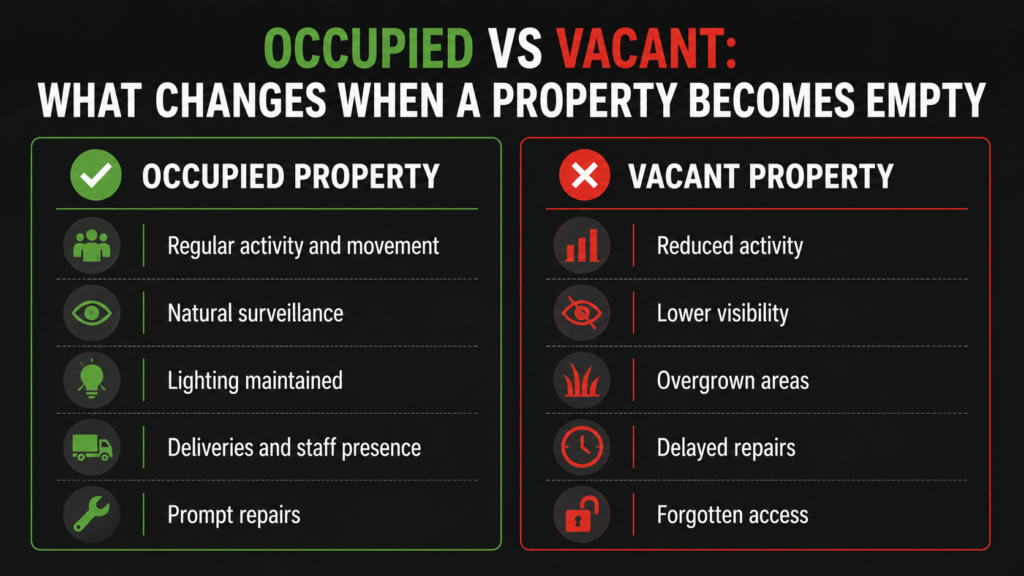
Once the tenant leaves, regular movement disappears, natural observation falls away, and small problems can remain unnoticed for longer. Across vacant property risks in Manchester industrial areas, the exact exposure depends on the building, its neighbours, its boundary, its contents and the length of the vacancy.
For owners, the best response is not to assume that every empty unit needs the same level of protection. Inspect it properly. Keep access records current. Review the perimeter. Understand the insurance conditions. Respond when something changes.
And where the property’s risk or vacancy period makes routine management insufficient, professional support can provide the additional visibility and response capability that the owner cannot reasonably maintain alone.