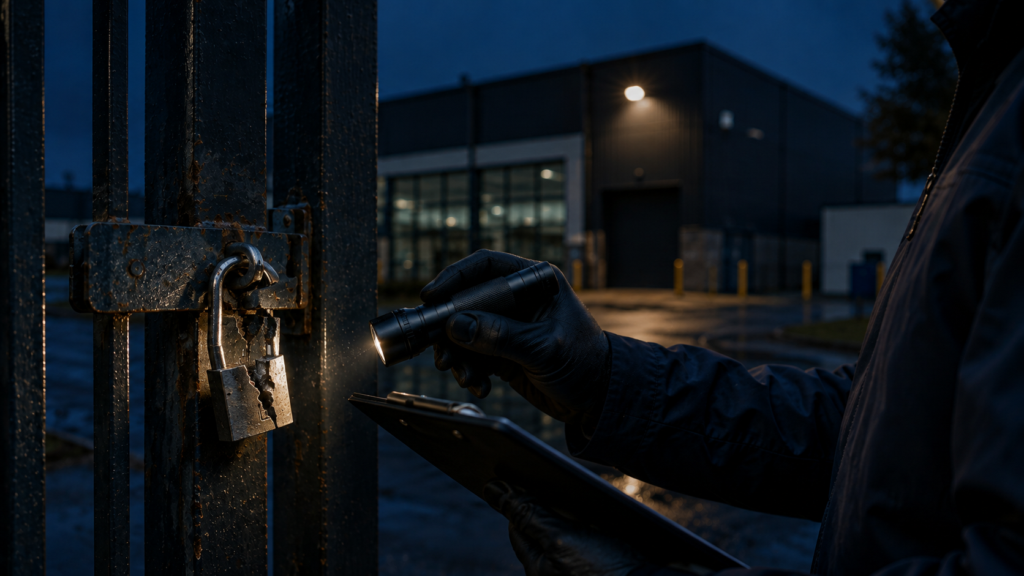
Recognising signs of intrusion at vacant commercial property early gives owners a chance to respond before a small problem becomes a larger loss. The priority is not to investigate alone. It is to identify what has changed, protect people, preserve useful evidence and arrange the right response.
Vacant Property Signs of Break-In: What Should You Look For?
Some warning signs are obvious. Others are easy to dismiss. Common vacant property signs of break-in include:
- damaged locks, padlocks or shutters;
- broken or displaced windows;
- open gates or unsecured doors;
- damaged fencing;
- missing keys or access cards;
- unusual marks around entrances;
- signs that items inside have been disturbed.
One clue does not necessarily mean an intrusion. A damaged gate could have been caused by a vehicle, while an open door might have been left unsecured by a legitimate contractor.
That is why comparing the property with previous inspection records matters. What was the condition last time, and what has changed since then?
Signs of Unauthorised Entry Commercial Property Owners Often Miss
Not every intrusion involves forced entry. Someone may have entered through an unsecured service door, an old access credential or a gate that was never properly closed. That makes signs of unauthorised entry commercial property owners should watch for broader than broken locks.
Look for:
- doors that should be secured but are unexpectedly open;
- unexplained lights or equipment running;
- objects moved from their usual position;
- unfamiliar rubbish or packaging;
- unusual CCTV or alarm activity;
- unexpected access records;
- evidence that someone has been using the premises.
The important distinction is between observation and assumption. Record what you actually found rather than deciding immediately how it happened.
Empty Building Intrusion Signs: Look for Patterns, Not One Clue
A useful inspection considers several clues together.
For example, a failed light means little on its own. A failed light beside a damaged gate, disturbed fencing and an unexplained alarm activation deserves much more attention.
These empty building intrusion signs should therefore be assessed against the property’s normal condition: Was the entrance secured? Is the damage new? Was anyone scheduled to visit? Do access records match?
That context can help distinguish a maintenance issue from a genuine security concern without encouraging owners to carry out their own investigation.
Vacant Property Inspection Findings Should Be Recorded Properly
A vague note such as “checked property” is not particularly useful.
Good vacant property inspection findings should show:
- date and time;
- areas inspected;
- condition of entrances and boundaries;
- unusual findings;
- photographs where appropriate;
- alarm or CCTV status;
- expected contractor or visitor activity;
- action taken.
This creates a useful record for owners, property managers, insurers and other responsible parties.
It also makes recurring problems easier to spot. If the same gate keeps appearing in inspection reports, the answer may not be another temporary repair. The underlying weakness may need addressing.
For larger or higher-risk premises, professional inspections can provide a consistent record of what has been checked between visits.
Commercial Property Break-In Warning Signs That Need Faster Action
Some findings deserve immediate escalation rather than waiting for the next routine visit. Pay particular attention to:
- obvious forced entry;
- damaged gates or boundaries;
- evidence that someone has occupied the building;
- missing keys or access devices;
- unexplained movement or removal of equipment;
- repeated alarm activations;
- several warning signs appearing together.
These commercial property break-in warning signs do not mean an owner should enter and investigate alone. If there is a reasonable possibility someone remains inside, personal safety takes priority.
What to Do After Vacant Property Break-In
If you suspect an intrusion, don’t turn a property inspection into an improvised confrontation.
A practical response is:
- Stay outside or move somewhere safe if someone may still be inside.
- Contact police or emergency services when the circumstances require immediate assistance.
- Notify the owner, property manager or responsible contact.
- Avoid disturbing possible evidence unnecessarily.
- Preserve relevant CCTV, alarm and access information.
- Arrange an appropriate inspection once the situation is safe.
- Review how the property may have been accessed and what needs to change.
This is where professional support can become valuable. For owners who need structured oversight between visits, vacant property security support can provide scheduled checks, documented activity and a defined response process.
The objective isn’t simply to have someone look around the building. It’s to make sure changes are identified, recorded and acted upon.
When Professional Support Makes Sense
One unusual finding may trigger a review. A pattern is different.
Additional support may be worth considering when:
- incidents keep recurring;
- inspection gaps are difficult to manage;
- valuable equipment remains on site;
- the property is isolated;
- alarm activations occur outside normal hours;
- nobody is readily available to attend the premises.
Depending on the property, that support might include scheduled visits, live guard tracking, mobile patrols, keyholding and alarm response, or a more consistent physical presence.
For Manchester-area properties, owners can also explore local security support in Manchester where a locally managed arrangement is more practical than relying solely on internal staff. The right solution should reflect the property, not a standard package.
A Simple Intrusion-Response Checklist
When something looks wrong:
- Observe: record what you can see without making assumptions.
- Protect: don’t enter if there may be an intruder or another hazard.
- Report: notify the appropriate person or emergency service.
- Preserve: retain relevant CCTV, alarm and access records.
- Review: identify how the weakness occurred.
- Improve: repair the immediate problem and reassess the wider arrangement.
The purpose is simple: don’t let a suspicious change become tomorrow’s forgotten maintenance note.
Conclusion
The clearest signs of intrusion at vacant commercial property are not always dramatic. A damaged lock, an unexpected access record or an open gate can be enough to warrant a closer look.
The important thing is knowing when to stop treating something as routine.
Owners should prioritise safety, record what they find and escalate suspected intrusion appropriately. When unusual findings become a pattern, scheduled professional inspections, patrols or out-of-hours response can provide visibility that internal teams may struggle to maintain.
A vacant property doesn’t need to be watched every second. It does need to be actively managed, properly checked and ready to respond when something changes.