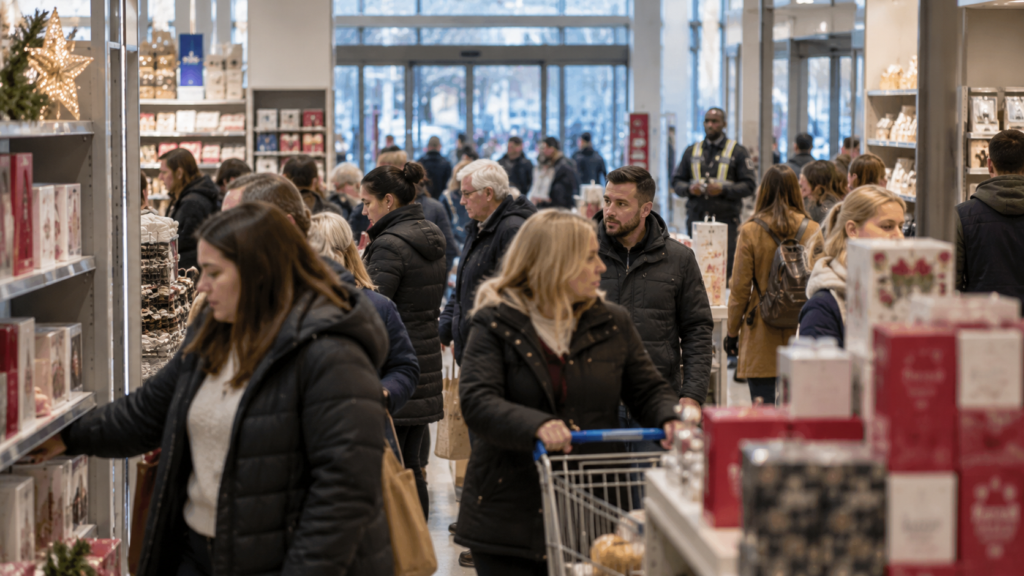
When an aisle is completely empty, spotting potential loss or security concerns is straightforward. Clear sightlines, quiet surroundings, and simple store floor dynamics give your team total awareness of their surroundings.
Mitigating these blind spots requires a proactive strategy that moves far beyond basic, passive CCTV. By positioning SIA-licensed security guards at high-vulnerability entry points and conducting dynamic floor sweeps, retailers can eliminate hidden risks, protect their frontline teams, and stop unseen shrinkage right when footfall peaks.
Understanding Busy Store Visibility Problems During Peak Trading
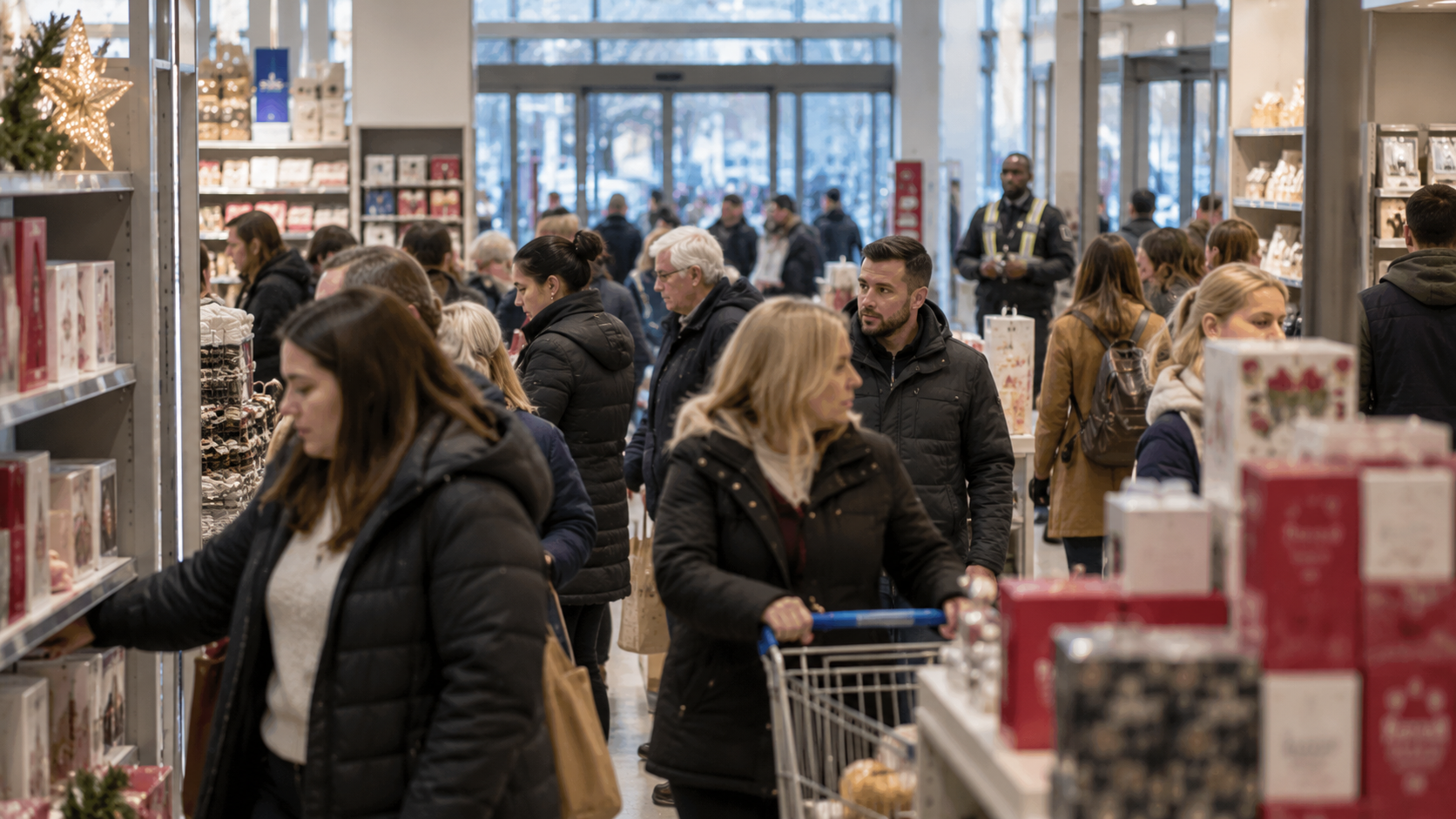
Managing busy store visibility problems means coming to terms with how fast a store’s risk profile shifts the second customer numbers swell. Blind spots are rarely permanent architectural mistakes. More often than not, they are dynamic visual blackouts caused by shifting crowds, packed queue lines, and temporary promotional displays.
When customer volume spikes, natural surveillance the everyday ability of sales assistants to keep an eye on high-value stock simply breaks down. Employees naturally get pulled toward processing transactions at the till, managing fitting room queues, or helping shoppers find sizes.
This environment creates severe customer congestion and security risks. Dense crowds act as human shields for opportunistic thieves, while intense footfall near promotional islands and queue lines draws staff attention away from nearby high-value display racks. As a result, crowded shop floor visibility plummets precisely when the risk of organised retail crime and shoplifting is at its highest point.
7 Critical Blind Spots That Open Your Store to Unseen Loss
To protect inventory and keep your floor safe during rush hours, store leaders must look closely at where visibility actually breaks down. Here are the seven most common blind spots missed during high-traffic surges.
1. The Vestibule and Entrance Flank
Retail entrance blind spots develop the second large groups pour through the doors simultaneously. Promotional banners, security tagging arches, and seasonal display stands frequently block the view from primary cashier banks toward the front doors. When crowds surge through the entrance, thieves exploit these unmonitored flanks to execute quick “push-out” thefts, slipping right past distracted till staff without triggering a response.
2. The Self-Checkout Swarm
The shift toward self-service scanning has created massive self-checkout blind spots. During busy trading windows, a single employee might be overseeing six to eight active terminals surrounded by waiting customers and shopping trolleys. This overcrowding blocks the staff member’s view, making it absurdly easy for dishonest shoppers to skip-scan items, swap barcodes, or walk away with unpaid goods hidden beneath unmonitored queues.
3. High-Density Display Aisles
High shelving units maximise floor space, but they also destroy sightlines. When an aisle fills up, the tops of display fixtures and the backs of tall endcaps block central walkway views. Prolific shoplifters specifically seek out these high-density display zones to conceal high-value goods inside booster bags, knowing sales assistants simply cannot see over the shelving tops.
4. The Stockroom Transition Zone
The swinging doors leading from the sales floor to back-of-house storage carry severe retail stockroom visibility risks. During heavy restocking shifts, these doors are constantly propped open or pushed back and forth by staff hauling pallets. Unmonitored back corridors allow opportunistic trespassers to slip into restricted areas or create unmonitored zones where internal inventory shrinkage can happen completely unnoticed.
5. CCTV Camera Shadow Zones
Many stores rely heavily on ceiling-mounted cameras, but retail CCTV blind spots expand rapidly during peak hours. Hanging POS promotional signage, holiday decorations, and tall crowds create physical shadows that fixed lenses cannot see through. A camera angle that offers a crystal-clear view of an empty aisle on a Tuesday morning might be 80% obscured by customer bodies and overhead banners on a busy Saturday.
6. Fitting Room Approach Corridors
The transitional space leading toward fitting rooms is a classic blind spot. Attendants focused on counting garments at the fitting room desk often cannot see the immediate corridor leading up to their station. Suspects take high-value apparel into these unmonitored approach zones to remove security tags or conceal items before ever reaching the attendant check-in point.
7. Deep Emergency Exit Recesses
Fire exits have to remain accessible by law, but they are often tucked at the end of deep, quiet side corridors or recessed alcoves. Because these areas see zero regular footfall, they become ideal concealment zones during busy periods where individuals can tamper with merchandise or force an exit door for a rapid escape.
Mapping Your Store's Hidden Physical Vulnerabilities
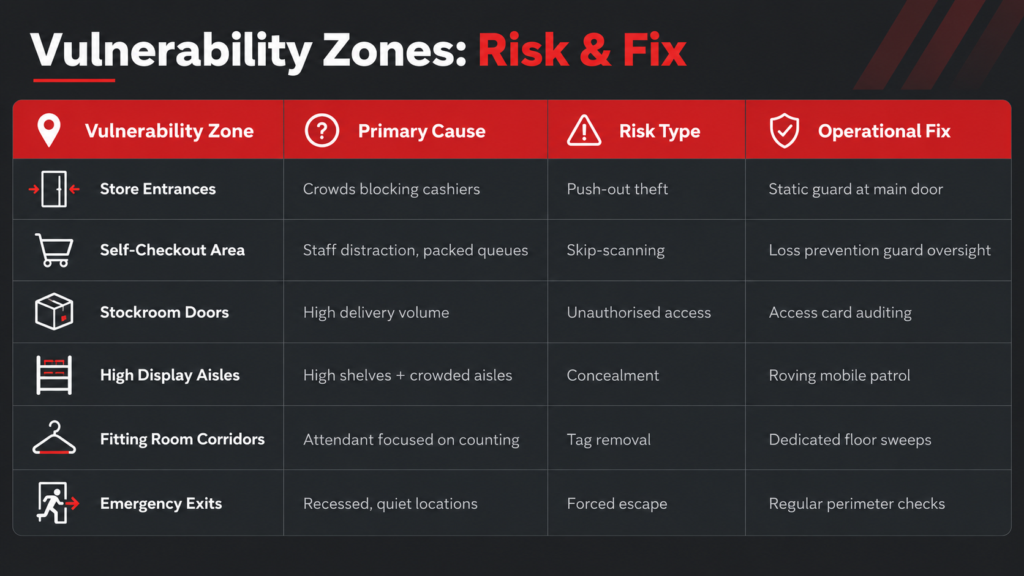
Addressing these blind spots requires analysing how each zone behaves when footfall spikes. The comparison table below breaks down common site vulnerabilities, their underlying causes, and the corresponding operational security fix required to close the gap.
Vulnerability Zone | Primary Cause During Peak | Risk Type | Operational Guarding Fix |
Store Entrances | Crowds blocking cashiers | Push-out theft, quick escape | Uniformed static guard presence at main door |
Self-Checkout Area | Staff distraction, packed queues | Skip-scanning, barcode swapping | Positioned loss prevention guard oversight |
Stockroom Doors | High delivery volume, open doors | Unauthorised access, stock leakage | Access card auditing & guard floor sweeps |
High Display Aisles | High shelves + crowded aisles | Concealment in booster bags | Roving mobile patrol & mirror positioning |
Fitting Room Corridors | Attendant focused on counting | Tag removal, garment concealment | Dedicated guard floor sweeps in transition zones |
Emergency Exits | Recessed, quiet locations | Forced escape, hidden concealment | Regular physical perimeter checks & sensor checks |
Eliminating Visibility Risks Through Active Floor Guarding
Relying exclusively on fixed cameras or expecting busy floor staff to manage retail store blind spots during busy periods is a direct route to unmanageable stock loss. Cameras record what happened after the fact, but they cannot physically step in to prevent a crime or clear a blocked sightline in real time.
This is where integrating dedicated, professional security personnel completely changes the game. Deploying uniformed static guards right at primary entrance nodes establishes immediate visual deterrence at your store’s most obvious blind spot. When potential offenders see an SIA-licensed officer standing by the entrance, the appeal of a rapid push-out theft vanishes instantly.
To protect internal blind spots like high-density aisles, stockroom corridors, and self-checkout zones, static guarding works best alongside active floor patrols. Security officers move organically with the flow of customer traffic, walking into crowded zones where fixed camera angles fail.
By maintaining a calm, visible presence across high-risk aisles, guards provide vital physical support to frontline employees. In line with statutory Health and Safety Executive workplace guidelines on managing retail environments, pairing smart physical layouts with dedicated on-site protection significantly reduces risks and floor conflict.
Integrating specialised security services in Glasgow allows store leadership to bridge the gap between static loss prevention and daily customer care. When guards actively patrol known visibility gaps, they relieve sales assistants of the pressure to act as improvisational security. This human presence is particularly vital during high-volume trading surges, where prioritising Glasgow retail staff safety during peak hours ensures frontline workers remain protected, supported, and confident on the shop floor.
Actionable 5-Point Blind Spot Audit Checklist
Before your next high-traffic trading shift, walk your sales floor using this practical 5-point checklist to find and fix hidden sightline risks:
- Perform a “Crouch & Crowd” Check: Stand at your main cashier and till banks during a busy window. Crouch down to average eye level to see if crowds, display dump bins, or promotional banners completely block your view of the main doors.
- Audit Overhead CCTV Clearance: Look up at your primary CCTV domes to ensure seasonal promotional banners, hanging signs, or festive decorations haven’t been placed directly in the camera’s field of view.
- Re-Align Self-Checkout Guarding Positions: Position the supervising employee or security officer at an elevated or central point where they can view all scanning screens simultaneously, rather than standing behind waiting queue lines.
- Enforce Strict Stockroom Door Protocols: Ensure stockroom swing doors remain closed and latched during peak sales hours. Verify that access keypads or card readers are active to prevent unauthorised public entry.
- Station Dedicated Security at Primary Entry Points: Place uniformed security guards at high-traffic entrance blind spots during peak hours to maintain continuous visual deterrence when staff are occupied.