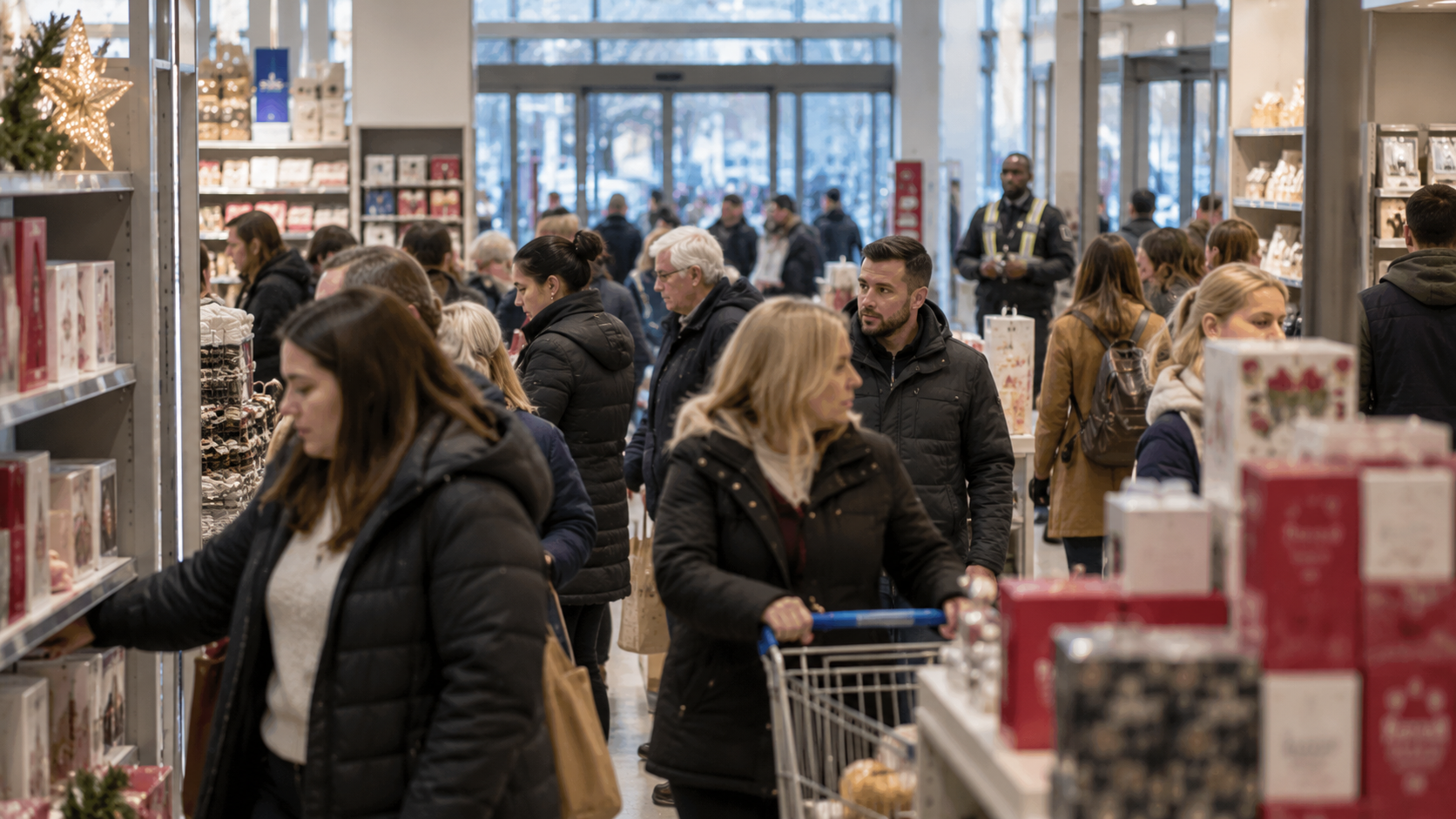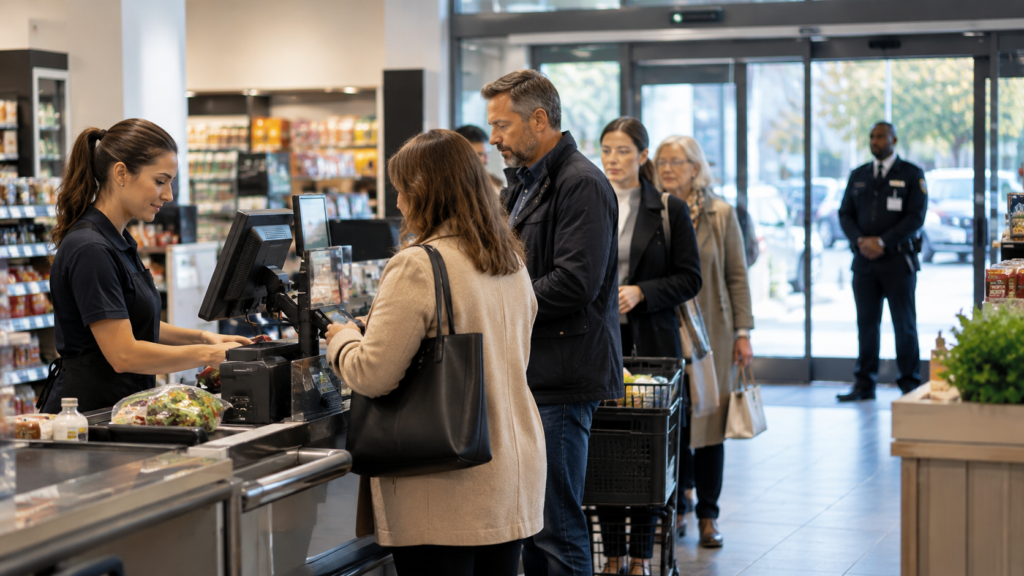
Nothing about that situation is unusual. The problem is that when everyone is occupied, retail staff safety during high-risk trading hours can become harder to maintain. Staff may have less time to notice warning signs, respond to aggressive behaviour or ask a colleague for help.
That matters against a backdrop of persistently high retail crime. The British Retail Consortium’s 2026 Crime Report recorded around 1,600 incidents of violence and abuse against shopworkers every day, down from 2,000 the previous year but still far above the pre-pandemic figure of 455 a day. Retailers also recorded 5.5 million detected incidents of shop theft during the period covered by the report.
The answer isn’t to make every busy shop feel like a fortress. It is to understand where pressure builds, decide which risks employees can manage themselves, and recognise when additional support is sensible.
What Makes High-Risk Trading Hours Different?
A store doesn’t need to be open late to become high-risk. A Saturday afternoon can put more pressure on a team than a quiet Tuesday evening. Christmas trading, promotions, payday weekends and major local events can all change the number of people moving through a store in a short period.
The issue is not simply footfall. It’s competing demands. An employee serving customers cannot give their full attention to a developing incident nearby. A supervisor pulled into a customer complaint isn’t watching the entrance. A colleague covering self-checkout may not see what is happening around a high-value display.
That makes peak periods worth assessing separately. Typical pressure points include:
- busy entrances and exits;
- self-checkout areas;
- high-value or easily concealed merchandise;
- fitting rooms;
- stockroom doors;
- customer-service desks;
- queues and congested aisles;
- loading or service areas;
- periods when several employees are occupied simultaneously.
The HSE advises employers to identify where and when violence and aggression can arise and to put controls in place that reflect the actual risks of the workplace.
Five Pressure Points Managers Should Review Before the Next Peak Period
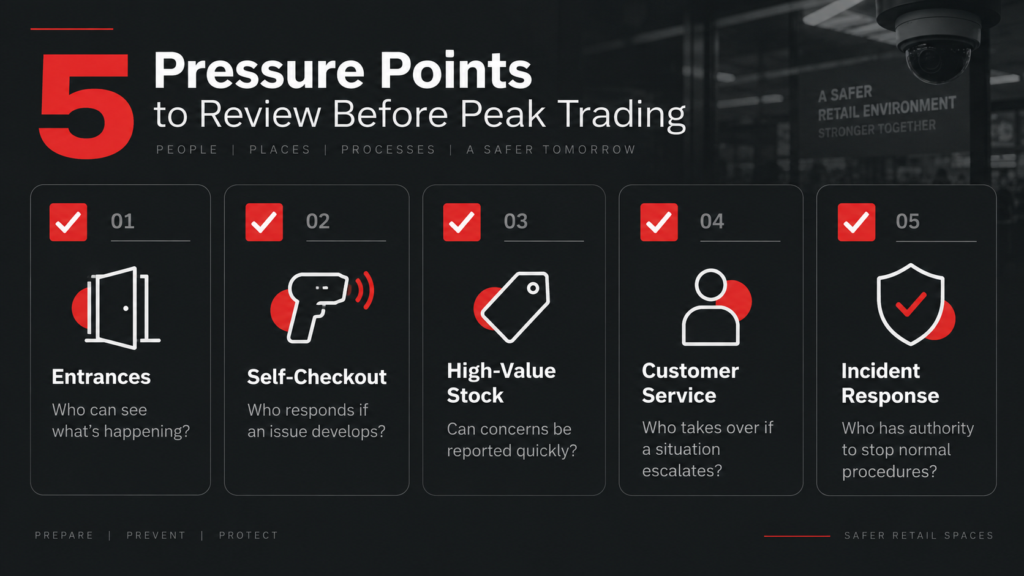
The same busy period can create very different problems from one store to another. A quick review helps identify where attention is most likely to disappear.
- Entrances become difficult to watch: A constant stream of customers can make it harder to notice unusual behaviour or identify people repeatedly entering and leaving.
- Employees become spread out: A store can have plenty of staff but still lack effective coverage if everyone is dealing with different tasks.
- Customer disputes take longer to manage: A difficult interaction becomes more challenging when colleagues are busy, and there is a queue waiting.
- Suspicious behaviour can go unnoticed: When employees are focused on serving customers, small warning signs can be missed.
- Communication breaks down: Someone may notice a concern but assume another colleague has already dealt with it.
These aren’t necessarily failures. They’re pressure points. And they are exactly where managers should consider whether ordinary staffing arrangements remain suitable.
Retail Staff Pressure During Peak Trading Can Become a Safety Issue
“Peak trading” is usually discussed in terms of sales. For employees, it can feel like being asked to do five jobs at once.
A member of staff may be serving customers, answering questions, monitoring self-checkout, restocking shelves and dealing with a difficult interaction within the same ten-minute period. Add an unexpected incident and the pressure increases again.
That is why retail staff pressure during peak trading deserves more attention than simply asking whether enough people are scheduled.
Managers should look for signs such as:
- employees repeatedly covering several areas at once;
- supervisors being pulled away from the shop floor;
- staff hesitating to report incidents because the store is too busy;
- employees expected to manage customer aggression while continuing normal duties;
- no obvious person available to take over when a situation escalates.
The BRC has reported that violence and abuse against retail workers continue to affect wellbeing, confidence and retention despite the recent improvement in incident levels.
That is important because a safety problem does not become less serious simply because it happened during a profitable trading period.
How Staff Safety During Peak Shopping Hours Can Be Improved
There isn’t a universal staffing ratio that makes a busy shop safe. What matters is whether responsibility is clear. Before a major trading period, managers can review:
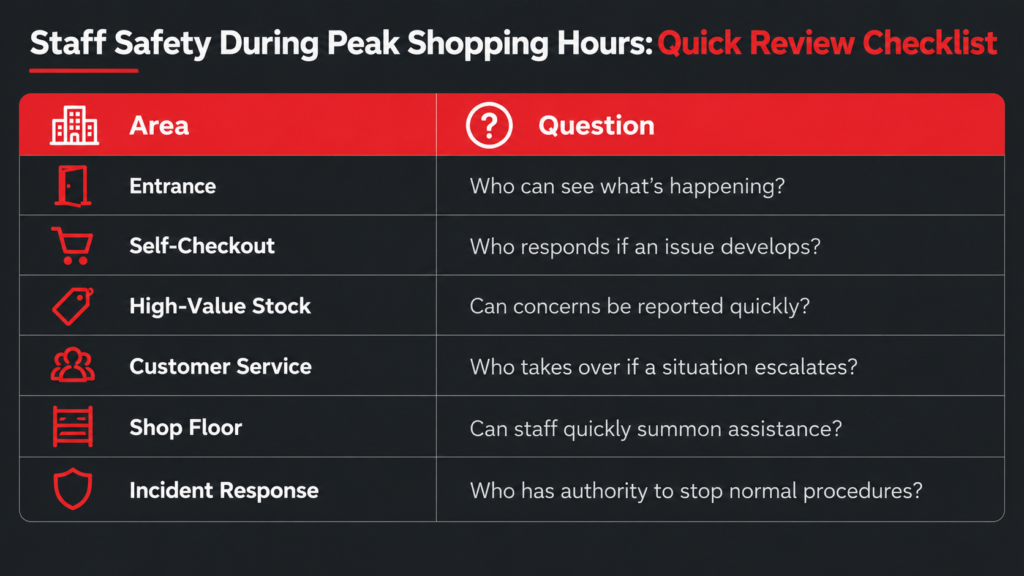
This is where staff safety during peak shopping hours becomes an operational question rather than simply a security policy. Sometimes the answer is better deployment of the existing team. Sometimes it means adjusting the layout or procedure.
And sometimes the risk assessment shows that additional retail guards are appropriate during particular trading periods.
That distinction is important. Additional security doesn’t have to mean permanent additional staffing. A retailer may need support only during a promotion, a seasonal rush, a high-footfall weekend or a period when incidents have become more frequent.
Retail Staff Conflict During Busy Periods: Don't Let the Queue Dictate the Response
Imagine an employee dealing with an angry customer while twelve people are waiting to pay. The pressure is obvious.
Get the situation finished. Keep the queue moving. Don’t let the other customers become frustrated. But trying to resolve a confrontation quickly can sometimes make it worse.
Retail staff conflict during busy periods should be handled through a clear escalation process rather than allowing the queue to dictate how aggressively an employee responds.
Staff should understand:
- when they can continue a normal customer-service conversation;
- when to involve a supervisor;
- when to ask for trained support;
- when they should disengage;
- when police or emergency assistance may be required.
The Retail Trust, working with Alliance Manchester Business School, has published guidance aimed at helping retailers prevent and manage work-related violence and aggression. Its recommendations emphasise practical prevention, safer working environments and support for employees.
This fits an important principle:
A retail employee is there to serve customers. They shouldn’t be expected to improvise as a security professional when a situation becomes threatening.
A trained guard can provide that additional layer during higher-risk periods, allowing store colleagues to maintain their normal roles.
Why Peak Trading Safety Procedures Need to Work Under Pressure
Policies often look sensible when nobody is using them. The real test comes at 5 pm on a Saturday when every member of the team is occupied.
Good peak trading safety procedures should therefore be short, clear and practical. Everyone should know what happens when a concern is raised, who responds and where employees can move if an interaction becomes unsafe.
A useful procedure might cover:
- Before peak trading: Confirm staffing responsibilities, communication methods and escalation routes.
- During peak trading: Keep vulnerable areas covered where reasonably possible and encourage employees to report concerns early.
- During an incident: Prioritise people. Follow the agreed escalation process rather than improvising under pressure.
- Afterwards: Record the incident and review whether the response worked.
The last stage matters. If the same issue keeps occurring every Friday evening, the retailer has learned something. The answer may be changing deployment, improving procedures or adding professional support at that particular time.
When CCTV Isn't Enough During Peak Trading
CCTV remains a valuable part of a retail environment. It provides visibility, supports incident reviews and can help preserve evidence for police. But it does not physically respond to what it sees.
That distinction becomes particularly relevant during busy periods. A camera can show that an argument started near an entrance. It cannot calm the people involved. It can record suspected shoplifting. It cannot support a member of staff who is being intimidated. It can show what happened afterwards, but it cannot intervene while the situation is unfolding.
This doesn’t make CCTV ineffective. It means busy retail store safety risks need a layered approach.
The BRC reports that retailers have invested almost £5.5 billion over five years in crime-prevention measures, including CCTV, security personnel, technology and improved data collection. The organisation also attributes some recent improvement to greater collaboration between retailers, police and government.
Store Layout Can Create Safety Problems When Footfall Surges
Sometimes the problem isn’t staffing. It’s visibility.
A promotional display may block sightlines. Queues can spill into entrances. Self-checkout areas may become crowded. A fitting-room corridor can be difficult to monitor while employees are helping customers elsewhere. These design issues don’t necessarily create a security incident by themselves. They can, however, make it harder for employees to notice one.
During a peak-period review, managers should ask:
- Which areas become congested?
- Where do employees lose visibility?
- Can customers move between zones without passing through an obvious point of observation?
- Can an employee step away from a confrontation safely?
- Can assistance be requested without abandoning another vulnerable area?
This is also where professional retail guards can sometimes add value. Their presence can be positioned around an identified vulnerability rather than simply placing somebody at the front door for the sake of visibility.
A high-footfall store might need support near self-checkouts. Another may have a recurring problem around a particular entrance. A third may need additional personnel during a seasonal promotion rather than throughout the year.
When Should a Retailer Consider Retail Guards?
Not every busy period calls for additional security. There are, however, some useful warning signs that a retailer’s normal staffing arrangement may no longer be enough.
Consider additional support where there are:
- repeated theft or aggression during particular trading periods;
- staff concerns about their ability to manage incidents;
- blind spots that cannot reasonably be covered by the existing team;
- major promotional events expected to increase footfall;
- high-value merchandise combined with stretched staffing;
- repeated incidents requiring management intervention;
- a history of violence or threatening behaviour.
In those situations, retail guards can work alongside the existing store team rather than replacing it.
For example, a professional officer can provide visible presence around a higher-risk area, observe developing behaviour, support incident management and help protect employees when an interaction moves beyond ordinary customer service.
A professional retail security service is built around SIA-licensed officers supporting staff, managing incidents and providing visible deterrence in retail environments. That doesn’t mean every retailer needs permanent coverage.
It means the option exists when the risk assessment shows that an ordinary team is being asked to manage more than it reasonably should. For retailers operating in Glasgow, the local environment can also influence how support is planned. Businesses reviewing their options can speak to a professional security company in Glasgow about arrangements that reflect their trading hours, store layout and previous incident patterns.
What Happens After a Peak-Period Incident?
It is tempting to treat an incident as finished once the customer leaves. A better approach is to learn from it.
A short retail employee incident response review can ask:
- What happened?
- Where did it happen?
- What were employees doing immediately beforehand?
- Was help available?
- Did the escalation procedure work?
- Was the incident reported properly?
- What could be changed before the next busy period?
This is particularly useful when incidents are repeated. If the same doorway appears in several incident reports, or the same trading window produces repeated confrontations, the pattern is more valuable than any individual event.
HSE guidance encourages employers to report and learn from work-related violence and aggression rather than treating incidents as isolated events.
That approach also creates better conversations between retailers and their security providers. A guard should not simply attend an incident, write a report and disappear into the next shift. Useful observations can help managers understand where their arrangements are working and where they need adjustment.
Conclusion
Busy trading should be positive for a retailer. It should mean more customers, more sales and a team working at full pace.
But full pace can also expose weaknesses that aren’t obvious during quieter periods.
Retail staff safety during high-risk trading hours depends on understanding those pressure points: where visibility falls, where conflict is more likely to develop, where employees become stretched and when additional support is justified.
Good procedures give staff clear boundaries. Technology provides useful information. Police remain essential when offences, violence or immediate threats require law-enforcement intervention. And where a store’s risk assessment shows that ordinary staffing isn’t enough, trained retail guards can provide another layer of support.