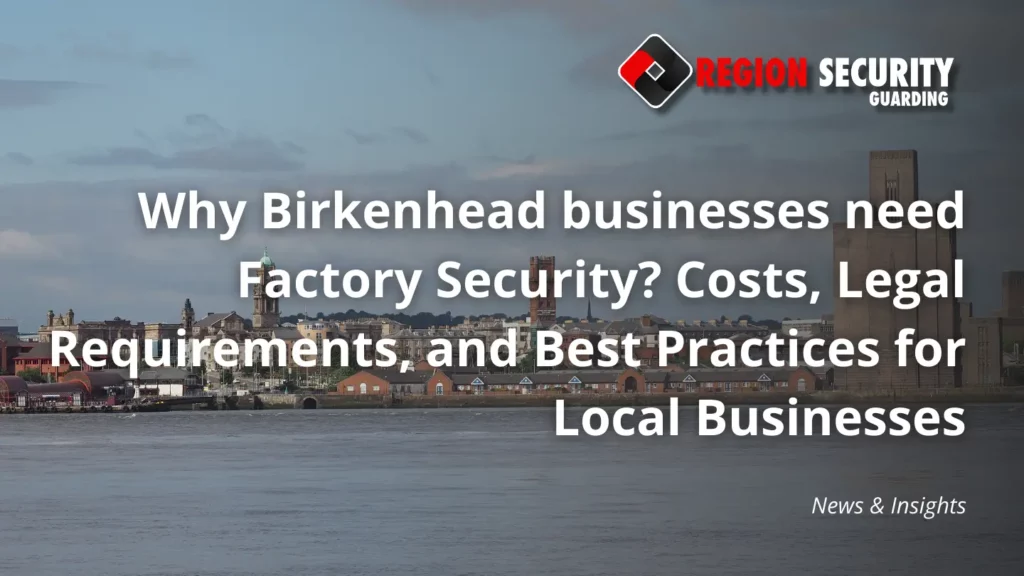
Birkenhead factories do not sit in isolation. Many operate beside housing, docks, rail links, and busy roads. That mix keeps goods moving, but it also widens exposure. A quiet yard at night is rarely as empty as it looks.
Most factories hold assets that are hard to replace. Machinery, tools, and materials that have already been paid for but are not yet in use. When access is loose or monitoring is thin, losses happen quickly and often go unnoticed until production is hit.
This is why Birkenhead businesses need factory security is a real business question, not a box-ticking exercise. Good factory security is less about reacting to crime and more about control. Who comes in? When? Why? And what happens if something goes wrong?
Local risk patterns, legal duties, and insurance expectations all shape that decision. The aim is simple: keep work moving, limit disruption, and avoid hidden costs.
Table of Contents
Understanding Factory Security Basics
Factory security in Birkenhead works best when it reflects how sites operate day to day. This is not about theory or generic models. It is about managing access, movement, and risk in places where production cannot simply pause without consequence.
Below, each aspect is broken down clearly, using the realities of Birkenhead’s industrial environment.
What Factory Security Means in Practice
Factory security focuses on control rather than observation alone. Unlike offices, where people and data are the main concern, factories combine people, machinery, materials, and vehicles in the same space. That mix raises the stakes. In practice, factory security is designed to:
- Control who enters the site and when
- Protect fixed machinery and stored materials
- Manage vehicle and delivery access safely
- Reduce disruption during incidents
- Support production continuity
Warehouse security often centres on stock movement. Office security prioritises working hours and internal access. Factories sit somewhere else entirely. They operate longer hours, involve hazardous equipment, and rely on predictable routines to stay safe.
How Local Crime Patterns Shape Security Planning
Birkenhead’s industrial areas sit close to docks, tunnels, rail lines, and housing. That proximity keeps logistics efficient, but it also increases exposure. Theft and trespass here tend to follow opportunity rather than force.
Common risk drivers include:
- Poorly defined boundaries on shared estates
- Low lighting around yards and service roads
- Sites that appear inactive overnight
- Adjacent vacant units with no oversight
Security planning that ignores these local conditions often looks fine on paper but fails in practice. Effective planning accounts for how the surrounding area behaves, not just what happens inside the fence line.
The Highest-Risk Times for Factory Intrusion
Risk is rarely spread evenly across the day. Certain periods consistently create more exposure, especially on active manufacturing sites.
High-risk times often include:
- Early mornings before full supervision is in place
- Shift changeovers when access points are busy
- Late evenings with reduced staffing
- Weekends with limited oversight
- Planned shutdowns and holiday closures
These windows matter because they combine lower attention with open access. Security that only focuses on nighttime patrols often misses these quieter but risk-heavy periods.
Which Factory Types Face Greater Exposure
Not all factories carry the same level of risk. The nature of what is produced, stored, or handled plays a major role. Factories with higher exposure often include:
- Sites holding metals, fuel, or specialist equipment
- Facilities linked to regular logistics movements
- Operations using shared yards or access roads
- Older sites with complex layouts
- Units within large industrial estates
On estates, one weak site can raise risk for others. This is why industrial estate security in Birkenhead needs coordination, not isolated decisions.
Shift-Based Manufacturing and Coverage Needs
Factories running multiple shifts depend on consistency. Gaps between coverage periods can undo otherwise solid planning. Overnight operations, in particular, bring different pressures.
Shift-based sites need security that can:
- Maintain routine during low-activity hours
- Provide a visible presence without disrupting work
- Support supervisors during quieter shifts
- Spot changes in normal patterns quickly
This is where well-structured factory security services in Birkenhead focus less on reaction and more on predictability. When routines stay steady, unusual activity stands out faster.
Delivery Schedules and Access Risk
Deliveries keep factories moving, but they also create repeated access points. Each delivery introduces people, vehicles, and temporary changes to the normal flow.
Access risks increase when:
- Vehicles queue outside the gates
- Doors remain open longer than planned
- Contractors move unsupervised
- Documentation checks are rushed
Over time, these moments become familiar and less scrutinised. That familiarity is often where problems begin.
Shutdowns, Holidays, and Changing Risk
When production stops, risk does not disappear. It shifts. Idle machinery, empty yards, and reduced supervision change how sites are perceived.
During shutdowns, security priorities often move towards:
- Asset protection rather than access control
- Preventing trespass and vandalism
- Monitoring perimeter integrity
- Maintaining clear incident records
Industrial security costs UK-wide often rise after incidents that occur during these quieter periods. Planning ahead reduces that exposure.
Why Location Experience Matters
Birkenhead does not face these challenges alone. Coastal and logistics-linked towns like Southport show how access risk increases near transport routes. Industrial areas in places such as Burnley highlight how mixed-use estates and vacant units affect neighbouring sites. These lessons apply locally, even when the geography differs.
Legal and Compliance Requirements
Rules matter more than most factory owners expect. In Birkenhead, security decisions are often judged after something goes wrong, not before. That is when compliance stops being paperwork and starts shaping outcomes.
Licensing and Who is Allowed to Guard a Factory
Anyone providing guarding on a factory site must hold the correct licence. This applies during normal production, overnight cover, and short shutdown periods. There is no separate category for “temporary” or “low-risk” work.
Licensing matters because it shows three things:
- The person is legally allowed to do the role
- Basic training standards have been met
- There is clear accountability if an incident occurs
On industrial estates close to public routes, this is often treated as a minimum expectation, not an upgrade.
What Happens if Unlicensed Security is Used
Using an unlicensed cover is not a technical slip. It is a criminal offence. Enforcement does happen, but the bigger risk often appears later.
Common consequences include:
- Fines issued to the business
- Directors are being questioned about oversight
- Claims being delayed or reduced
- Responsibility shifting back to the site owner
What feels like a saving at the time can become a long dispute when records are reviewed.
When Background Checks Become Relevant
Not every factory role requires additional vetting. Checks come into play when security staff can access sensitive areas, restricted materials, or internal facilities used by employees.
This often applies to sites that:
- Handle regulated goods
- Store high-value components
- Restrict access to certain production zones
Many Birkenhead factories operate with mixed access. Applying checks only where needed helps show balance rather than blanket control.
How Insurers Influence Security Decisions
Insurance policies often mention security in broad terms. The detail only becomes clear after a loss. At that point, expectations are tested.
Insurers usually look for:
- Clear coverage arrangements
- Evidence of controlled access
- Records that show how incidents were handled
- Proof that arrangements were reviewed
If gaps appear, claims can stall. This is why legal alignment and factory security compliance tend to surface together.
Data Protection and Camera Use
Cameras and access systems are common across industrial sites. Their use is allowed, but their misuse is not.
Factories must be clear about:
- Why is data collected
- Who can see it
- How long has it been kept
- How does it support safety or investigation
Footage should have a clear purpose. Casual use creates risk. Poor handling can lead to complaints or enforcement action, even when the system itself is lawful.
VAT and Cost Clarity
Security services are usually subject to standard VAT rules. This applies whether the cover is permanent or short-term.
Confusion around VAT often affects:
- Budget comparisons
- Forecasts
- Audit reviews
Getting this wrong does not invalidate a service, but it can complicate reporting later.
Local Planning and Site Conditions
Most rules come from national law, but local factors still apply. In Birkenhead, planning conditions linked to industrial estates or redeveloped land may include expectations around lighting, boundaries, or access routes.
Similar patterns appear elsewhere. Regeneration areas in Lancaster often carry added scrutiny. Mixed-use zones across Cheshire show how public and industrial space can overlap. These details rarely affect daily operations, but they matter during inspections or claims.
Records that Show Compliance
Doing the right thing is only half the job. Being able to show it matters just as much. Factories are often asked to provide records during reviews or investigations.
Common documents include:
- Proof of valid licences
- Vetting records where applicable
- Risk assessments
- Incident and access logs
- Camera usage policies
- Safety coordination notes
When these are missing, even good practice can be hard to defend.
What Martyn’s Law is Likely to Change
Martyn’s Law is expected to affect larger sites and places with higher occupancy. Factories are not the main target, but many will still fall within scope. The likely focus is on:
- Preparedness rather than control
- Clear response planning
- Coordination between safety and security
For Birkenhead businesses, this points towards proportionate planning, not heavy measures. Those who understand the direction early tend to adjust more calmly.
Costs, Contracts, and Deployment
Cost is often the first question raised when factory security is discussed in Birkenhead. It is also the area where assumptions cause the most confusion. Security pricing is not fixed. It shifts with how a site works, when it operates, and what risks it carries at different points in the year. Cost discussions change once teams understand why Birkenhead businesses need factory security. Pricing only works when it reflects real exposure.
What Shapes Factory Security Costs Locally
There is no single figure that applies to every factory. Costs are driven by exposure rather than postcode. In Birkenhead, this usually comes down to how open a site is and how often it is active.
Factors that tend to influence spend include:
- Size and layout of the site
- Number of access points and gates
- Operating hours across the week
- Whether yards are shared or self-contained
- Level of vehicle movement
Factories close to transport routes or mixed estates often need more consistent coverage than isolated units. This is where factory security services in Birkenhead are usually priced around presence and control, not just hours on paper.
How Fast Can Security Be Deployed?
Deployment speed depends on preparation, not urgency. For new sites or sudden risk periods, coverage can often be put in place within days. This is common during refits, shutdowns, or after a break-in nearby.
Faster deployment is possible when:
- Site layouts are clearly documented
- Access rules are defined early
- Operating hours are confirmed
- Expectations are realistic
Delays usually come from uncertainty. When roles, coverage windows, or responsibilities are unclear, mobilisation slows.
Contract Lengths and What They Signal
Most factory security contracts are not short-term by design. Longer agreements provide stability and allow routines to settle. In Birkenhead, contracts often reflect how permanent the risk is rather than how cautious the buyer feels.
Common approaches include:
- Ongoing contracts for live production sites
- Fixed-term cover for redevelopment or expansion
- Temporary agreements during shutdowns or seasonal changes
Short contracts are not always cheaper. They often come with higher rates or less flexibility.
Notice Periods and Exit Planning
Notice periods matter because they protect both sides from sudden gaps. For factories, this is about continuity rather than convenience. Losing coverage overnight creates exposure that insurers notice quickly.
Most arrangements include notice periods that allow time to:
- Adjust coverage safely
- Handover site knowledge
- Maintain incident records
Clear exit terms reduce risk during change, which is often when problems appear.
Inflation and Long-Term Planning
Inflation affects factory security quietly. Wage pressure, compliance costs, and operating expenses all feed into long-term pricing. Avoiding this topic does not stop it from having an impact.
Long-term planning works best when it:
- Allows for gradual cost changes
- Avoids underpriced agreements
- Focuses on service stability
Sites that fixate on short-term savings often face disruption later. This pattern has been seen across industrial areas from Preston to Blackburn, where sudden cost corrections caused coverage gaps.
How Security Supports Insurance Discussions
Security is rarely purchased for insurance alone, but it plays a role in negotiations. Insurers look for evidence that risk is understood and managed, not just insured.
Security arrangements can support this by:
- Showing consistent site control
- Demonstrating incident response capability
- Reducing uncertainty around access and loss
When claims arise, documented coverage often matters more than the headline cost.
Procurement Rules and Contract Structure
The Procurement Act 2023 has changed how some public and semi-public organisations approach security contracts. While not every Birkenhead factory falls under these rules, many work within supply chains that do.
The Act encourages:
- Clearer evaluation criteria
- Better documentation
- Proportionate decision-making
For factories, this means contracts need to be defensible, not just affordable. Decisions must show logic and balance.
Why Cost Should Never Be Viewed Alone
Factory security costs only make sense when viewed alongside risk, continuity, and liability. The cheapest option is rarely the most stable. The most expensive option is not always the most effective.
Good planning asks better questions:
- What risk exists during quiet periods?
- What happens if coverage fails?
- How exposed is the site during change?
When these questions are answered honestly, costs become easier to justify. In Birkenhead, factories sit close to homes, transport, and shared spaces. That makes clarity more important than the figure on the invoice.
Training, Operations, and Daily Duties
Factory security in Birkenhead lives in the gaps between production. It sits alongside machines, people, and vehicles that all move on their own schedule. Training and daily routines only work when they respect that pace. Security staff often work alone during nights or low-activity periods. These situations must be managed in line with HSE guidance on lone working.
Training that Reflects Real Factory Risk
Training for factory environments is grounded in awareness. Guards need to understand how industrial sites behave when they are busy and how they change when activity drops. This is not about memorising procedures. It is about reading space and movement.
Factory sites face specific pressures. Vehicles, contractors, and machinery all move through shared space. Training needs to prepare guards to spot risk early and step in without blocking work.
Industrial areas around Chester show the same pattern. When training focuses on judgement rather than instruction, security blends into operations instead of clashing with them.
The First Moments of a Security Shift
The start of a shift is often quiet. That does not make it unimportant. This is when guards learn what the day or night will look like.
Early awareness usually comes from small details:
- Which areas are active
- Which doors should stay closed
- What deliveries are expected
Missing these details creates confusion later. A steady start saves time and reduces mistakes as the shift unfolds.
Handovers on Round-the-Clock Sites
Factories that run without stopping rely on information moving cleanly between teams. Problems often appear when one shift assumes the next knows what they do.
Good handovers are simple. They focus on what changed, not everything that happened. A brief conversation supported by clear notes works better than long reports that no one reads.
Across logistics-heavy areas near Warrington, poor handovers have been linked to repeated access issues. Consistent transitions reduce that risk without adding work.
Knowing Where Attention Matters Most
Factories are not evenly risky spaces. The focus changes during the day. Some areas matter more at certain times:
- Machinery zones during maintenance
- External yards when activity slows
- Loading bays when vehicles queue
Security works best when attention moves with the site. Fixed routines often miss these shifts.
Reporting Without Paperwork Overload
Daily reporting supports memory. It creates a simple record of what changed and what did not. This becomes useful later, especially when questions arise.
Good reports are short. They note issues, not routine. They help managers see patterns without reading pages of text. Over time, they support reviews, claims, and planning without slowing work.
Dealing With Incidents Calmly
Most incidents on factory sites are minor. Small issues happen on-site. The real risk often comes from how people react to them.
Effective responses keep things moving:
- The issue is contained
- Supervisors are informed
- Work continues where safe
This approach protects production while still managing exposure. It also builds trust between security and site teams.
Secure-Down During Quiet Periods
Shutdowns and holidays change how factories look from the outside. Quiet sites draw attention. Security routines need to shift.
During these periods, focus often moves towards:
- Limiting access to essentials only
- Checking boundaries more often
- Keeping clear records of visits
Planning this before production stops avoids rushed decisions later.
Why Routine Matters More Than Reaction
Factories depend on rhythm. When security follows that rhythm, changes stand out faster. Unusual movement becomes easier to spot. Small issues are addressed before they grow.
Reactive approaches often cause disruption. Routine creates stability.
Learning From Nearby Regions
Birkenhead shares many traits with other industrial areas. Sites near Chester highlight how shared access complicates control. Operations around Warrington show how delivery flow shifts risk through the day. These lessons travel because the pressures are similar.
Performance, Risks, and Challenges
Factory security in Birkenhead is often judged by what does not happen. No loss, shutdown, and no claim. That makes performance harder to measure, but not impossible. The challenge is knowing which signals matter and which ones create noise.
What Performance Really Looks Like on Factory Sites
Many factories track activity but miss impact. Counting patrols or logged hours says little about whether risk is being reduced. What matters is whether security supports steady production and clear control.
Factory managers often focus on indicators such as:
- Frequency of access issues or near misses
- Repeated problems in the same area
- Delays caused by security-related disruption
- Time taken to spot and contain incidents
These measures show whether security is helping operations or getting in the way. On well-run sites, problems become smaller over time, not louder. Performance is not only reviewed internally. It is also measured against what a security company in Birkenhead has agreed to deliver.
Weather and Perimeter Exposure
Weather affects factory sites more than office buildings. Birkenhead’s coastal conditions bring wind, rain, and sudden changes that test boundaries.
Heavy rain can obscure sight lines. Wind can damage fencing or move loose materials. Cold weather affects lighting and equipment reliability. These changes increase exposure at the edges of a site, especially overnight.
Perimeter issues tend to rise when:
- Lighting fails during storms
- Gates are left unsecured after high winds
- Temporary barriers are weakened
Factories in Crewe have seen similar issues where open land meets rail routes. In parts of Cumbria, remote locations amplify weather-related risk because response times stretch. Planning needs to account for this reality, not treat weather as an exception.
Fatigue and Overnight Coverage
Overnight factory security comes with different risks. Quiet hours and repetition can lead to fatigue. This matters because tiredness affects judgement before it affects attention. Small decisions get delayed. Unusual movement blends into the background. That is when issues slip through.
Good overnight coverage relies on structure, not intensity. Clear routines, predictable checks, and defined escalation points help maintain alertness without overloading staff. This is one reason why 24/7 factory security coverage needs to be planned around human limits, not just clock hours.
Health and Safety Intersections
Factory security does not operate in isolation. It overlaps with health and safety every day. Vehicles move through shared spaces. Machinery operates close to the walkways. Contractors arrive with limited site knowledge.
Common intersection points include:
- Vehicle and pedestrian routes
- Maintenance work near active production
- Lone working during quiet shifts
- Emergency access during incidents
When these overlaps are not considered, security responses can create new risks. Blocking a route or delaying a vehicle creates risk. Good planning aligns security actions with site safety rules.
Measuring Effectiveness Without Disruption
One of the biggest challenges is assessing performance without slowing work. Factories cannot afford audits that interrupt production or constant changes to routine.
Effective measurement often relies on trends rather than snapshots.
- Fewer repeated issues.
- Shorter response times.
- Clearer records.
These signs show progress without requiring constant intervention. Sites that struggle often chase metrics instead of outcomes. That approach adds cost and confusion without reducing risk.
When Poor Planning Increases Liability
Poorly planned factory security does more than fail to protect assets. It increases liability. When roles are unclear or coverage is thin, responsibility blurs. After an incident, that lack of clarity becomes a problem.
Liability exposure often rises when:
- Coverage does not match operating hours
- Access rules are inconsistent
- Incidents are poorly recorded
- Security decisions lack rationale
In these cases, industrial security costs UK-wide tend to climb after claims because insurers reassess risk. What seemed affordable before an incident often looks inadequate after.
The Cost of Weak Performance Signals
Weak performance is not always obvious. It shows up as small disruptions. Minor delays. Unexplained losses. Over time, these add up.
Factories that fail to track meaningful indicators often react late. By the time issues surface, damage is already done. This pattern appears across many regions, from logistics hubs near Crewe to remote manufacturing sites in Cumbria.
Why Challenge Does Not Mean Failure
Challenges are not a sign that security is failing. They are a sign that conditions are changing, such as weather shifts, production changes, and risk moves.
Effective factory security adapts quietly. It adjusts routines, refines focus, and learns from small signals before they become big problems.
Technology and Future Trends
Technology has changed factory security in Birkenhead, but not by removing people from the picture. It has changed how risk is spotted and how decisions are made when sites are busy, quiet, or in between. The biggest shift is not hardware. It is awareness.
Factories here often sit close to roads, housing, and shared industrial land. Movement never fully stops. Technology helps separate normal activity from what does not belong. A Home Office factsheet on Martyn’s Law requirements outlines the implementation period and preparatory requirements.
How Tools Now Support Factory Awareness
Older approaches relied on fixed routines. Doing the same checks in the same order once worked. Sites are more complex now.
Today, tools support wider visibility. Large yards, long boundaries, and mixed access points are easier to oversee without adding disruption. The aim is not constant watching. It is an early notice when patterns change.
This shift matters most during quiet periods, when small changes are easy to miss.
AI as Support, Not Control
AI plays a narrow role on factory sites. It scans movement, timing, and behaviour. It highlights what looks unusual. It does not decide what to do next.
This matters because judgement still sits with people. AI reduces noise. It cuts down false alerts. It helps focus attention when human concentration drops, such as late at night or during long shutdowns. When used properly, it saves time rather than adding work.
Remote Monitoring and On-Site Presence
Remote monitoring works best as a backstop. It supports on-site coverage without replacing it. This is especially useful during weekends, holidays, or low-activity shifts.
Its value comes from confirmation. Seeing what is happening before acting reduces overreaction. It also helps lone coverage feel less isolated during quiet hours. Used on its own, it has limits. Used alongside physical presence, it adds balance.
Drones and Large Industrial Estates
Drones are not a standard feature. They are situational. In Birkenhead, interest tends to appear on large estates with open land, long fences, or hard-to-see edges.
They are most useful after storms, during temporary closures, or when ground access is restricted. They offer a quick view, not a constant patrol. For many sites, simpler tools do the job better.
Predictive Planning Tools
Predictive tools look backwards to plan forward. They review incident history, access records, and activity levels. From that, they highlight when risk may rise.
This helps with:
- Planned shutdowns
- Seasonal changes
- Shifts in delivery patterns
Planning ahead reduces pressure. It allows changes to be made calmly rather than under stress.
Sustainability and Security
Environmental concerns now touch security planning. This is less about image and more about efficiency. Changes often focus on reducing waste. Lights switch on only when needed. Cameras activate with movement. Vehicle patrols are used where they add value, not out of habit. These steps lower running costs and cut unnecessary activity without weakening control.
Conclusion
Factories in Birkenhead work in the open. Roads run past gates, homes sit close to yards, and vehicles arrive early and leave late. This makes work faster, but it also means risk is never far away.
This guide exists to help business owners and site managers think clearly before problems appear. It looks at how factory security fits real working conditions, not ideal ones. Legal duties, insurance pressure, daily routines, and future planning are linked. When one is ignored, the others usually follow.
Understanding why Birkenhead businesses need factory security is not about fear. It’s about control. Knowing who can enter and how decisions hold up when things slow down or go wrong.
Some risks show up during busy hours. Others appear when sites feel quiet. New shifts, temporary closures, and layout changes all add risk. These moments are where weak planning is exposed.
The goal is simple. Help Birkenhead factory operators make choices they can explain, defend, and rely on when it matters most.
Contact us for more information.
Frequently Asked Questions
1. How do I spot weak points on a factory site?
Risk often rises when sites feel busy but control is loose, with open gates, shared yards, and unchecked deliveries.
2. Does a small factory still need security?
Size does not remove risk. Smaller sites often have fewer staff on duty and less oversight. That can make problems harder to spot when they start.
3. Are daytime hours safer than nights?
Not always. Many incidents happen during handovers or early mornings. Activity creates cover. Quiet sites are not the only targets.
4. Can security work without slowing production?
Yes, if it fits how the site runs. Poor planning causes delays. Good planning stays in the background and supports work instead of interrupting it.
5. What usually goes wrong when security is poorly planned?
When access rules drift, records thin out, and responsibility blurs, decisions become harder to defend.
5. Do temporary closures really increase risk?
They can. Idle sites attract attention. Fewer people notice change. Access often becomes relaxed without meaning to.
6. Who should review security on a factory site?
Owners, operations, and facilities teams should all be involved. When one group decides alone, gaps are easy to miss.