Merseyside’s business landscape has always had a certain energy to it, part gritty, part ambitious, and very much shaped by the ebb and flow of a port city that never really sleeps.
Yet that same vibrancy brings pressure: Liverpool’s rising retail theft figures, persistent warehouse break-ins around the Port of Liverpool, and the familiar thread of anti-social behaviour in nightlife areas all push local companies to rethink their physical security protection.
It’s one reason why Merseyside businesses need manned guarding more today than ever before, compared to a few years ago. CCTV helps, of course, but it can’t step in, question a loiterer, or prevent a situation from escalating. Manned guarding services in Merseyside fill that gap.
This guide unpacks the costs, legal duties, deployment models, and smarter approaches shaping modern Merseyside commercial security.
Table of Contents
Understanding Manned Guarding Basics in Merseyside
What Is Manned Guarding and How Does It Differ from Static or Remote Security in Merseyside
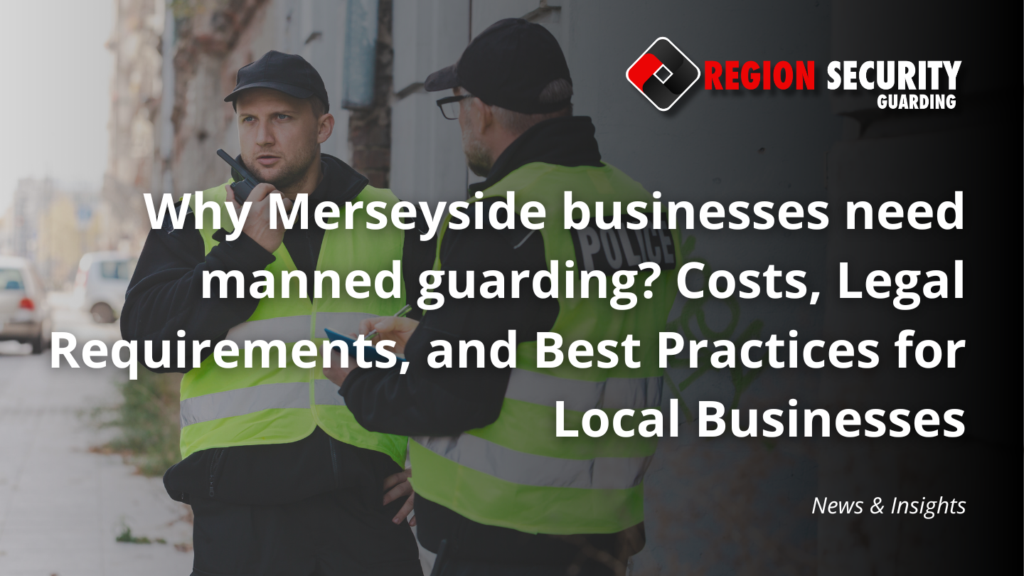
If you strip it back to the bones, manned guarding is the simplest idea in the world: a trained human being, physically present, able to judge a situation in real time and step in before something spirals.
That “presence” gets underestimated until you see the difference it makes. Unlike static CCTV setups or remote monitoring stations tucked away somewhere in the Midlands, on-site officers can smell a problem brewing before a camera even locks focus.
They can ask the person lingering by the staff entrance what they’re doing. They can intervene. They can reassure anxious staff with a simple nod that says, ‘You’re safe, I’m here’.
That’s the core distinction. Technology witnesses; a guard responds. And for many on-site security guards for businesses across Merseyside, that responsiveness is worth its weight in gold.
Impact of Merseyside Crime Rates on Guarding Demand
Crime in Merseyside isn’t flat or predictable. Latest data shows around 82 crimes per 1,000 people in the area, higher than many parts of England and Wales, and violence and sexual offences make up a large slice of that total.
Liverpool’s crime rate sits above the Merseyside average, often outpacing neighbouring boroughs like Wirral or Sefton. Birkenhead, for example, has recorded roughly 93 incidents per 1,000 residents, well above the regional norm.
All of this matters to business owners. Uniformed guards don’t just watch cameras. They deter and interrupt. They calm things down before a crowd spills out of control.
In high-crime zones, busy streets, transport hubs, and late-night venues, this proactive presence prevents losses and keeps staff and customers safer. That’s exactly why Merseyside businesses need manned guarding.
Peak Crime Hours and High-Risk Areas for Local Businesses
Merseyside has its own rhythm of risk. Anyone who’s walked through Concert Square or Mathew Street on a Friday at 1 am knows the energy there can flip in an instant, spirited nightlife one minute, chaos the next. Those hotspots see spikes in assaults, property damage, and general disorder.
At the opposite end of the day, warehouses around Speke and the riverfront report early-morning break-ins, criminals slipping in before the sun properly climbs. And nearer to the docks, thefts linked to cargo movements remain a persistent headache. These aren’t freak occurrences. They’re patterns. And patterns are exactly what manned guarding services in Merseyside are designed to disrupt.
Merseyside-Specific Vulnerabilities for Warehouses and Industrial Sites
Industrial crime in Merseyside has its own flavour. Sites around the Port of Liverpool face threats tied to the supply chain: pilfering, trespassers cutting through fencing, and attempts to target high-value goods during off-peak hours. Over in Birkenhead and Bootle, construction projects contend with equipment theft, stripped copper, and the occasional brazen trespasser who simply hops the hoarding.
Then there are scrap-metal yards and logistics parks scattered across St Helens and Knowsley, prime targets for thieves motivated by quick resale markets. If any sector illustrates the importance of physical security protection, it’s these.
How Manned Guarding Addresses Anti-Social Behaviour in Merseyside Retail Parks
Retail parks like Edge Lane, Speke Retail Park, or New Mersey Retail Park see a different breed of problem: groups hanging around, vehicles cruising aimlessly, the occasional flare-up that unsettles shoppers. Cameras catch the footage, but they don’t change the behaviour. Guards do. Their visibility alone shifts the social atmosphere.
Rising Retail Theft and Increased Daytime Patrol Demand
Liverpool and St Helens have both seen noticeable rises in shoplifting over the past 24 months, and it’s not just late-night theft. Daytime offences, particularly grab-and-run incidents, have soared. SIA-licensed patrol officers can react quickly, coordinate with store staff, gather evidence, and de-escalate confrontations before they become messy.
Differences Between Day and Night Guarding Risks in Merseyside
Day shifts have higher footfall: customers wandering in and out, delivery drivers rushing, contractors appearing at odd intervals. The risk comes from distraction and volume.
Night guards face the opposite: silence, long hours, and the occasional unpredictable visitor. Trespassers. Vandals. Individuals testing boundaries. Each requires a different temperament and skill set.
Seasonal Events Impacting Guarding Needs
Merseyside’s calendar has its own security pulse.
- Match days for Liverpool FC or Everton stretch resources.
- The River of Light Festival draws huge crowds and unpredictable movement.
- Christmas markets and waterfront events bring a tide of visitors, along with pickpockets and opportunists.
Each event reshuffles risk, and businesses adapt accordingly.
Security Needs Linked to Merseyrail and Transport Hubs
Transport hubs, Liverpool Lime Street, Moorfields, and James Street, attract anti-social behaviour, especially during commuter peaks and late-night services. Businesses near these zones often increase guarding because the footfall itself becomes a risk multiplier.
Economic and Business Growth Factors Driving Demand
Merseyside’s growth in logistics, creative industries, tech, and hospitality has brought prosperity, but it has also widened the surface area for crime. More premises, more staff, more equipment, more hours of operation.
All the reasons why Merseyside businesses need manned guarding during periods of expansion. As companies invest, they also need meaningful business security solutions Merseyside that protect those investments, not just patch the gaps.
Legal and Compliance Requirements in Merseyside
SIA Licensing Requirements for Security Guards in Merseyside
Every legitimate security guard in the UK operates under the oversight of the Security Industry Authority (SIA). Anyone who tells you otherwise, well, that’s your cue to walk away.
In Merseyside, guards typically hold one of several front-line licences, covering roles such as guarding, door supervision, or CCTV monitoring. Each licence demands structured training and renewal every three years.
The training isn’t just box-ticking. It covers conflict management, situational awareness, and, after several high-profile incidents, counter-terror awareness. In an area with heavy footfall and major events, those skills matter.
Penalties for Using Unlicensed Guards
You’d think companies would never risk hiring unlicensed guards, yet cases pop up now and then. The consequences aren’t gentle. The SIA can pursue criminal prosecution, dish out fines running into thousands, and even recommend shutting down a contract immediately. Clients aren’t immune either; knowingly employing unlicensed staff can drag them into legal trouble. The message is simple: don’t cut corners.
DBS Checks for Security Personnel
DBS checks are another foundation stone of security employment. Standard checks confirm whether a guard has any relevant convictions. Enhanced DBS checks, used in environments involving vulnerable individuals or sensitive data, dig deeper.
Most commercial sites stick to standard checks, but hospitals, schools, and certain public venues within Merseyside require enhanced vetting. It’s the kind of detail a responsible provider addresses before the contract even begins.
Insurance Requirements for Hiring Security Guards
If licensing protects people, insurance protects businesses. A reputable security company should carry:
- Public liability insurance (covering incidents involving the public),
- Employer liability insurance (required by law),
- Professional indemnity insurance (covering errors or negligence).
If a provider can’t show proof of coverage, that’s a red flag, even more so if they dodge the question.
Data Protection and CCTV Integration Compliance
The moment CCTV enters the conversation, GDPR becomes unavoidable. Manned guarding often runs alongside cameras and access control systems, which means the handling of personal data, video footage, visitor logs, and incident reports must comply with UK GDPR. Key considerations include:
- How long footage is stored,
- Who gets access,
- Whether the signage on-site properly informs customers and staff.
Sloppy data handling is not just unethical; it can lead to ICO investigations.
VAT Rules for Manned Guarding Services in the UK
Security services fall under the standard VAT rate. That said, misconceptions float around, especially among smaller businesses, about potential exemptions. No, manned guarding is not zero-rated or reduced-rated, regardless of the sector. Transparent providers explain VAT early on because no one enjoys a surprise on their invoice.
Merseyside Council Requirements for Construction-Site Security
Construction sites present their own legal quirks. Councils across Merseyside often require proper hoarding, documented patrol arrangements, out-of-hours guarding for high-risk areas, and secure storage for plant equipment.
Regeneration zones in Liverpool, Birkenhead, Bootle, and parts of Sefton sometimes impose additional conditions due to community safety concerns. A compliant guarding provider knows local rules well enough to stop a developer accidentally breaching them.
Documentation That Proves a Security Firm’s Compliance
Before a business signs anything, it should see evidence of compliance, including:
- SIA Approved Contractor Scheme (ACS) certification,
- BS 7858 vetting records for guards,
- Up-to-date insurance certificates,
- Training documentation, if relevant to the site.
A legitimate firm provides these without hesitation.
Implications of Mandatory Company Licensing for Clients
Company licensing, now an established expectation, helps clients assess risk. When a firm is licensed and audited, liability is reduced on both sides. Clients gain confidence that guards are vetted, trained, and managed properly. It creates transparency, accountability, and frankly, peace of mind.
SIA Licensing Changes Affecting Manned Guard Hiring
The SIA has been tightening standards over the years. Terror awareness (ACT training), physical intervention updates, and emergency first-aid requirements now form part of licensing. These evolutions mean guards in Merseyside are more capable than ever, though it also raises operational costs for providers, something clients should understand.
Labour Law Impact on Guard Overtime
Guards work long hours; that’s no secret. But labour law limits how employers schedule them. The Working Time Regulations govern maximum weekly hours, mandatory rest breaks, and holiday pay. Non-compliant scheduling can cause trouble fast, financially and legally.
Post-Brexit Labour Rules and EU National Employment
Brexit shifted the hiring landscape. EU nationals once worked freely across Merseyside’s security sector; now they must meet right-to-work requirements. This change contributed to staffing shortages and wage increases, factors that inevitably ripple into contract pricing.
Role of Manned Guarding in Merseyside Event Licensing
Event organisers in Liverpool face robust licensing conditions. Crowd control, attendee ratios, perimeter protection, and emergency planning all sit under the council’s watchful eye. And with Martyn’s Law approaching full implementation, venues must demonstrate stronger counter-terror measures. Manned guarding in Merseyside forms a core part of that compliance framework.
Collaboration Between Merseyside Police and Private Security Firms
Police and private guards often cross paths, especially in nightlife districts like the Ropewalks or Pier Head during events. Joint patrols, shared intel, and coordinated responses help reduce strain on both sides. The relationship isn’t always glamorous, but it works.
Data from Merseyside Police Informing Deployment Strategies
Patterns matter. Police heat maps showing burglary spikes, repeat offender routes, or ASB clusters guide businesses in deciding where and when to allocate guards. Security providers worth their salt use these insights to shape deployment, not guesswork.
Collaboration Between BCRP and Private Security
CitySafe Liverpool and other Business Crime Reduction Partnerships operate as intelligence bridges. They share alerts, suspect images, and behavioural trends with private security teams. For retailers, this info is often crucial; it helps catch offenders who hop between stores or boroughs.
Costs, Contracts, and Deployment in Merseyside
Typical Cost Differences: City Centre vs Suburbs
Ask ten Merseyside businesses how much they pay for a manned guard, and you’ll hear ten different numbers, though a pattern emerges quickly. Liverpool city centre carries a premium, partly because the risks are higher, partly because experienced guards gravitate toward busier posts, and partly because working in an area that never truly winds down demands a certain temperament.
Move outward to Knowsley, Wirral, or St Helens, and the rate often softens. Not dramatically, but enough that you can see the geography reflected in the invoice. Industrial estates in Wirral might pay less per hour than a retail unit on Church Street, yet more than a quiet office park near Huyton.
Rates fluctuate because the cost of hiring security guards for Merseyside companies isn’t a flat figure. It’s shaped by a web of influences:
- Site risk levels,
- Shift patterns (days vs nights),
- Whether guards need specialist skills,
- Travel requirements,
- Staffing shortages in certain boroughs.
Security is local. The pricing mirrors that.
Deployment Timeline: How Long It Takes to Hire and Mobilise Guards
Some businesses assume that security firms keep spare guards sitting on a bench somewhere, waiting to be deployed at a moment’s notice. Real life is messier. A proper mobilisation has several moving pieces:
- BS 7858 vetting (identity checks, employment history, criminal background)
- A site risk assessment to understand vulnerabilities
- Inductions covering layout, hazards, and escalation steps
- Equipment setup, ranging from radios to site-specific access credentials
If everything lines up smoothly, a provider might mobilise within 48–72 hours. Larger or more complex sites may need a week or two. Rushing the process generally creates more problems than it solves.
Common Contract Lengths in Merseyside
Contracts vary, though a few formats appear again and again:
- Rolling 30-day agreements are popular with smaller businesses testing the waters
- 12-month fixed-term contracts for stable, ongoing guarding needs
- Event-based contracts tied to festivals, sports matches, or construction milestones
The right choice depends on risk appetite and how predictable the site’s operations are. Retailers facing fluctuating crime levels might prefer agility; a logistics hub tends to value consistency.
Standard Notice Periods for Ending Security Contracts
In most cases, 30 days is the standard notice window. It gives the provider a chance to reshuffle staff and ensures the client isn’t suddenly left unprotected. Immediate termination clauses exist, but they’re usually invoked only for serious breaches, unlicensed guards, unsafe conduct, or something that puts a business at real risk.
Impact of Wage Increases on 2025 Guarding Costs
If you’ve watched the security industry over the last decade, you’ll know wage inflation is the headliner in almost every cost conversation. The Real Living Wage rises yearly, and many guards, particularly experienced ones, expect pay above that baseline.
Add in national labour shortages, tightened right-to-work rules, and a shrinking pool of night-shift-friendly recruits, and the outcome is a predictable spike in operational costs. Providers don’t enjoy passing these increases along, but they don’t have much choice either.
Inflation and Long-Term Contract Pricing
Long-term security agreements used to be straightforward; now they’re tinted with economic uncertainty. Because inflation has been so unpredictable, many contracts include:
- price adjustment mechanisms, and/or
- index-linked clauses, typically tied to CPI or wage indices.
Counterintuitive as it sounds, these clauses protect both sides. They stop the provider from absorbing unsustainable losses and prevent the client from suddenly seeing a massive mid-contract price jump.
How Manned Guarding Reduces Business Insurance Premiums
Insurers love documented risk reduction. And manned guarding, when done properly, is exactly that. Businesses often see lower premiums because underwriters recognise the impact of:
- real-time incident intervention,
- controlled access points,
- improved perimeter protection,
- documented patrols,
- proper escalation protocols.
But here’s the catch: insurers only give credit when the evidence is airtight. They want compliance documents, guard logs, reports, SIA licence numbers, the full bundle. In other words, Professional security guarding UK isn’t just better service; it’s an insurance-friendly operational model.
Impact of the Procurement Act 2023 on Public-Sector Contracts
The Procurement Act 2023 quietly reshaped how public-sector bodies in Merseyside award contracts. Transparency rules are stricter, and social value scoring weighs more heavily than before. For security tenders, this means:
- Providers must demonstrate ethical employment practices,
- Bids need clearer evidence of quality and impact,
- Pricing must be justified in detail,
- Tender evaluations must be more transparent.
The knock-on effect? Higher standards for everyone. Public bodies can’t simply choose the cheapest bid anymore, and security companies must prove they bring tangible value, not just bodies in uniforms.
Training, Operations, and Daily Guard Duties
Retail Training Standards
Retail manned guarding in Merseyside isn’t merely “watching the door.” It’s a tricky blend of psychology, patience, and the occasional steel spine. Guards are trained in conflict resolution because heated moments in a Liverpool high street store rarely announce themselves politely.
They learn how to defuse situations without escalating them, how to read a customer’s body language, and sometimes how to simply listen when someone begins to fray at the edges.
Customer service matters too. A guard who can offer a calm, reassuring presence becomes an extension of the brand, not an intimidating barrier. Then there’s theft-prevention: identifying suspicious behaviour, monitoring blind spots, and knowing when a discreet approach works better than a direct confrontation. It’s an art form, really.
Start-of-Shift Procedures for Manned Guards in Merseyside
The first moments of a shift set the tone. A guard doesn’t just clock in and walk around aimlessly; there’s a ritual to the start of duty. Radios get checked (are they charged, or did someone forget again?), CCTV screens flicker through the night’s recordings, alarm panels are tested, and PPE is confirmed.
Next comes the first perimeter sweep. It’s often quiet at this hour, almost eerie, which makes small signs of tampering stand out more sharply. After that, the guard reviews handover logs, snippets of the previous shift’s highs and lows. And finally, a refresher of emergency protocols: not because they’ve forgotten, but because muscle memory saves lives.
Shift Handover Processes
Good security rests on good communication. The handover between shifts can feel like a mini briefing room at times. Guards run through any unusual events, hand over keys, note any maintenance issues, and confirm which areas of the site require additional attention. A missed detail here can echo through the entire day.
Patrol Frequency and Patterns
Patrols aren’t random laps around a building. They follow a rhythm based on risk, time of day, and site layout. High-risk areas get more passes. Some spots require hourly checks; others demand more spontaneity to avoid predictability.
Typical patrol considerations include:
- Movement through internal and external zones,
- Checking isolated corridors,
- Verifying that high-value storage areas remain untouched.
A good guard knows when to follow the script and when to deviate.
Industrial Perimeter Checks
Warehouses and industrial parks across Merseyside have their own worries. Fences get tested, sometimes literally. Gates need to be checked for signs of forced entry. Utilities, electrical cabinets, water meters, and comms boxes must be examined for any hint of tampering. A frayed padlock or a shifted panel can signal the start of something bigger.
Required Logbook and Reporting Tasks
Security logs aren’t for decoration. Every shift generates a small mountain of notes: hourly patrol entries, visitor arrivals, alarm incidents, suspicious activity, maintenance problems, and anything else that might matter later. If something ever goes wrong, the logbook becomes the factual backbone of the investigation.
Equipment Verification at Shift Start
A surprising number of issues in security occur because the equipment wasn’t tested properly. So guards verify:
- Radios are clear and functional,
- CCTV monitors operate without glitching,
- Alarm panels register inputs,
- PPE is intact.
A faulty radio at the wrong moment? Not worth thinking about.
Alarm Response Protocols
When an alarm triggers, you don’t stroll over casually. Guards move quickly but carefully, verifying the source while staying alert for threats. If the situation warrants it, escalation to Merseyside Police happens swiftly. Every step gets documented: when the alarm rang, how the response unfolded, and what was found.
CCTV System Inspection Duties
CCTV inspection goes beyond glancing at a screen. Guards check camera angles, ensure no blind spots have emerged, confirm lighting is adequate, and report any equipment faults immediately. Cameras are only as useful as their upkeep.
Internal Access-Point Verification
Fire exits, restricted-access rooms, back-of-house corridors, and loading docks all get verified. An obstructed exit doesn’t just breach compliance; it endangers lives. Access control is part safety, part crime deterrent, part operational discipline.
Fire Safety and Lighting Checks
Emergency lighting must function flawlessly, especially in large sites with complicated layouts. Fire panels are checked, exits assessed, and any flickering lights or dead zones logged. Fire safety rarely makes headlines, but it’s the backbone of compliant operations.
Supervisor Reporting Frequency
During quieter shifts, especially overnight, guards maintain scheduled check-ins with supervisors. These check-ins confirm welfare, status, and site stability. If anything escalates, escalation channels are activated instantly.
24/7 Shift Pattern Structures
Round-the-clock guarding typically rotates through a 4-on/4-off pattern or 12-hour shifts. Fatigue management becomes crucial; tired guards make mistakes. Reputable providers monitor working hours meticulously to avoid burnout.
Emergency Response Times in Liverpool, Wirral, and Southport
Response times vary by site and staffing levels. Many providers aim for rapid attendance, particularly in Liverpool city centre, where incidents escalate quickly. In Wirral and Southport, coverage is more spread out, but coordination with emergency services helps bridge gaps. A guard’s presence often reduces the need for public services to intervene.
End-of-Shift Secure-Down Procedures
The shift ends much as it begins, with structure. Guards complete one final patrol, ensure every door is secure, reset alarms, update logs, and pass over keys and notes to the incoming officer. When done properly, the handover is seamless; when rushed, problems pile up fast.
Performance, Risks, and Staffing Challenges
KPIs for Manned Security Performance
Measuring security performance is never as tidy as a spreadsheet suggests, but businesses still need hard indicators. KPIs act as the compass, not the destination. Where things become interesting is how those indicators are interpreted.
The usual suspects include:
- Incident reduction: The gold standard, though oddly, good guarding can make this look deceptively quiet. Sometimes a “boring” month is the sign of exceptional work.
- Response times: How fast a guard reacts when something shifts in the environment, such as an alarm, a suspicious figure, or an access breach.
- Patrol completion rates: Consistency matters; missed patrols create blind spots that criminals love.
- Client satisfaction: Arguably the most subjective metric, but if staff feel safer, if customers linger longer, if managers stop hearing complaints, those are KPI wins too.
The real experts know performance isn’t about chasing perfect numbers; it’s about reducing chaos in unpredictable places.
Impact of Merseyside Weather on Guarding
Merseyside weather has a personality of its own. Ask any guard who’s stood near the waterfront at 3 am while a gust off the Mersey tries to unpeel their jacket from their body. Heavy rain, swirling wind, and low-visibility mornings complicate patrols. They also shape the guard’s decision-making: stay longer under shelter to assess risk from a distance, switch patrol routes because the usual path has become slippery, or double-check perimeter structures battered by the night’s storm.
Weather creates risks that don’t announce themselves politely. Guards document unsafe conditions, fallen debris, pooling water, and exposed wiring, so the site can respond before accidents occur. A storm doesn’t wait for a maintenance team; the guard becomes the first line of hazard reporting.
Health Impacts of Long Shifts
Security work can stretch the human body in unkind ways. Long shifts invite fatigue, and fatigue invites mistakes. Reaction times are slow. Awareness blurs at the edges. A guard who’s been awake for too many hours might miss the small clues, the rustle behind a pallet stack, the shadow near the fire exit, that normally trigger instinctive responses.
This isn’t a matter of simple tiredness; it’s a safety issue. Good providers rotate shifts properly and track hours ruthlessly. When guards become overstretched, performance drops sharply, and risk skyrockets for everyone involved.
Mental Health Support for Night Guards
Night work is its own ecosystem. Isolation creeps in quietly; hours fold into one another; the absence of daylight alters mood more than most people admit. Guards often say the toughest moments aren’t the incidents, they’re the long silences between them.
Employers have a responsibility here. Support might include structured breaks, mental-health check-ins, access to counselling, or training in stress management techniques. Even small adjustments, like ensuring supervisors check in with night guards more frequently, can make a noticeable difference. It’s humanity, not policy, that often holds the line.
Environmental Regulations for Outdoor Patrolling
Outdoor patrols aren’t exempt from environmental rules. Guarding near residential areas means navigating noise restrictions. Industrial zones add another layer: dust, emissions, and lighting control. Construction sites? They mix all of the above with an ever-changing physical layout that can frustrate even the most seasoned guard.
Sustainability sneaks into the conversation, too. Businesses increasingly expect guarding providers to think about eco-conscious practices, lower-emission vehicles, efficient route planning, and reduced waste. Not because it’s trendy, but because environmental compliance carries legal and reputational weight.
Retention Strategies in a Competitive Labour Market
Security staffing in Merseyside feels like a tug-of-war these days. More businesses want trained guards, yet fewer people are entering the field. That gap creates tough competition, and it forces companies to think harder about how they keep good staff. The old idea of “turn up, do your hours, go home” no longer works. Guards want more, and frankly, they deserve more.
Some approaches that actually help include:
- Upskilling: extra training in first aid, CCTV work, or conflict management. These skills build confidence and open new doors.
- Bonuses or loyalty rewards: nothing huge, but enough to show the company sees the effort.
- Fair shift patterns: no one performs well when they’re running on fumes.
- Clear career paths: routes into supervisor roles or specialist posts so guards can grow.
When businesses treat guards as key people, not just bodies in uniforms, they keep staff longer, cut hiring costs, and offer better service to clients who depend on security guard services for local businesses.
Technology and Future Trends in Manned Guarding Merseyside
Digital Transformation of Urban Guarding Practices
Digital tools have seeped into manned guarding in a way that once felt futuristic. Now it’s routine to see a guard in Liverpool tapping through a smart reporting app, snapping photos of a damaged shutter, logging a trespasser’s description, or timestamping a patrol.
GPS verification has also become standard, not because guards can’t be trusted, but because clients want transparency and real-time proof of presence.
For many teams, the tech isn’t a nuisance; it’s a relief. It keeps paperwork lean and gives supervisors instant insight into what’s happening on sprawling sites.
Post-COVID Security Impacts
COVID changed the job in ways we didn’t expect. Hygiene protocols became second nature, wiping touchpoints, distancing during interventions, and managing queue systems. Some habits have stuck, partly because businesses like the added structure. Occupancy monitoring is another legacy: controlling flow inside retail stores or limiting crowd density during peak times.
And then there’s the quiet transformation, contactless visitor systems replacing clipboards. Guards now guide people through digital check-ins, reducing touchpoints and speeding up entry. Small improvement, big effect.
Role of AI Surveillance Supporting Guards
AI isn’t replacing guards; it’s giving them another set of eyes. In Liverpool and Wirral, AI-powered CCTV can flag abnormal behaviour, such as someone pacing outside a closed unit, loitering near a fence line, or moving into restricted areas. Automated alerts cut through the noise so guards focus on genuine threats.
Think of AI as the lookout perched higher up, while the guard stays on the ground making decisions. One interprets patterns; the other interprets people.
Remote Monitoring Integration
The blend of remote monitoring and physical guarding is becoming the preferred model for complex sites. CCTV control rooms in Knowsley and Wirral act as real-time support hubs, feeding information directly to guards on the ground. If something unusual pops up, the remote team pings the patrolling officer.
Businesses like this dual-response setup because it pairs technology’s vigilance with a guard’s ability to intervene. It also fuels the ongoing debate: manned guarding vs CCTV for business security. The truth? One rarely replaces the other; they tend to work best as a team.
Drone Assistance in Large Sites
Drones have quietly entered the security conversation. Ports, construction zones, and industrial estates, especially those near the waterfront, benefit from aerial sweeps where ground patrols struggle with scale. Drones don’t get tired. They don’t need torchlight. They cover blind spots inaccessible to foot patrols.
The future likely holds hybrid roles: guards trained not only to patrol but also to operate or coordinate drone-assisted surveillance.
Predictive Analytics for Risk Assessment
Predictive analytics is a new and interesting tool in security. These systems look at past crime, busy hours, and police data to suggest when and where risks may increase. It’s not fortune-telling, but it does help businesses plan ahead.
Insurance companies use similar scoring when they assess commercial sites. This means both insurers and security providers work toward the same goal: lowering risk and keeping businesses safer.
Upskilling Certifications Needed for Modern Guards
The days when a guard only needed basic training are long gone. Modern guarding demands certifications such as:
- ACT (Counter Terrorism) training,
- First aid,
- Fire marshal qualifications,
- Basic cyber awareness (increasingly relevant for sites with digital access controls).
Upskilling keeps guards adaptable, and it opens better career pathways for those who want to grow.
Green Security Practices Emerging in Merseyside
Sustainability isn’t a side quest anymore. Guarding firms across Merseyside are shifting toward low-emission patrol vehicles, solar-lit perimeters, and uniforms made from recycled materials. Even reporting systems are going paperless. It’s cost-efficient, eco-conscious, and increasingly expected by clients.
Impact of Martyn’s Law for Venues
Martyn’s Law is shaping Merseyside security planning faster than many expected. Venues like the Liverpool Echo Arena, clubs near Concert Square, and hospitality spaces across the region must strengthen counter-terror strategies.
Training, drills, perimeter management, and incident response planning all step up a level. Guards become not just watchkeepers, but front-line components of national resilience.
Conclusion
Manned guarding has become a quiet but vital part of business life in Merseyside. It is not glamorous or loud, but it matters. As crime changes, shops grow, and the local economy gets busier, the need for trained guards on-site has become much stronger.
This mix of real human presence, solid physical security protection, clear compliance, and fewer insurance problems creates safer workplaces every day. These practical benefits explain why Merseyside businesses need manned guarding now more than ever.
The best results come when trained guards work alongside good technology and a clear risk-management plan. Business security solutions Merseyside should fit each site, not follow a one-size-fits-all model.
Choose a security provider with strong skills, honest standards, and proven experience. When you do, your business becomes more resilient, and your people and property stay protected with confidence.
FAQs
Why do businesses in Merseyside invest in manned guarding?
The region’s crime patterns aren’t static; retail theft, industrial break-ins, and nightlife-related issues change quickly, and businesses want a safeguard that can think on its feet. A trained guard offers something cameras can’t: presence, judgement, and deterrence.
What type of businesses need manned guarding in Merseyside?
Pretty much anyone facing footfall, high-value stock, or isolated premises. Retailers, logistics hubs, construction sites, corporate offices, and hotels each have their own vulnerabilities. Some need guards only at night; others need full-time coverage.
What is the cost of hiring security guards for Merseyside companies?
Rates vary widely. Liverpool city-centre sites pay more, suburban businesses slightly less. Costs depend on risk level, shift times, required skills, and how quickly deployment is needed. It’s rarely a flat per-hour figure.
Are there legal requirements for manned guarding services in Merseyside?
Yes. Guards must hold valid SIA licences. Providers need proper insurance, vetted staff, and compliance with data-protection rules. Construction sites and large events often face added local requirements.
How does manned guarding reduce crime for local businesses?
By disrupting it before it happens. Guards deter opportunists, spot suspicious behaviour early, and step in during incidents. Their presence alone often shifts the behaviour of would-be offenders.
What’s better for security, manned guarding or CCTV?
Neither wins alone. CCTV captures evidence; guards interpret situations and act. The best setups blend the two, so each covers the other’s blind spots.
What should I look for when choosing a security company in Merseyside?
Check accreditation (SIA ACS), staff vetting standards, training depth, insurance cover, and the provider’s understanding of local risk. If they can’t explain how they’d protect your site, not just any site, keep looking.
How quickly can a manned guarding team be deployed to my Merseyside site?
Anywhere from 48 hours to a week, depending on vetting, risk assessments, and site complexity. Emergency cover can be faster, but proper mobilisation shouldn’t be rushed.