A premises does not need to be in a high-crime area to have weaknesses that could be exploited. The useful starting point is therefore not choosing a service, but understanding commercial & public site vulnerabilities Solihull and what type of control would address that particular gap.
What Are the Main Commercial & Public Site Vulnerabilities Solihull?
The most important vulnerabilities usually involve uncontrolled access, weak perimeter protection, limited visibility, unattended periods, valuable assets and insufficient monitoring. These weaknesses can look very different between an office, warehouse, retail premises, construction site, healthcare facility or public building.
Uncontrolled access creates opportunities for unauthorised entry
Poorly controlled entrances are one of the clearest vulnerabilities on any site. Problems can arise when visitors enter without being checked, contractors move between restricted areas, or vehicles can reach operational areas without adequate screening.
Multiple entrances can make the situation harder to manage. A main reception may be supervised while a side entrance, loading bay or staff access point receives much less attention.
Tailgating is another practical concern. Someone may enter immediately behind an authorised person without going through the same checks.
On larger commercial premises, vehicle access can create an additional challenge because deliveries, contractors and employees may all arrive through the same gate.
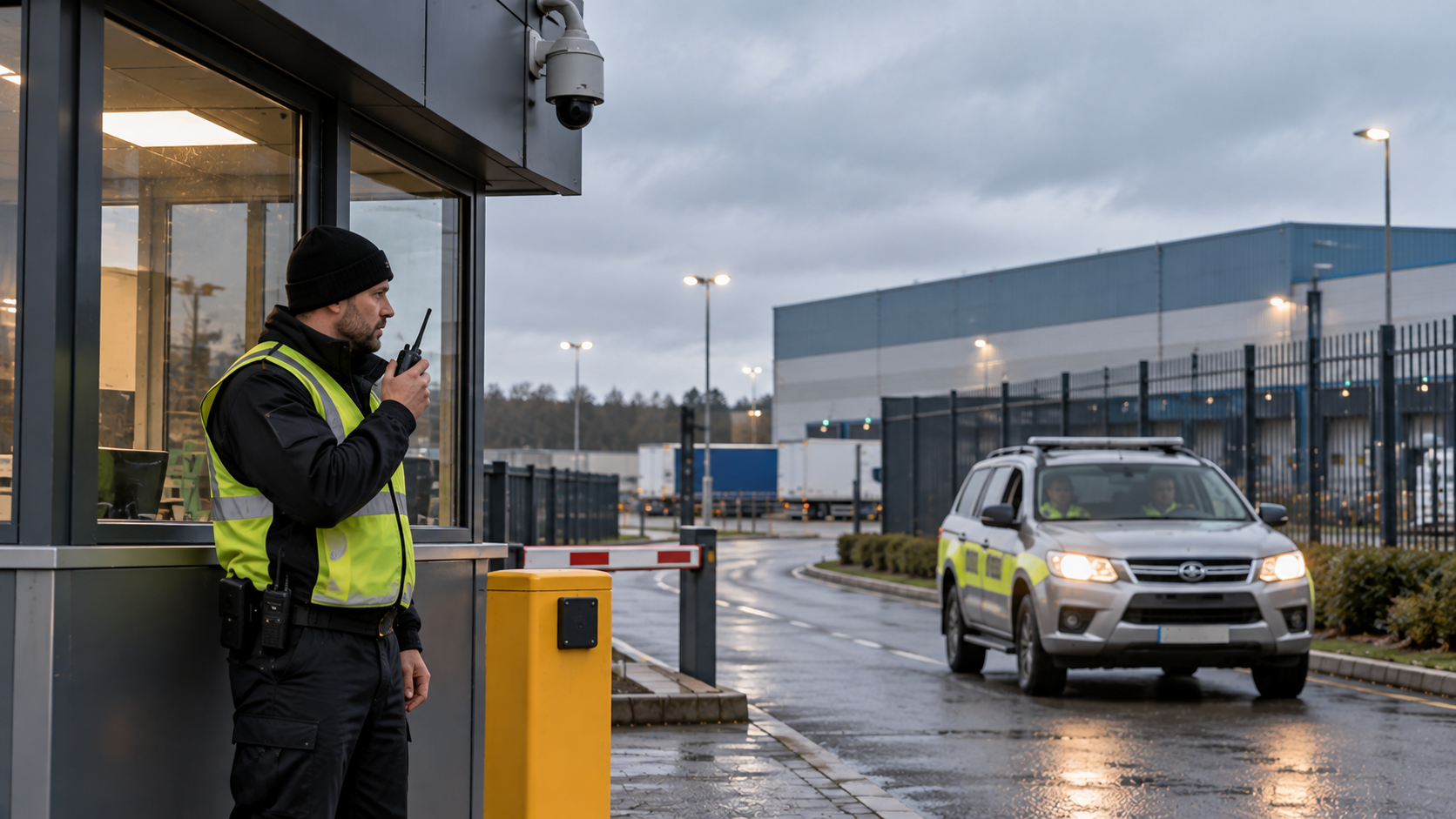
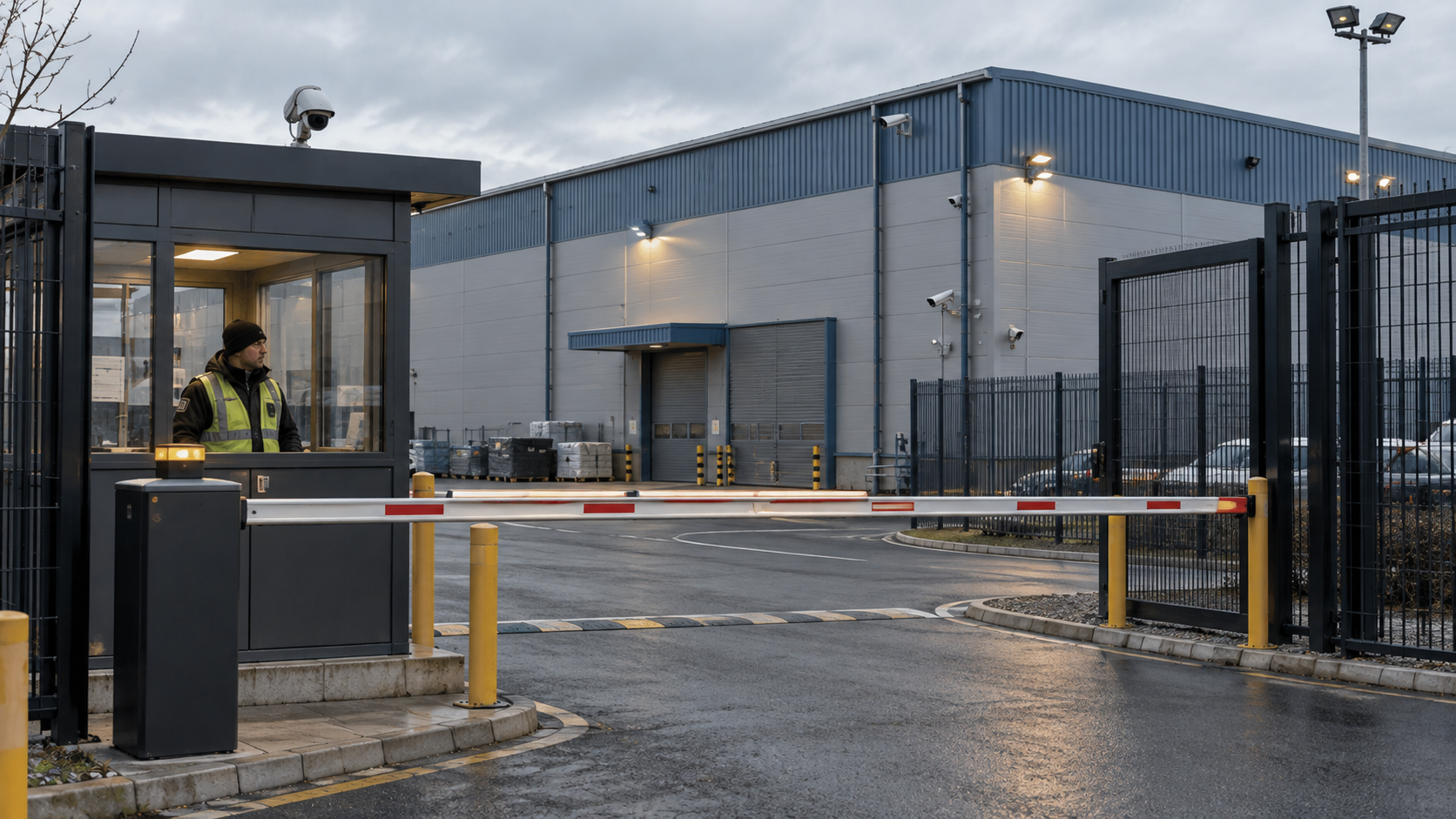
Gatehouse security, access control and manned guarding can address different parts of this problem. The appropriate option depends on how the site operates rather than simply its size.
Poor visibility can leave vulnerable areas unchecked
A site can have good locks and still have areas that are difficult to observe. Blind spots around rear entrances, storage areas, yards, car parks and perimeter fencing can make suspicious activity harder to identify.
Large premises can be particularly difficult to observe continuously, especially where buildings, vehicles or equipment obstruct lines of sight. CCTV monitoring can provide visibility in areas that are not continuously occupied.
Mobile patrols can add physical checks, while on-site personnel can observe activity and respond when something appears out of place.
The key point is that visibility is not only about having cameras. It is about knowing which areas need to be observed and what should happen when something unusual is identified.
Empty periods can increase exposure
Security weaknesses often become more noticeable when fewer people are present. Overnight periods, weekends, bank holidays and temporary closures can leave commercial or public premises with little routine activity.
Construction sites can face a similar issue outside working hours, when equipment and materials may remain on site without the normal workforce present. Mobile patrols can provide physical checks during these periods.
Keyholding and alarm response can provide another layer when an alarm is activated. A simple but often missed point is that a site should not be assessed only during its busiest hours. The quietest period may reveal a completely different set of vulnerabilities.
What Does Crime Data Tell Us About Security Risk in Solihull?
Current official data does not show Solihull as having an unusually high overall crime rate. Police.uk, using ONS data, records a crime rate of 81.87 per 1,000 residents in Solihull for the year ending March 2026, compared with a West Midlands force average of 103.21 per 1,000.
That comparison provides useful local context, but it should not be treated as a measurement of the risk at an individual business or public building. Crime statistics describe an area.
They do not show whether a particular entrance is poorly controlled, whether a yard has blind spots or whether a building is left unattended overnight. For that reason, a lower area-level crime rate does not remove the need to understand site-specific vulnerabilities.
Which reported crimes are relevant to commercial and public premises?
West Midlands Police data shows that reported crime varies considerably between neighbourhoods within Solihull.
For example, in the NEC area, the most commonly reported crimes during June 2026 included violence and sexual offences (14), other theft (12), criminal damage and arson (6), and vehicle crime (6).
The picture is different in Shirley, where shoplifting (136) was the most commonly reported category during the same month, followed by violence and sexual offences, criminal damage and arson, and vehicle crime.
These figures should not be interpreted as commercial-site crime figures. They are neighbourhood-level police data. They do, however, show why a single Solihull-wide assumption can be misleading. The relevant question for a site manager is what local conditions and site characteristics mean for that particular premises.
Security Vulnerabilities at Commercial and Public Sites in Solihull: How Should They Be Assessed?
Security vulnerabilities should be assessed by examining the site’s entrances, perimeter, people movement, assets, operating hours, visibility, incident history and response arrangements. A useful security risk assessment for commercial premises connects those factors rather than treating each one in isolation.
Start with access, perimeter and vulnerable zones
Begin at the points where people and vehicles enter the premises. Check the main entrance, secondary doors, gates, loading areas, rear access points and car parks. Consider whether each route has an obvious purpose and whether access is restricted where necessary.
Perimeter fencing should also be considered. Gaps, damaged sections or poorly observed areas can create opportunities for unauthorised access.
The aim is not to make every entrance equally restrictive. It is to understand which routes need control and where existing arrangements may leave an unnecessary gap.
Examine people, assets and operating patterns
Next, consider what happens on the site throughout a normal working day. Staff numbers, visitor movement, deliveries and shift changes can all affect exposure. High-value equipment or stock may require additional attention, particularly where it is stored in accessible or isolated areas.
Operating patterns matter too. A site with substantial daytime activity may have a very different risk profile after employees leave.
Public premises also need to consider footfall and the movement between public and staff-only areas. The vulnerability may not be the building itself but the way people move through it.
Review monitoring and incident response
The final stage is to establish whether the site can identify and respond to an incident effectively.
Review CCTV coverage, patrol arrangements, alarms, keyholding procedures, incident records and escalation routes. A camera that covers an entrance but leaves the adjoining approach unseen may not provide the level of visibility expected.
The same applies to response procedures. Staff should know who takes responsibility when an alarm activates, or an incident is reported.
Which Services Address Different Commercial Site Vulnerabilities?
The service should correspond to the commercial site security risks in Solihull rather than being selected simply because a site is commercial.
The right approach starts by identifying the specific vulnerability and then choosing a measure that addresses that particular gap. Different controls solve different problems, and some sites may need a combination.
Vulnerability | Relevant service | What it addresses |
Uncontrolled entry | Gatehouse/access control | Screens people and vehicles |
Unattended premises | Mobile patrols | Physical checks during vulnerable periods |
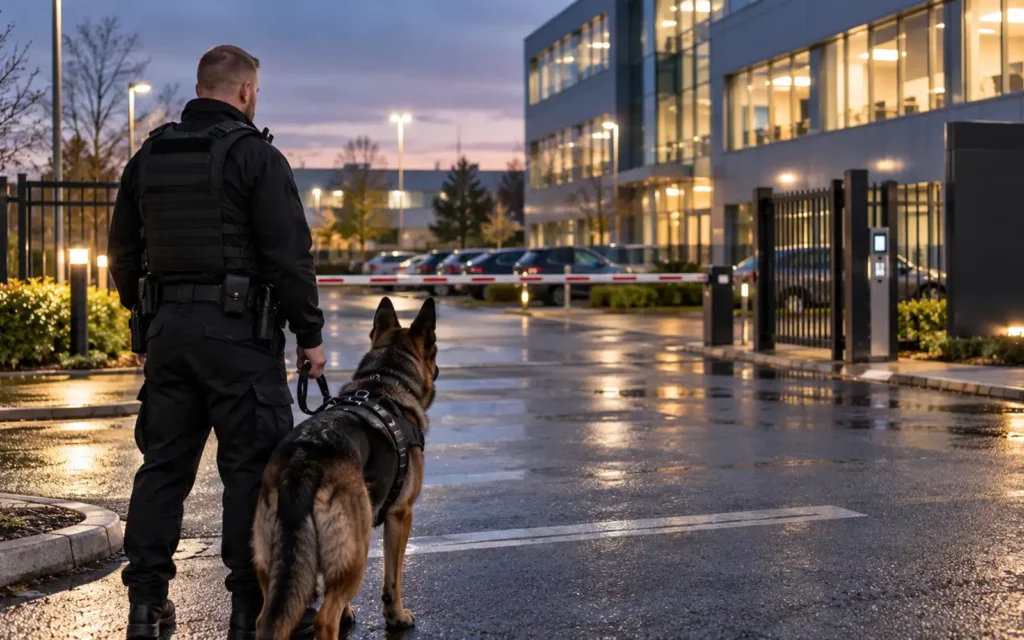
Large or isolated areas | K9 security | Visible deterrence and patrol capability |
Theft or unauthorised activity | Manned guarding | On-site presence and intervention |
Blind spots | CCTV monitoring | Remote observation |
Alarm activation | Keyholding and alarm response | Response when an alarm is triggered |
Multiple sites | Mobile patrols and tracking | Scheduled or random checks across locations |
When does manned guarding make sense?
Manned guarding can be appropriate where a site needs a consistent physical presence rather than occasional checks.
This can apply to premises with constant footfall, valuable assets, several access points or active construction and industrial activity. It can also be useful where staff need someone on site who can observe activity and deal with issues as they arise.
The reason for using on-site personnel should be clear. If the actual weakness is an isolated perimeter that needs periodic checking, continuous guarding may not be the only option worth considering.
When can patrols, CCTV or response services address specific gaps?
Patrols can help where the main concern is physical checking during selected periods. CCTV can improve visibility where areas cannot be watched continuously. Keyholding and alarm response can provide a response arrangement when an alarm is activated.
These measures can also complement one another. For example, CCTV may identify an issue while a physical response arrangement deals with what happens next. The right combination depends on the site’s identified weaknesses, not on a standard package.
Which Services Address Public Site Security Vulnerabilities in Solihull?
Public premises often require controls that account for open access, unpredictable visitor behaviour, multiple users and periods of high footfall. The focus is therefore often on controlling movement without making legitimate access unnecessarily difficult.
Public access requires stronger entrance and movement controls
Reception areas and public entrances can become difficult to manage when there are large numbers of visitors or several groups using the same building. Access control can help separate public areas from staff-only sections.
Security personnel can support visitor management and provide a visible point of contact where people need assistance. Gatehouse arrangements may be more relevant to public sites with vehicle access, larger grounds or controlled entry points.
Busy periods also deserve separate consideration. An entrance that works well on a quiet weekday may require additional controls during an event or period of increased public activity.
High-footfall environments need visibility and rapid intervention
High visitor numbers can make unusual behaviour harder to identify. Staff may also have to deal with theft, aggressive behaviour or concerns involving vulnerable people while continuing their normal duties.
Manned guarding can provide an identifiable presence in busy areas. CCTV monitoring can support visibility across spaces that are difficult to observe directly, while mobile patrols can cover areas away from the main public flow.
The objective is not simply to increase the number of people watching a site. It is to make sure that activity can be noticed and acted upon where the existing arrangements leave a gap.
Out-of-hours protection needs a different approach
Once a public building closes, its security requirements change. The building may be empty, access points may be locked and routine staff activity may stop. At that point, keyholding, alarm response, CCTV and mobile patrols can address different aspects of the out-of-hours risk.
A useful plan should identify who receives an alarm notification, who can attend the premises and what happens if signs of unauthorised entry are found.
How Can Businesses Reduce Vulnerabilities Before Choosing Additional Services?
Organisations should first identify the vulnerability, review existing controls and determine when and where protection gaps occur before adding another security measure. This avoids paying for measures that do not address the actual weakness.
Use a site-specific security review
A practical review can start with six questions:
- Where could someone enter without authorisation?
- Which areas have limited visibility?
- When is the site least occupied?
- Which assets would be most attractive to thieves?
- Have there been previous incidents or near-misses?
- Who responds when something happens?
The answers should be based on the actual premises. A warehouse with a large yard will have different priorities from an office with one controlled entrance.
Incident records are particularly useful. Repeated problems in the same area may indicate a weakness that deserves attention rather than another temporary response.
Match the response to the actual gap
Once the weakness is understood, the response becomes easier to define.
Weak access → access control
Poor visibility → CCTV or monitoring
Large perimeter → patrols or K9 capability
Unattended periods → patrols or keyholding
High public interaction → trained on-site personnel
This approach keeps the focus on prevention and suitability. Not every premises needs every type of protection.
What Should a Solihull Site Security Plan Include?
A useful site security plan should document the site’s vulnerabilities, existing controls, responsible personnel, escalation process and review schedule. It should also be practical enough for staff to follow rather than becoming a document that is rarely consulted.
Build the plan around four essentials
- Site vulnerabilities: Record the areas, activities and periods that create the greatest exposure.
- Existing preventative measures: Document current access controls, CCTV, alarms, patrols and other security measures for commercial and public premises.
- Incident and escalation procedures: Set out who should be contacted, what information should be recorded and what happens when an incident requires escalation.
- Regular review and adjustment: Reassess the plan when the premises or its use changes.
A site can change considerably after refurbishment, a change in operating hours, increased occupancy, new equipment or an incident. Those changes can introduce weaknesses that were not present when the original arrangements were created.
Conclusion
There is no single service that addresses commercial & public site vulnerabilities Solihull. Commercial and public sites in Solihull should first identify their specific exposure, then select controls that address those gaps.
Local crime data provides useful context, but it cannot replace a site-level review. Official figures show that Solihull’s overall crime rate is below the West Midlands force average, while neighbourhood-level data demonstrates that reported crime patterns can differ within the borough.
The practical approach is to connect the vulnerability with the appropriate control. Access problems may call for access management, poor visibility may point towards CCTV or patrols, and unattended periods may require physical checks or an alarm-response arrangement.
For organisations reviewing their options, a security company Solihull can be considered after the site’s requirements have been established. Businesses operating across several locations may also need to consider a security company West Midlands that can support a broader regional requirement.