Introduction
The West Midlands is one of the UK’s most significant industrial and manufacturing regions, with a high concentration of factories, production plants, and industrial estates across Birmingham, Coventry, Wolverhampton, Dudley, and surrounding areas. These sites often house high-value machinery, raw materials, finished goods, and sensitive processes, making factory security a critical operational concern rather than a secondary support function.
Police-recorded crime data for the West Midlands consistently shows that industrial and commercial premises account for a notable share of non-residential theft and criminal damage incidents, underlining the ongoing exposure faced by factory and manufacturing sites across the region. Factory security in the West Midlands is shaped by scale and complexity. Large footprints, multiple access points, frequent deliveries, contractor movement, and extended or 24/7 operating hours create exposure that cannot be managed through systems alone. Risks typically arise during shift changes, overnight production, and quieter operating windows, where unauthorised access, internal theft, vandalism, or safety breaches can go unnoticed until disruption has already occurred.
For manufacturers, factory security is fundamentally about maintaining control. Businesses must protect assets, manage site access, support health and safety compliance, and prevent incidents that could lead to downtime, insurance claims, or regulatory scrutiny. In a region where production continuity and supply-chain reliability are commercially critical, effective factory security becomes an essential part of operational resilience rather than a reactive response to isolated incidents.

Understanding Factory Security Basics in the West Midlands
What Factory Security Means in the West Midlands Context
Factory security in the West Midlands focuses on protecting large-scale manufacturing and industrial sites where production continuity, asset protection, and safety compliance are critical. This includes facilities in major industrial centres such as Coventry and Wolverhampton, as well as surrounding manufacturing estates. Security typically involves a combination of on-site presence, controlled access management, perimeter oversight, and coordination with operational teams to manage risk across expansive facilities.
Unlike office or retail environments, factories operate with heavy machinery, hazardous materials, high-value equipment, and complex workflows. Security is therefore not just about preventing theft, but about maintaining control over who is on site, when, and for what purpose particularly during shift changes, deliveries, and maintenance windows.
Factory Security Versus Static and Remote-Only Systems
Static security measures such as CCTV, alarms, access control, and monitoring systems are widely used across West Midlands industrial estates and manufacturing parks. These systems provide visibility, incident records, and alerts, but they are inherently reactive. Cameras capture events after they happen, and alarms trigger once a breach has already occurred.
Factory security relies on real-time oversight. On-site security personnel can identify unusual activity, challenge unauthorised access, and respond immediately to safety or security issues. In large manufacturing environments where delays can lead to downtime or safety risks, this real-time decision-making is often the difference between a contained issue and operational disruption.
Local Crime and Risk Patterns Affecting West Midlands Factories
Crime affecting factories in the West Midlands is typically opportunistic and asset-focused rather than random. Industrial estates with multiple occupiers, shared access roads, and limited natural surveillance are more exposed to unauthorised entry, metal theft, fuel siphoning, and theft of tools or finished goods.
These risks are not evenly distributed throughout the day. Incidents are more likely to occur during low-visibility periods such as overnight shifts, weekends, bank holidays, and shutdown periods when staffing levels are reduced and production activity is quieter.
Peak Risk Periods for West Midlands Manufacturing Sites
Factories operating 24/7 face different risk profiles across each shift. Daytime risks often relate to access control, contractor movement, and internal loss, particularly during busy production and delivery periods. Evening and night shifts introduce increased exposure to perimeter breaches, unauthorised access, and delayed incident detection.
Planned shutdowns, maintenance periods, and seasonal slowdowns can also increase vulnerability. During these times, reduced staffing and irregular site activity make it easier for security breaches to go unnoticed unless active controls are in place.
Sector-Specific Vulnerabilities in the West Midlands Industrial Landscape
The West Midlands hosts a diverse industrial base, including automotive manufacturing, metal fabrication, logistics-linked production, food processing, and advanced manufacturing. Each sector brings specific security considerations, from protecting high-value components and intellectual property to managing access to hazardous zones.
Common vulnerabilities include multiple vehicle entrances, poorly lit yards, unsecured loading bays, and legacy buildings not designed for modern access control. Factory security strategies must account for these physical realities rather than relying on standardised approaches.
Managing Behaviour, Safety, and Access on Industrial Sites
Factory security plays a key role in maintaining order and safety across busy industrial environments. This includes managing contractor access, enforcing site rules, monitoring adherence to safety protocols, and acting as a visible authority presence during high-risk periods.
By maintaining consistent oversight, factory security helps prevent minor breaches of procedure from escalating into accidents, theft, or regulatory issues. This is particularly important on sites where production pressures, tight schedules, and multiple third parties increase the likelihood of rule deviations.
Economic and Industrial Growth Driving Factory Security Demand
Ongoing industrial investment and redevelopment across the West Midlands has increased factory size, throughput, and complexity. As sites expand and integrate more automation, the potential impact of security incidents on production and supply chains grows accordingly.
Factory security supports this growth by helping businesses maintain operational resilience, protect capital investment, and demonstrate robust risk management to insurers, auditors, and supply-chain partners.
Costs, Contracts, and Deployment for Factory Security in the West Midlands
Typical Cost Drivers for Factory Security in the West Midlands
Factory security costs in the West Midlands vary more by risk exposure and operating patterns than by site size alone. Facilities located within dense industrial clusters or near major transport routes including areas such as Sandwell and Solihull often face higher costs due to increased access points, vehicle movements, and asset concentration.
Factories operating extended shifts, night production, or weekend activity typically incur higher security costs than those with standard daytime operations. Additional cost pressure arises where sites require perimeter patrols, vehicle gate control, or coverage across large footprints.
The distinction between urban and peripheral industrial estates is less pronounced than in retail environments. Instead, exposure to theft, unauthorised access, and business interruption tends to be the primary factor influencing overall security spend.
Deployment Timelines for Factory Guarding
Deployment timelines depend on the complexity and compliance requirements of the factory site. Straightforward access control roles can often be mobilised within a short timeframe once risk assessments and assignment instructions are agreed.
More complex deployments such as multi-gate facilities, high-value manufacturing plants, or sites with hazardous operations require additional planning. This includes site familiarisation, safety briefings, and coordination with facilities and operations teams, extending mobilisation time.
For West Midlands manufacturers, early engagement is critical where guarding is linked to production schedules or regulatory inspections.
Common Contract Lengths for Factory Security Services
Factory security contracts in the West Midlands typically range from 6 to 24 months, depending on operational stability and investment horizon. Shorter contracts are common for new sites, transitional phases, or where security requirements are still being assessed.
Longer-term agreements are often favoured where factories operate continuous production or have fixed infrastructure requiring consistent guarding. These arrangements provide predictability for budgeting and support continuity in site knowledge and procedures.
Notice Periods and Contract Exit Considerations
Standard notice periods for factory security contracts commonly fall between 30 and 90 days. Longer notice periods may apply where guarding arrangements are deeply integrated into site operations or where specialised training has been provided.
From a client perspective, clarity on notice terms is essential. Abrupt termination can create immediate compliance gaps, particularly where insurance policies or regulatory expectations assume ongoing factory security.
Impact of Wage Pressures on Factory Security Costs
Security wage increases continue to influence guarding costs in 2025, particularly in regions like the West Midlands where manufacturing, logistics, and infrastructure projects compete for labour.
While wage pressures are an external factor, underpriced contracts often result in service instability. For factory operators, the risk lies not in transparent cost increases but in guarding arrangements that cannot be sustained at the agreed rate.
Inflation and Long-Term Contract Pricing
Inflation affects factory security pricing through wages, training costs, insurance premiums, and operational overheads. Long-term contracts increasingly include indexation or review clauses to manage this exposure.
For manufacturers, understanding how pricing adjustments are handled is more important than achieving the lowest initial rate. Predictable, review-based pricing supports financial planning and reduces the risk of sudden cost escalation.
Relationship Between Factory Guarding and Insurance Costs
Effective factory security can support favourable insurance terms, particularly for factories with high asset values, critical machinery, or business interruption exposure. Insurers often view documented access control, patrol routines, and incident reporting as positive risk controls.
While guarding does not guarantee premium reductions, poorly controlled sites may face higher excesses or coverage limitations. For many West Midlands factories, guarding is part of maintaining insurability rather than a discretionary cost.
Public Sector Factories and the Procurement Act 2023
Where factory sites fall under public ownership or supply public sector contracts, the Procurement Act 2023 influences how security services are sourced. This places greater emphasis on transparency, compliance history, and value beyond headline pricing.
For West Midlands industrial sites connected to public infrastructure or defence supply chains, procurement compliance affects not only contract award but ongoing audit readiness.
Training, Operations, and Daily Duties in West Midlands Factory Security
Factory security in the West Midlands requires guards who are trained not just in basic site protection, but in managing complex industrial environments where safety, access control, and continuity of operations are critical. Manufacturing sites often operate extended hours, involve high-value machinery, hazardous materials, and multiple contractors, all of which shape how factory security must function day to day.
Training standards for factory security officers
Manned guards deployed to factories must hold a valid Security Industry Authority licence and be vetted to BS 7858 standards, ensuring reliability in environments where access to assets, production processes, and sensitive areas is unavoidable. Beyond licensing, effective factory guarding depends on site-specific induction covering health and safety procedures, fire risk awareness, emergency shutdown protocols, and controlled movement around operational machinery.
In the West Midlands, where factories often sit within shared industrial estates or mixed logistics zones, guards are also expected to understand vehicle movement control, contractor access procedures, and lone-working risks during early mornings and night shifts.
Start-of-shift routines and site familiarisation
At the start of a shift, factory guards focus on establishing site status rather than routine patrols alone. This includes confirming which production lines are active, identifying overnight incidents from handover logs, and checking that access points align with scheduled staffing and deliveries.
For many West Midlands manufacturing sites, this step is critical due to staggered shifts, rotating contractors, and varying production schedules across the week. Early identification of anomalies such as unsecured doors, unauthorised vehicles, or unexpected personnel reduces the risk of disruption before production ramps up.
Patrols and perimeter control in industrial environments
Patrol routines in factory settings are structured around risk zones, not just time intervals. Priority areas typically include perimeter fencing, loading bays, raw material storage, plant rooms, and external utility access points. In industrial parts of the West Midlands, where factories may border transport routes or neighbouring estates, perimeter checks play a significant role in preventing unauthorised access and theft of materials or equipment.
Rather than constant movement, patrols are designed to create predictable oversight of vulnerable areas while maintaining visibility during shift changes and delivery windows.
Shift handovers and continuity of control
Effective factory security depends on clean, accurate handovers. Guards record incidents, near misses, access issues, and safety observations in site logbooks or digital reporting systems. Incoming officers are briefed on anything affecting operational risk, such as temporary access permissions, equipment faults, or previous attempts at unauthorised entry.
For 24/7 manufacturing sites common across the West Midlands, these handovers ensure continuity of control and reduce reliance on management intervention for routine security decisions.
Equipment checks and alarm response
Guards verify the functionality of security systems at the start of duty, including CCTV coverage, alarm panels, access control readers, and communication devices. In factory environments, early alarm response is especially important, as false alarms may signal equipment faults, environmental issues, or safety risks rather than intrusion alone.
Factory security provide immediate on-site assessment, helping distinguish between security incidents and operational or maintenance issues without unnecessary production downtime.
Visitor, contractor, and vehicle management
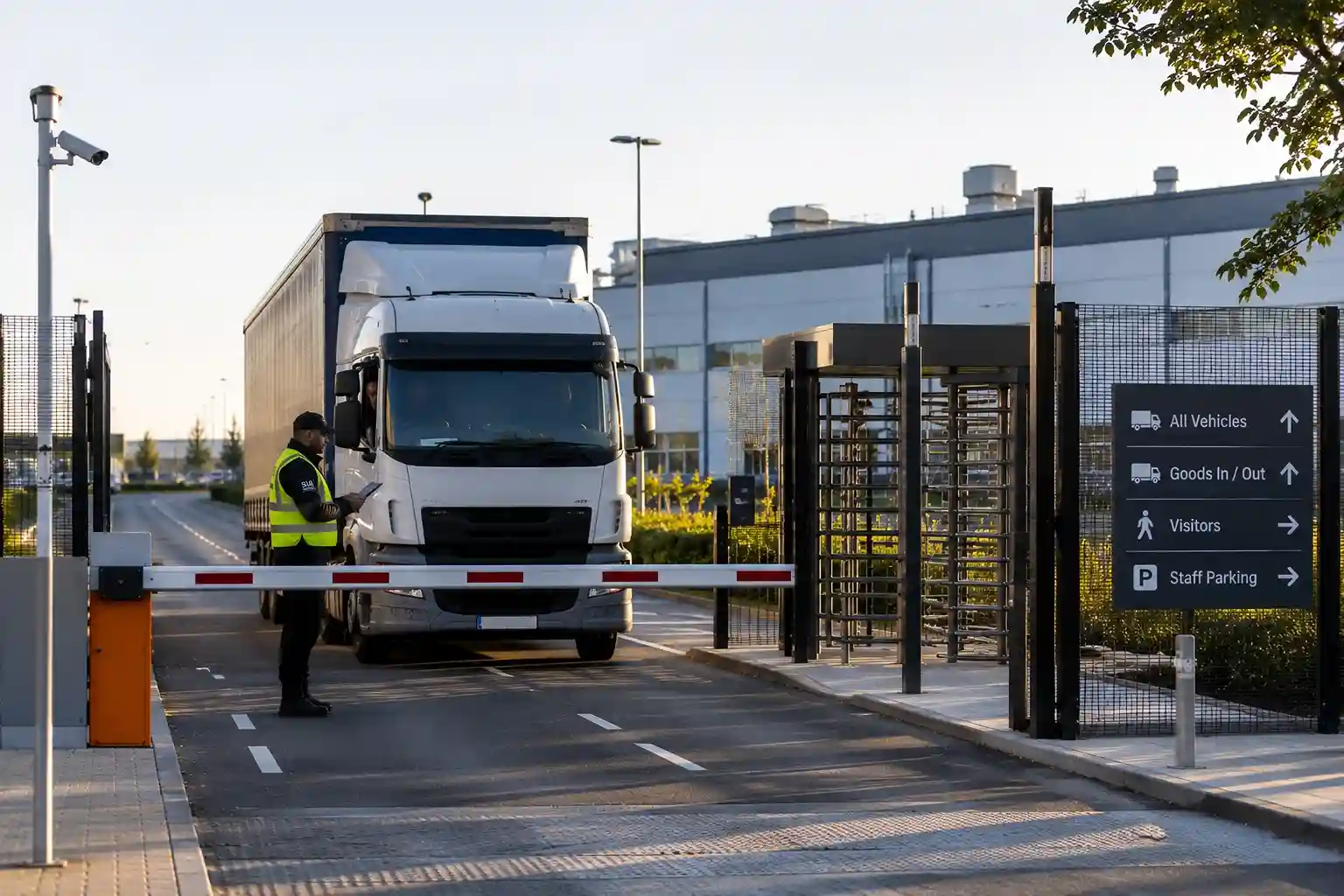
Factories experience frequent non-employee access through maintenance teams, delivery drivers, and short-term contractors. Guards manage visitor logging, ID verification, permit confirmation, and vehicle movement to ensure access aligns with authorised schedules.
This function is particularly valuable in West Midlands industrial zones where multiple businesses operate close together and informal access routes can develop if unmanaged.
Fire safety and environmental checks
Fire safety remains a core duty. Guards check escape routes, fire doors, assembly points, and signage as part of regular patrols, especially during night shifts when supervisory presence is reduced. In factories handling flammable materials or operating heat-intensive processes, early detection of anomalies such as blocked exits or unauthorised storage significantly reduces risk exposure.
Lighting checks across yards, loading areas, and access roads also form part of routine oversight, supporting both safety and crime prevention.
Reporting and supervision
Guards maintain structured reporting throughout the shift, documenting patrol outcomes, incidents, and site conditions. Regular supervisor check-ins during night shifts or extended hours help maintain standards and provide escalation routes if operational risks change.
For factory operators, this reporting supports compliance, insurance evidence, and internal audits without placing additional administrative burden on site management.
End-of-shift secure-down procedures
At the end of a shift, guards confirm secure-down of non-operational areas, ensure access points are locked or controlled as required, and hand over updated site status to the next officer or duty manager. On sites with partial overnight production, this process ensures security controls remain aligned with active operations rather than blanket shutdown assumptions.
Training, Operations, and Daily Duties in West Midlands Factory Security
Factory security in the West Midlands requires guards who are trained not just in basic site protection, but in managing complex industrial environments where safety, access control, and continuity of operations are critical. Manufacturing sites often operate extended hours, involve high-value machinery, hazardous materials, and multiple contractors, all of which shape how factory security must function day to day.
Training standards for factory security officers
Manned guards deployed to factories must hold a valid SIA licence and be vetted to BS 7858 standards, ensuring reliability in environments where access to assets, production processes, and sensitive areas is unavoidable. Beyond licensing, effective factory guarding depends on site-specific induction covering health and safety procedures, fire risk awareness, emergency shutdown protocols, and controlled movement around operational machinery.
In the West Midlands, where factories often sit within shared industrial estates or mixed logistics zones, guards are also expected to understand vehicle movement control, contractor access procedures, and lone-working risks during early mornings and night shifts.
Start-of-shift routines and site familiarisation
At the start of a shift, factory guards focus on establishing site status rather than routine patrols alone. This includes confirming which production lines are active, identifying overnight incidents from handover logs, and checking that access points align with scheduled staffing and deliveries.
For many West Midlands manufacturing sites, this step is critical due to staggered shifts, rotating contractors, and varying production schedules across the week. Early identification of anomalies such as unsecured doors, unauthorised vehicles, or unexpected personnel reduces the risk of disruption before production ramps up.
Patrols and perimeter control in industrial environments
Patrol routines in factory settings are structured around risk zones, not just time intervals. Priority areas typically include perimeter fencing, loading bays, raw material storage, plant rooms, and external utility access points. In industrial parts of the West Midlands, where factories may border transport routes or neighbouring estates, perimeter checks play a significant role in preventing unauthorised access and theft of materials or equipment.
Rather than constant movement, patrols are designed to create predictable oversight of vulnerable areas while maintaining visibility during shift changes and delivery windows.
Shift handovers and continuity of control
Effective factory security depends on clean, accurate handovers. Guards record incidents, near misses, access issues, and safety observations in site logbooks or digital reporting systems. Incoming officers are briefed on anything affecting operational risk, such as temporary access permissions, equipment faults, or previous attempts at unauthorised entry.
For 24/7 manufacturing sites common across the West Midlands, these handovers ensure continuity of control and reduce reliance on management intervention for routine security decisions.
Equipment checks and alarm response
Guards verify the functionality of security systems at the start of duty, including CCTV coverage, alarm panels, access control readers, and communication devices. In factory environments, early alarm response is especially important, as false alarms may signal equipment faults, environmental issues, or safety risks rather than intrusion alone.
Factory security provide immediate on-site assessment, helping distinguish between security incidents and operational or maintenance issues without unnecessary production downtime.
Visitor, contractor, and vehicle management
Factories experience frequent non-employee access through maintenance teams, delivery drivers, and short-term contractors. Guards manage visitor logging, ID verification, permit confirmation, and vehicle movement to ensure access aligns with authorised schedules.
This function is particularly valuable in West Midlands industrial zones where multiple businesses operate close together and informal access routes can develop if unmanaged.
Fire safety and environmental checks
Fire safety remains a core duty. Guards check escape routes, fire doors, assembly points, and signage as part of regular patrols, especially during night shifts when supervisory presence is reduced. In factories handling flammable materials or operating heat-intensive processes, early detection of anomalies such as blocked exits or unauthorised storage significantly reduces risk exposure.
Lighting checks across yards, loading areas, and access roads also form part of routine oversight, supporting both safety and crime prevention.
Reporting and supervision
Guards maintain structured reporting throughout the shift, documenting patrol outcomes, incidents, and site conditions. Regular supervisor check-ins during night shifts or extended hours help maintain standards and provide escalation routes if operational risks change.
For factory operators, this reporting supports compliance, insurance evidence, and internal audits without placing additional administrative burden on site management.
End-of-shift secure-down procedures
At the end of a shift, guards confirm secure-down of non-operational areas, ensure access points are locked or controlled as required, and hand over updated site status to the next officer or duty manager. On sites with partial overnight production, this process ensures security controls remain aligned with active operations rather than blanket shutdown assumptions.
Performance, Risks, and Operational Challenges in West Midlands Factory Security
Effective factory security is measured not by visibility alone, but by how consistently it reduces operational disruption, protects assets, and supports safe production. For manufacturing sites across the West Midlands, performance management focuses on reliability, incident control, and the ability to operate securely across long hours and varied conditions.
Key performance indicators for factory Security
Businesses typically assess factory security performance through operational KPIs rather than volume-based metrics. These include incident response times, accuracy and completeness of incident reporting, compliance with patrol schedules, and consistency of access control enforcement.
For factories operating 24/7, additional indicators such as handover quality, alarm response outcomes, and adherence to site-specific safety procedures are often more meaningful than raw incident counts. Strong performance is reflected in fewer escalations to management, reduced production interruptions, and clearer audit trails for insurers and regulators.
Reporting quality and decision support
Security reporting in factory environments must do more than log events. Guards are expected to record context, not just outcomes, what was observed, how it was assessed, and why a particular response was taken. This level of reporting helps site managers understand emerging risks, such as repeat access issues, vulnerable delivery windows, or recurring safety concerns around specific zones.
In the West Midlands, where many factories operate within shared industrial estates, this documentation also supports coordination with landlords, neighbouring sites, and insurers when wider risks develop.
Weather and environmental risk exposure
Weather has a practical impact on factory guarding effectiveness, particularly for sites with large outdoor perimeters, yards, or loading areas. Poor visibility, heavy rain, fog, or icy conditions can increase both security and safety risks, affecting patrol routes, vehicle movement, and access control reliability.
Guards document weather conditions as part of routine logs when they materially affect patrol coverage, lighting effectiveness, or access safety. For businesses, this documentation provides evidence that risks were identified and managed rather than ignored, which is especially relevant during incident reviews or insurance claims.
Health and fatigue considerations in long-shift environments
Factory security often involves extended shifts, night work, or rotating patterns aligned with production schedules. While workforce wellbeing is not a client management responsibility, fatigue risk is an operational concern. Reduced alertness can affect judgement, response times, and reporting accuracy if not properly controlled.
From a business perspective, this reinforces the importance of realistic coverage planning, clear patrol expectations, and supervision structures that prioritise alertness during higher-risk periods such as early mornings, shift changes, and overnight hours.
Night-shift operational risk management
Night shifts introduce different challenges from daytime guarding. Reduced staff presence, limited natural surveillance, and lower external support increase reliance on on-site security judgment. Guards must manage alarms, unauthorised access attempts, and safety issues without immediate management oversight.
Factories across the West Midlands often rely on structured check-ins, clear escalation protocols, and well-defined emergency procedures to maintain control during these hours. The effectiveness of these systems directly impacts overall site risk.
Environmental and regulatory exposure
Factories must also consider environmental regulations when deploying outdoor factory security. Patrols around waste storage, chemical handling areas, or drainage systems require guards to be aware of spill risks, unauthorised dumping, or tampering that could trigger regulatory consequences.
Security officers act as an early warning layer, identifying issues before they escalate into compliance breaches or operational shutdowns.
Service continuity and underperformance risk
One of the less visible risks for factory operators is underperforming guarding rather than absent guarding. Inconsistent patrols, poor reporting, or passive access control can create a false sense of security while leaving vulnerabilities unaddressed.
From a business standpoint, the focus should be on whether guarding arrangements consistently support production continuity, safety standards, and insurer expectations, not simply whether a guard is present on site.
Technology and Future Trends in West Midlands Factory Security
Technology has become an important force multiplier for factory security across the West Midlands, particularly in large industrial estates, logistics-adjacent manufacturing sites, and multi-shift production environments. Rather than replacing on-site guards, modern systems increasingly support better judgment, faster response, and clearer risk visibility.
How technology has changed factory security practices
Factory guarding has shifted from purely physical presence to integrated oversight. Guards now work alongside CCTV systems, access control platforms, and alarm networks that provide wider site visibility than manual patrols alone.
For manufacturers operating large footprints or complex layouts, this integration allows guards to prioritise response, verify incidents remotely before escalation, and maintain coverage across areas that would otherwise require excessive patrol frequency.
Post-COVID changes in factory security protocols
Post-COVID operational changes have influenced factory security in subtle but lasting ways. Many sites now operate with leaner overnight staffing, staggered shifts, and increased reliance on automated access systems.
This has increased the importance of guards managing access integrity, monitoring unauthorised movement during off-peak hours, and responding to alarms in lower-occupancy environments where issues may go unnoticed for longer.
The role of AI-supported surveillance in factory environments
AI-enabled CCTV analytics are increasingly used across West Midlands factories to support on-site guards. These systems assist with motion detection in restricted zones, after-hours access alerts, and identification of unusual movement patterns around yards, loading bays, or perimeter fencing.
Crucially, AI supports decision-making rather than enforcement. Guards still assess context, confirm intent, and determine appropriate response, reducing false alarms while improving response speed.
Remote monitoring as a complement to on-site guarding
Remote monitoring hubs are often paired with factory security to provide additional oversight during night shifts or low-activity periods. Cameras, alarms, and sensors can be reviewed remotely, allowing guards on site to focus on physical response rather than constant screen monitoring.
For businesses, this layered approach improves resilience without significantly increasing on-site staffing levels.
Use of drones in large industrial and factory sites
Drone patrols are beginning to appear in very large or high-risk industrial environments, particularly where perimeter coverage is extensive or terrain limits visibility.
In factory settings, drones are typically used periodically rather than continuously, supporting perimeter inspections, roof checks, or post-incident assessments. They complement ground-level guarding by reducing blind spots rather than replacing patrols.
Predictive analytics and risk planning
Some manufacturers now use predictive analytics tools to assess security needs based on incident history, access data, and operational patterns. These tools help identify higher-risk time windows, vulnerable zones, or seasonal exposure linked to production cycles.
For decision-makers, this supports more targeted guarding deployment rather than uniform coverage that may not reflect real risk.
Training and certification trends linked to technology
While core SIA licensing remains the foundation, guards operating in modern factory environments increasingly require familiarity with CCTV systems, access control platforms, and digital reporting tools.
From a business perspective, this matters because guards who can interpret system data and document incidents accurately provide stronger audit trails and clearer evidence for insurers and compliance reviews.
Green and sustainable security practices
Environmental considerations are increasingly relevant for West Midlands factories with sustainability targets. Security practices are adapting through energy-efficient lighting, reduced vehicle patrols supported by camera coverage, and digital reporting to minimise paper use.
These changes reduce operational impact while maintaining security standards, particularly across large outdoor industrial sites.
Martyn’s Law and future implications for factory sites
While Martyn’s Law is primarily focused on public venues, its principles around risk assessment, preparedness, and proportionate security are influencing wider site security planning.
For factories that host visitors, contractors, or public-facing elements such as training centres or showrooms, this may result in clearer access control procedures, improved incident planning, and stronger documentation of security measures.
Conclusion
Factory security in the West Midlands is shaped by scale, access complexity, and the concentration of industrial activity across manufacturing and logistics corridors. For many sites, risk does not come from isolated high-impact incidents, but from repeated exposure to theft, unauthorised access, vandalism, and operational disruption over time.
Factory security remains a practical control where factories operate large footprints, handle high-value materials, or rely on continuous production. On-site guards provide judgement, visibility, and response capability that static systems alone cannot deliver, particularly during low-occupancy periods, shift changes, and out-of-hours operations.
For decision-makers, the question is not whether factory security is needed, but how it should be structured to reflect site layout, operating hours, and real risk exposure. When aligned with technology, compliance requirements, and insurance expectations, factory guarding becomes a stabilising operational function rather than a reactive cost.
Frequently Asked Questions
1. When does a factory in the West Midlands typically need stronger security measures?
Enhanced factory security becomes important when sites operate around the clock, store high-value materials, have multiple vehicle and pedestrian access points, or have experienced incidents such as theft, trespass, or vandalism. Large industrial estates around the West Midlands, particularly those with limited night-time activity, are more exposed outside normal production hours.
2. Is factory security a legal requirement?
There is no single law that says every factory must have a specific type of security. However, businesses do have legal duties to take reasonable steps to protect employees, visitors, and property. Health and safety law, fire safety regulations, and insurance policy conditions all create expectations that risks including unauthorised access and criminal damage are properly controlled.
3. How does factory security support insurance requirements?
Insurers often assess how well a site is protected before setting terms. Documented access control, perimeter protection, alarm response, and regular site checks can help demonstrate that the business has taken reasonable precautions. This can influence premiums, policy conditions, and how smoothly claims are handled after an incident.
4. What are the main risks factory security is designed to manage?
Typical risks include unauthorised entry, theft of tools, metals or fuel, vandalism, arson, vehicle movements in yards, and safety issues involving contractors or visitors. Security measures also help ensure site rules are followed, especially in hazardous or restricted production areas.
5. Are night periods a higher risk for factories?
Yes. Reduced staffing, fewer neighbouring businesses operating, and longer emergency response times can increase exposure overnight and at weekends. Many factories increase security controls during these periods to maintain oversight when natural supervision is low.
6. Can CCTV alone provide effective factory security?
CCTV is an important part of modern factory security, but on its own it is usually reactive. Cameras capture footage and generate alerts, but effective protection depends on how quickly issues are identified and addressed. For many sites, CCTV works best as part of a wider approach that may include physical patrols, access control, and monitored alarms.
7. How long does it take to deploy factory guards?
Deployment typically takes a few days to a few weeks, depending on site complexity, vetting requirements, and handover planning. Faster mobilisation is possible for temporary or short-term risk cover.
8. What compliance checks should businesses expect from a guarding provider?
Businesses should expect SIA licensing, BS 7858 vetting, clear insurance documentation, GDPR-compliant reporting processes, and evidence of site-specific risk assessment.
9. Does factory size affect guarding costs?
Cost is influenced more by risk profile, operating hours, and access complexity than size alone. Smaller sites with isolated locations or high-value assets may require more intensive coverage than larger, lower-risk facilities.
10. How should businesses review whether guarding is still appropriate?
Regular reviews should consider incident trends, operational changes, production schedules, and insurance feedback. Guarding should adapt as the site evolves rather than remain static.