Factory security in Sussex isn’t a box-ticking exercise anymore. It’s become a quiet pressure point for local businesses that feel safe until they’re not. Coastal Sussex has a rhythm of its own. It has the early starts, late deliveries and empty yards just before dawn. This is where the actual problems creep in.
Why Sussex businesses need Factory Security now comes down to timing, proof, and preparedness, not just guards on a gate. Theft rarely looks dramatic here; it’s subtle and opportunistic. A van that shouldn’t be there and a door were left open during a shift change. By the time losses show up on paper, the damage is already done.
The Fundamentals of 2026 Industrial Asset Protection
Factory security in 2026 is no longer a generic concept you can lift from office or warehouse guidance and hope it sticks. Sussex factories operate differently from the others. They move earlier, stop later, and rely on people, vehicles, and processes crossing the same space all day long. That reality shapes everything.
What is factory security and how is it different in Sussex
Factory security is about protecting live operations, not just stored goods. Offices tend to shut down in timing, and warehouses get a pause on work. But factories stop their work rarely. They have machines stay warm, hold staff rotation and active vehicles.
In Sussex, this difference matters more than in most areas. Industrial sites often sit close to residential roads, coastal routes, or mixed-use estates. That proximity increases casual access risk.
Factory security focuses on:
- Controlling people’s movement during production
- Securing plant, tooling, and raw materials
- Managing vehicle flow without slowing output
- Monitoring blind spots created by machinery and layout changes
That’s why Sussex businesses need Factory Security to be increasingly a planning question, not a reaction after a loss.
How Sussex’s industrial crime profile shapes planning
Sussex crime isn’t evenly spread. Rural zones remain relatively calm. But the industrial estates around Brighton, Hove, and Eastbourne show consistently higher incident levels. Opportunistic theft dominates, as does the unauthorised access.
This is where Everyday Risk Analytics matters. There are no dramatic break-ins, but the repeated, low-value losses that add up.
In 2026, effective planning means:
- Regular blind-spot audits as layouts change
- Evidence sharing aligned with NICE Investigate
- Demonstrable compliance for insurers and regulators
The highest-risk times for factory intrusion
Data across the South East points to one uncomfortable truth. Theft loves routine most in factories. Morning shift changes, especially between 6 AM and 9 AM, account for nearly half of reported incidents. Gates open. Attention splits. Vehicles queue. Small mistakes slip through.
Add early deliveries or relief staff, and the risk compounds. Human error spikes when speed matters most.
Which Sussex factories face the greatest exposure
Not all factories carry the same risk profile. In Sussex, exposure rises sharply for:
- Food processing and cold storage sites
- Light manufacturing near coastal routes
- Facilities linked to the Gatwick Airport corridor
- Plants with shared access roads or unsecured yards
Cargo integrity becomes critical where materials pass through multiple hands before production even begins.
How shift-based manufacturing changes coverage needs
Factories don’t sleep, but people do. Shift work creates security gaps if coverage isn’t layered properly.
Best practice in 2026 blends:
- Static guarding during peak transitions
- Automated controls to reduce reliance on memory
- Oversight aligned with SIA Business Approval Scheme standards
Guards alone aren’t enough, and systems must back them up.
Delivery schedules and access risk
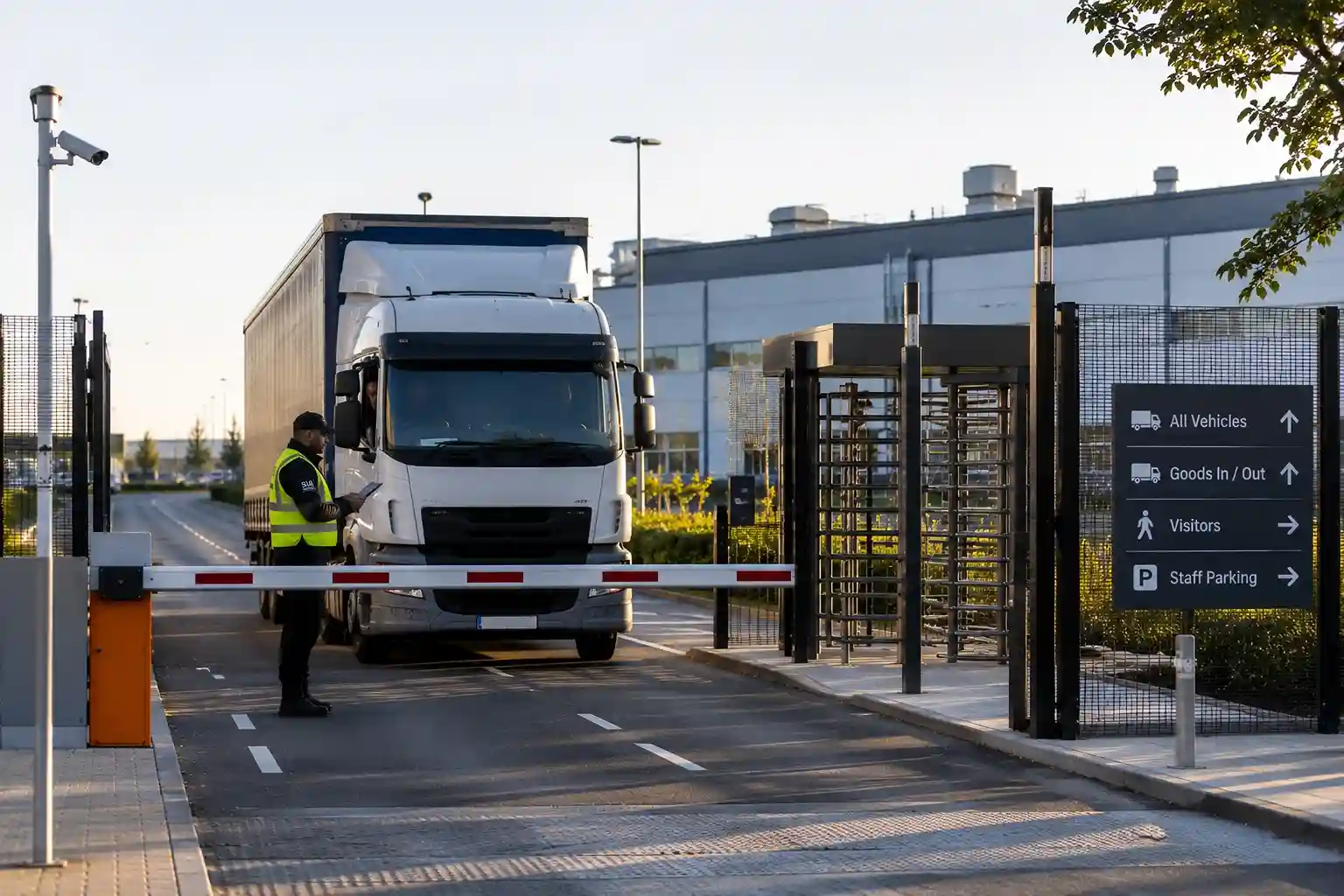
Every delivery is a temporary hole in your perimeter. Sussex factories often juggle multiple suppliers, late arrivals, and ad-hoc collections.
- Gates opening outside planned windows
- Unknown drivers under time pressure
- Reduced checks during busy production periods
Automated logging and controlled entry points matter more than politeness at the gate.
Shutdowns, holidays, and the false sense of safety
Holiday closures feel safe, but sites won’t. When factories pause, patterns disappear along with them. The lights go off, the noise stops, and that silence advertises opportunity. Temporary security uplift during shutdowns is now standard practice, not an overreaction.
In short, factory security in Sussex is about reading the rhythm of the site. Miss the beat, and problems arrive quietly.
Legal and Compliance Requirements in Sussex
Legal compliance in factory security isn’t glamorous, but it’s where most Sussex businesses get caught out. Not through intent. Through assumption. Rules change quietly, guidance shifts, and suddenly what felt “about right” last year no longer stands up to scrutiny.
What SIA requirements apply to factory security staff
Any security officer carrying out guarding, access control, or patrol duties at a factory must hold a valid SIA licence. There’s no grey area here. If someone is paid to protect assets or control entry, licensing applies.
Beyond individual licences, insurers and regulators increasingly expect contractors to operate under the SIA Business Approval Scheme (BAS). It’s not the law, but it’s becoming the commercial standard in Sussex.
Penalties for using unlicensed security
Safety and protection are vital for factory security. And there is no grey side to it. If something goes wrong, then the entire thing can collapse. This is where shortcuts get expensive. Using unlicensed guards can lead to:
- Unlimited fines
- Invalidated insurance cover
- Prosecution for both the contractor and the factory operator
- Reputational damage that lingers long after the fine is paid
Local authorities don’t care if it was “temporary cover” or “just overnight”. Liability sticks.
When DBS checks are required in factory settings
DBS checks aren’t universal, but they’re common. Factories handling sensitive materials, high-value tooling, or controlled access zones usually require at least basic or standard DBS clearance.
This becomes non-negotiable when:
- Staff work unsupervised on night shifts
- Guards have access to production data or restricted areas
- Sites operate near schools, ports, or residential zones
Insurance conditions tied to contract security
Insurers in the South East are getting picky. In 2026, many policies now include clauses tied to Martyn’s Law ‘Standard Tier’ preparedness and evidence-based risk controls.
Common conditions include:
- Proof of licensed and trained security staff
- Documented patrol and access procedures
- Incident reporting aligned with NICE Investigate
- CCTV coverage that meets evidential standards
Meet the conditions, and premiums often drop. Miss them, and claims get questioned.
GDPR compliance for CCTV and access systems
Cameras don’t just watch criminals; they collect personal data. Still, guards have to follow the rules of surveillance. Some get to misuse the recording for their own profit. And that’s where GDPR steps in to prevent it. Factories must:
- Clearly display CCTV signage
- Limit footage retention to defined periods
- Restrict access to recorded material
- Maintain a lawful basis for monitoring staff areas
Oversight falls under the Information Commissioner’s Office, not the police. A common mistake, and a costly one.
VAT on factory security services
Security services are VAT-rated, and factories must budget accordingly. There are no special exemptions just because the service is protective. Misunderstanding VAT treatment doesn’t reduce liability. It just delays the bill.
Sussex council and planning considerations
Some Sussex councils impose conditions linked to industrial estates, especially around:
- Lighting levels
- Vehicle movements at night
- Noise and patrol timing
- Mid Sussex ‘Car Cruising’ PSPO compliance
Security plans often form part of planning approvals, whether businesses realise it or not.
Documents that prove compliance
If you can’t show it, it didn’t happen. Not just in Sussex, places like Berkshire, Kent and Surrey sites expects right documents. In 2026, compliance evidence usually includes:
- SIA licences and DBS records
- BAS certification
- CCTV and GDPR policies
- Risk assessments and audit logs
- Incident and evidence-sharing records
How Martyn’s Law affects large factories
For larger factories and logistics hubs, Martyn’s Law changes expectations. Preparedness supports a better stand and not rising panic. They hold documented planning, have trained staff and clear escalation routes.
This is one more reason why Sussex businesses need Factory Security, which is no longer just about deterring theft. It’s about standing up to scrutiny when it counts.
The Cost of Security in Sussex: 24/7 Industrial Cover
Despite the heading, let’s be clear about the ground reality. This section is about factory security costs in Sussex, because that’s where pricing, risk, and compliance pressure actually land. And costs in 2026 are no longer driven by headcount alone. They are shaped by timing, proof, and how well a site understands its own exposure.
What are typical factory security costs in Sussex
There’s no single rate card that fits every factory. Sussex sites vary too widely for that. Location, shift patterns, and access complexity all move the dial.
That said, most factories budgeting for 24/7 cover in Sussex will see costs influenced by:
- Number of access points and vehicle gates
- Shift change intensity (especially early mornings)
- Requirement for licensed, site-trained officers
- Level of reporting and compliance evidence needed
Costs rise sharply when security is reactive. Planned coverage, aligned with Why Sussex businesses need Factory Security, almost always comes in cheaper over a year than patching gaps after incidents.
How quickly can factory security be Deployed
Speed depends on preparation, not panic. For a new or at-risk Sussex factory:
- Temporary cover can often be deployed within 24–72 hours
- Full 24/7 structured coverage typically takes 7–14 days
Faster deployment is possible if site data, access rules, and risk assessments already exist
Factories that keep basic documentation ready move more quickly. Everyone else waits.
What contract lengths are common
Short-term thinking costs more in the long run. Most Sussex factories now operate on:
- 6-month stabilisation contracts for new sites
- 12-month agreements for established operations
- Multi-year frameworks where insurance discounts apply
Longer terms don’t mean being locked in. They usually mean better pricing and stronger continuity.
What notice periods usually apply
Notice periods are often overlooked until they matter. Typical arrangements include:
- 30 days for short-term or temporary cover
- 60–90 days for standard factory contracts
- Immediate termination clauses for compliance breaches
Factories should always match notice terms to production risk, not just cost.
Inflation and long-term security planning
Inflation doesn’t just affect wages. It affects uniforms, vehicles, training, and compliance overhead.
Smart factories plan for:
- Annual review clauses rather than fixed-rate traps
- Incremental adjustments instead of sudden jumps
- Security models that reduce reliance on manual coverage
Ignoring inflation doesn’t freeze costs. It just delays the shock.
How factory security supports insurance negotiations
This is where security quietly pays for itself. Insurers increasingly reward factories that can demonstrate:
- Consistent licensed coverage
- Incident reporting discipline
- Preparedness aligned with Martyn’s Law ‘Standard Tier’ expectations
In Sussex, this has translated into 10–15% premium reductions for factories that can prove control, not just presence.
The Procurement Act 2023 and factory security contracts
The Procurement Act 2023 has shifted expectations, even for private-sector factories working with public bodies or mixed-use estates. In practice, this means:
- Greater emphasis on transparency and value
- Clear documentation of service delivery
- Justifiable pricing structures
Security contracts that can’t explain themselves don’t survive audits.
Pulling Cost Can Affect Most
Factory security costs aren’t just a line item. They are leveraged; when done properly, they reduce losses, smooth insurance discussions, and keep production predictable. That’s the real cost equation Sussex businesses are now working with.
Essential Training and Daily Operational Protocols for Sussex Factory Security
Factory security only works when training and daily routines line up with how a site actually runs. Not how it looks on a policy document. Sussex factories are busy, noisy, and constantly changing. That reality shapes every protocol on the ground.
What training standards apply in factory environments
At a minimum, factory security officers must be fully licensed and site-trained. But licensing alone doesn’t prepare someone for live production.
Effective factory security training in Sussex now covers:
- Safe working around moving machinery
- Vehicle–pedestrian conflict awareness
- Incident response without halting production
- Evidence handling aligned with NICE Investigate
- Preparedness expectations linked to Martyn’s Law Standard Tier
Sites using contractors aligned with the SIA Business Approval Scheme usually see fewer operational mistakes. Not because guards are stricter, but because they understand industrial environments.
What happens at the start of a factory security shift
Shift starts are where risk either tightens or leaks. A proper factory security shift briefing is short, practical, and focused. Officers typically:
- Review overnight or previous-shift incidents
- Confirm production schedules and delivery windows
- Check access permissions and expected contractors
- Walk key routes before activity peaks
Those first 15 minutes matter more than the next eight hours.
How shift handovers work on 24/7 sites
Handover isn’t a chat. It’s a controlled transfer of awareness. In Sussex 24/7 factories, best practice includes:
- Face-to-face updates at control points
- Written or digital logs signed by both officers
- Highlighting machinery shutdowns or unusual yard activity
This matters most during early mornings. The same window where theft risk is highest.
Priority checks around machinery, yards, and loading bays
Factories don’t have quiet areas; they have overlooked ones. Security teams focus daily checks on:
- Machinery zones left idle between shifts
- Yards with temporary fencing or stacked materials
- Loading bays during staggered deliveries
- Vehicle gates during peak arrival times
One loose pallet stack can create a blind spot for weeks if nobody flags it.
Daily reporting expectations
Reporting doesn’t need to be long. It needs to be useful. Factory security teams are expected to log:
- Access irregularities
- Vehicle movements outside the schedule
- Safety hazards spotted during patrols
- Minor incidents before they escalate
These reports support why Sussex businesses need Factory Security, not as theory. But as evidence, insurers and managers actually use.
Handling incidents without disrupting production
Stopping a factory costs money. Security knows that. Most incidents are handled quietly:
- Isolate the issue, not the operation
- Secure evidence without blocking workflows
- Escalate only when thresholds are met.
Secure-down procedures during shutdowns
Shutdowns change everything. Silence attracts attention. During planned closures or holidays, factory security shifts into secure-down mode:
- Reduced access points
- Increased perimeter checks
- Machinery zones locked and logged
- Patrol patterns adjusted to remove predictability
This is where preparation shows. Factories that rehearse shutdown protocols lose less. Every time. In Sussex, strong factory security isn’t loud or heavy-handed. It’s steady, observant and safe, in the best possible way.
Performance, Risks, and Challenges in Sussex
Factory security in Sussex rarely fails in dramatic ways. It drifts. Small compromises stack up. A gate left open because it always has been. A patrol skipped when the rain got heavy. Over time, those habits show up as loss, liability, and uncomfortable questions.
KPIs factory managers should actually track
Not everything that matters can be counted. But some things must be. Useful factory security KPIs in Sussex tend to be practical, not flashy:
- Access breaches per shift, not per month
- Response time during peak delivery windows
- Incidents logged versus incidents escalated
- Patrol completion during adverse conditions
- Evidence quality for insurance or investigation
If reports look perfect every week, something’s being missed.
Weather and perimeter security on industrial sites
Sussex weather is rarely extreme, but it’s persistent. Wind, salt air near the coast, and winter rain quietly weaken perimeters.
Common weather-driven risks include:
- Fence movement loosening fixings
- Flooded yards are creating new access routes
- Fog reduces CCTV visibility
- Storm noise masking intrusion attempts
Factories near coastal routes feel this first. Weather planning is now part of why Sussex businesses need Factory Security, not an afterthought.
Fatigue and overnight factory coverage
Overnight security is where fatigue hides in plain sight. Long, quiet hours, repetitive patrols, and minimal interaction can increase mental strain. This increases the fatigue on guards and leads to:
- Slower response times
- Missed anomalies that don’t trigger alarms
- Reduced vigilance during early-morning shift changes
This is why layered coverage matters. Automation supports people. It doesn’t replace them.
Health and safety risks that overlap with security
Factory security officers operate inside live workplaces. That brings shared responsibility. Intersecting risks include:
- Vehicle–pedestrian conflict in yards
- Working near moving machinery
- Slips and trips in poorly lit areas
- Emergency response during medical incidents
Security teams often act first. Training must reflect that reality.
When poor factory security increases liability
Weak security doesn’t just invite theft. It amplifies liability. Poor planning can result in:
- Insurance claims are being challenged
- Breach of duty of care to staff or visitors
- Regulatory scrutiny after incidents
- Failure to meet Martyn’s Law Standard Tier expectations
Factories with documented procedures fare better every time.
Evidence, accountability, and exposure
Modern factory security isn’t just about presence. It’s about proof. Insurers and investigators increasingly expect:
- Clear audit trails
- Incident evidence formatted for NICE Investigate
- Decision logs showing proportionate response
Without that, even well-intended actions can be questioned.
The Sussex-specific challenge
Sussex factories operate in mixed environments. Coastal towns, residential fringes and busy transport corridors. That complexity raises the bar. Security plans that ignore local context fail quietly. Until they don’t.
This is why Sussex businesses need Factory Security to keep surfacing in boardroom conversations. Performance isn’t about doing more. It’s about doing the right things, consistently, when nobody’s watching.
Technology and Future Trends in Sussex
Factory security in Sussex has shifted quietly over the last few years. Not with flashy control rooms or sci-fi promises, but with practical tech that solves everyday problems. The kind managers notice only when it’s missing.
How technology has changed factory security in Sussex
Urban-industrial areas like Brighton, Hove, and Eastbourne don’t give factories much breathing room. Tight boundaries, shared access roads and residential foot traffic nearby. Technology has stepped in to reduce friction.
Modern factory security now leans on:
- Smarter access control instead of manual checks
- Integrated CCTV that adapts to lighting and weather
- Automated logging that removes guesswork
This shift supports why Sussex businesses need Factory Security as a system, not just a presence.
The real role of AI in factory security
AI isn’t replacing guards. That myth needs to die. In factory environments, AI is used to reduce noise, not people. It filters what matters from what doesn’t.
Common AI-supported functions include:
- Detecting unusual movement patterns in yards
- Flagging vehicles arriving outside expected windows
- Identifying loitering near machinery or loading bays
When used properly, AI cuts fatigue. When overused, it creates blind faith. Balancing it is what matters the most.
Remote monitoring and on-site guards
Remote monitoring doesn’t mean “nobody on site”. It means backup. In Sussex factories, remote teams support guards by:
- Watching multiple cameras during peak periods
- Verifying alarms before escalation
- Providing a second pair of eyes during shift changes
This layered approach reduces response delays without pulling guards away from the ground.
Are Drone patrols relevant for Industrial Estates
It can be useful and does sometimes. But this upgrade has not always been implemented. Drone patrols make sense for:
- Large, spread-out estates
- Sites with perimeter blind spots
- Temporary coverage during shutdowns
They don’t replace foot patrols. They complement them. Especially during low-activity periods when visibility matters more than presence.
Predictive tools and factory security planning
This is where Everyday Risk Analytics earns its keep. Predictive tools help factories understand:
- When incidents are most likely to occur
- Which zones attract repeated low-level losses
- How shift patterns influence exposure
Instead of reacting, factories adjust patrols and controls before patterns repeat.
Green security practices in industrial settings
Sustainability has reached security. Slowly, but it’s here. Emerging green practices include:
- Energy-efficient lighting with motion triggers
- Reduced patrol vehicle use through smarter routing
- Longer-life hardware to limit replacements
- Remote diagnostics to cut unnecessary site visits
These changes don’t weaken security. They usually improve it.
Martyn’s Law and future factory requirements
Martyn’s Law won’t turn factories into fortresses. But it will demand clarity, for larger factories and logistics hubs, expectations will include:
- Documented preparedness plans
- Trained staff who know escalation routes
- Evidence of proportionate, rehearsed responses
Security records aligned with NICE Investigate will matter more than assumptions ever did.
Where Sussex factories are heading
Technology isn’t about doing more. It’s about removing uncertainty. Factories that adopt tools carefully, train people properly, and keep plans grounded will adapt easily.
The future of factory security in Sussex looks quieter. More measured and far harder to exploit.
Conclusion
Factory security in Sussex doesn’t fail loudly and shows greater impact. The threats often slip into the site. Though the habit here or the shortcut there. It can affect the factory the most. By the time losses surface, the opportunity has already passed.
Why Sussex businesses need Factory Security now comes down to control, proof, and timing. Just clear planning that matches how factories actually run can protect the property. The sites that get this right aren’t the most fortified.
They are the most aware. They spot patterns early, adjust quietly, and keep production moving without fuss. That’s what modern factory security looks like here. Steady. Practical. Hard to catch out.
Frequently Asked Questions
1. Is factory security really necessary if we’ve never had a break-in?
Honestly, that’s when sites are most exposed. Most Sussex factories that experience losses hadn’t had issues before. Security isn’t about reacting to history. It’s about protecting against patterns you don’t see yet.
2. How is factory security different from just locking gates and using CCTV?
Locks and cameras are static. Factories aren’t. Proper factory security manages people, vehicles, shifts, deliveries, and downtime together. Miss one of those, and the system leaks.
3. Do smaller factories in Sussex need the same level of security as large plants?
Not the same level, but the same thinking. Smaller sites often have fewer controls and more predictable routines, which can actually increase risk if nothing is layered in.
4. When do most factory thefts actually happen?
It happens quietly. They does early mornings, shift changes and busy delivery windows. Rarely in the middle of the night with alarms blaring. That’s a myth that factories pay for later.
5. Will visible security disrupt production or slow staff down?
Only if it’s badly planned. Good factory security blends into operations. Most staff stop noticing it after a week. That’s usually a sign it’s working.
6. Can factory security help with insurance, or is that just sales talk?
It helps when it’s documented properly. Insurers look for evidence, not promises. Logs, incident reports, and clear procedures make conversations shorter and premiums easier to justify.
7. What happens to factory security during shutdowns or holidays?
That’s when it matters most. No noise, no movement, predictable silence. Temporary changes to patrols and access control during shutdowns prevent “easy wins” for intruders.
8. How do we know if our current factory security is actually effective?
If you can explain why patrols run when they do, how incidents are recorded, and what would change tomorrow if risk shifted, you’re in a good place. If not, there’s probably work to do.