Most shops already have cameras. And many have upgraded to AI-powered systems. Yet shoplifting keeps climbing, not falling. That gap leaves a lot of owners asking the same quiet question: what are we missing?
CCTV feels like control. You can see what happened, and you can replay it. You can store it. But watching a theft later is not the same as stopping it in the moment. The two are often confused.
This article explains why CCTV footage doesn’t stop shoplifting and needs additional guards to protect your shop. And you learn why relying on footage alone often gives a false sense of safety rather than real protection.
The False Sense of Security CCTV Creates
Cameras give the impression that someone is always watching you. But that feeling can be comforting, but comfort is not the same as protection.
CCTV Is Reactive, Not Preventive
CCTV works in reverse order. The theft happens first. The footage matters later. By the time anyone checks a recording, the item is gone, and the person has left.
This is the key weakness. Cameras collect evidence, but they do not intervene. They don’t speak. They don’t move. They don’t interrupt a decision while it is being made. They simply watch and remember.
That’s why recording loss does not stop loss. A shop can have clear footage, timestamps, and face shots, yet still take the hit. The system did its job, but the outcome stayed the same.
Most experienced shoplifters understand this. They know cameras are there to document, not to challenge. Many assume no one is actively watching live feeds. Others know the chances of follow-up are low. With that knowledge, the camera becomes background noise rather than a barrier.
How Shoplifters Actually Think in 2026
Shoplifting today looks very different from ten years ago. Cameras became sharper. Systems became smarter. Offenders adjusted just as fast. For many, theft is no longer impulsive. It is planned, tested, and refined over time.
Most experienced thieves do not fear being seen. Some even expect it as to know what they focus on in response. That’s why CCTV footage doesn’t stop shoplifting and relies on guards to prevent theft.
Organised Retail Crime Adapts Faster Than Technology
Organised retail crime groups treat shops like trial runs. They watch layouts and test blind spots. One visit is enough to learn where cameras don’t reach or where shelves block the view.
Masks and hooded clothing are now normal. Distraction is common. One person draws attention while another takes items. Timing matters too. Busy hours, staff changeovers, and quiet late evenings all reduce risk.
AI detection does not change this. A system may flag movement or patterns, but a flag is not a stop. If no one acts on that alert, the theft continues. Detection without interruption offers little deterrence.
Familiar Stores Become Low-Risk Targets
Repeat offenders prefer the familiar. They learn staff routines quickly. Camera coverage becomes predictable. Response times become clear. Once those patterns are known, risk drops. The store turns from a guarded space into an easy one, even with cameras running.
The Limits of AI-Powered CCTV
In 2026, many business owners trust AI cameras more than ever. The systems sound advanced, the dashboards look smart, and the alerts feel reassuring.
It’s easy to assume this level of technology offers the same protection as a person on the floor. That belief is common, but it blurs an important line.
The “AI-CCTV Replaces Guards” Myth
AI cameras are good at noticing patterns. They flag movement that looks odd. They spot behaviour that falls outside the norm. That part works.
What they don’t do is act. An alert is not an intervention. A highlighted clip does not change what a person decides to do next.
A useful way to think about AI-CCTV is as a smoke alarm. It tells you there is a fire. It can even tell you where it started. But it does not put the fire out.
For that, you still need a firefighter. In an emergency, it can’t act better than a professional. That’s why CCTV footage doesn’t stop shoplifting or an emergency situation without reliable guards.
What AI Can Detect But Cannot Do
AI systems cannot block an exit. They cannot challenge someone acting suspiciously. They cannot calm a situation before it escalates. They cannot step between a thief and a member of staff. When things turn physical or tense, technology stays passive.
Why Guards Change Behaviour Before Theft Happens
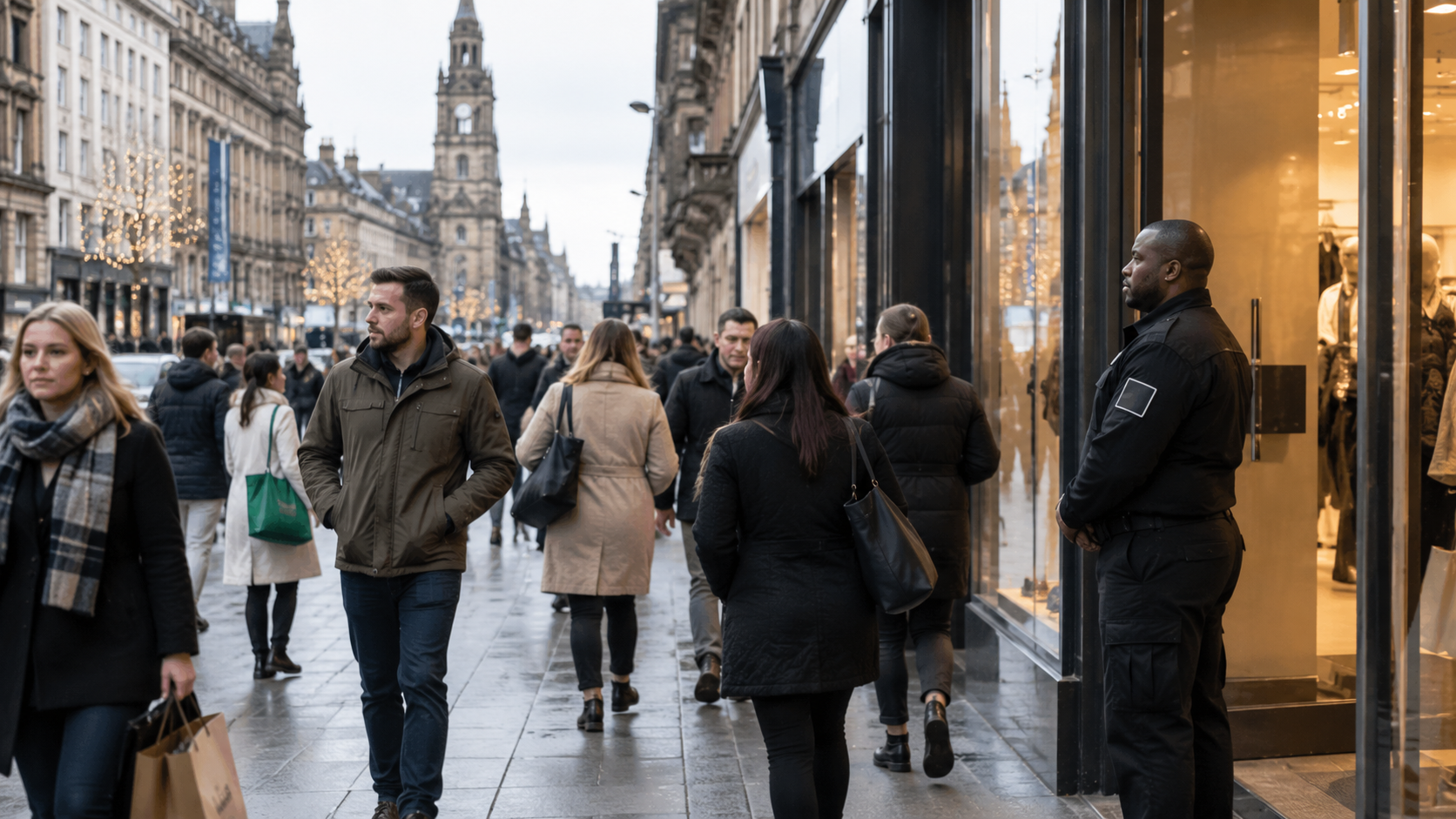
Security guards are often misunderstood. Their real value is not force or confrontation. It’s psychology. A visible person changes how a space feels and how decisions are made inside it.
Deterrence By Presence
Most theft starts as a choice, not an action. A guard interrupts that choice. The moment someone notices a uniform, the plan becomes less certain.
Unlike cameras, a guard shifts the balance immediately. The offender must account for a human response, not just a recording. Many walk away at that point. No theft. No incident. Just a change of mind.
Real-Time Behavioural Intervention
Guards read people, not screens. They notice pacing, scanning, nervous movement, and odd routes through a store. These signs appear long before an item is taken.
A simple greeting can break momentum. A calm question can reset behaviour. Often, that’s enough. Early engagement stops concealment before it happens. It prevents escalation. It protects staff without drama. That quiet, human interruption is something no system can replicate.
CCTV Still Matters, Just Not Alone
CCTV is not the enemy here. If it is used properly, it plays an important role. The problem starts when cameras are treated as a full solution rather than one part of a wider setup.
Where CCTV Actually Adds Value
Cameras are strong when it comes to evidence. Clear footage helps confirm what happened, when it happened, and who was involved. That matters for internal reviews and staff protection.
Recorded incidents can support investigations under the NICE Investigate framework. They also help when filing police reports or insurance claims. In these cases, good footage reduces doubt and speeds up paperwork.
CCTV also helps businesses learn. Reviewing patterns can highlight weak spots, busy times, or layout issues that invite theft.
Post-Incident Recovery Has Limits
What CCTV cannot do is reverse loss. Once stock leaves the building, recovery is rare. Even with clear images, follow-up takes time and rarely leads to items being returned.
The admin still lands on the retailer. Reports must be written. Clips must be pulled. Staff must answer questions. The cost is not just the item taken, but the time spent dealing with it afterwards.
Conclusion
Cameras are good at showing what went wrong. They give clarity after the fact. But clarity does not prevent loss. It only explains it. Guards work earlier in the chain. They influence behaviour before a line is crossed. That difference is easy to miss and costly to ignore.
Learning the line makes it easier to understand how to utilise the camera. Learning why CCTV footage doesn’t stop shoplifting without professionals makes things easier and improves security.
Coverage is about seeing more. Control is about changing outcomes. Shops that rely only on cameras often have plenty of footage and the same problems. The real shift happens when recording supports action, not when it replaces it.
Frequently Asked Questions
Does CCTV stop shoplifting on its own?
We don’t see CCTV stopping theft by itself. It records what happens, but it doesn’t change behaviour in the moment. Most theft still goes ahead once that line is crossed.
Why don’t shoplifters worry about being filmed?
From what we have seen, many assume no one is watching live. They also know footage rarely leads to quick consequences, so the risk feels low.
Is AI CCTV better than standard cameras?
We think AI helps with awareness, not prevention. It can flag odd behaviour, but it still relies on someone else to act on that information.
Do guards always need to confront people?
No, in our experience, most situations never reach that point. Simple presence and early engagement often stop things quietly.
What works best for reducing shoplifting?
We have found that combining people and technology works best. Cameras support decisions, but people change outcomes.