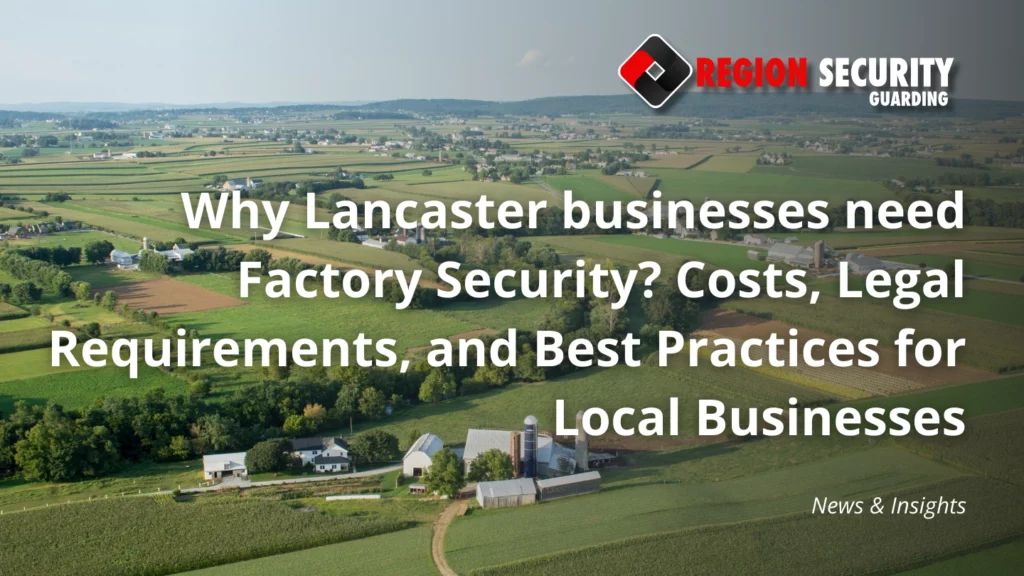
Factories in Lancaster operate in a different risk landscape than offices or retail units. Sites run early and late. Goods sit in volume. Access points multiply. That combination changes exposure. This is why Lancaster businesses need factory security is a practical question, not a generic one.
Across Lancaster, industrial estates sit beside residential roads, ports, and arterial routes. Some sites share yards, while others stand alone with limited oversight at night. Shift work creates quiet windows. Deliveries pause, but valuable assets remain on site. These gaps invite theft, trespass, and disruption.
Local factories also depend on logistics links. Proximity to main roads helps trade, but it also shapes risk. Vehicles come and go, boundaries blur, and when security is light, losses escalate quickly. The aim is not constant presence. It is control that matches how Lancaster factories actually operate.
Table of Contents
Understanding Factory Security Basics
What Does Factory Security Mean in Lancaster
Factory security in Lancaster is shaped by how sites actually function day to day. Unlike offices, factories combine people, machinery, vehicles, and stored materials in one space. Unlike warehouses, production sites change rhythm constantly. Noise rises and falls. Access points open and close. Responsibility shifts between teams.
Many Lancaster factories sit close to residential roads or shared industrial estates. Others operate from older buildings adapted over time. These layouts affect visibility, access control, and response speed. Security here is less about perimeter strength alone and more about managing movement across the site.
At its core, factory security focuses on:
- Controlling who enters, when, and for what reason
- Reducing blind spots created by layout or shift changes
- Maintaining accountability during quiet or transitional periods
How Lancaster’s Local Risk Profile Shapes Planning
Lancaster does not mirror the threat patterns of larger cities, but that does not mean risk is low. Industrial sites often experience fewer incidents, but when losses do occur, they are harder to detect and recover from.
Factories near routes connecting north toward Cumbria or south toward Chester face steady transient traffic. Vehicles and unfamiliar faces blend into normal activity. This makes casual intrusion easier and detection slower.
Local risk planning tends to focus on patterns rather than volume:
- Isolated sites after dark
- Shared yards with unclear responsibility
- Long gaps between patrols or checks
This is where industrial site risk management in Lancaster becomes practical rather than theoretical. The goal is early interruption, not reactive response.
High-Risk Times Most Factories Underestimate
The most vulnerable periods are rarely during full production. Risk rises when activity thins but does not stop.
Common high-risk windows include:
- Early mornings before teams arrive
- Late evenings when supervision reduces
- Weekends with limited staffing
- Changeovers between shifts
During these periods, assumptions replace checks. A door left unlocked for convenience becomes routine. Over time, patterns form. Those patterns are noticed. Security planning works best when coverage expands and contracts with these risk windows instead of staying static.
Factory Types With Greater Exposure in the Lancaster Area
Not every factory faces the same pressure. Exposure increases when assets are visible, mobile, or easily resold.
Higher-risk factory types often include:
- Sites storing metals, fuel, or components
- Facilities with multiple loading bays
- Premises sharing access with other businesses
- Converted buildings with legacy layouts
Manufacturing site security in Lancaster often has to compensate for design limits. Older sites were built for efficiency, not controlled access. Security fills that gap.
Shift-Based Manufacturing and Coverage Gaps
Factories running multiple shifts never fully close, yet they are rarely fully staffed. This creates a false sense of continuity.
Problems often arise because:
- Responsibility changes hands frequently
- Access granted by one team is not reviewed by the next
- Visitors arrive during handovers
Security during shift-based operations is about consistency. When checks, logging, and visibility remain stable, risk drops. When they vary by team or time, gaps appear.
Delivery Schedules and Access Risk
Deliveries are necessary. They are also one of the most common sources of security failure. Risk increases when:
- Vehicles arrive outside normal hours
- Drivers are unfamiliar with the site
- Gates or doors remain open to save time
These moments feel routine, which is why they are often overlooked. Yet many incidents start during deliveries, not after hours.
Clear oversight during delivery windows reduces exposure without slowing operations.
Shutdowns, Holidays, and Dormant-Site Risk
When production stops, risk does not disappear; however, it changes. Empty sites signal opportunity. Noise drops. Movement becomes noticeable only if someone is watching.
During shutdowns:
- Fewer staff are present to challenge access
- Contractors and maintenance teams create uncertainty
- Insurance expectations often increase
Factory security costs in Lancaster can rise during these periods if cover is not planned properly. A limited but focused presence often works better than minimal oversight.
Why Basics Matter Before Scale
Factory security legal requirements in the UK provide a framework, but effectiveness comes from application. The basics matter because they shape everything else.
Strong factory security is built on:
- Predictable routines
- Clear accountability
- Coverage that reflects real activity
In Lancaster, factories operate within mixed environments, regional transport links, and varied site designs. Understanding these basics allows businesses to plan security that fits reality, rather than relying on assumptions that only surface when something goes wrong.
Legal and Compliance Requirements
Licensing Rules That Apply To Factory Security in Lancaster
Factories in Lancaster are covered by the same national security laws as the rest of the UK. There is no local exemption. If a person is guarding access, checking visitors, or patrolling a factory site, they must hold a valid licence issued by the Security Industry Authority.
This applies whether the guard is full-time, temporary, or covering nights only. It also applies even if the site feels low risk. Licensing is not about threat level. It is about legality.
For business owners, this matters because responsibility does not stop with the provider. If unlicensed guarding is used, the factory operator may still be held accountable. That risk often surfaces during insurance reviews or after an incident, not before.
Consequences of Using Unlicensed Security Staff
The penalties for using unlicensed guards are clear, but the real damage is often indirect. Issues usually appear when:
- An insurer reviews a claim
- A loss investigation begins
- An incident reaches legal review
At that point, the question is not how serious the incident was. It is whether reasonable steps were taken. Unlicensed guarding weakens that position immediately.
Fines, contract termination, and insurance disputes can follow. These outcomes are hard to reverse.
When Background Checks Become Necessary
Factories are not public spaces. Even during working hours, access is controlled. Guards often work alone. They may hold keys and move freely across the site. Because of this, background checks are commonly expected where:
- Guards work unsupervised
- Sensitive areas are accessible
- Out-of-hours cover is in place
This is especially relevant for Lancaster factories handling specialist manufacturing, stored materials, or restricted processes. The aim is not to screen for perfection. It is to reduce avoidable risk.
Insurance Expectations and Factory Security
Insurance policies rarely spell out security rules in detail. Instead, they refer to “adequate” or “appropriate” measures. That language leaves room for judgement. In practice, insurers look for consistency.
They expect:
- Licensed personnel
- Clear deployment scope
- Records that show security is active, not symbolic
Factories on the edge of town or on shared estates may face closer scrutiny. Reduced visibility increases reliance on guarding. If security exists only to tick a box, insurers tend to notice.
Data Protection And Surveillance Duties
Many Lancaster factories use CCTV. Some also use access control systems. Both collect personal data. That brings legal responsibility. Compliance here is not complex, but it is often neglected.
Factories must ensure:
- People know monitoring is in place
- Footage is stored for a defined time
- Access to recordings is restricted
Problems arise when systems expand over time. A camera added for safety ends up covering a shared yard. Access logs are kept longer than needed. These are not malicious errors. They are gradual ones.
VAT and Factory Security Services
Security guarding is a taxable service. This affects cost planning rather than compliance, but errors still cause friction. Factories often run into issues when:
- Cover changes during shutdowns
- Multiple contracts overlap
- Emergency cover is added at short notice
Finance teams usually want clarity here. Not because tax changes risk, but because unclear billing complicates approval and forecasting. Clean structure matters.
Local Planning and Site Conditions in Lancaster
Lancaster does not impose special security mandates on factories. However, planning conditions can still affect how security is applied.
This often shows up in:
- Lighting limits near housing
- Fence height restrictions
- Shared boundary rules
These constraints do not remove the need for security. They shape how it is delivered. Similar challenges are seen in towns like Macclesfield, where industrial sites sit close to residential areas.
Security planning has to work within these limits, not against them.
Evidence that Demonstrates Compliance
Compliance is proven through records. Not promises. Factories that manage this well keep:
- Proof of licensing
- Written site instructions
- Incident logs
- Surveillance policies
These documents matter when decisions are reviewed later. They also help when security needs to change. Without them, every adjustment becomes harder to justify.
How Martyn’s Law May Affect Larger Factory Sites
Martyn’s Law is aimed at public venues, but some factory sites may still be affected. This is more likely where facilities include training centres, visitor access, or large logistics operations.
For Lancaster factories, the impact is expected to be limited but real. The focus will be on awareness, planning, and response. Not on turning factories into fortresses.
Sites that already understand access, movement, and accountability will adapt with less disruption.
Costs, Contracts, and Deployment
What Factory Security Costs Look Like for Lancaster Sites
Factory security costs in Lancaster are shaped more by layout and timing than by headline rates. Two sites of similar size can carry very different costs depending on access points, operating hours, and exposure.
Factories with open yards, shared entrances, or night activity tend to require more visible cover. Sites that shut down fully overnight often need less presence, but stronger control during short risk windows. This is why comparing prices across regions, such as the Wirral or Birkenhead, rarely tells the full story. Context matters more than averages.
Costs also rise when security is added late. Reactive cover is almost always more expensive than planned deployment. Businesses that treat guarding as a fixed overhead tend to overspend without improving protection.
How Fast Factory Security Can Be Put in Place
Deployment speed depends on clarity. When site expectations are clear, coverage can often be arranged within days. When they are not, delays follow. Common causes of slow deployment include:
- Unclear operating hours
- No agreed access rules
- Uncertainty over delivery patterns
Lancaster factories that plan security early usually move faster. Those adding cover after an incident often lose time aligning expectations. Speed matters, but precision matters more. A fast deployment that does not fit the site creates costs without control.
Contract Lengths That Factories Usually Commit To
Most factories avoid very short contracts unless the need is temporary. One-off cover works for shutdowns or refurbishments, but it rarely suits ongoing operations.
Typical arrangements fall into three patterns:
- Short-term cover for defined risk periods
- Rolling agreements are reviewed annually
- Multi-year contracts for stable sites
Longer contracts often offer better cost control, but only if the service matches the site. Locking into a poor fit increases risk rather than reducing it. Lancaster manufacturers often prefer flexibility early, then stability once routines settle.
Notice Periods and Why They Matter
Notice periods are rarely discussed until they become a problem. For factory security, they influence risk as much as cost.
Short notice allows change, but it can also disrupt continuity. Longer notice supports planning but reduces agility. The balance depends on how stable the site is.
Factories with seasonal output or fluctuating shifts benefit from shorter commitments. Sites with fixed production cycles often value predictability instead. The key is alignment, not default terms.
Inflation and Long-term Planning
Inflation affects guarding quietly.
- Rates rise over time.
- Insurance excesses shift.
- Operating costs increase.
Factories that ignore this tend to face sudden adjustments rather than gradual ones. Long-term planning helps smooth those changes. This does not mean locking into rigid terms. It means understanding how costs may move and building flexibility into contracts.
In regions like Lancashire, where many factories operate on tight margins, predictable spend often matters more than the lowest initial rate.
How Factory Security Supports Insurance Discussions
Security is rarely purchased for insurance alone, but it often influences outcomes. Insurers look at guarding as part of the overall risk picture.
Effective security can:
- Reduce excess levels
- Support broader coverage
- Strengthen claim positions
This is especially relevant for factories storing high-value materials or running overnight operations. When insurers see clear deployment plans and consistent cover, negotiations tend to move faster. Unclear arrangements slow them down.
Procurement Rules and Factory Security Contracts
The Procurement Act 2023 changes how public bodies appoint services, but its influence reaches further. Private firms supplying public contracts often align with its principles to avoid conflict later.
For factories working with public-sector clients, this affects how security contracts are structured. Transparency, fair competition, and documented decision-making matter more.
This does not add bureaucracy for its own sake. It encourages clearer scopes and better records. For Lancaster businesses involved in regulated supply chains, this clarity reduces friction during audits or reviews.
Deployment Decisions That Control Cost
The biggest cost driver is not the number of guards. It is where and when they are used. Well-planned factory security focuses on:
- High-risk periods, not constant presence
- Control points, not blanket coverage
- Visibility where it changes behaviour
This approach often costs less while delivering more value. It also scales better when operations expand or contract.
Why Cost Decisions Should Stay Operational
Security spend works best when it reflects how the factory actually runs. Decisions made only at the procurement or finance level often miss this.
Lancaster factories that involve operations teams early tend to:
- Deploy faster
- Waste less cover
- Adjust more easily over time
Costs, contracts, and deployment are not separate topics. They shape each other. When aligned, factory security becomes predictable and defensible. When treated in isolation, it becomes a recurring problem that never quite fits.
Training, Operations, and Daily Duties
Training Expectations in Lancaster Factory Environments
Factory security training in Lancaster is shaped by the environment, not theory. Guards are not there to observe from a distance. They operate alongside machinery, vehicles, and live production. Training reflects that reality.
At a basic level, guards must understand site layout, access rules, and safety boundaries. Beyond that, training focuses on judgement.
- Knowing when to challenge.
- Knowing when not to interrupt.
- Knowing how to spot something out of place without slowing work down.
This is where factory guarding differs from retail or office cover.
Local factories often involve mixed risks. Training must prepare guards for imperfect conditions, not ideal ones.
What Happens At The Start of a Factory Security Shift
The start of a shift sets the tone. On factory sites, this moment matters more than most managers realise.
A proper shift start is not rushed. Guards review what changed since the last handover. Deliveries arrive, maintenance is scheduled, and access is limited. Even small details matter.
In Lancaster factories, early shifts often begin before full staffing. Quiet sites require sharper awareness. Late shifts carry different pressure. Fatigue increases, activity slows, but both demand a different focus.
Managing Handovers on 24/7 Factory Sites
Continuous operations create invisible risk at handover points. As responsibility shifts, information can be lost, and this is where many failures begin.
Effective handovers focus on clarity:
- What happened
- What is pending
- What to watch
Factories running through the night depend on this flow. Without it, guards work in isolation rather than continuity. Over time, gaps form.
Sites in industrial regions such as Tameside and Bury face similar challenges. Shift-based manufacturing creates constant change. Lancaster is no different.
Priority Checks Around Machinery and External Areas
Factories are not static; machines power down, yards fill and empty, and loading bays change hands repeatedly.
Security checks prioritise areas where change creates risk. Machinery zones are reviewed for unauthorised access, not technical faults. Yards are checked for unfamiliar vehicles, damaged fencing, or unusual movement. Loading bays receive attention because they combine access, time pressure, and trust.
These checks are not exhaustive, but they are selective. The goal is early detection, not constant interruption.
Daily Reporting and Why it Matters
Reports are often treated as paperwork. In factories, they are operational tools.
Daily reporting helps decision-makers understand patterns:
- Repeated access issues
- Delivery delays
- After-hours movement
For Lancaster manufacturers, this information supports planning. It feeds into insurance discussions and informs future security spending. When reports are vague or inconsistent, value drops quickly.
Good reporting does not describe everything. It highlights what matters.
Handling Incidents Without Stopping Production
Incidents on factory sites are rarely dramatic. More often, they are subtle. A door forced but not breached. A person on site without authorisation. A delivery arriving at the wrong time.
The challenge is to respond without disruption. Shutting down production carries a cost. Overreaction creates friction. Underreaction invites repeat issues.
Trained security teams manage this balance. They isolate problems. Communicate clearly. Escalate only when needed. This approach protects output while maintaining control.
This balance is one reason why Lancaster businesses need factory security, a practical discussion, not a generic one. The right approach supports operations instead of working against them.
Secure-Down Procedures During Shutdowns
Shutdowns change the role of security by stopping production and shifting the risk. During planned closures, secure-down procedures focus on:
- Confirming access points
- Verifying site clearance
- Monitoring contractor activity
Factories often underestimate this phase. Quiet sites draw attention, noise drops, and guards become the main line of awareness. In Lancaster, where many factories sit near mixed-use areas, shutdown security protects more than assets. It protects liability.
Why Operations Matter More Than Routines
Factory security fails when it becomes mechanical. Routines without context lose effectiveness. Strong operations adapt:
- To shift changes
- To seasonal demand
- To site expansion or contraction
Training supports this adaptability. Daily duties reinforce it. Together, they create a security presence that fits the factory, not one imposed on it.
Performance, Risks, and Challenges
What Factory Managers Should Actually Measure
Factory security performance in Lancaster is often judged on presence rather than outcomes. That is a mistake. What matters is not whether security is visible, but whether it reduces exposure in ways that can be explained and defended.
Useful indicators are practical. They include response times to alerts, unsecured access points, and repeated issues in the same area. These signals show whether control is improving or drifting. They also support discussions around factory security costs in Lancaster, because they connect spending to effect.
Overly complex metrics rarely help. Factory managers need clarity, not dashboards that require interpretation. If a measure does not change behaviour or planning, it adds noise.
Weather as a Hidden Risk Factor
The weather has a quiet but real impact on industrial sites. In Lancaster, rain, wind, and seasonal darkness affect how perimeters behave.
Heavy rain softens the ground. Fences loosen. Gates shift. Poor lighting makes it harder to spot. During winter months, long hours of darkness reduce natural surveillance and increase reliance on artificial light.
These conditions are common across the Northwest, especially on exposed estates or older sites. Security plans that ignore the weather often fail gradually. Small gaps appear, making access harder to monitor. Over time, risk increases without a single obvious fault.
Weather-aware security adjusts checks and coverage. It does not assume the perimeter behaves the same in January as it does in July.
Fatigue and Overnight Coverage
Overnight factory security is challenging because sites quieten down, activity slows, and routines repeat.
Fatigue affects awareness long before it causes visible failure. Missed details, slower reactions, and assumptions replacing checks make it clear this is not a staffing issue. It is an operational one.
Factories running late or on continuous shifts rely heavily on overnight cover. In Lancaster, where sites may feel isolated after dark, that reliance increases. When fatigue is not managed, coverage exists in name only.
Good planning limits monotony. It varies focus areas. It supports alertness through structure rather than pressure. Without this, even experienced guards struggle to maintain consistent attention.
Where Health and Safety Meet Security
Factories are governed by strict health and safety duties. Security operates within that framework, not alongside it. Risks intersect in areas such as:
- Vehicle movement in yards
- Access near active machinery
- Lone working during quiet periods
Security teams often become the first to spot hazards.
- A blocked fire exit.
- A spill left unattended.
- An unsecured ladder.
These issues may not be security incidents, but ignoring them increases liability.
In Lancaster factories, this overlap matters because many sites operate with lean staffing. When security notices issues early, risk reduces. When boundaries are unclear, problems escalate.
Why Poor Planning Increases Liability
Poorly planned factory security creates exposure even when no incident occurs. Insurers and investigators look at intent and structure, not just outcomes.
Common planning failures include:
- Static cover that ignores peak risk times
- Unclear responsibility during shift changes
- Security presence without documentation
These weaknesses become visible after a loss. At that point, explaining decisions becomes harder. This is where industrial site risk management in Lancaster either holds or collapses.
Factories in Greater Manchester have faced similar scrutiny following incidents on mixed-use estates. The lesson is consistent. Planning must reflect reality, not assumptions.
External Pressures and Internal Strain
External pressures like supply delays and workforce changes affect how factories function.
Security that cannot flex with these pressures becomes a liability. Fixed routines clash with changing operations. Guards are present, but misaligned.
This is especially relevant for Lancaster businesses connected to regional supply chains. Movement between sites, depots, and clients across the Northwest increases complexity. Security must understand that flow to remain effective.
The Cost Of Ignoring Small Failures
Most factory security failures are not dramatic. They are repetitive. A gate was left unsecured. A door propped open. A report was not followed up on. Over time, these small failures signal weakness. They attract attention and increase loss frequency rather than severity.
Factories that address minor issues early often avoid major disruption later. Those who ignore them tend to face compounded problems, including disputes over factory security legal requirements in the UK when incidents are reviewed.
Balancing Control With Production
Security that disrupts production creates resistance. Security that ignores risk creates exposure.
The balance lies in understanding how the factory works. When activity peaks. When it slows. Where pressure points sit.
For Lancaster factories, this balance defines success. Performance is not about intensity. It is about fit. When security aligns with operations, risk reduces without friction. When it does not, challenges multiply quietly until they surface all at once.
Technology and Future Trends
How Technology is Reshaping Factory Security in Lancaster
Factory security in Lancaster has changed quietly over the last decade. Not through dramatic systems or fully automated sites, but through better support around people already in place. Technology now fills gaps that were once accepted as unavoidable.
Lancaster’s factory landscape includes compact industrial estates, edge-of-town sites, and facilities tied to regional transport routes. These environments benefit most from tools that extend awareness rather than replace presence. Technology helps security teams see more, respond earlier, and document decisions more clearly.
This shift mirrors patterns seen across the Northwest, including larger industrial zones in Greater Manchester. In Lancaster, the difference is scale, so solutions must be proportionate and not overbuilt.
The Role Of AI in Modern Factory Security
Artificial intelligence now supports factory security in narrow but useful ways. It does not make decisions. It highlights patterns.
AI-driven systems can flag unusual movement, repeated access attempts, or activity outside normal hours. For factories, this matters because risk often hides in routine. AI notices when routine breaks.
In Lancaster, where many sites run predictable schedules, these tools help focus attention. They reduce the chance of missing subtle changes. Importantly, AI supports guards rather than replaces them. Human judgement remains central, especially where context matters.
Remote Monitoring As Support, Not Substitution
Remote monitoring has become more common on industrial sites. For Lancaster factories, its value lies in reinforcement.
Remote teams can:
- Watch low-activity areas
- Escalate issues early
- Support lone guards during quiet periods
This approach reduces isolation. It also strengthens records. When incidents occur, footage and logs are already in place.
Remote monitoring works best when paired with on-site awareness. Alone, it struggles to interpret intent. Together, the two provide balance.
Are Drones Relevant For Lancaster Industrial Estates?
Drone use in factory security is limited but growing. Their relevance depends on site layout rather than trend.
Large estates with wide perimeters, open land, or poor sightlines may benefit. Compact sites often do not. In Lancaster, where many factories sit near mixed-use areas, drones raise privacy and planning questions.
When used carefully, drones support perimeter checks after hours or during shutdowns. They are not patrol replacements. They are inspection tools. Used poorly, they create risk rather than reduce it.
Predictive Tools and Planning Support
Predictive security tools analyse past incidents, access data, and timing. They help forecast where risk may increase.
For factory managers, this supports planning rather than prediction. It helps answer practical questions.
- When should the cover increase?
- Where do issues repeat?
- Which periods show drift?
This is especially useful when reviewing factory security costs in Lancaster. Decisions backed by trend data are easier to justify internally and externally.
Green Security Practices in Industrial Environments
Sustainability now influences security design. Factories face pressure to reduce energy use and environmental impact.
Emerging practices include:
- Low-energy lighting tied to movement
- Reduced patrol mileage through smarter zoning
- Longer-life equipment with fewer replacements
These changes do not weaken security. In many cases, they improve focus. Lancaster factories working toward environmental targets often integrate security planning into wider sustainability efforts.
Technology As a Force Multiplier
The common thread across these trends is balance. Technology strengthens factory security when it supports people and planning.
Overreliance creates fragility, underuse leaves gaps, and the goal is alignment.
For Lancaster businesses, future-ready factory security is not about chasing tools. It is about choosing support that fits the site’s reality, operational rhythm, and legal expectations. When technology is applied with restraint, it increases control without adding noise. That is where progress happens.
Conclusion
Factories in Lancaster operate under pressures that are easy to underestimate. Production runs on tight margins. Sites sit close to public routes. Activity does not stop cleanly at the end of the day. This is why Lancaster businesses need factory security is not a marketing question. It is a planning one.
This guide brings together the issues local factory operators actually face. Legal duties that do not disappear when sites feel low risk. Costs that rise when cover is added late instead of planned early. Daily operations where small gaps, not major failures, cause the most damage. It also looks ahead at how technology, data, and future regulation may shape decisions over the next few years.
The aim is clarity. Not pressure and not exaggeration. Just a clear view of risk as it exists in Lancaster’s industrial settings.
For business owners, operations teams, and finance leads, the value lies in alignment. Security that fits how the site runs. Contracts that stand up to review. Protection that insurers, auditors, and internal stakeholders can understand and defend.
Good factory security does not announce itself. It holds quietly until it is needed.
Frequently Asked Questions
1. Do small factories in Lancaster really need formal security?
Yes. Smaller sites often face higher risk due to limited staff, shared access, and quieter surroundings after hours.
2. Is factory security only needed at night?
No. Many incidents happen during shift changes, early mornings, or delivery windows, not just overnight.
3. How do insurers view factory security arrangements?
Insurers look for proportionate, planned security. Clear cover often supports claims and renewal discussions.
4. Can factory security be adjusted during shutdowns or holidays?
Yes. Coverage is usually reduced but becomes more focused during closures, when sites are quieter.
5. Does factory security slow down production?
When planned properly, it supports operations by reducing disruption, not creating it.
6. Are shared industrial estates harder to secure?
They can be. Shared yards and access routes increase exposure if roles and boundaries are unclear.