University should be a time of growth and independence. But for too many students, it’s also a time of vulnerability. Here’s a number that should make us all stop: 57% of undergraduates have encountered criminals or had money stolen in the past year.
Where you live makes a big difference. A survey of 600 students found that 75% of students in Purpose-Built Student Accommodation (PBSA) feel safe. That drops to just 56% for private renters. The gap is real. It affects how students feel, how they perform, and whether they thrive at university.
Behind these numbers are real people. Young people living away from home for the first time. Navigating unfamiliar cities. Often unaware of their rights or the security they should expect. The National Union of Students found that 84% had experienced problems with their accommodation.
Student numbers are rising. Housing pressure is intensifying. New regulations, including Martyn’s Law, are raising the bar for student safety. This article looks at the state of student safety in 2026, how Martyn’s Law affects student housing, and what universities and accommodation providers need to do right now.
Source: righttomove.co.uk
Table of Contents
Student Safety Statistics UK: What the Latest Figures Tell Us
The numbers don’t lie. Student safety in the UK is patchy. Where you live matters.
Safety Perceptions: PBSA vs Private Rentals
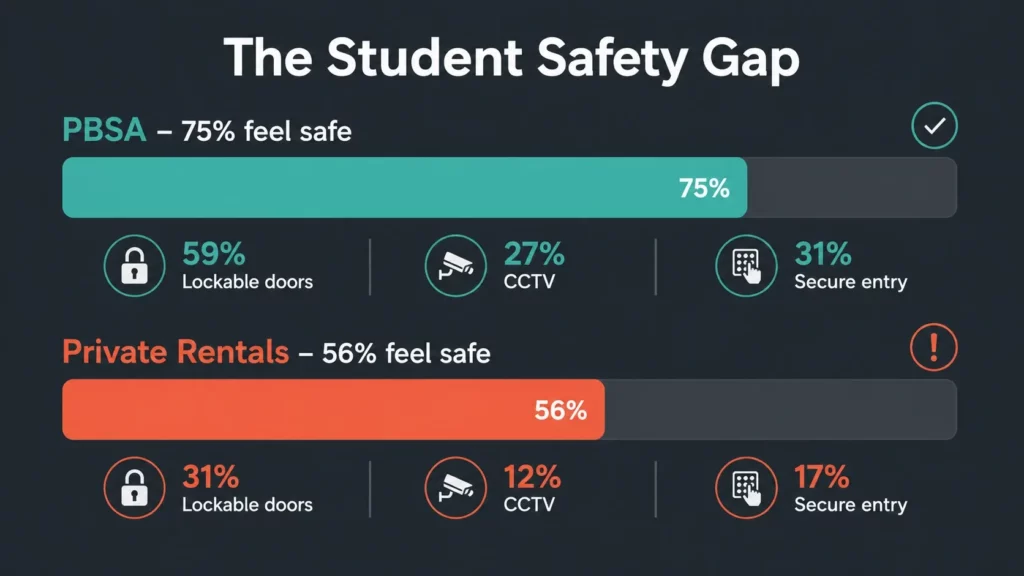
Seventy‑five per cent of PBSA residents feel safe in their accommodation. For private renters? Just 56%. This gap affects satisfaction too. 67% of PBSA students rate their stay positively, compared with 51% of private renters. When you feel unsafe, everything else suffers.
Security Features: A Clear Disparity
The physical security gap is stark. PBSA rooms are nearly twice as likely to have lockable bedroom doors, 59% compared to 31% in private rentals. Lockable windows? 48% in PBSA versus 30% in private homes.
CCTV is present in 27% of PBSA sites. That’s more than double the 12% in private accommodation. Secure entry systems are also more common in PBSA, 31% versus 17%.
| Security Feature | PBSA (%) | Private Rental (%) |
| Lockable bedroom door | 59% | 31% |
| Lockable windows | 48% | 30% |
| CCTV | 27% | 12% |
| Smart doorbell | 29% | 13% |
| Secure entry system | 31% | 17% |
Sources: Here! Students’ survey, Knight Frank/UCAS research
Geographical Variations
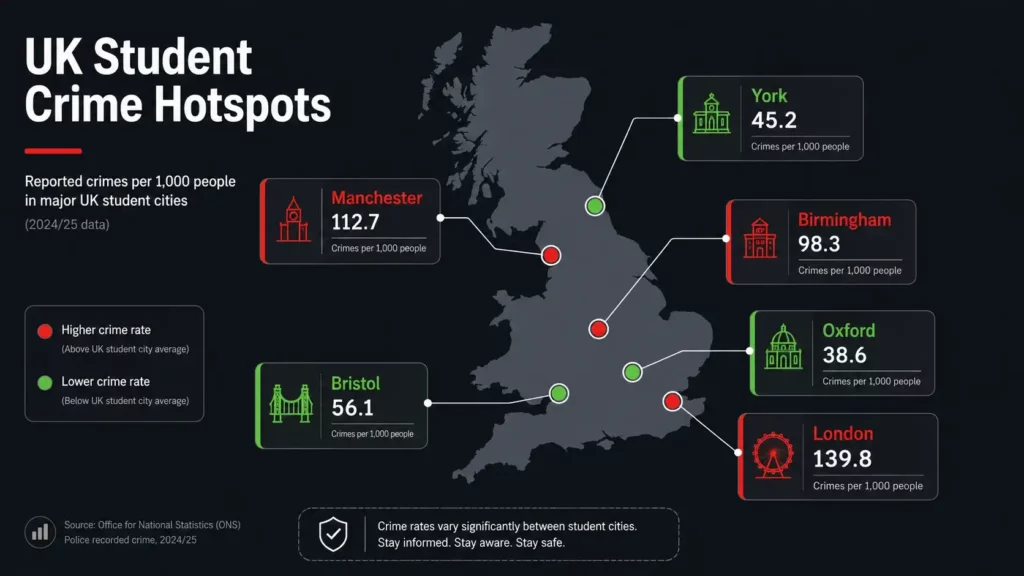
Location matters. According to ONS crime data, London tops the list with 432.3 crimes per 1,000 people. Manchester follows with 164.2. Middlesbrough has 161.6. Bristol? 132.2. Oxford sits at 127, well above the national average of 85.
Sheffield ranks lowest for safety. Only 69% of PBSA residents and 44% of private renters feel safe there. Manchester follows at 66%. At the other end, Oxford reports the highest safety perception at 88%. Liverpool hits 80%. Leeds sits at 78%.
University Crime: Violence and Sexual Misconduct
The statistics are alarming. A third of female college students say that they have experienced sexual harassment at the university. It happens to 33% of women nearly three times as often as it hits men at 12%.
According to The Office for Students, 24.5% of students had experienced sexual harassment whilst in higher education. 14.1% had been assaulted or sexually violated. Of veterinary science students, 29% had experienced sexual assault.
Police logged 2,762 violent and sexual offences in Sheffield North West, which includes the university campus and student housing, between May 2024 and April 2025.
Why Students Are Becoming More Vulnerable to Crime
Students face risks that most people don’t think about. Criminals know exactly what to target.
Open Campuses and Shared Accommodation
University campuses are open by design. Anyone can walk in. That’s great for learning. It’s terrible for security.
Shared accommodation means multiple people have access to common areas. Doors get left unlocked. Keys are shared between flatmates. Security is only as strong as the weakest link.
City-Centre Nightlife
Students love city‑centre nightlife. Late‑night travel, alcohol, and unfamiliar surroundings are a perfect storm for theft and violence. In Manchester, a young woman was bottled near Manchester Student Village in January 2025. A month later, 19‑year‑old Luke O’Connor was fatally stabbed near the University of Manchester halls.
High-Value, Portable Items
Students carry expensive gear such as laptops, smartphones, headphones, and bicycles. Thieves love them because they are easy to steal and easy to sell. In Oxford, bicycle theft is one of the most commonly reported crimes.
Unfamiliar Surroundings
New students don’t know the area. They don’t know which routes are safe or how to report incidents. This vulnerability is worst in the first few weeks of term, a period criminals target deliberately.
Lack of Awareness of Scams
Fraudsters love students. Fifty‑seven per cent of undergraduates have encountered criminals or had money stolen. Bank impersonation scams jumped from 9% to 25% in just one year.
Students are also being recruited as “money mules” tricked or paid to forward large deposits to another account. Experts believe £10 billion is laundered this way in the UK every year. About two‑thirds of those targeted are under 30. International students are particularly vulnerable.
PBSA vs Private Rentals: Does Where Students Live Affect Their Safety?
Purpose‑Built Student Accommodation (PBSA) offers real security advantages over private rentals. The data backs this up.
Access Control
PBSA properties use secure entry systems, key fobs, and PIN codes. Private rentals often rely on basic locks that are easy to bypass. 31% of PBSA properties have secure entry systems. Private rentals? Just 17%.
Concierge and Visitor Management
PBSA sites have dedicated front‑of‑house teams who monitor access and verify identities. Think of it as professional gatehouse security for student living. Private rentals don’t have this. Students have to manage access themselves, and most aren’t very good at it.
Maintenance Response
PBSA providers fix broken locks, faulty intercoms, and damaged doors quickly. In private rentals, repairs are often delayed. Weeks or even months pass before security issues get fixed.
Communal Areas
PBSA common areas are monitored and managed. Private HMOs (houses in multiple occupation) often have unmonitored shared spaces where anyone can walk in unnoticed.
Student Perceptions
The impact on students is clear. 75% of PBSA residents feel safe. Just 56% in private rentals. Students in private rentals are more likely to feel anxious, insecure, and unsupported.
| Factor | PBSA | Private Rental |
| Access control | Secure entry systems (31%) | Basic locks (17%) |
| Concierge | Dedicated front‑of‑house | None |
| Maintenance | Prompt repairs | Often delayed |
| Communal areas | Monitored | Unmonitored |
| Student safety perception | 75% feel safe | 56% feel safe |
Student Wellbeing and the Link Between Feeling Safe and Academic Success
Feeling unsafe doesn’t just affect mental health. It affects grades.
Confidence and Belonging
Students who feel unsafe avoid campus life. They skip evening lectures. They don’t go to social events. They withdraw from extracurriculars. This isolation affects their sense of belonging. They don’t feel part of the university community.
Reporting Incidents
Students who feel unsafe are less likely to report incidents. This creates a cycle of underreporting. 43% of students have witnessed sexual harassment or violence, but many don’t report it. The problem stays hidden.
Attendance and Retention
Fear of crime keeps students away. They avoid campus. They miss lectures. They fall behind. Some even drop out. A study found that 33% of students have considered dropping out due to financial and safety pressures.
Mental Health
The mental health impact is significant. Students who experience crime or fear of crime report higher anxiety, depression, and disrupted studies. 72% of UK students say mental health affects their concentration. 70% say financial concerns are negatively affecting their mental health.
The Academic Impact
The ripple effect of insecurity goes beyond immediate distress. It damages academic performance, mental health, and long‑term outcomes. Students who feel unsafe simply don’t achieve their potential.
What Universities Are Doing to Improve Student Safety
Universities are taking action. Here’s what they’re doing.
- Campus Patrols: Several universities have increased their patrols, especially in secluded areas during nighttime. The professional manned guard service supplies trained and SIA-licensed personnel.
- Concierge and Front‑of‑House Teams: The dedicated concierge and front-of-house teams stationed at the accommodation sites provide visibility and rapid response to any incidents.
- Access Management: Access control systems such as secure access cards, key fobs, or PIN numbers have become common practice. Access logs help to keep an audit trail.
- CCTV and Lighting: Extensive CCTV coverage and better lighting improve the coverage of blind spots. Cardiff Central Station is equipping itself with 29 new CCTV cameras to monitor ‘event days’.
- Emergency Phones and SafeZone Apps: Emergency phones on campus provide immediate access to security. The SafeZone app lets students alert security quickly and discreetly.
- Welfare Teams: Dedicated teams support students who’ve experienced crime, harassment, or trauma. They offer counselling, reporting assistance, and ongoing support.
- Security Awareness Campaigns: Universities run campaigns to educate students about safety, scams, and reporting procedures. The Home Office’s “Stop! Think Fraud” campaign targets students specifically.
For universities looking to enhance security, partnering with a professional security company in York can provide tailored solutions for campus and accommodation safety.
What Martyn’s Law Means for Student Accommodation and University Campuses
Martyn’s Law, the Terrorism (Protection of Premises) Act 2025, received Royal Assent in April 2025. It comes into force in Spring 2027.
Qualifying Premises
The Act applies to premises where 200+ people may be present. That includes large student accommodation blocks with common rooms, study areas, and dining facilities. It also covers lecture theatres, libraries, and sports halls.
Student Halls
Large PBSA sites are almost certainly in scope. Those signed up to approved codes may be exempt from some parts of the system, but they still need public protection procedures.
Major University Events
Open days, graduation ceremonies, and sporting fixtures may also fall within scope if 200+ people are expected.
Emergency Planning
Standard-tier premises need public protection procedures: evacuation, invacuation, lockdown, and communication. Enhanced‑tier (800+ capacity) need documented security plans, physical measures, and a designated senior individual.
Responsible Persons
The person who controls the premises- the owner, occupier, or facility manager, holds legal responsibility. They cannot delegate it away.
For the full national picture, read our Master Blog: Severe Threat, Stronger Defence: Public Sector Security After Martyn’s Law.
Why Parents and Students Now Expect More Than Basic Security
Safety is now a key factor in choosing a university.
University Choice
Parents and students look at crime data, security measures, and accommodation safety. Universities with good records and visible security are more attractive.
Open Days
Open days showcase security measures. Touring accommodation, seeing security staff, understanding reporting procedures, all of it reassures prospective students and parents.
Accommodation Marketing
PBSA providers market safety as a key differentiator. Lockable doors, CCTV, concierge, secure entry: these are now standard selling points.
International Students
International students are particularly concerned about safety. They may be unfamiliar with UK laws and reporting procedures. Universities with strong security teams attract more international applications.
Parent Expectations
Parents expect universities to take responsibility for their children’s safety. They want reassurance that the university has clear procedures, trained staff, and a proactive approach.
Reputation
A university’s reputation for safety affects its brand. High‑profile incidents attract negative attention and damage trust. Investing in student safety protects reputation.
Practical Ways Universities Can Build Safer Student Communities
Here’s what works. A checklist for building safer campuses.
- Risk Assessments: Do regular risk assessments on all accommodations and buildings within the campus.
- Reporting Incidents: Ensure the availability of clear ways for reporting incidents. Anonymity helps in getting more incidents reported.
- Access Management: Have a controlled access system using card keys and passwords. Keep records of visitors.
- Induction: Include safety education during induction. Teach reporting methods, scams, and safety practices.
- Visitor Policies: Enforce visitor check‑in procedures. All visitors were logged and escorted where necessary.
- Welfare Procedures: Provide welfare support for students who’ve experienced crime. Offer counselling, reporting assistance, and ongoing support.
- Local Police Partnerships: Engage with local police to share intelligence and coordinate responses.
- Communication During Emergencies: Use multiple channels: SMS, app alerts, PA systems, social media. Test and rehearse communication plans.
Frequently Asked Questions
1. What security measures should student accommodation have?
Locking doors and windows, CCTV, secure access system, and security on-site or available at all times. For larger properties, SIA security personnel and advanced AI surveillance.
2. How does Martyn’s Law affect student halls?
It is applicable to any property that could accommodate 200+ persons. Large halls and common areas fall into this category, thus needing to implement public protection procedures and possibly security plans.
3. What’s the difference between PBSA and private rental security?
PBSA provides lockable doors, CCTV, and a secure access system. Private rentals typically lack these and expose students to higher risks.
4. How many security guards should a student block have?
Depends on size and risk. General guideline: 2‑4 guards per 1,000 residents for low‑risk sites, 6‑10 for high‑risk sites.
5. Can universities be liable for student safety in private rentals?
They have a duty of care but no direct liability for this matter. Universities must provide advice and support to students and landlords.
Protecting the Next Generation
The figures are stark. The security gap between PBSA and private lets is growing. One in three female students has been the victim of sexual harassment. 57% have met criminals within the last 12 months. Student well-being is affected when students are at risk.
Martyn’s Law upholds standards. Universities need to move fast and be ready by the Spring 2027 deadline. Unsafe students are unhealthy students. Universities have a responsibility that goes beyond the university gates.
Student Accommodation security cannot be an optional extra. It’s a must-have. Our future students deserve no less.