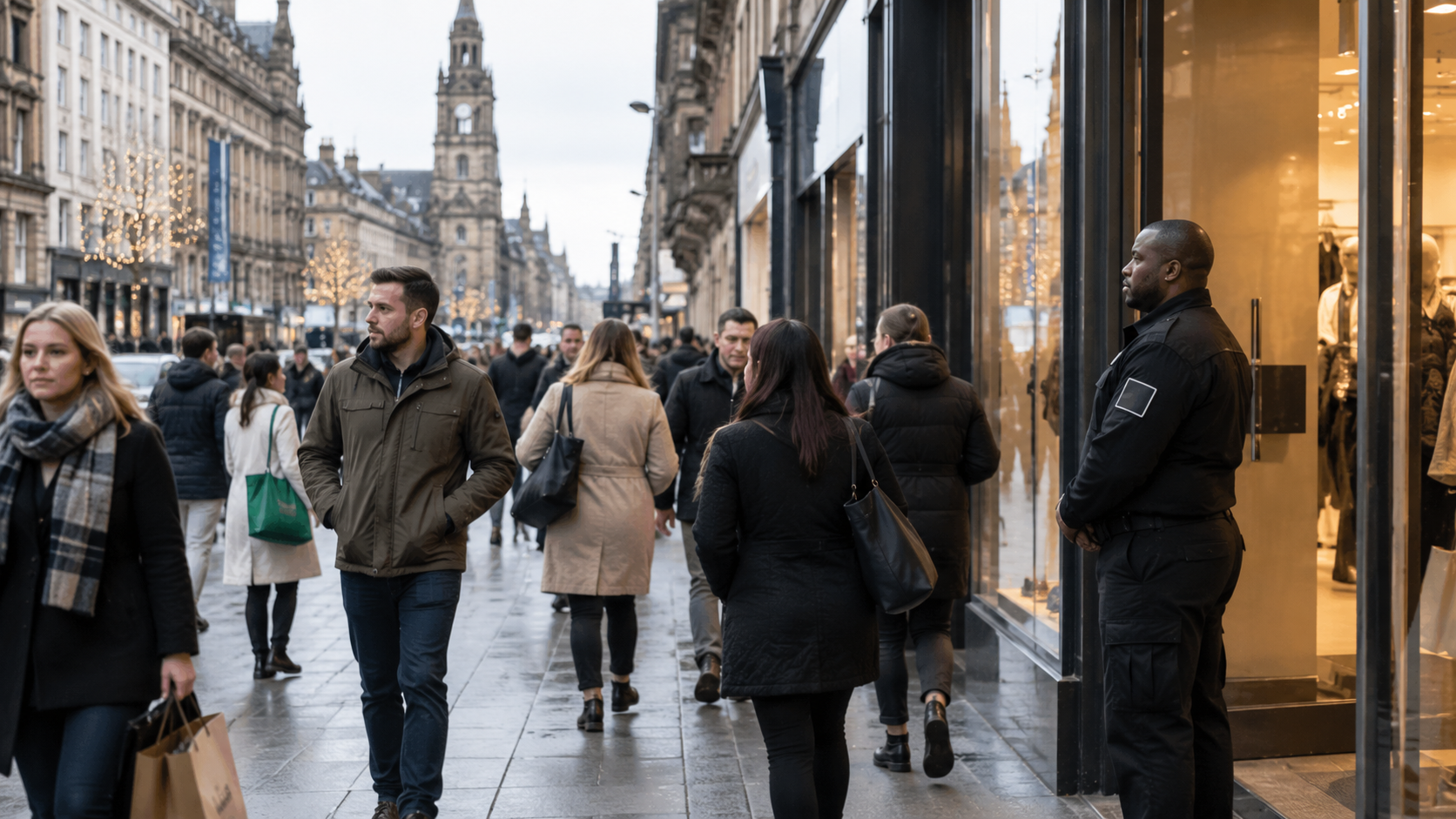
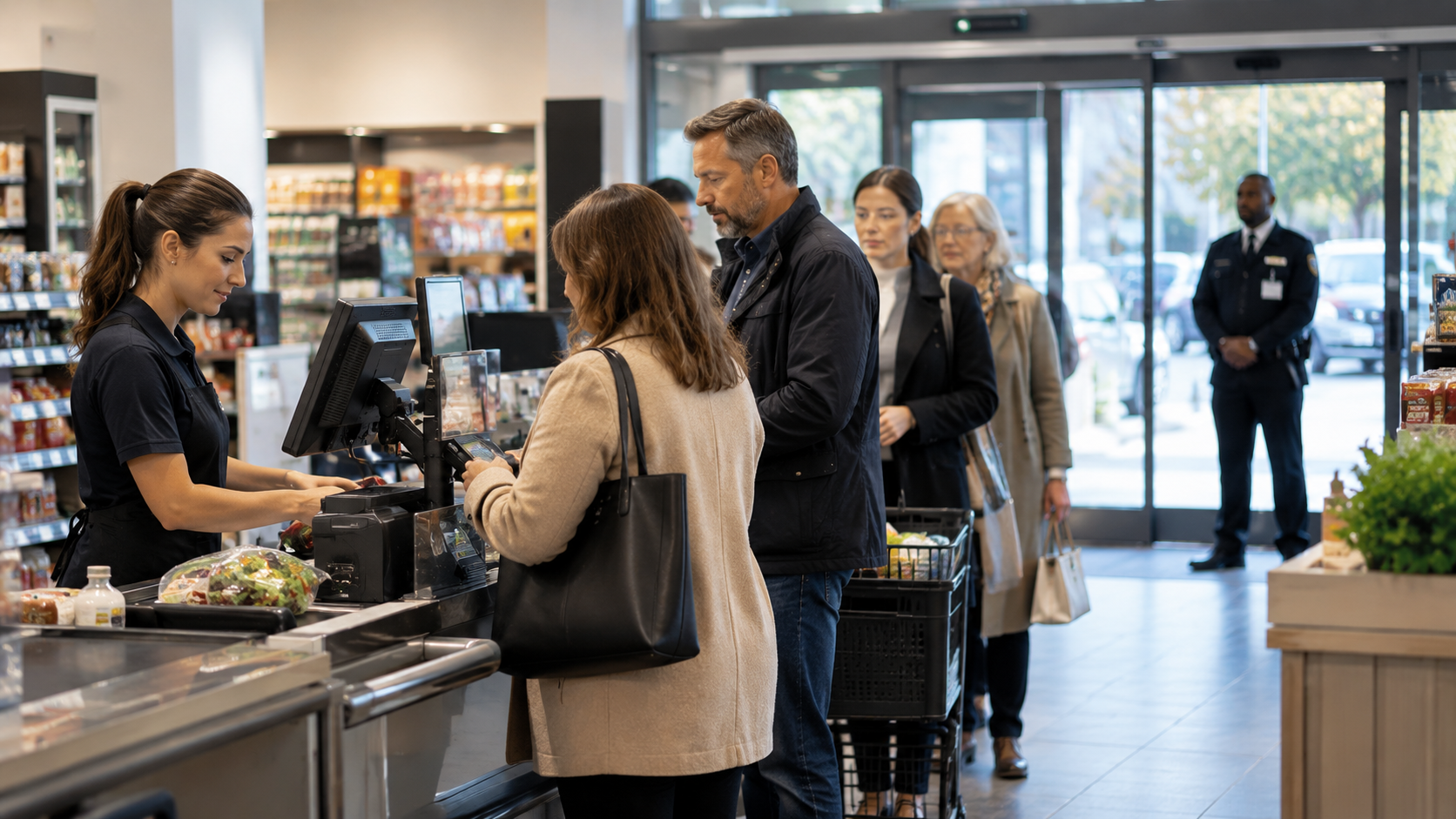
Retail environments in Oldham operate within a mix of town-centre high streets, retail parks, neighbourhood shopping areas, and transport-linked locations. Footfall patterns vary sharply by time of day, trading hours extend into evenings and weekends, and many sites sit close to public transport or mixed-use developments. According to national retail crime reporting, incidents of theft and violence against retail staff across Greater Manchester have increased year-on-year in recent reporting periods, with town-centre and transport-linked retail locations accounting for a disproportionate share of recorded incidents.
Oldham’s retail risk profile is shaped by timing and opportunity rather than constant pressure. Peak trading hours, late afternoons, weekends, and seasonal surges create predictable windows where opportunistic theft, organised retail crime, and conflict incidents are more likely to occur. While CCTV and alarms provide visibility, they cannot intervene, de-escalate situations, or adapt to real-time conditions on the shop floor or in shared public spaces. This gap is where on-site security presence becomes relevant for many local retailers.
For business owners and operational decision-makers, the question is not whether every retail site requires security at all times, but when the level of risk justifies a physical presence. In Oldham, where retail locations often operate alongside residential areas, transport routes, and evening economies, effective retail security supports safer trading environments, protects staff and customers, and helps maintain continuity during high-risk periods rather than serving as a purely reactive measure.
Table of Contents

Understanding Retail Security Basics in Oldham
What Retail Security Means in the Oldham Context
Retail security in Oldham focuses on managing risk within publicly accessible trading environments where footfall, accessibility, and shared public space create exposure. Unlike purely industrial or private sites, retail locations must balance loss prevention with customer experience, staff safety, and regulatory compliance, a challenge shared with nearby town centres such as Wigan.
In Oldham, this often involves visible security presence, access oversight, and rapid response to incidents rather than passive monitoring alone. Similar retail layouts and mixed-use environments across parts of Merseyside reflect the same need for active, on-site security to maintain safe, uninterrupted trading in busy public areas.
How Retail Security Differs from Static and Remote Measures
Static security measures such as CCTV, alarms, and electronic tagging play an important supporting role, but they operate reactively. They record incidents or trigger alerts after thresholds are crossed.
Retail security with on-site personnel introduces judgement and adaptability. Guards can intervene early, manage behaviour before it escalates, and respond proportionately to situations involving customers, staff, or delivery activity. In Oldham’s retail environment, where incidents are often opportunistic and time-specific, this flexibility is a key differentiator.
Local Risk Patterns Affecting Oldham Retail Sites
Retail risk in Oldham is shaped more by timing and activity than by location alone. Incidents tend to cluster around predictable periods such as late afternoons, evenings, weekends, and seasonal retail peaks.
Town-centre shopping areas, high-street clusters, and retail parks experience different pressures depending on footfall density, transport access, and proximity to evening economy activity. These patterns influence when retail security presence is most effective, rather than suggesting uniform coverage at all times.
High-Risk Retail Environments in Oldham
Certain retail formats in Oldham face higher exposure than others. Convenience stores, supermarkets, discount retailers, and high-turnover outlets experience increased risk due to open layouts, frequent transactions, and limited staff coverage during quieter periods.
Retail parks and edge-of-town shopping areas face different challenges, particularly during evening hours when footfall drops but stores remain open. In these environments, visible retail security acts as both a deterrent and a reassurance for staff working reduced shifts.
Daytime Versus Evening Retail Security Pressures
Daytime retail security in Oldham is often focused on deterrence, customer interaction, and early identification of suspicious behaviour. This includes managing repeat offenders, reducing theft opportunities, and supporting staff during busy trading periods.
Evening and late-opening hours introduce different risks. Reduced staffing levels, lower footfall, and surrounding activity increase the likelihood of confrontation, anti-social behaviour, or attempted theft. Retail security during these hours prioritises presence, staff protection, and rapid escalation control.
Seasonal and Event-Driven Retail Risk
Retail risk in Oldham fluctuates throughout the year. Seasonal sales periods, school holidays, and promotional events increase footfall and transaction volume, which in turn raises exposure to theft and disorder.
Retail security allows coverage to be scaled around these periods, ensuring that protection aligns with actual risk rather than remaining static year-round. This adaptability is particularly valuable for retailers operating on tight margins.
Economic and Business Growth Influences
Ongoing changes in consumer behaviour, extended opening hours, and increased reliance on convenience retail have altered the risk profile for Oldham businesses. As operating hours stretch later and staffing levels are optimised for cost efficiency, retail security fills the gap between operational necessity and risk control.
For many Oldham retailers, the role of security is less about reacting to crime trends and more about supporting stable, predictable operations in an increasingly complex trading environment.
Legal and Compliance Requirements for Retail Security in Oldham
SIA Licensing: A Legal Requirement for Retail Security
Any individual carrying out licensable retail security activities in Oldham must hold a valid Security Industry Authority (SIA) licence. This applies to roles involving guarding premises, monitoring public access, preventing theft, or managing incidents within retail environments.
Using an unlicensed security operative is a criminal offence under UK law. Liability does not sit solely with the guard or security provider; the retail business permitting the deployment may also face enforcement action. Consequences can include fines, invalidated insurance cover, and increased scrutiny following incidents.
SIA licensing is not a procedural detail. It is a baseline requirement that underpins legal compliance, insurance validity, and credibility if incidents are reviewed by insurers or authorities.
Vetting, DBS, and Workforce Screening Expectations
While DBS checks are not mandatory for every retail security role, they are often expected where guards interact closely with the public, manage conflict situations, or operate in environments involving vulnerable individuals.
Most reputable providers follow BS 7858 vetting standards, covering identity verification, employment history, and background checks. From a retail business perspective, this reduces exposure to internal risk, misuse of access, or failures in duty of care that may only surface after an incident.
Insurers and landlords increasingly expect evidence that appropriate screening has taken place, particularly in town-centre and high-footfall retail locations across Oldham.
Insurance and Liability Considerations for Retail Sites
Retail businesses engaging security services must ensure that their provider holds adequate public liability and employer’s liability insurance, with retail guarding activities clearly included within policy terms.
In Oldham, where many retail premises operate within shared public spaces, shopping parades, or retail parks, liability exposure extends beyond theft to include injury, conflict management, and customer safety. Clear contractual definitions of responsibility and documented security procedures play a key role in defending claims.
Poorly defined arrangements or gaps in documentation can expose retailers to disputes even when guards are present on site.
Data Protection and CCTV Integration in Retail Environments
Where retail security operates alongside CCTV, body-worn cameras, or monitoring systems, UK GDPR and the Data Protection Act apply. Retailers remain accountable for how personal data is collected, stored, accessed, and retained, even when security functions are outsourced.
For Oldham retail sites, compliance requires clear signage, defined retention periods, controlled access to footage, and documented procedures for subject access requests. Failure to meet these requirements can result in regulatory action and reputational harm, particularly in customer-facing environments.
VAT and Commercial Treatment of Retail Security Services
Retail security services are subject to standard VAT rules, which must be factored into cost planning and procurement decisions. Misclassification or informal arrangements can lead to compliance issues and retrospective financial exposure.
For multi-site retailers or those operating under tight margins, understanding the full commercial structure of security contracts is essential for accurate budgeting and audit readiness.
Local Authority and Event-Related Security Expectations
Retail premises in Oldham that host promotional events, late-night trading, or seasonal activities may face additional security expectations set by local authorities or landlords. These can include visible security presence, incident logging, and coordination with local services during higher-risk periods.
While Martyn’s Law (Protect Duty) is still developing, it is expected to increase focus on preparedness, risk assessment, and visible security for publicly accessible venues. Retailers should anticipate greater emphasis on documented security planning rather than reactive measures.
Why Compliance Matters for Oldham Retailers
For a security company in Oldham, legal compliance in security is not abstract. It directly affects insurance protection, incident defensibility, and operational credibility.
When incidents occur, scrutiny often focuses less on whether security was present and more on whether it was lawful, proportionate, and properly managed. Retailers that understand and meet these requirements place themselves in a stronger position to manage risk, protect staff and customers, and maintain uninterrupted trading.
Costs, Contracts, and Deployment for Retail Security in Oldham
What Drives Retail Security Costs in Oldham
The cost of retail security in Oldham is shaped less by a flat hourly rate and more by where, when, and how security is deployed. Town-centre retail locations, high-street clusters, and sites close to transport links generally attract higher costs due to increased footfall, longer trading hours, and a higher likelihood of public interaction or conflict management.
Retail parks, neighbourhood shopping parades, and edge-of-town sites often operate at slightly lower cost levels, as guarding is more focused on access monitoring, theft deterrence, and overnight asset protection rather than continuous customer engagement. However, sites with extended evening trading or shared public access may still require enhanced coverage regardless of location.
City-Centre vs Local Retail Areas
Retail premises closer to Oldham town centre tend to face higher operational pressures. Busier environments mean guards must manage theft risk, anti-social behaviour, and staff safety simultaneously, particularly during late afternoons, weekends, and seasonal trading peaks.
By contrast, suburban or standalone retail locations may experience fewer incidents during trading hours but higher vulnerability after closing. In these cases, costs are driven by overnight coverage, lone-worker considerations, and response readiness rather than visible daytime presence.
Contract Lengths and Commercial Structure
Most retail security arrangements in Oldham are structured as medium to long-term contracts, typically ranging from six months to multiple years. Longer contracts provide price stability and continuity, which is often favoured by insurers and landlords, particularly for shopping centres or multi-unit retail sites.
Short-term or ad-hoc security is usually reserved for temporary risk increases, such as refurbishments, seasonal trading surges, or repeated theft incidents. While flexible, these arrangements often carry higher daily costs due to mobilisation and planning requirements.
Notice Periods and Flexibility
Standard notice periods for retail security contracts commonly range from four to twelve weeks, depending on coverage levels and contractual terms. For retailers, understanding notice provisions is important to avoid gaps in protection or disputes during store closures, relocations, or operational changes.
Well-structured contracts allow for scaling coverage up or down as trading patterns change, rather than locking businesses into static arrangements that no longer reflect risk.
Wage Pressures and Pricing in 2025
Rising wages for licensed and vetted security personnel continue to influence retail security pricing. Increases reflect not only pay rates but also higher compliance, training, and insurance costs passed through contracts.
For Oldham retailers, the risk lies less in higher prices and more in under-priced security services that compromise consistency, documentation, or compliance. Low-cost arrangements often fail under scrutiny following incidents or insurance claims.
Inflation and Long-Term Cost Planning
Economic inflation affects retail security through fuel costs, uniforms, equipment, and administrative overheads. Long-term contracts increasingly include review clauses to manage these pressures transparently rather than relying on sudden price increases.
From a budgeting perspective, predictable and documented pricing structures support financial planning far better than reactive security spending after incidents occur.
Insurance Impact and Cost Justification
While retail security does not automatically reduce insurance premiums, insurers often view consistent, well-documented guarding arrangements favourably. Evidence of incident prevention, clear reporting, and proportionate coverage can strengthen claims defensibility and reduce disputes following theft, injury, or damage.
For many Oldham retailers, the value of guarding lies in loss prevention, reduced disruption, and operational confidence, rather than immediate premium reductions.
Procurement Act 2023 and Public-Facing Retail
For retail premises operating within publicly owned developments or under local authority oversight, the Procurement Act 2023 places greater emphasis on transparency, compliance, and value over headline cost. Retailers operating in these environments may face stricter expectations around supplier credentials, documentation, and service continuity.
Understanding these requirements helps avoid delays or compliance issues when renewing or restructuring security arrangements.
Balancing Cost and Risk in Oldham Retail Environments
The most effective retail security strategies in Oldham align spend with actual exposure. Under-deploying security can lead to losses far exceeding any short-term savings, while over-deploying creates unnecessary operational cost.
Retailers that assess risk based on trading hours, footfall patterns, and incident history are better positioned to structure contracts that are proportionate, compliant, and financially defensible supporting day-to-day trading without treating security as a reactive expense.
Training, Operations, and Daily Duties for Retail Security in Oldham
Training Standards for Retail Guards
Retail security in Oldham depends heavily on guards being trained for public-facing environments, not just static site protection. Beyond holding a valid SIA licence, effective retail guards are trained in conflict management, theft prevention, incident reporting, and customer-facing communication.
For retailers, the importance of training lies in consistency and judgement. Poorly trained guards increase the risk of escalation, complaints, or procedural errors that can undermine both staff confidence and insurance claims following incidents.
Shift Start: Establishing Control Early
When a guard starts a shift at an Oldham retail site, the priority is not patrol volume but situational awareness. This includes understanding trading hours, known risks from previous shifts, and any store-specific concerns such as repeat theft attempts or staff safety issues.
A structured shift start reduces blind spots early in the day, particularly during opening hours when staff are preparing tills, stock rooms are active, and customer flow is still building.
Handover and Information Continuity
Retail environments rely heavily on effective handovers. Guards working across shifts must clearly understand unresolved incidents, suspicious behaviour patterns, or temporary vulnerabilities such as broken lighting or altered store layouts.
For Oldham retailers, good handover practices reduce reliance on memory or assumptions and help ensure that security responses remain consistent across busy trading days and quieter evening periods.
Patrols and Presence During Trading Hours
In retail settings, patrols are designed to support visibility and deterrence, not just perimeter checks. Guards typically focus on entrances, high-risk product areas, staff-only access points, and shared public spaces where theft or anti-social behaviour is more likely.
The value for businesses comes from guards being present at the right times after school hours, weekends, and late trading rather than following rigid patrol schedules that do not reflect customer flow.
Access Control and Internal Checks
Retail guards in Oldham frequently support access control for delivery areas, stock rooms, and staff entrances. Ensuring that these areas are monitored helps reduce internal shrinkage risks and unauthorised access during busy operational periods.
Internal checks also help identify issues early, such as unsecured doors or unsafe conditions, which can create liability risks if left unaddressed.
Equipment and Systems Awareness
Rather than performing technical maintenance, guards are trained to verify operational readiness. This includes confirming that CCTV displays are active, alarms are responsive, and communication equipment functions correctly at the start of duty.
From a business perspective, this creates an auditable record that security systems were operational should incidents later be questioned by insurers or auditors.
Incident Response and Early Intervention
In retail environments, many incidents start with small suspicious behaviour, minor disputes, or attempted theft. Trained guards focus on early intervention and observation, escalating only when necessary and in line with agreed procedures.
For Oldham retailers, this approach helps minimise disruption to customers while still protecting staff and stock.
Documentation and Daily Reporting
Accurate documentation is a critical operational output of manned guarding. Daily logs typically record patrol observations, incidents, equipment issues, and any interactions that may later require review.
These records provide retailers with evidence-based visibility over security performance and support compliance with insurer expectations following claims or disputes.
Fire Safety and Environmental Awareness
Guards are trained to remain alert to fire risks, blocked exits, and unsafe conditions during their shifts. While they are not fire marshals, their presence adds an additional layer of observation during long trading hours or late-night operations.
In shopping environments where responsibility is shared across tenants, this role supports broader site safety without duplicating internal staff duties.
End-of-Shift Secure-Down Procedures
At closing time, guards support secure-down routines, including monitoring customer exit flow, ensuring staff leave safely, and confirming that access points are secured according to site protocols.
For retailers in Oldham, particularly those trading late or operating in shared retail spaces, this reduces end-of-day vulnerability when staff numbers are low and fatigue is higher.
Why Daily Routines Matter for Oldham Retailers
The effectiveness of retail security is rarely defined by dramatic incidents. It is built through predictable routines, clear documentation, and trained judgement applied consistently across trading days.
For Oldham businesses, well-structured training and daily operations translate into fewer disruptions, clearer accountability, and security arrangements that hold up under scrutiny whether from insurers, landlords, or internal stakeholders.
Performance, Risks, and Operational Challenges in Oldham Retail Security
Measuring Performance: What KPIs Actually Matter
For retail businesses in Oldham, security performance is best assessed through outcomes, not activity volume. Useful indicators include incident frequency and severity, response times to theft or conflict situations, quality and consistency of incident reporting, and the ability to maintain stable coverage during peak trading periods.
From a commercial perspective, the most valuable KPI is often disruption avoided. Fewer store closures, reduced staff turnover linked to safety concerns, and smoother peak-hour operations indicate that security arrangements are functioning as intended.
Environmental and Weather-Related Risks
Oldham’s retail environment includes high-street locations, retail parks, and mixed-use developments where weather directly affects footfall patterns and risk exposure. Poor weather can concentrate customers indoors, increase congestion at entrances, and reduce visibility in external areas such as car parks and service yards.
Effective retail security accounts for these conditions by adjusting patrol focus and observation priorities rather than maintaining fixed routines. For businesses, the risk lies not in the weather itself, but in unadapted security coverage during adverse conditions.
Documenting Conditions and Context
Professional retail guarding includes documenting environmental factors that influence incidents, such as poor lighting, weather-related crowding, or reduced visibility. These observations form part of daily logs and incident reports.
For Oldham retailers, this documentation provides valuable context if incidents are reviewed by insurers, landlords, or internal compliance teams. It demonstrates that risks were identified and monitored, rather than ignored.
Shift Lengths and Performance Risk
Extended shifts can affect alertness and decision-making, particularly during late trading hours or overnight coverage at retail parks. While staffing management sits with the security provider, the performance risk sits with the business.
From a client perspective, the concern is not guard welfare policy but operational reliability. Fatigue-related errors can lead to missed incidents, slower response times, or inconsistent reporting, all of which increase exposure during critical trading periods.
Mental Load in Public-Facing Retail Roles
Retail security involves continuous public interaction, conflict de-escalation, and decision-making in unpredictable situations. Night shifts and late trading hours can heighten these pressures, particularly in locations with evening economy spillover.
For Oldham businesses, recognising this as an operational risk, not a human resources issue—helps explain why well-structured rotations, clear escalation protocols, and realistic coverage expectations are essential to maintaining consistent security performance.
Compliance with Environmental and Safety Regulations
Outdoor patrols in retail parks and shared access areas are subject to general UK workplace safety and environmental regulations. These influence how guards operate during low-light conditions, adverse weather, or in areas with vehicle movements.
Retailers benefit when guarding arrangements reflect these constraints, as non-compliant practices can expose the business to liability if incidents occur in poorly managed environments.
The Risk of Underperformance
The most common performance failure in retail security is not absence, but misalignment. Guards may be present but deployed at the wrong times, focused on low-risk areas, or operating without sufficient site awareness.
For Oldham retailers, this often becomes visible during seasonal peaks, sales events, or extended opening hours, when security demands increase but coverage remains static.
Why Performance Oversight Matters
Retail security should be treated as a managed operational function, not a fixed-cost service. Regular performance review using incident trends, reporting quality, and operational feedback allows businesses to adjust coverage before problems escalate.
In Oldham’s varied retail landscape, this oversight helps ensure that guarding arrangements remain proportionate to risk, defensible to insurers, and aligned with how the site actually operates.
Technology and Future Trends in Oldham Retail Security
How Technology Has Changed Retail Guarding in Urban Centres
In towns such as Oldham, retail security has shifted from relying solely on physical presence to blended security models. Guards are now supported by digital systems that improve visibility, communication, and documentation rather than replacing on-site judgement.
This change matters for retailers because it allows security coverage to scale with risk. Instead of increasing guard numbers across all hours, technology helps focus attention on high-risk periods and locations.
Post-COVID Changes in Retail Security Protocols
Post-COVID retail operations introduced new challenges: altered footfall patterns, more frequent conflict around queueing or access control, and increased lone working during quieter trading periods. Security protocols adapted by placing greater emphasis on situational awareness, conflict de-escalation, and clearer incident escalation routes.
For Oldham retailers, this means modern guarding is less about enforcement and more about managing interaction risk in busy, mixed-use retail environments.
The Role of AI Surveillance in Retail Settings
AI-enabled CCTV systems are increasingly used in retail environments to identify unusual behaviour, crowd build-up, or repeated movement patterns. In Oldham, these systems are most effective when they alert on-site guards rather than operating independently.
AI does not make decisions or intervene. Its value lies in directing human attention to developing risks, particularly in large stores, shopping centres, and retail parks where visual coverage is wide.
Remote Monitoring as a Force Multiplier
Remote monitoring allows off-site teams to observe alarms, CCTV feeds, and access events outside trading hours. When combined with manned guarding, this creates a layered response: remote teams identify issues early, while on-site guards provide immediate assessment and action.
For retail businesses in Oldham, this approach can be especially effective for overnight coverage, service yards, and low-footfall periods when full on-site staffing may not be proportionate.
Drone Use in Retail and Mixed-Use Areas
Drone patrols remain limited in retail environments due to airspace rules, privacy considerations, and proximity to the public. Where used at all, they are typically restricted to large, private retail parks or logistics-linked sites, and only as a supplementary tool.
For most Oldham retail sites, ground-level guarding combined with fixed surveillance remains the most practical and compliant approach.
Predictive Analytics and Risk Planning
Predictive analytics tools analyse historical incident data, footfall trends, and trading patterns to identify when and where risk is most likely to increase. These insights support better deployment decisions rather than real-time intervention.
Retailers benefit by aligning security coverage with peak risk windows such as weekends, late evenings, seasonal sales, and promotional events, rather than maintaining uniform coverage throughout the week.
Upskilling and Certification Trends
As retail environments become more complex, guarding roles increasingly require skills in incident reporting systems, CCTV operation, and data protection awareness. While SIA licensing remains the legal baseline, additional training in conflict management and technology use improves operational consistency.
For businesses, the value lies not in certifications themselves but in reduced incident escalation and clearer documentation.
Green and Sustainable Security Practices
Environmental considerations are beginning to influence retail security operations. Energy-efficient lighting, reduced patrol vehicle use, and smarter scheduling help lower environmental impact without compromising coverage.
In Oldham retail parks and mixed-use developments, these practices also improve visibility and safety while supporting broader sustainability objectives.
The Impact of Martyn’s Law on Retail Security
Martyn’s Law is expected to increase the focus on risk assessment, preparedness, and response planning for publicly accessible venues. While many retail sites may fall into lower-tier requirements, the direction of travel is clear: greater emphasis on visible preparedness and documented procedures.
For Oldham retailers, this is likely to reinforce the importance of trained on-site security presence that can observe, assess, and respond in real time, supported by clear reporting and escalation frameworks.
Conclusion
Retail security in Oldham is shaped by practical realities rather than abstract risk. Town-centre locations, high-street clusters, and retail parks all operate within environments where footfall fluctuates sharply by time of day, season, and local activity. These conditions create exposure not only to theft, but also to anti-social behaviour, conflict, and operational disruption.
For Oldham businesses, retail security is less about reacting to isolated incidents and more about maintaining control during predictable pressure points. A visible, trained guarding presence adds judgement and accountability where static systems alone cannot adapt. It supports safer trading conditions for staff and customers while providing the documentation and oversight increasingly expected by insurers and regulators.
The most effective approach is proportionate and informed. Understanding local risk patterns, legal obligations, cost structures, and operational limitations allows businesses to deploy retail security where it delivers genuine value. In Oldham’s evolving retail landscape, security planning works best when it is treated as part of operational resilience rather than a reactive expense.
Frequently Asked Questions (FAQs)
1. Do all retail businesses in Oldham need manned security?
Not necessarily. The need depends on factors such as location, trading hours, footfall levels, and exposure to public access. Town-centre stores, late-opening retailers, and larger sites with repeat incidents are more likely to benefit from on-site security.
2. How is retail security in Oldham different from nearby areas?
Oldham’s retail environment combines busy high streets, transport-linked locations, and retail parks. This mix creates varying risk profiles across short distances, requiring more tailored security coverage rather than a one-size-fits-all approach.
3. Can CCTV alone replace retail security guards?
CCTV provides valuable evidence and oversight but cannot intervene, de-escalate situations, or adapt to changing conditions in real time. Many Oldham retailers use CCTV alongside guards to balance visibility with response capability.
4. What legal requirements apply to retail security guards in Oldham?
Retail security guards must hold a valid SIA licence for the activities they perform. Businesses are also expected to use properly vetted providers and ensure compliance with data protection laws when CCTV is involved.
5. Are businesses responsible if a guard is unlicensed?
Yes. Allowing an unlicensed guard to operate is a criminal offence. Liability can extend beyond the security provider to the business that permitted the deployment.
6. How do retail security costs vary within Oldham?
Costs typically differ between town-centre locations and quieter suburban or retail park sites. Factors such as public interaction, hours of operation, and incident frequency influence pricing more than a flat hourly rate.
7. Can retail security help with insurance requirements?
Yes. Insurers often view manned security as a risk-mitigation measure, particularly for higher-value stock or sites with a history of incidents. Clear reporting and documented procedures can support claims and policy terms.
8. How quickly can retail security be deployed in Oldham?
Deployment times depend on the complexity of the site, licensing checks, and contract terms. Planned deployments are smoother than reactive ones, which is why forward risk assessment is important.
9. How does Martyn’s Law affect retail businesses in Oldham?
While not all retail sites will fall under the highest obligations, Martyn’s Law signals increased expectations around preparedness, awareness, and response planning for publicly accessible spaces.
10. What is the biggest mistake businesses make when planning retail security?
The most common issue is misalignment either under-deploying security during high-risk periods or over-deploying without clear objectives. Effective retail security starts with understanding risk, not simply adding coverage