Youth crime remains a concern across the UK, affecting individuals, families and local communities. Although fewer children are entering the Youth Justice System than in previous years, repeat offending and more serious offences continue to present challenges. Understanding why youth crime happens is an important step towards preventing it.
This guide explains why youth crime is a problem, the latest UK youth crime statistics, the most common offences, and the steps parents, schools and communities can take to help prevent it.
Table of Contents

Why is Youth Crime a Problem?
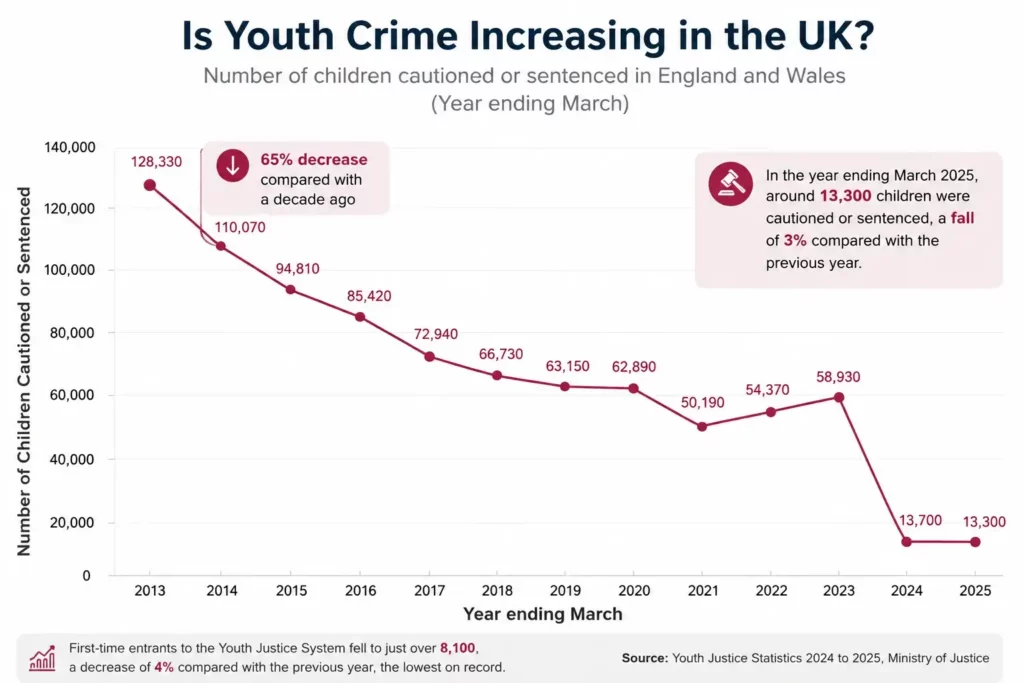
In the year ending March 2026, Youth Justice Statistics showed around 13,300 children were cautioned or sentenced, a fall of 3% on the previous year and 65% down on a decade ago. Sentencing occasions actually rose slightly, up 1% to just under 13,000, the third year-on-year increase in a row, so fewer children are entering the system overall, but a court sentence is becoming relatively more likely for those who do.
First-time entrants also hit a new low: just over 8,100 children entered the youth justice system for the first time, down 4% and the lowest figure on record.
So what do the youth crime statistics UK tell us? The headline numbers keep falling, but reoffending tells a more complicated story. The reoffending rate itself dropped to 31.8%, down 0.7 percentage points after two years of increases. However, children who do reoffend are doing so far more often than before, averaging 4.44 reoffences each, the highest frequency rate in ten years. That combination- fewer children offending overall but a hardcore reoffending more intensively is what’s driving continued investment in rehabilitation and early intervention.
What Are the Types of Youth Crime?
Just like adults, juveniles are capable of committing crimes. However, they will more commonly commit offences like criminal damage and theft or burglary. So, what are the different types of youth crime?
Theft
Theft is the act of taking another person’s property and permanently depriving them of it. Multiple kinds of theft can occur, like shoplifting, fraud, car theft, and robbery.
In the year ending March 2025, theft and handling offences made up 14% of all proven offences committed by children, the second-largest category behind violence against the person.
Assault
Another crime that is commonly committed among youths is assault. This umbrella term tends to cover crimes such as common assault, grievous bodily harm (GBH), unlawful wounding, and sexual assault.
Violence against the person remains the single largest category of youth offending, accounting for 23% of all proven offences in the year ending March 2025, around 8,100 offences and 32% of all arrests. Common assault makes up the bulk of this, at 39% of violence offences, while offences at the most serious end, like murder, stay under 1%. Concerningly, sexual offences have continued to rise for a third consecutive year, up 6% to around 1,500 offences.
Drug Abuse
Drug abuse is another one of the crimes that juveniles may commit. Most commonly, it is described as the habitual taking of illegal drugs. Crimes that fall under the drug abuse category are theft of drugs, drug trafficking, drug sales, and drug manufacturing.
In the year ending March 2025, drug offences fell by 4% compared with the previous year, to around 2,500 proven offences. The large majority, 70%, were for possession rather than supply, and cannabis remains the most common drug involved, accounting for 66% of cases.
Criminal Damage
Criminal damage is the unlawful damage of property that belongs to someone else. Graffiti, arson and forced entry are among the most common examples for this category of crime.
When it comes to youth crime statistics UK, criminal damage moved in the opposite direction to drug offences this year: youth cautions for criminal damage and arson rose by 14% in the year ending March 2025 compared with the year before.
Possession of Weapons
Possession of weapons is one of the most serious forms of youth offending. The illegal carrying of weapons, like knives and guns, can result in immediate arrest and consequently prosecution. This is caused by the fear of the intent for which the weapon is carried. If the weapon’s intended use is in public areas, it poses a threat to others.
Possession of weapons offences are now recorded as their own category for the first time (previously grouped under violence against the person), and already make up 12% of all proven offences, around 4,100 in total. Separately, knife or offensive weapon offences resulting in a caution or sentence came to just under 3,700 in the year ending March 2025, a 2% increase on the previous year and 23% higher than a decade ago.

What Are the Causes of Youth Crime?
Before learning how to help prevent youth crime, it is first important to understand why juveniles may turn to crime in the first place. Unfortunately, there isn’t a sole reason behind why youths commit crimes, but it tends to be because of the following reasons.
Education
In some cases, young people turning to crime can come as a result of their level of education. If students consider themselves failing consistently, they may just give up entirely on their attempts to improve. As a result, they will instead gravitate toward acts of crime instead.
Peer Pressure
Peer pressure can be another large contributing factor. Juveniles who are constantly surrounded by those who actively commit crimes may end up joining in to avoid ‘feeling left out’. This comes from a want to ‘fit in with the crowd’. Peer pressure can make it difficult to resist given the fear of being bullied by their peers or becoming lonely.
Abuse
It is also important to remember that youth crime isn’t always the result of peers. Environments can also have a large impact on their likeliness and drive to commit crimes. Juveniles who suffer from an abusive environment or family relations are unfortunately likely to develop negative self-esteem. This increases the chances of them caring less about their wellbeing.
Financial Issues
Growing up in poverty unfortunately means less opportunities may be available in life, like education, job opportunities and travel. These opportunities help to increase quality of life, and without them, people may feel the need to begin rebelling and lashing out in order to get what they want. As an example, those struggling through dire times may consider stealing to be a necessity.
Media
With the ever-growing popularity and accessibility of media, youths continue to become exposed to it. Juveniles may begin to show signs of aggressive or violent behaviour when repeatedly exposed to it through games or film. Alternatively, it is not uncommon for social media influencers to film themselves being nuisances and committing crimes framed as ‘pranks.’ When children see adults or role models performing these actions, they may feel inclined to copy them, seeing it as ‘cool’ or ‘engaging.’
In studies performed, there has been a noticeable association between screen violence and mental health. This often leads to an increase in bullying and cyberbullying among juveniles. Aggressive behaviour also tends to display in their childhood and can be a predictor of violent behaviours as they grow older.
Is Youth Crime Increasing in the UK?
The latest Youth Justice Statistics show that youth crime continues to decline overall. In the year ending March 2025, around 13,300 children were cautioned or sentenced, a 3% decrease from the previous year and 65% lower than a decade ago. At the same time, sentencing occasions increased by 1%, suggesting that while fewer children are entering the Youth Justice System, those who do are more likely to receive a court sentence.
The number of first-time entrants also fell to just over 8,100, the lowest figure on record. This reflects continued progress in preventing young people from entering the justice system for the first time.
However, the reoffending figures present a different picture. Although the overall reoffending rate fell to 31.8%, children who reoffended committed an average of 4.44 offences each, the highest frequency recorded in the last decade. This suggests that while youth crime is declining overall, a smaller group of repeat offenders continues to account for a significant share of offending.
These findings show why prevention is just as important as enforcement, making early support and positive intervention key to reducing youth crime.
How to Stop Youth Crime
It is unlikely that youth crime can be completely stopped. There are, however, actions that can be taken to prevent it from happening.
In a child’s life, their parents are the most influential figures. Because of this, they are far less likely to commit crimes if they are provided with a good influence and have a trusting, healthy relationship where the child isn’t afraid to communicate. This means agreeing on rules, being able to talk through problems calmly and reasonably, and also supporting each other.
Next to parents, schools should be playing a large part in influencing the behaviour of children. When teachers build up respectful relationships with their students and provide an environment they feel comfortable with, this can reduce the likelihood of behavioural issues. Students may feel safe enough to open up about concerns or issues they have and are likely to feel encouraged to attend school.
In addition to these, there are dedicated prevention programmes within local communities. These are designed to encourage young people to stay away from crime. If a juvenile finds themselves in trouble with the law, or there are concerns they might soon commit a crime, they can be placed on a programme.
With all of this in mind, it is frequently debated whether crime can be fully stopped or not. What is certain, though, is that if others are involved in helping, fewer youths will find themselves turning to crime in the future.

Conclusion
Youth crime continues to affect individuals, families and communities across the UK. Although fewer children are entering the Youth Justice System than in previous years, repeat offending and serious offences remain a challenge. Understanding the causes of youth crime, recognising the most common offences and supporting early intervention can help reduce the risk of reoffending. Parents, schools, youth services and local authorities all have an important role in guiding young people towards positive choices and creating safer communities.
If you would like to learn more about crime prevention, explore our related guides covering knife crime, anti-social behaviour and practical security advice. At Region Security Guarding, we also share useful insights on protecting businesses, public spaces and local communities from crime through effective security measures and prevention strategies. Together, education, support and prevention can help build a safer future for everyone.
Frequently Asked Questions
What is youth crime?
Youth crime refers to criminal offences committed by children and young people under 18, including theft, violence, drug offences and vandalism.
What causes youth crime?
Youth crime often results from family problems, peer pressure, poverty, school exclusion, substance misuse, poor mental health or community influences.
Is youth crime increasing in the UK?
Overall youth crime is falling, although repeat offending and some serious offences continue increasing, creating ongoing challenges for communities nationwide.
What is the most common youth offence?
Violence against the person remains the most common youth offence, followed by theft, criminal damage, weapon possession and drug offences.
How can youth crime be prevented?
Strong family support, positive education, community programmes and early intervention help reduce offending and encourage young people to make safer choices