Introduction
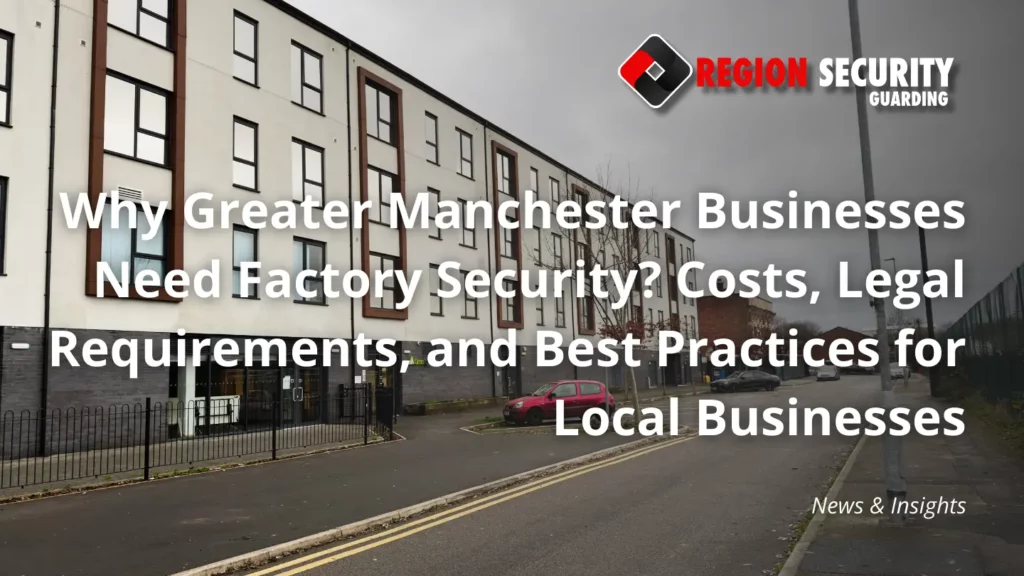
Greater Manchester is one of the UK’s largest manufacturing and industrial regions, with factories spread across Trafford Park, Salford, Bolton, Oldham, Rochdale, Stockport, Tameside, and Wigan. These facilities often operate extended hours, rely on just-in-time production, and house high-value machinery, raw materials, and finished goods. When disruption happens, the impact is usually operational missed deadlines, halted production lines, and contractual penalties rather than just the loss of physical assets.
According to the UK’s most recent commercial victimisation data, more than one in five manufacturing and industrial premises in England and Wales experienced at least one crime incident in the past year, with theft and burglary among the types reported by businesses across sectors.
Why Greater Manchester businesses need factory security is closely linked to how these industrial sites are structured and used. Large perimeters, multiple vehicle access points, contractor traffic, and shift-based staffing create predictable windows of vulnerability. In this environment, security is less about visible deterrence and more about maintaining control of who and what enters the site, protecting operational continuity, and meeting insurer and compliance expectations.
For factory operators, the aim is proportionate protection, security that reflects real exposure without interfering with productivity.
Table of Contents
Factory Security Basics in Greater Manchester
Factory security in Greater Manchester focuses on protecting industrial sites where production continuity, safety, and controlled access matter more than public-facing deterrence. Manufacturing facilities, engineering plants, food processors, and industrial warehouses operate in environments with large perimeters, vehicle movements, contractor access, and valuable equipment all of which create risks that differ significantly from retail or office settings.
Unlike static or remote-only security such as alarms and CCTV, factory security involves trained on-site personnel who can manage access in real time, challenge unauthorised individuals, oversee deliveries, and respond immediately to issues that could disrupt operations. Technology records events; on-site security helps prevent them from escalating.
Greater Manchester’s industrial footprint including Trafford Park, Salford Quays’ industrial zones, Bolton, Oldham, Rochdale, Stockport, Tameside, and Wigan means many factories sit on busy estates with shared roads and multiple access points. This layout, combined with shift work and out-of-hours operations, creates predictable windows of vulnerability that require active oversight rather than passive monitoring alone.
Industrial Crime Patterns and High-Risk Sectors
Crime affecting factories in Greater Manchester is usually linked to opportunity, site accessibility, and the resale value of materials rather than high-profile incidents.
Heavy Manufacturing and Engineering
Sites storing metal stock, copper cabling, specialist tools, and plant equipment can be targeted, particularly during nights or shutdown periods. Even minor theft or interference can halt production lines.
Warehousing Supporting Manufacturing
Facilities holding components or finished goods awaiting distribution face risks from internal and external access points, especially where vehicle movements are frequent.
Food Production and Processing
Security here is tied closely to compliance and hygiene. Unauthorised access can lead to product contamination concerns, regulatory consequences, and waste of stock.
Industrial Estates with Mixed Tenants
Shared access roads and limited overnight activity can create anonymity, making it easier for unauthorised vehicles or individuals to enter without immediate challenge.
Risk Timing in Greater Manchester Industrial Areas
Peak risk periods for factories typically occur when sites are operationally quiet but still contain valuable assets.
Overnight hours, weekends, and bank holidays are common windows of exposure. Seasonal shutdowns and maintenance periods also increase vulnerability, as regular staff presence is reduced and unusual activity may go unnoticed.
Shift changeovers are another sensitive period. Increased vehicle and pedestrian movement can make it harder to distinguish legitimate access from unauthorised entry unless procedures are clearly managed.
Proximity to major transport routes such as the M60, M62, and M6 supports logistics but also allows quick access and exit from industrial estates, increasing the importance of controlled entry points and visible oversight.
Why On-Site Factory Security Matters More Than Remote Monitoring Alone
Remote monitoring systems, alarms, and CCTV play an important role in factory protection, but they mainly provide detection and evidence. In large industrial environments, risks often involve physical access to yards, loading bays, plant rooms, or storage areas where immediate intervention can prevent disruption.
On-site security supports:
- Real-time access control for vehicles, staff, and contractors
- Early identification of suspicious behaviour around perimeters or storage areas
- Rapid response to alarms or unusual activity
- Consistent logging of incidents and irregularities for compliance and insurance purposes
This combination of human oversight and technology is particularly important in Greater Manchester’s industrial estates, where multiple units, shared infrastructure, and varied operating hours create complex risk environments.
Operational Growth and Industrial Security Demand
Greater Manchester’s continued investment in logistics, light manufacturing, and advanced engineering has expanded the number and size of industrial facilities across the region. As sites grow, so do the challenges of managing access, protecting assets, and maintaining safe working environments.
Factory security becomes part of operational planning rather than an afterthought supporting production schedules, protecting supply chain continuity, and ensuring that security measures align with how the site actually functions day to day.
Legal and Compliance Requirements for Factory Security in Greater Manchester
Security at industrial sites is not just an operational matter — it carries legal, regulatory, and insurance implications. For factories in Greater Manchester, compliance affects liability, audit readiness, and how incidents are viewed by insurers and enforcement bodies.
SIA Licensing for Security Personnel
Any security officer undertaking guarding duties at a factory including access control, patrols, gatehouse duties, or incident response must hold a valid Security Industry Authority (SIA) licence. This is a legal requirement across England and Wales and applies regardless of whether the site is in Trafford Park, Salford, Bolton, Oldham, or elsewhere in Greater Manchester.
The licence confirms that the individual has completed approved training, identity checks, and criminality screening at a national level. For businesses, using licensed personnel is not optional, it is the baseline for lawful security provision.
Penalties for Using Unlicensed Guards
Deploying unlicensed security personnel can lead to criminal penalties for both the individual and the company responsible. For the client — in this case, the factory operator knowingly using unlicensed guards can also create legal exposure, particularly if an incident occurs. Insurers may question claims where proper licensing was not in place, and enforcement action can follow if non-compliance is identified.
BS 7858 Vetting and DBS Context
While SIA licensing is mandatory, BS 7858 vetting is an industry-recognised standard for screening security personnel. It involves employment history checks, identity verification, and background screening. Many insurers and corporate compliance frameworks expect guards at higher-risk industrial sites to be vetted to this standard.
DBS checks are not legally required for every security role, but they are often included as part of the broader vetting process, particularly where guards may access sensitive areas, high-value stock, or confidential production environments.
Insurance Expectations for Factories Using Security Guards
Factories employing manned security are typically expected to ensure their provider holds:
- Public liability insurance
- Employer’s liability insurance
- Professional indemnity cover (in some cases)
From the factory’s perspective, documented evidence of these policies helps demonstrate due diligence. Insurers may also look more favourably on sites with structured, licensed security in place when assessing risk.
Data Protection and CCTV Integration
Where factory security integrates with CCTV systems, UK GDPR and the Data Protection Act 2018 apply. Guards involved in monitoring or handling recorded footage must follow clear procedures covering:
- Lawful use of surveillance
- Secure storage of recordings
- Controlled access to footage
- Appropriate incident reporting
Responsibility ultimately sits with the site operator as data controller, but security personnel must operate within those rules. Poor handling of CCTV data can lead to regulatory scrutiny beyond the original security issue.
VAT Treatment of Manned Security Services
Manned guarding services in the UK are generally subject to VAT. For factories, this affects budgeting and contract structuring rather than compliance risk, but it is relevant when comparing in-house versus outsourced models and when forecasting long-term security costs.
Local Authority and Site-Specific Requirements
While there are no separate “Manchester-only” guard licensing rules, factories may fall under local planning conditions, environmental health requirements, or site-specific operating licences that reference security controls particularly for high-risk manufacturing, chemicals, or waste processing. Security measures can form part of demonstrating compliance with these broader obligations.
Documentation That Demonstrates Compliance
From a factory operator’s perspective, a compliant security arrangement should be supported by clear documentation, such as:
- Proof of SIA licences for deployed staff
- Confirmation of BS 7858 vetting standards
- Company insurance certificates
- Assignment instructions and site procedures
- Incident reporting and audit records
These documents are often requested during insurer reviews, customer audits, or after serious incidents.
Security Company Licensing and Approval Schemes
Many security providers operating in Greater Manchester also hold voluntary accreditations, such as SIA Approved Contractor Scheme (ACS) status. While not legally mandatory, these schemes indicate that the company has been independently assessed on quality management, vetting, and service delivery standards factors that can matter to insurers and corporate compliance teams.
Labour Law Considerations
Employment law including working time regulations and overtime rules applies to security personnel just as in any other role. For factories, the relevance is indirect but important: non-compliant staffing practices by a contractor can lead to service disruption, legal disputes, or reputational risk that ultimately affects the site.
Post-Brexit Workforce Rules
Right-to-work checks are a legal requirement for employers, including security firms supplying staff to Greater Manchester sites. While this sits with the security provider, factory operators benefit from ensuring their contractor follows robust verification processes as part of overall compliance assurance.
Interaction with Greater Manchester Police
In practice, factory security teams may liaise with Greater Manchester Police (GMP) during incidents such as theft, trespass, or suspicious activity. Clear reporting lines and accurate incident records support effective collaboration and can influence how seriously and quickly incidents are addressed.
Patterns of crime shared through local business networks and police briefings can also inform how sites adjust patrol routines, access controls, or out-of-hours coverage.
Business Crime Reduction Partnerships (BCRP)
Some industrial and mixed-use areas participate in local business crime partnerships. While more common in retail, these networks can extend to industrial zones, allowing information sharing about suspicious activity, vehicle movements, or emerging risks. Security personnel are often the point of contact for this coordination.
Martyn’s Law and Its Relevance to Industrial Sites
Martyn’s Law (the Terrorism (Protection of Premises) legislation) is primarily aimed at publicly accessible venues, but larger factories with visitor centres, public-facing facilities, or event spaces may fall within scope depending on access levels and capacity.
Even where not directly in scope, the broader direction of travel is clear: organisations are expected to show proportionate preparedness, risk awareness, and response planning. Security teams play a role in access control, incident escalation, and emergency coordination under these frameworks.
Costs, Contracts, and Deployment of Factory Security in Greater Manchester
For factory operators, security costs are rarely judged in isolation. They are weighed against downtime risk, insurance expectations, and the potential disruption caused by theft, trespass, or safety incidents. Understanding how pricing and contracts are structured helps businesses make proportionate, defensible decisions.
What Drives the Cost of Factory Security?
The cost of on-site security at a factory in Greater Manchester depends less on postcode and more on risk profile and operational demands. Key drivers typically include:
- Hours of coverage – 24/7 guarding carries very different cost implications compared to nights-only or weekend coverage
- Number of access points – Multiple gates, yards, and pedestrian entrances require more oversight
- Site size and layout – Large, spread-out estates increase patrol time and visibility requirements
- Nature of assets – High-value machinery, tools, metals, or finished goods increase risk exposure
- Duties required – Gatehouse control, vehicle checks, contractor management, and safety monitoring add responsibility beyond basic patrols
While city-centre assignments sometimes carry higher rates due to logistics and travel, many industrial estates in areas such as Trafford Park, Salford, Wigan, Bolton, and Oldham present equal or greater security complexity, meaning suburban or out-of-town sites are not necessarily cheaper to protect.
Typical Timeframes to Deploy Security
Mobilising a factory security team is not instantaneous, but it is usually faster than many businesses expect. For planned coverage, deployment often takes a few days to a few weeks, depending on:
- Site survey and risk assessment
- Agreement of assignment instructions
- Scheduling of licensed personnel
- Induction and familiarisation with site procedures
Urgent or short-term cover can sometimes be arranged more quickly, but structured mobilisation leads to more consistent performance and clearer accountability.
Contract Lengths for Factory Security
In Greater Manchester, factory security contracts are commonly structured over 12, 24, or 36 months. Longer terms provide cost stability and allow security arrangements to be tailored to the site over time, while shorter contracts may suit temporary risks such as refurbishment periods, shutdown phases, or construction work within an operational facility.
The choice of term is less about commitment and more about aligning security provision with the factory’s operational cycle and risk horizon.
Notice Periods and Contract Flexibility
Standard notice periods to amend or end a guarding contract often range from one to three months, depending on the agreement. From a factory operator’s perspective, clarity on notice terms is important for budgeting and operational planning, especially where production volumes or site usage may change.
Flexibility can sometimes be built in for seasonal adjustments, shift pattern changes, or phased reductions in coverage, but this should be agreed in advance rather than assumed.
Wage Pressures and Their Impact on Costs
Security is a people-delivered service, so labour costs form the largest component of pricing. Increases in the National Living Wage, statutory employment costs, and pension contributions all influence hourly rates. For factories, this means that long-term budgets should allow for gradual cost adjustments rather than assuming static pricing over multiple years.
Inflation and Long-Term Pricing
Beyond wages, broader inflation affects fuel, uniforms, equipment, and administrative overheads. Many contracts include review mechanisms linked to inflation or statutory cost changes. While this can increase expenditure over time, it also helps maintain service stability and reduces the risk of sudden, disruptive price corrections.
How Security Links to Insurance Considerations
Documented, professional security arrangements can support conversations with insurers, particularly for factories handling high-value stock, specialist equipment, or hazardous materials. While security does not automatically guarantee premium reductions, it can:
- Demonstrate active risk management
- Support compliance with policy conditions
- Provide documented incident response procedures
- Reduce the likelihood of large or repeated claims
Insurers tend to view structured manned security as part of a wider risk control framework rather than a standalone solution.
Public Sector Sites and the Procurement Act 2023
For publicly funded factories, research facilities, or manufacturing sites linked to government bodies in Greater Manchester, the Procurement Act 2023 influences how security contracts are tendered and awarded. The focus is on transparency, fair competition, and demonstrable value, rather than lowest price alone.
This can encourage more robust evaluation of quality, compliance, and risk management standards when appointing security providers, aligning procurement decisions more closely with operational and legal considerations.
Training, Operations, and Daily Duties in Factory Security (Greater Manchester)
Factory security is most effective when it runs on structured routines, clear reporting, and consistent standards. For manufacturing and industrial sites across Greater Manchester, the aim is not constant visible activity, but steady control of access, safety, and risk throughout each shift.
Training Standards for Factory Security Personnel
Security officers working in factory environments are typically trained beyond basic guarding requirements. In addition to holding a valid SIA licence, they are usually briefed in:
- Access control and gatehouse procedures
- Health and safety awareness relevant to industrial settings
- Emergency response and evacuation protocols
- Incident reporting and evidence preservation
- Conflict management and communication
Factories often require site-specific inductions so officers understand traffic routes, restricted zones, hazardous areas, and contractor procedures.
What Happens at the Start of a Shift
When arriving on duty, a security officer’s first priority is to gain situational awareness. This usually involves reviewing the previous shift’s handover notes, checking for outstanding issues such as contractor presence, maintenance works, or earlier incidents.
The focus is on understanding the current site status before beginning routine patrol or access duties.
Initial Site and Perimeter Checks
Early in the shift, officers confirm that the perimeter is secure. For factories in areas such as Trafford Park, Salford Quays’ industrial zones, or estates in Bolton and Oldham, this often includes:
- Checking gates, fences, and barriers for damage
- Ensuring access points are locked or staffed as required
- Looking for signs of trespass, tampering, or forced entry
These checks are about early detection. Many security breaches are discovered during routine inspections rather than during incidents themselves.
Shift Handovers
Handover between officers is a critical control point. Incoming staff are briefed on:
- Ongoing deliveries or collections
- Contractors on site
- Faults with alarms, lighting, or CCTV
- Any suspicious activity or previous incidents
Clear handovers reduce the risk of gaps in awareness, particularly on 24/7 manufacturing sites.
Patrol Frequency and Purpose
Patrols in factory settings are scheduled at intervals based on site size and risk level. The purpose is not simply to be seen, but to:
- Deter unauthorised access
- Identify safety hazards such as spills or obstructions
- Check that restricted areas remain secure
- Monitor plant rooms, storage yards, and loading bays
Regular patrols help demonstrate active risk management to insurers and auditors.
Equipment Checks at the Start of Duty
Security officers confirm that essential systems are working before relying on them. This typically includes:
- Radios or communication devices
- Torches and body-worn equipment (where used)
- Alarm panels showing normal status
- CCTV monitors functioning and recording
Early checks prevent small technical faults from becoming larger blind spots later in the shift.
Alarm Response Procedures
If an alarm activates during early or quiet shift hours, officers follow site-specific procedures. This usually means verifying the alarm source, checking for authorised activity, and escalating to management or emergency services if required.
The goal is a measured response that balances safety with avoiding unnecessary disruption.
Visitor and Contractor Logging
Factories often have frequent vehicle and contractor movements. Security staff maintain visitor logs that record:
- Names and company details
- Time of arrival and departure
- Purpose of visit
- Authorisation checks
This supports both security and health & safety compliance.
CCTV and Internal Access Checks
At the start of duty, officers confirm CCTV feeds are visible and recording. They also verify that internal access controls — such as key cabinets, coded doors, or restricted workshops — remain secure.
These steps help ensure that technical systems are supporting, rather than replacing, human oversight.
Fire and Safety Checks
Factory environments carry higher safety risks than many commercial sites. Guards remain alert to:
- Blocked fire exits
- Unsafe storage near escape routes
- Faulty emergency lighting
- Unusual smells, leaks, or overheating equipment areas
While not replacing maintenance teams, security officers act as an additional layer of observation.
Reporting During the Shift
Officers record patrol findings, incidents, and observations in site logbooks or digital reporting systems. Regular supervisor check-ins may also occur, especially during night shifts, to confirm welfare and site status.
Good reporting creates an audit trail that supports investigations, insurance claims, and compliance reviews.
End-of-Shift Secure-Down
Before finishing duty, officers ensure that:
- All access points are in their correct state
- Outstanding issues are logged
- Keys, passes, and documents are accounted for
- A clear handover is prepared for the next shift
This prevents small oversights from becoming overnight vulnerabilities.
Shift Patterns on 24/7 Factory Sites
Many Greater Manchester factories operate continuous or extended hours, meaning security coverage often runs in rotating day and night shifts. Consistency in procedures across all shifts is more important than the time of day, as risks exist both during production and downtime.
Emergency Response Expectations
On industrial estates in areas like Salford, Trafford, and Wigan, security officers are expected to act as the initial on-site response to incidents until emergency services or site management take over. Response times depend on the nature of the incident, but preparedness, communication, and accurate information are the priorities.
Performance, Risks, and Challenges in Factory Security Greater Manchester
Factory security performance is not measured by how often guards intervene, but by how consistently risk is reduced without disrupting operations. For industrial sites across Greater Manchester, understanding performance means looking at patterns, reporting quality, and how well security supports safe production.
Key Performance Indicators (KPIs) for Factory Security
Businesses typically track indicators that reflect risk control rather than activity levels. Useful KPIs include:
- Number and type of incidents detected and resolved
- Response times to alarms or on-site issues
- Accuracy and completeness of incident and patrol reports
- Compliance with patrol schedules and access control procedures
- Reduction in repeat trespass, theft, or unauthorised access
These measures help determine whether security is preventing disruption, not just reacting to it.
How Weather Affects Factory Security in Greater Manchester
Weather plays a practical role in industrial security. Heavy rain, fog, frost, or high winds can reduce visibility, increase slip hazards, and affect how easily officers can patrol large external areas such as yards, loading zones, and perimeter fencing.
Poor weather can also create vulnerabilities. Fewer people outdoors and reduced visibility can make attempted trespass less noticeable without consistent patrol routines.
Documenting Weather Conditions During Patrols
Security officers often note significant weather conditions in patrol or incident logs when they affect site conditions. For example, icy surfaces near access points, storm damage to fencing, or lighting failures during heavy rain are recorded because they influence both safety and security risk.
This documentation supports facilities teams and demonstrates active monitoring to insurers.
Health Impacts of Long or Night Shifts
Factory security frequently involves long or overnight shifts, particularly on 24-hour production sites. Fatigue can affect alertness, decision-making, and reaction times, which is why structured patrol routines, clear procedures, and supervisor oversight are important.
From a client perspective, consistent performance standards and clear reporting help ensure that risk control does not rely solely on individual judgement during quiet hours.
Mental Wellbeing Considerations for Night Work
Working alone or at night on large industrial estates can be isolating. While the responsibility for staff welfare sits with the employer, clients benefit when security providers maintain stable teams, proper supervision, and clear escalation procedures.
Good communication channels between guards, supervisors, and site contacts reduce the likelihood of issues going unreported.
Environmental and Site-Specific Regulations
Outdoor factory security must operate alongside environmental and safety rules. This can include:
- Restrictions on vehicle movements in certain zones
- Controls around hazardous storage areas
- Procedures for working near loading operations or heavy machinery
Security staff need to understand these boundaries so that patrols support, rather than conflict with, site safety policies.
Operational Challenges on Industrial Sites
Factories in Greater Manchester often cover large footprints with mixed indoor and outdoor areas. Challenges can include:
- Multiple vehicle entry points
- Shared industrial estates with public road access
- Contractor activity outside normal hours
- Temporary shutdowns or maintenance periods
Security performance is strongest when routines adapt to these changing conditions rather than remaining fixed.
Service Stability and Continuity
For clients, one of the main risks is inconsistency in how security is delivered over time. Stable deployment, clear procedures, and structured supervision help maintain consistent standards across different shifts and officers.
This stability supports reliable reporting, smoother audits, and stronger insurer confidence.
Technology and Future Trends in Factory Security Greater Manchester
Technology is changing how factory security is delivered across Greater Manchester, but not by replacing people. Instead, it is improving how officers see risk, respond to incidents, and document activity. The direction of travel is integration combining human presence with smarter systems that extend visibility across large industrial sites.
How Technology Has Changed On-Site Guarding
Modern factory security relies far less on purely reactive patrols. Digital reporting tools, body-worn devices, and integrated alarm systems mean officers now work with live information rather than waiting to discover issues during rounds.
For large sites, this reduces blind spots. Guards can respond based on alerts, access logs, and camera triggers, allowing patrols to be more targeted and risk-led rather than repetitive.
Post-COVID Operational Changes
Since COVID, there has been a greater focus on controlled access, visitor logging, and contractor traceability. Many factories introduced stricter sign-in procedures, separated shift access points, and clearer movement controls between operational zones.
Even where health restrictions have eased, these tighter access practices remain because they also strengthen site security and audit trails.
The Role of AI-Enabled Surveillance
AI-assisted CCTV is increasingly used to support, not replace, on-site officers. Systems can flag unusual movement near perimeters, vehicles in restricted zones, or activity during closed hours. Instead of watching screens continuously, guards are alerted to potential issues and can investigate quickly.
This improves response times while keeping human judgement at the centre of decision-making.
Remote Monitoring as a Force Multiplier
Many Greater Manchester factories now combine on-site security with remote monitoring centres. Out-of-hours camera feeds, alarm activations, and motion alerts can be reviewed remotely, with on-site guards directed to specific areas when needed.
This layered approach is particularly useful on large industrial estates where a single patrol cannot be everywhere at once.
Use of Drone Technology
Drone use in industrial security is still developing, but it is beginning to appear in large or complex sites. Drones can be used for perimeter inspections, roof checks, or post-incident assessments where access is difficult or unsafe.
They are not a replacement for guards but can provide rapid visual checks across wide areas, especially after alarms or severe weather.
Predictive and Data-Led Security Planning
Security decisions are becoming more data-driven. Incident logs, access control data, and alarm trends help businesses identify when and where risks occur most often. This allows patrol frequencies, staffing levels, and coverage areas to be adjusted based on patterns rather than assumptions.
For factories, this is especially valuable during seasonal shutdowns, shift changes, or periods of reduced production.
Upskilling and Broader Competence
As sites become more technology-enabled, guards increasingly need familiarity with digital reporting tools, integrated CCTV systems, and electronic access controls. The role is less about static presence and more about managing information and responding appropriately.
From a client perspective, this means security teams are better equipped to support investigations, audits, and compliance requirements.
Greener Security Practices
Sustainability is also influencing security operations. This includes the use of electric patrol vehicles, energy-efficient lighting linked to motion sensors, and reduced paper reporting through digital systems.
These measures do not change the core purpose of security but help align protective measures with wider environmental goals on industrial sites.
Martyn’s Law and Industrial Sites
Martyn’s Law is primarily associated with publicly accessible venues, but its wider influence is encouraging stronger emergency planning across many sectors. For factories that host visitors, contractors, or training events, there is increasing emphasis on documented response procedures, clear communication plans, and coordinated incident management.
Security teams play a role in these preparedness measures, particularly in managing access and supporting controlled responses during emergencies.
Conclusion
Factory environments across Greater Manchester operate on tight schedules, high-value assets, and complex site layouts. Disruption rarely comes from dramatic incidents; more often it stems from preventable issues — unauthorised access, theft of materials, damage, or safety breaches during quiet hours. That is why Why Greater Manchester businesses need factory security is less about visible guarding and more about maintaining operational control when supervision is naturally lower.
Effective factory security supports continuity. It helps businesses meet insurer expectations, demonstrate compliance with safety and data regulations, and maintain oversight of contractors, deliveries, and out-of-hours activity. In an industrial region where many sites run extended shifts or 24/7 production, the ability to detect and respond to issues early often prevents minor incidents from becoming costly downtime.
The right approach is proportionate, not excessive. Security should reflect the layout of the site, the value and portability of materials, operating hours, and how easily the premises can be accessed from surrounding roads or estates. When aligned properly with technology, procedures, and trained personnel, factory security becomes part of operational resilience rather than an isolated cost.
For Greater Manchester manufacturers, logistics operators, and industrial businesses, the real value lies in prevention, accountability, and keeping production moving safely and predictably.
Frequently Asked Questions
What makes factory security different from office or retail security?
Factories typically cover larger areas, have multiple access points, and operate outside standard business hours. The focus is on protecting equipment, materials, and processes rather than managing public-facing environments.
Do all factories in Greater Manchester need 24/7 security?
Not always. Security levels depend on operating hours, site layout, asset value, and location. Some sites need overnight guarding, while others may rely on a mix of patrols, access control, and remote monitoring.
How does factory security help with insurance requirements?
Insurers often expect evidence of physical security measures, controlled access, and incident reporting. A structured security presence can help demonstrate risk management and may support more favourable policy terms.
Are CCTV systems enough on their own for factory sites?
CCTV is valuable for visibility and evidence, but it does not physically intervene. On-site personnel or a monitored response is often needed to act quickly when alarms or suspicious activity are detected.
What are the biggest security risks for factories in industrial estates?
Common risks include theft of metals or equipment, unauthorised vehicle access, trespassing after hours, and internal access misuse during shift changes or contractor visits.
How long does it take to put factory security in place?
Basic coverage can often be arranged quickly, but effective long-term security usually starts with a site assessment to understand access points, operating patterns, and risk exposure.
Does factory security only focus on crime?
No. Security also supports health and safety by controlling site access, monitoring hazards during quiet periods, and ensuring emergency procedures can be followed if an incident occurs.
How does technology support factory security staff?
Technology such as access control, monitored alarms, and AI-assisted CCTV helps officers focus on real risks, respond faster, and maintain accurate incident records.
Can security levels be adjusted during shutdowns or peak periods?
Yes. Many factories increase security during shutdowns, maintenance periods, or times when high-value stock is stored, and reduce coverage when risk levels are lower.
What should a factory manager prepare before speaking to a security provider?
It helps to know site operating hours, number of entry points, areas of concern, existing systems in place, and any insurer or compliance requirements that may influence security planning.